
Bulletin - South Bend, IN News Today
The Common Council voted 9-0 on two ordinances that bring roughly 1,500 unregulated listings under a citywide permit system with revocation after three violations in a year.




South Bend Adopts First Short-Term Rental Rules With $150 Permit and Emergency Contact Mandate Starting January 2027
The Common Council voted 9-0 on two ordinances that bring roughly 1,500 unregulated listings under a citywide permit system with revocation after three violations in a year.
Photo from https://www.usgbc.org/

Every short-term rental in South Bend will need a city permit, a named emergency contact, and compliance with basic safety and maintenance standards starting January 1, 2027 after the South Bend Common Council voted 9-0 this week to adopt two ordinances that regulate the sector for the first time.
This permit ordinance which is introduced as Bill 52-26 carries a one-time $150 fee. The companion zoning ordinance, Bill 53-26, requires new non-owner-occupied rentals to obtain a special exception showing they fit the neighborhood while existing investor rentals keep their status under Indiana law.
South Bend's Short-Term Rental Permit Ordinance (Bill 52-26)
Bill 52-26 establishes South Bend’s permit program, fees, safety standards and enforcement rules for short-term rentals.
South Bend's Short-Term Rental Zoning Ordinance (Bill 53-26)
Bill 53-26 establishes zoning and special-exception requirements for short-term rentals in South Bend.
What the permit ordinance requires
Anyone offering a property for stays under 30 days will need a permit for that address whether the listing sits on Airbnb, Vrbo or elsewhere. The $150 fee is paid once rather than every year because Indiana Code 36-1-24-13 caps the initial charge at that amount and forbids cities from charging anything to renew.
Permits do expire after twelve months under the same provision so operators should plan on an annual renewal that costs nothing while the application also has to name someone who can respond to complaints. Community Investment Director Darryl Scott said that this contact requirement is what would give the city "increased visibility into who's operating the short-term rentals."
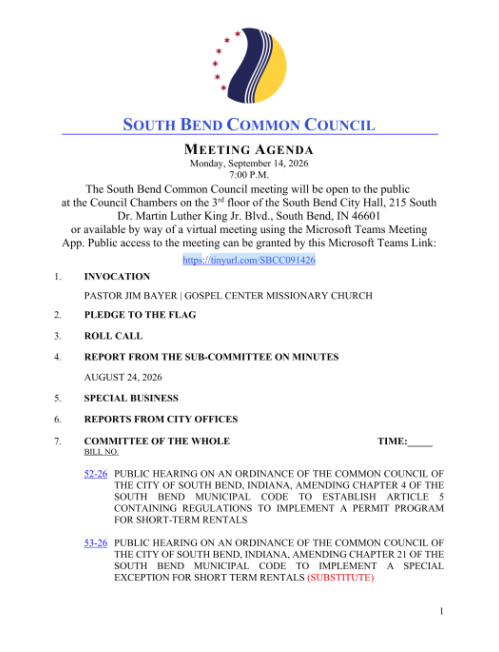
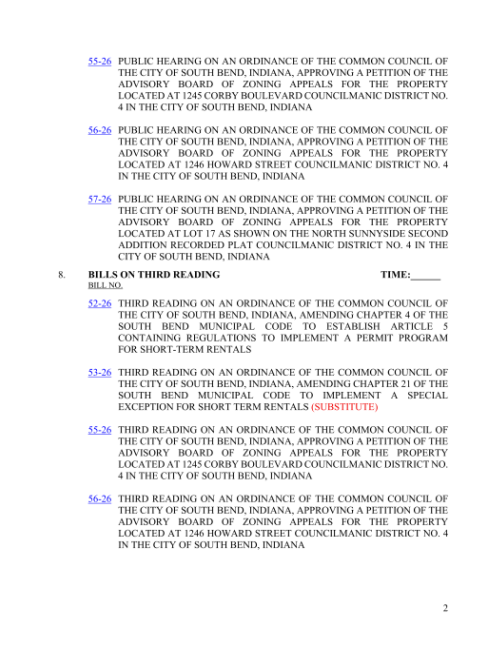
South Bend Common Council’s Sept. 14, 2026 meeting agenda lists Bills 52-26 and 53-26 on short-term rental permitting and zoning requirements. | Source: https://docs.southbendin.gov/
Enforcement: fines, then revocation
Indiana law fixes the outer bounds of enforcement and South Bend's ordinance works within them. Fines apply to each violation and Indiana Code 36-1-24-14 allows a city to revoke a permit for up to one year once an owner collects three citations in a calendar year which is the trigger South Bend adopted.


Renting with no permit is a different matter handled by Section 36-1-24-18 which classifies it as a Class C infraction capped at $500 and counts every booking as a fresh violation so the exposure grows with each reservation. The one number still missing is the fine the city will charge for a routine ordinance breach which has not been published.
The zoning split: owner-occupied versus investor rentals
Indiana law already sorts short-term rentals into two zoning categories and South Bend's ordinance simply applies the sorting. Under Indiana Code 36-1-24-8, a rental inside the owner's primary residence is a permitted residential use that zoning cannot touch which means owner-occupied hosts stop at the permit.
South Bend attorney summarizes short-term rental bills https://t.co/hzyt4MeW9D
— South Bend Tribune (@SBTribune) September 15, 2026
Rentals that are not owner-occupied fall under Section 36-1-24-9 which allows a city to require a special exception provided the process does not prohibit or unreasonably restrict them. Also, South Bend has now imposed that requirement on new investor rentals in residential districts while grandfathering those already operating, and denials can be appealed under state zoning law.
 WSBT 22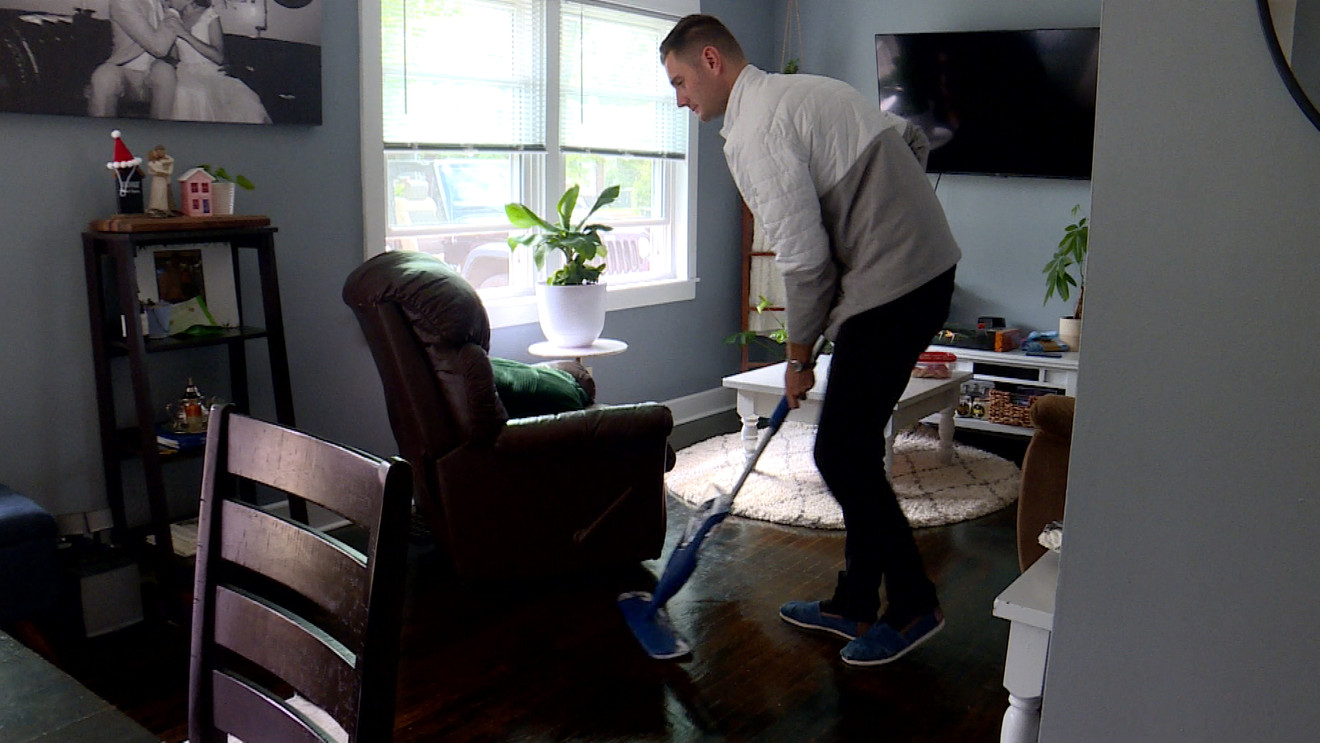
 WNDU Staff
How the rules came together
The path to the vote took two months and council member Oliver Davis opened the discussion in July by telling a public meeting that the city had more than 1,500 short-term rentals and a growing file of noise, parking and party complaints to go with them.
Short-term rentals in South Bend to see new regulations in new year https://t.co/9JP1cuw59O
— South Bend Tribune (@SBTribune) September 15, 2026
The bills went to a public hearing on August 10 and then to a packed community forum hosted by Fourth District council member Dr. Heidi Beidinger-Burnett on August 19 before council members approved the package they described as welcoming development while protecting neighborhoods.
⦾ Effective date: January 1, 2027
⦾ Permit required: Yes, one per property, $150 one-time fee (renewals free under state law)
⦾ Emergency contact: Required on the application
⦾ Safety standards: Basic safety and maintenance compliance required
⦾ Zoning: Owner-occupied rentals permitted by right; new non-owner-occupied rentals need a special exception; existing investor rentals grandfathered
⦾ Night cap: None
⦾ Penalty for non-compliance: Fines (amounts not yet published); permit revocation for up to one year after three violations in a calendar year; unpermitted operation is a Class C infraction under state law
⦾ Platform responsibility: None specified
In case you missed it:
 Jasmine Ruth Albatana
 Jasmine Ruth Albatana
 Jasmine Ruth Albatana
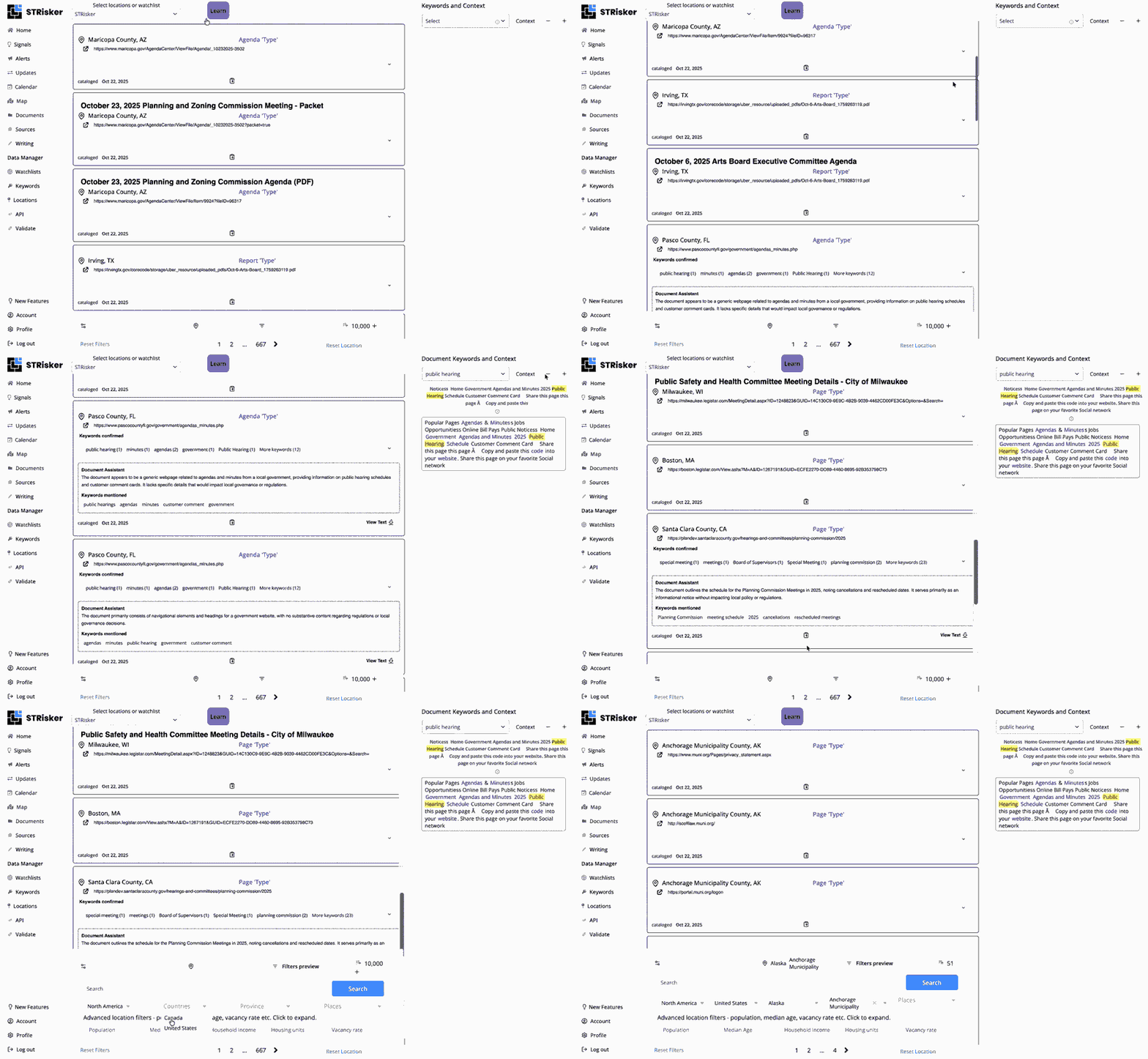
Strisker Document Analysis
Finding the right compliance documents shouldn’t feel like searching for a needle in a haystack - Strisker’s Documents Analysis is built to simplify your life, offering instant access to hundreds of thousands of documents from thousands of cities across the world.
Stay Updated with Strisker!
Strisker offers tools and features to keep you updated with the Short Term Rental movement (and now Data Centers!) movement across the world.
👍 We’d love your feedback.
We're always looking for ways to improve Bulletins.
Was this one useful to you? Other topics you'd like to see get covered?
✉️ Just reply directly to this email. We read and respond to every message!
-Will McClure
🙋 P.S.
Know someone else who should be reading this Bulletin? Feel free to forward this along. We want to make sure operators and stakeholders are aware of regulatory changes in their area.