
Data Center Conditional Use Permit: Reasons, Process, and Conditions Imposed
Understand what a data center conditional use permit is, why local governments require one, how approval works, and what conditions you can expect.
At A Glance 🔽
- A data center conditional use permit (CUP) is a local government approval that allows a data center to be constructed and operated on a specific property, as long as the development meets established standards.
- Local governments consider data center conditional use permits for various reasons, including electrical demand, water usage, noise levels, compatibility with neighboring areas, and public input.
- The steps for applying for and approving data center conditional use permits are: confirm the zoning and use table; hold a pre-application meeting; file a complete application; undergo a staff review and public hearing; receive the decisions and conditions; and appeal if needed.
- Data center conditional use permits also impose some conditions for data centers to retain their permits, such as a water usage plan, an energy consumption plan, a noise mitigation plan, zoning compliance, transparency obligations, labor and hiring standards, and an environmental and displacement review.
Definition
A data center conditional use permit (CUP) is a local government approval that allows a data center to be constructed and operated on a specific property, as long as the development meets established standards. In some jurisdictions, it is called a special use permit or special exception, where the data center is not automatically permitted “by right”. The applications must be reviewed first and approved with conditions attached.
💡Reasons
As the industry grows, data centers do not really fit into traditional land-use categories. Data centers look like warehouses from the street but behave more like heavy industrial users. Local governments require a conditional use permit for several reasons:
Electrical Demand
Data centers consume a significant amount of power and require specialized infrastructure. For example, a draft ordinance from Harmony, Minnesota, highlights this demand and stipulates that expanding an approved data center in a way that increases electrical demand, square footage, or infrastructure capacity requires a conditional use permit.
Water and Noise
Cooling systems and mechanical equipment impact nearby water supplies and neighbors. Reviews allow the city or county to establish boundaries and conditions before construction begins.
Compatibility with Neighbors
Many ordinances establish rules for the separation or screening of equipment near residential properties. The City of Bloomington, Minnesota, adopted an ordinance in 2022 that designates data centers as a new use category. These data centers are considered conditional uses in specific industrial and commercial districts, and the ordinance also sets forth performance standards.
Public Input
A conditional use permit typically involves a public hearing, where local governments provide residents the opportunity to formally comment on data center developments before a voting decision is made.
🏛️ Application and Approval Process
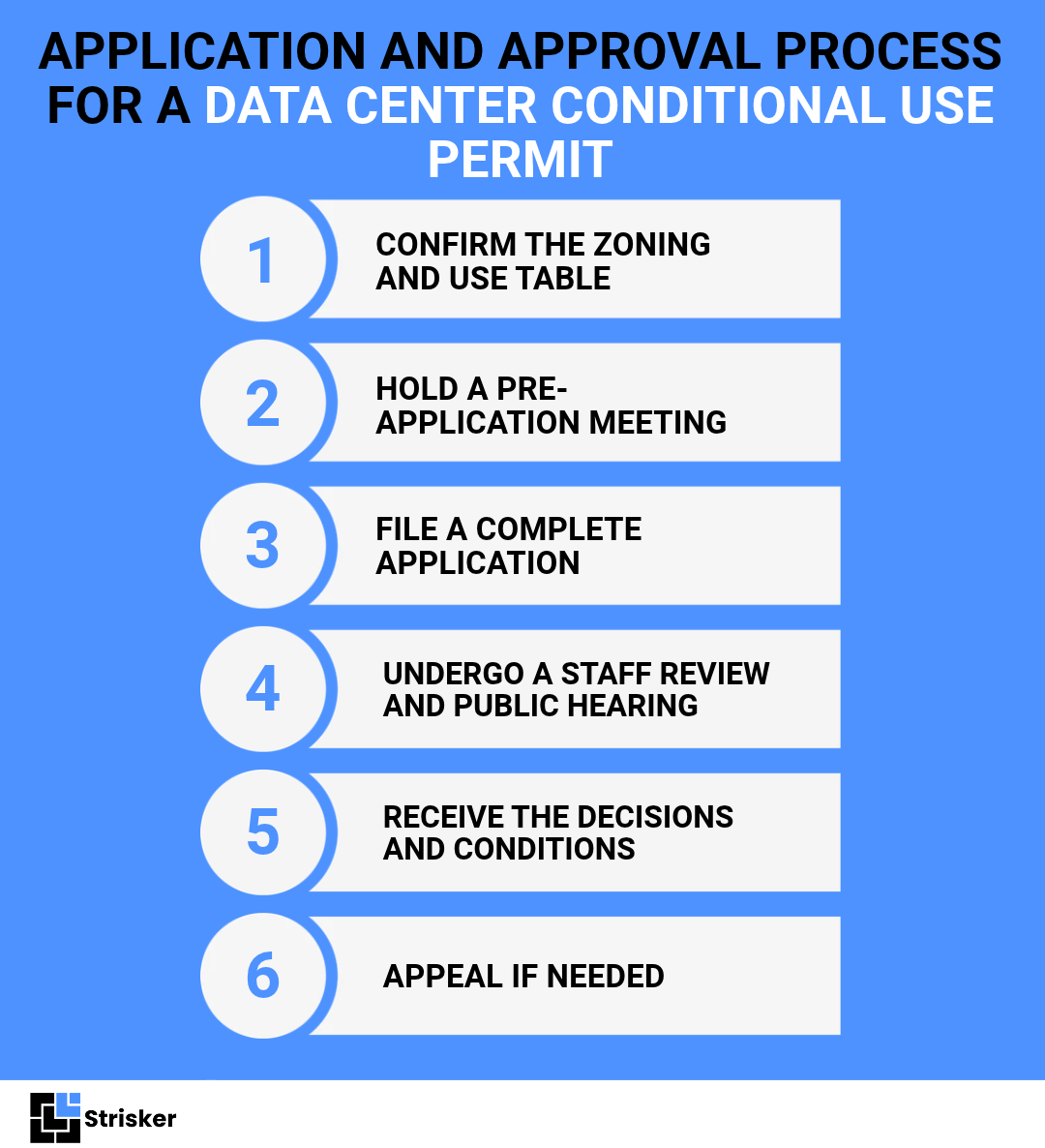
The specific steps can vary by city and county, so it's always a good idea to check the local zoning code. However, most places generally follow a similar process. The steps below outline how a project manager would plan for a data center project on a parcel designated for industrial use.
Step 1: Confirm the Zoning and Use Table
First, verify whether the property is located in a zoning district that permits data centers as a conditional use. If the zoning code does not mention this use at all, the project may require either a rezoning or a text amendment before a conditional use permit can be considered. Additionally, if the project only requires an exception to a dimensional rule, such as a setback or height limit, a separate zoning variance may be necessary.
Step 2: Hold a Pre-Application Meeting
Schedule a meeting with the planning or zoning staff before submitting your application. This meeting will help you understand the submission requirements, identify any hearings you need to attend, and determine any other necessary permits, such as a site plan or a building permit. Taking this step is the most effective way to address potential issues in advance and avoid any delays in your application process.
Step 3: File a Complete Application
Submit the application, application fee, and all requirements required by the jurisdiction. Most local jurisdictions will not begin their review until the application is complete. Missing a requirement can delay their process; hence, completing this step will keep the schedule on track.
Step 4: Undergo a Staff Review and Public Hearing
A staff member will assess the application against the zoning code and approval criteria. They will then prepare a report with a recommendation. The application will be presented and discussed at a public hearing conducted by the designated authority, such as a planning commission, hearing examiner, or governing body. Residents, applicants, and other interested parties are usually allowed to provide their comments before a decision is made.
Step 5: Receive the Decisions and Conditions
The decision-maker can approve the permit, approve it with conditions, or even deny it. When the permit is approved, the conditions become compulsory requirements for the property. If the required conditions are not met or followed, the permit may be denied.
Step 6: Appeal If Needed
Residents or data center developers may submit appeals to formally challenge data center decisions. Depending on the local government, these appeals can be directed to a Board of Zoning Appeals or the governing body. It’s important to note that appeal applications often have strict filing deadlines, so it is advisable to review the local regulations as soon as the decision is announced.
📋Conditions Imposed
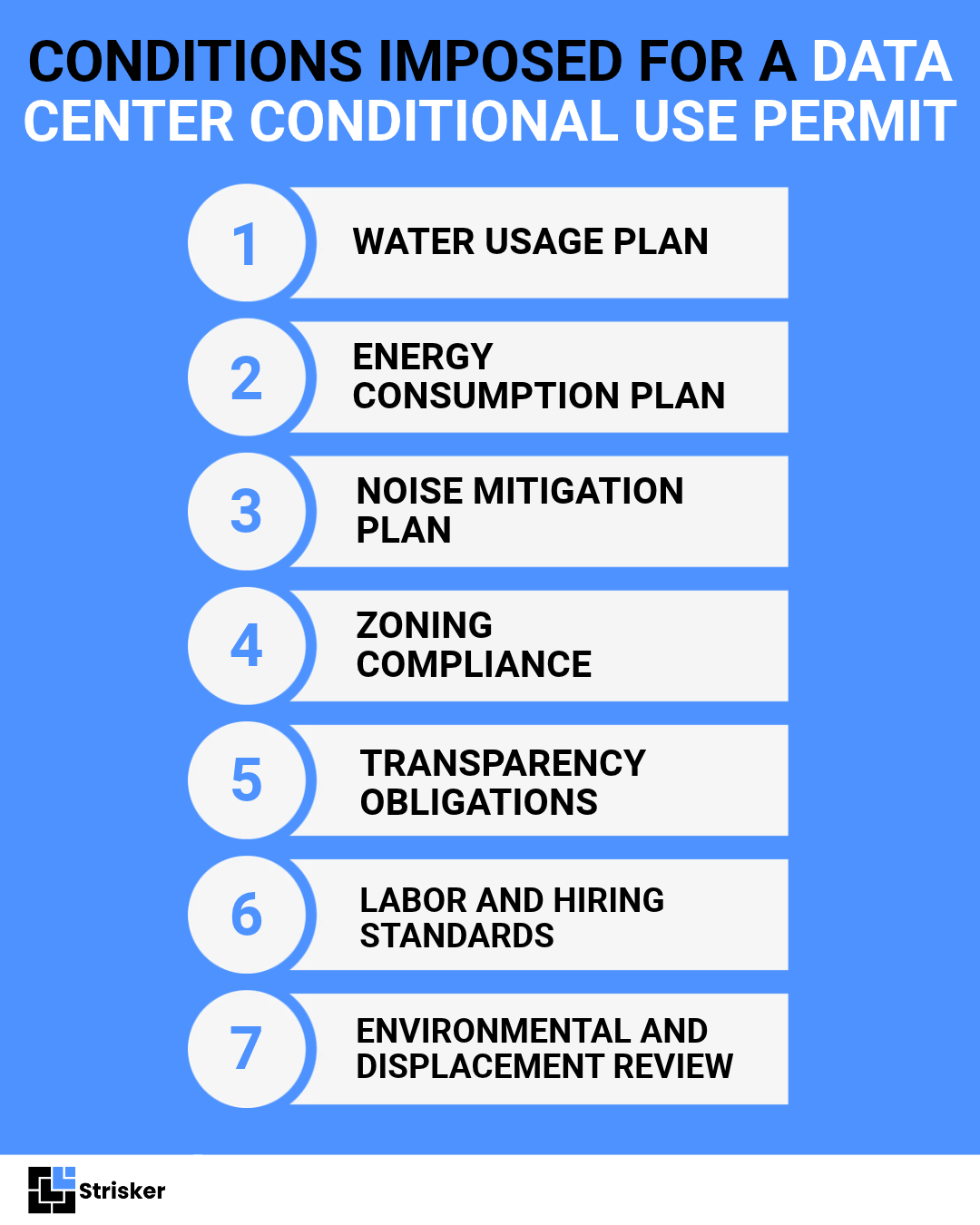
Conditions serve as the foundation for granting a conditional use permit for data centers. These conditions represent the additional requirements that data center projects must meet to retain their permits. Conditions vary by jurisdiction, but common ones include:
Water Usage Plan
This condition outlines the expected water consumption of the facility and its management. Cooling systems typically draw water from local supplies, so the local jurisdiction will evaluate the demand before granting approval. Once the data center is operational, the permit may require you to adhere to the conditions specified in the plan.
Energy Consumption Plan
This document outlines the power requirements and anticipated demand for a data center project. Data centers can significantly impact the local power grid. Having this plan in place gives officials and utility companies valuable insights into the energy consumption that the site will require.
Noise Mitigation Plan
This condition highlights efforts to minimize noise from mechanical equipment and generators. Common strategies include positioning equipment away from neighboring properties, adding sound barriers, and ensuring that noise levels do not exceed acceptable limits at the property boundary. This factor is particularly important for data centers located near residential areas or other noise-sensitive locations.
Zoning Compliance
This condition is intended to ensure compliance with the zoning regulations applicable to the parcel. It links the permit to the local code standards, which include setbacks, height restrictions, screening, and design guidelines. If the data center project later deviates from these regulations, the local government may classify it as a permit violation.
Transparency Obligations
This condition requires continuous reporting after approval, allowing both the public and local government to monitor the facility's operation over time. It encompasses resource usage and ensures compliance with other conditions. This prevents the review from expiring immediately after the permit is issued.
Labor and Hiring Standards
This condition sets forth commitments regarding job quality and local employment for construction and data center positions. It addresses concerns raised about data center developers hiring only a limited number of people once construction is complete.
Environmental and Displacement Review
This assures that the data center development will not worsen the displacement of residents and local businesses. It assesses the environmental impact, focusing on the communities that may be most affected.
Conclusion
A data center conditional use permit authorizes local governments to review and process data center projects, allowing them to impose conditions before construction and operation begin. There are several reasons why local governments may require this type of permitting, making it essential for data center developers to follow the application and approval process carefully.
Since conditional use permits do not automatically approve data center projects, local governments also establish additional requirements and documentation that must be met in order to retain these permits. Strisker offers tools, features, and newsletters to help you stay informed about new conditions and processes related to data center conditional use permits.
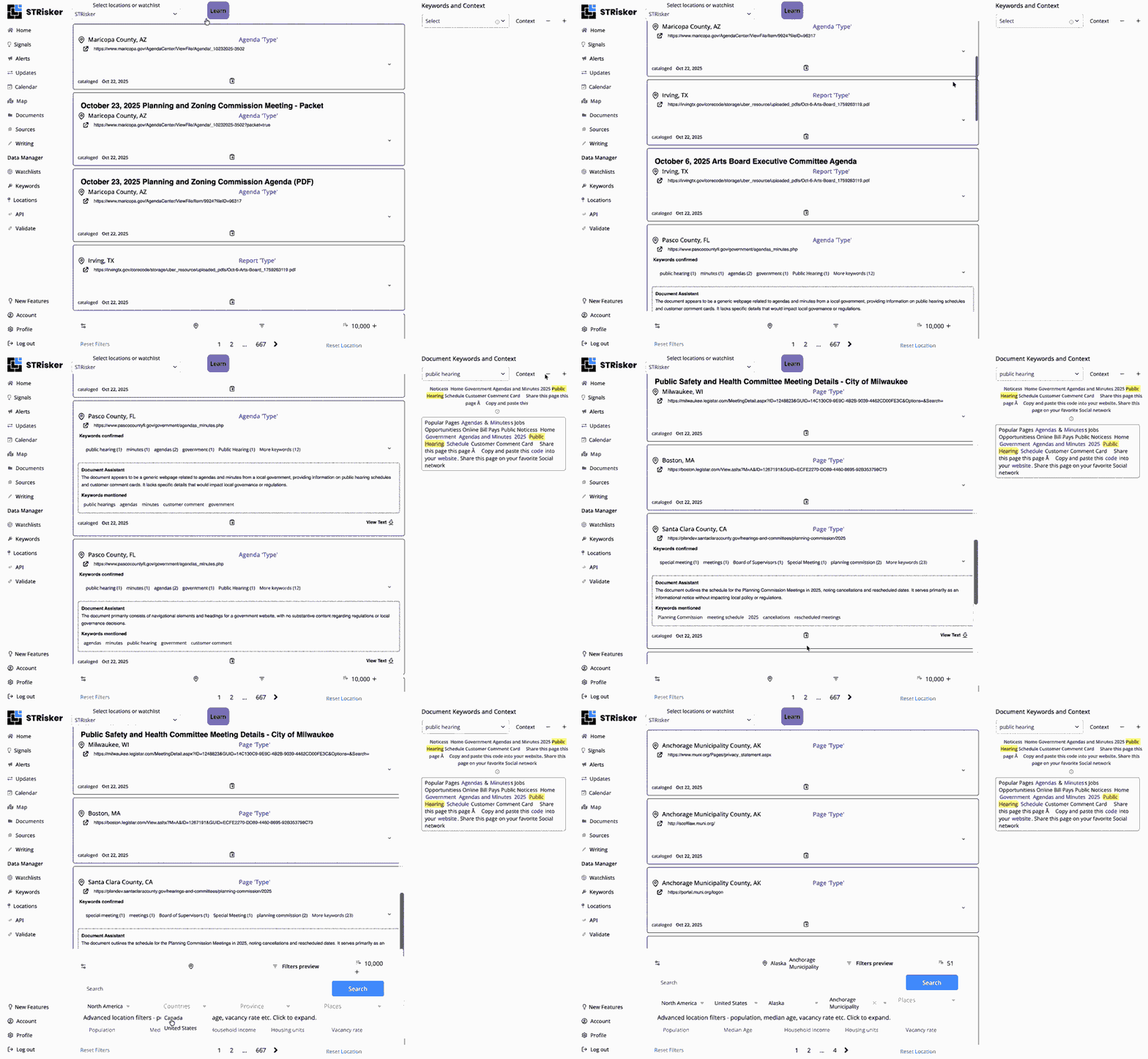
Strisker Document Analysis
Finding the right compliance documents shouldn’t feel like searching for a needle in a haystack - Strisker’s Documents Analysis is built to simplify your life, offering instant access to hundreds of thousands of documents from thousands of cities across the world.
FAQs
What documents are needed for a data center conditional use permit?
Document requirements may differ by jurisdiction, but the typical documents needed for a data center conditional use permit include:
- Completed petition
- Written project summary
- Site plan
- Utility, water, energy, and noise information
- Environmental review, where required by state law
It is still best to check with the local planning office for the submission checklist.
How long does a data center conditional use permit take?
There is no set duration for a conditional use permit. The length of the process typically depends on several factors, including the completeness of the application, the scheduling of meetings by the hearing body, and whether a rezoning is involved. Additionally, the timeline may extend if there is an appeal of the decision.
Why would a data center conditional use permit be denied?
A data center conditional use permit can be rejected for several reasons. Some of these reasons include:
- Incomplete submission of requirements
- Land that is not zoned for data center use
- Failure to meet the approval criteria or performance standards
- Incomplete power, water, and noise impact studies
Stay Updated with Strisker!
Strisker offers tools and features to keep you updated with the Short Term Rental movement (and now Data Centers!) movement across the world.
👍 We’d love your feedback.
We're always looking for ways to improve our content.
Was this one useful to you? Other topics you'd like to see get covered?
✉️ Just reply directly to this email. We read and respond to every message!
-Will McClure
🙋 P.S.
Know someone else who might be interested in this content? Feel free to forward this along.