
Data Center Planning Commission: Members, Documents, and Decision Process
Understand what a data center planning commission is, who its members are, which documents they review for data center projects, and how the decision-making process progresses.

At A Glance
- A data center planning commission is the appointed local body that evaluates and reviews rezoning, special exceptions, site plans, and zoning text amendments for data center projects.
- The data center planning commission consists of appointed local members: the commissioner, planning staff, planning director, legal counsel, and governing body liaison.
- The members review various documents and applications, including a staff report, application, narrative, site plan, technical studies, drafts of text amendments, special use permits, rezoning requests, meeting minutes, and public input.
- The typical process for a commission decisions process includes application submission, staff review, staff report and public notice preparation, hold public hearing, vote and issue a recommendation, and final action and follow-up.
Definition
A data center planning commission is the appointed local body that evaluates and reviews rezoning, special exceptions, site plans, and zoning text amendments for data center projects. It is not a separate body created for data centers. Meaning to say, this is the existing local planning commission for data center applications and ordinance changes. Its main role is to assess if the proposed facility or proposed rule for these facilities aligns with and complies with the local zoning ordinance and comprehensive plan.
In many areas, the planning commission does not have the final say. In Salt Lake City, for example, the Planning Commission recommends zoning and ordinance changes to the City Council, which makes the final decision, but it issues final rulings on conditional uses. Additionally, local regulations determine the extent of a commission's authority, meaning that a single data center project could be reviewed differently depending on the location.
🏛️Members
Most planning commission members are residents appointed by the mayor, city council, or county board. For example, in Salt Lake City, nine to eleven members are appointed by the Mayor with the City Council's consent and serve four-year terms. The local code establishes the number of seats, term lengths, and member qualifications. The following are the common participants in a data center planning commission:
Commissioners
They are the appointed community members who vote on each item. Typically, a chairperson and a vice chairperson head the meetings. Jurisdictions often aim for a balance of professional and neighborhood perspectives, so some commissioners may lack a background in planning. Their votes are expected to be based on the zoning code, the comprehensive plan, and the records from the hearings.
Planning Staff
They are the employees of the planning or community development department. They handle application processing, communication with applicants, and the collection of community comments. They are also responsible for writing the staff report. While the staff provides advice to the commission, they do not participate in voting.
Planning Director
They lead the department and are responsible for giving a report at the meeting and answering the policy questions from the commissioners.
Legal Counsel
The city or county attorney advises the commission on hearing procedures and the regulations that apply to the data center proposal. This includes guidance on conducting a hearing and which conditions may be legally attached for approval.
Governing Body Liaison
In some jurisdictions, a council member or supervisor is assigned to the commission. They are responsible for linking the commission to the body or council that grants final approval.
🗂️Documents and Applications to Review
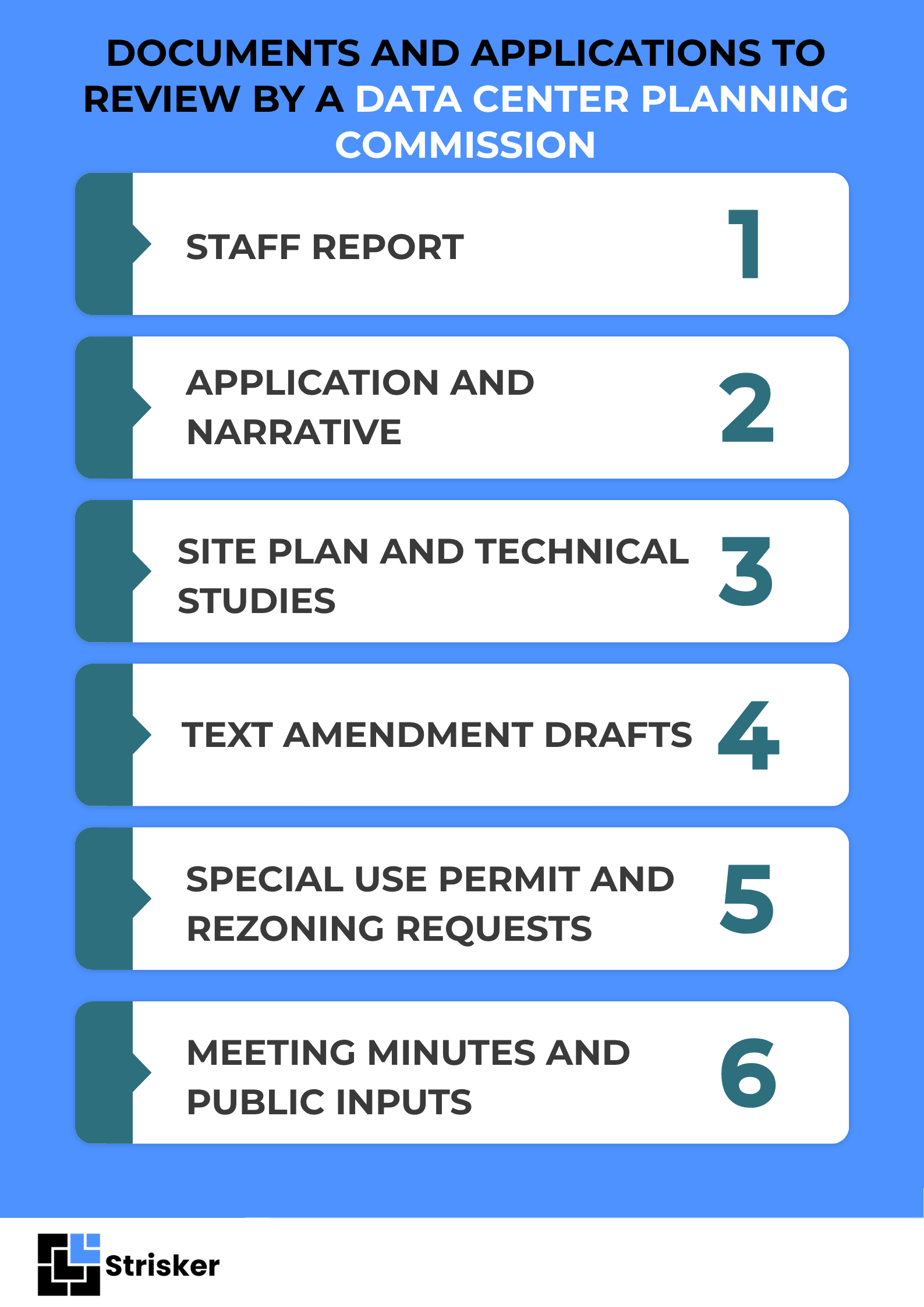
Prior to a hearing, the commission receives a packet. This packet contains various documents depending on the rule change or project request. The planning commission is expected to review some of the following materials:
Staff Report
It is the main document in the packet. This report summarizes the request, explains how it aligns with the zoning code and comprehensive plan, and lists comments from the reviewing agencies. It ends with a staff recommendation to approve, deny, or approve with conditions. Commission members may not follow it, but this report influences the discussion.
Application and Narrative
Application refers to what is proposed to the commission. In contrast, the narrative outlines the data center's building size, anticipated power load, cooling method, and construction timeline.
Site Plan and Technical Studies
The site plan includes details about the buildings, their setbacks, parking areas, landscaping, and access points. Some requests for data center development are commonly backed by additional technical studies, including:
- Noise studies measure the expected sound from cooling equipment and generators at the property line. Chandler, Arizona, for example, requires detailed noise mitigation studies for data centers.
- Water and utility assessment presents how much water and power the facility needs and the utility’s capacity to supply them.
- Traffic and construction impact estimates the truck trips and effects on nearby roads
- Visual and buffering plan displays the screening, building height, and distance from homes.
Text Amendment Drafts
If a community lacks data center rules, the item may be considered a Text Amendment rather than a project. According to the National League of Cities, older zoning codes often do not explicitly address data centers, which can lead to case-by-case review. The planning commission will review the proposed ordinance and language to decide whether to recommend it.
Special Use Permit and Rezoning Requests
In many areas, a data center needs a special use permit or a rezoning before it can be built, depending on the zoning district. For example, in September 2026, Prince William County, Virginia, adopted a zoning text amendment that shrank its Data Center Opportunity Zone Overlay District. The Planning Commission recommended approval with changes before the Board of County Supervisors adopted it. New data centers in the listed business, office, and industrial districts outside the overlay must now obtain a special use permit.
Meeting Minutes and Public Inputs
It indicates the meeting minutes from an earlier session, which include public comments. The past minutes show how the commission has addressed similar projects, the conditions they requested, and the concerns raised by neighbors.
🛠️Commission Decisions Process
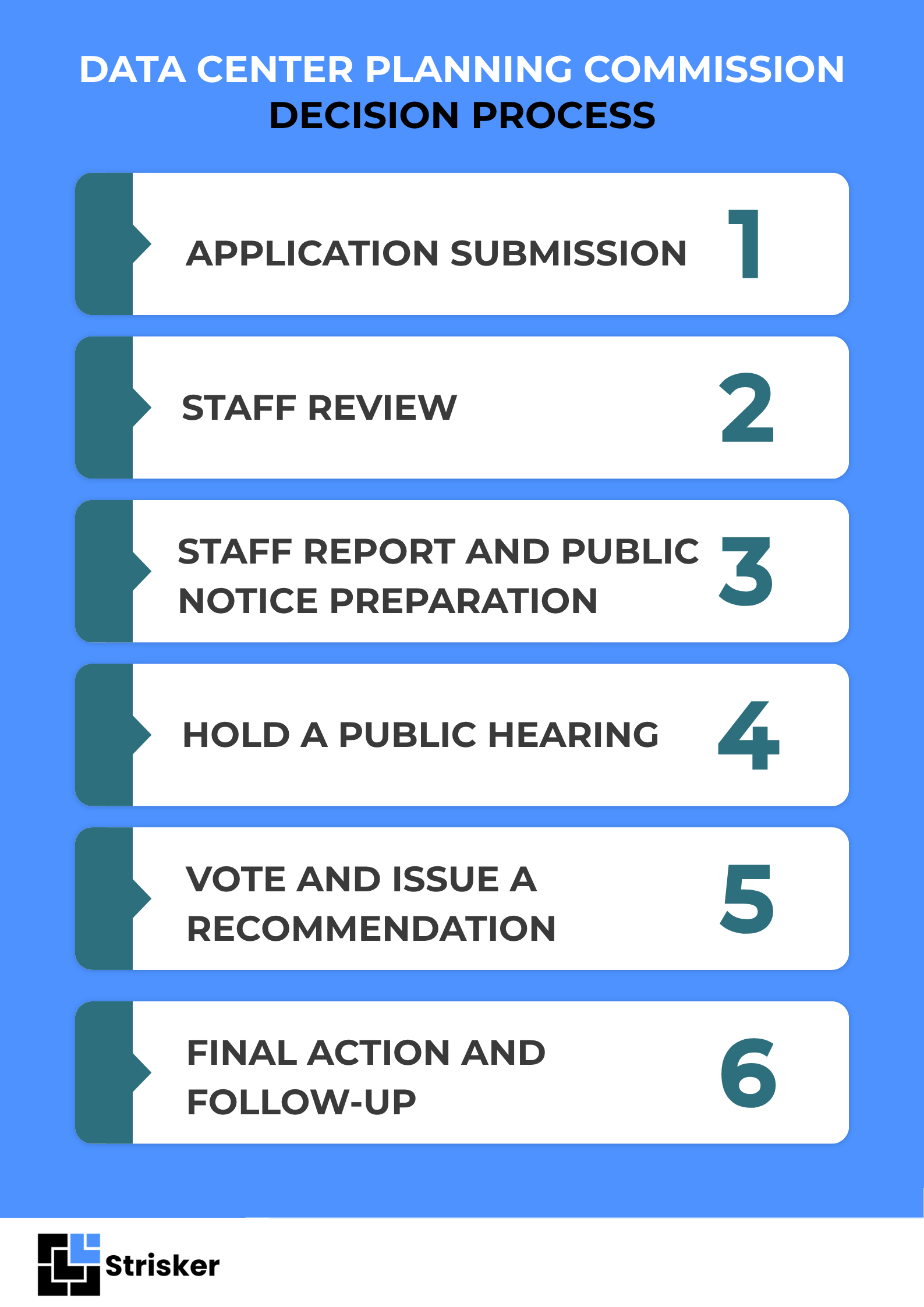
The process for commission decisions follows a specific order. While the details may vary by jurisdiction, most commissions adhere to these steps:
Step 1: Application Submission
This step involves the applicant submitting their application and paying the fee. A staff member will verify if the application is complete before it is scheduled. If any studies or forms are missing, the application usually stops here.
Step 2: Staff Review
During this step, the staff will review the application to ensure it complies with the zoning code and comprehensive plan. A staff member will also forward the application to other departments or utilities for their comments and often meet with the applicant. Most design changes occur at this stage. The staff will also seek input from the community, which may include mailing notices.
Step 3: Staff Report and Public Notice Preparation
The staff will prepare a report and issue the required hearing notice. State and local laws will also determine who must be notified and how far in advance. In Virginia, for instance, these notice requirements are set by Va. Code 15.2-2204.
Step 4: Hold a Public Hearing
During the public hearing, the staff and the applicant present the data center project, while members of the public have the opportunity to voice their comments and input. The commissioner then asks questions regarding various concerns, including noise levels, power demand, and water resources. Additionally, the proceedings of the public hearing are documented in the Meeting Minutes.
Step 5: Vote and Issue a Recommendation
The planning commission will vote to either approve, deny, approve with conditions, or postpone the application to a later meeting. In most areas, its recommendation will be forwarded to the city council or county board, which will also hold its own hearing.
Step 6: Final Action and Follow-Up
If the governing body grants approval, the applicant proceeds to obtain building permits and approvals from other agencies. There may be conditions established during this process, such as noise restrictions or required screening as part of the approval.
Conclusion
A data center planning commission is the local body responsible for reviewing data center applications and proposed zoning changes before a governing body makes its final decisions. The commission members evaluate a variety of documents, including staff reports, applications, technical studies, meeting minutes, and public comments, to develop their recommendations.
For a planning commission to make its recommendations and decisions, it follows a specific process. Applicants first submit their applications, and the commission ends the process with a final action or conducts follow-up if necessary. Strisker offers tools, features, and newsletters to keep you informed about public hearing announcements and decisions from the data center planning commission.
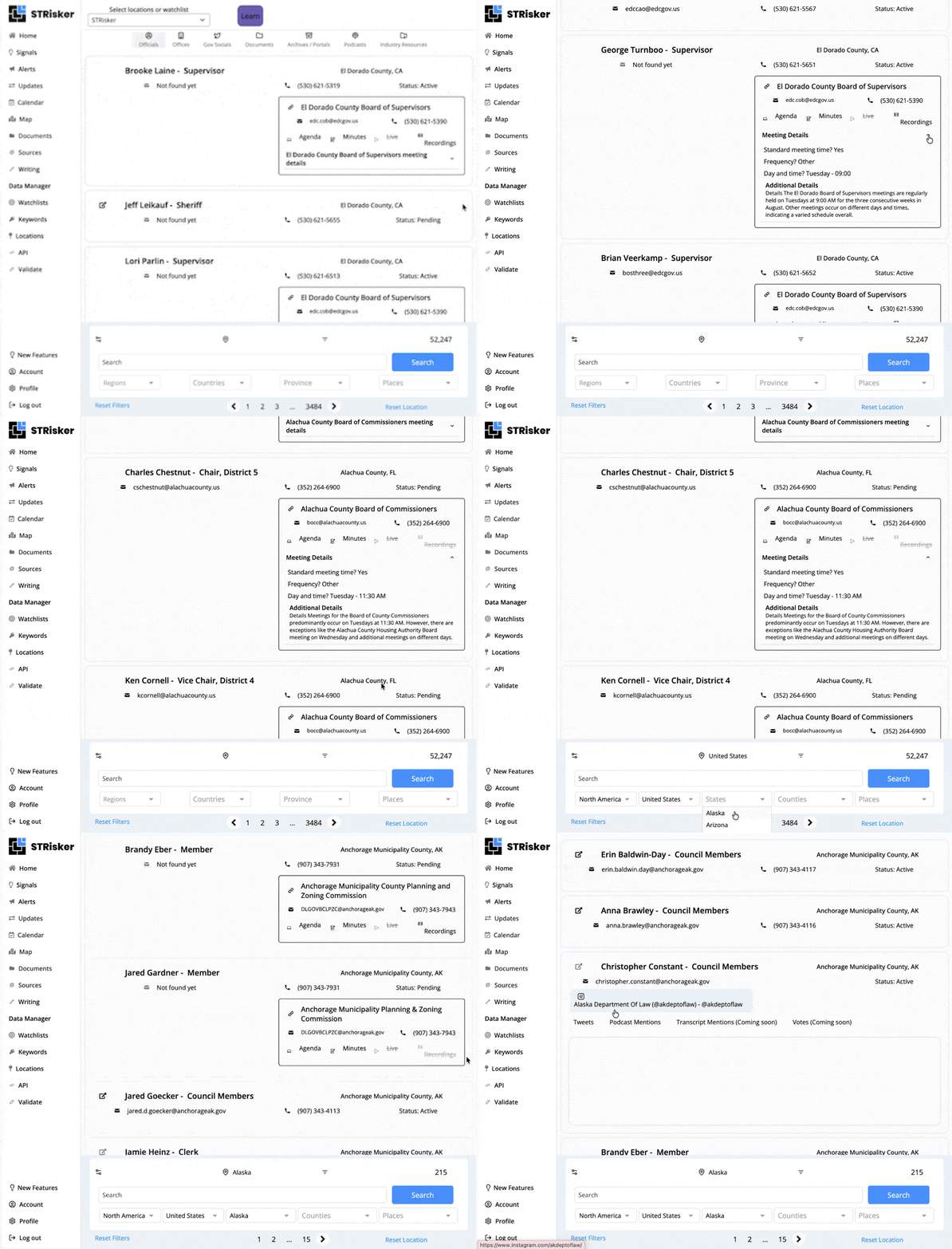
Strisker Government Officials Dashboard
Trying to keep up with the main players in the STR and Data Center game? Know your council members, commissioners, committee chairs, and key staff that are part of the process.
FAQs
How should a developer prepare for a data center planning commission hearing?
To prepare for a data center planning commission hearing, a developer must verify the accuracy of technical facts, address community concerns effectively, and organize the project’s decision record. Here are some of the steps that a developer can take for preparation:
- Organize a unified decision and fact base
- Engage with stakeholders earlier
- Assign and rehearse spokesperson roles
- Compile logistics and post-hearing minutes
How long does planning approval for a data center take?
Planning approval timelines for a data center vary widely by jurisdiction and project complexity. Projects that need a rezoning, special use permit, or text amendment generally take longer than a by-right site plan review, and utility coordination and infrastructure buildout alone can take 24 to 60 or more months, according to the Associated General Contractors of America.
Can a data center planning decision be appealed?
Yes, a data center planning decision can be appealed. However, the rules, eligibility for appeals, and valid grounds for appeal vary greatly by local jurisdiction. Additionally, the process may differ based on whether you are a project developer or a third party, such as a neighboring resident, community group, or opposition group. In Tennessee, for example, certain zoning decisions can be appealed to the board of zoning appeals and then taken to court, while Montana law requires a court petition within 30 days after a board of adjustment decision is filed.
Stay Updated with Strisker!
Strisker offers tools and features to keep you updated with the Short Term Rental movement (and now Data Centers!) movement across the world.
👍 We’d love your feedback.
We're always looking for ways to improve our content.
Was this one useful to you? Other topics you'd like to see get covered?
✉️ Just reply directly to this email. We read and respond to every message!
-Will McClure
🙋 P.S.
Know someone else who might be interested in this content? Feel free to forward this along.