
Data Centers: Daily Notes | April 15, 2026
Maine becomes first state to pass a data center moratorium; Ohio congressman files federal bill to make data centers pay for grid costs; New York proposes three-year statewide ban.


At A Glance 🔽
- Maine legislature passes first-in-nation moratorium on data centers over 20 MW.
- Ohio: U.S. Rep. Greg Landsman introduces the No Harm Data Center Act, requiring operators to cover grid costs and banning official NDAs.
- Minnesota House hears bill requiring full environmental studies and permitting for data centers; six lawsuits pending statewide.
- Washington's Utilities and Transportation Commission launches six-to-eight-month review of large-load power demands.
- New York Sen. Elizabeth Krueger introduces S.9144, a three-year statewide moratorium on new data center construction.
- Phillipsburg, NJ adopts town-wide ban on data centers in all zoning districts.
- Olyphant, PA council rejects data center zoning amendment, then invokes 180-day curative amendment to draft stronger rules.
- Harford County, MD councilman announces moratorium legislation; county executive says data centers aren't currently allowed.
MAINE
Maine's legislature passed the first statewide moratorium on large data centers in the nation, with the House voting 79-62 and the Senate 21-13.
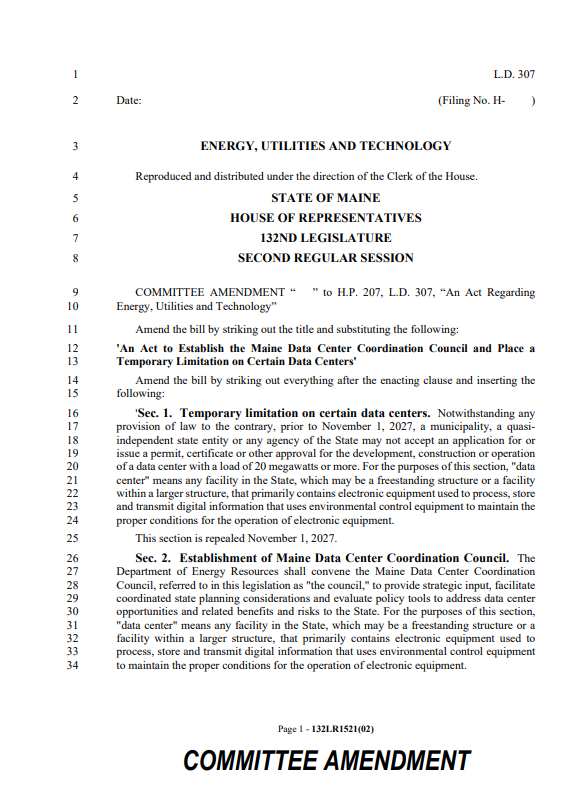
The ban applies to facilities exceeding 20 megawatts, a threshold that effectively blocks construction of most AI-scale data centers. The moratorium runs through November 2027 and creates a council to evaluate the cost of data centers on Maine residents. Maine ranks fourth highest in the nation for electricity prices.
OHIO
U.S. Rep. Greg Landsman of Ohio introduced the No Harm Data Center Act, federal legislation that would require data center operators to cover the full cost of new energy infrastructure and prohibit elected officials from signing nondisclosure agreements with developers.
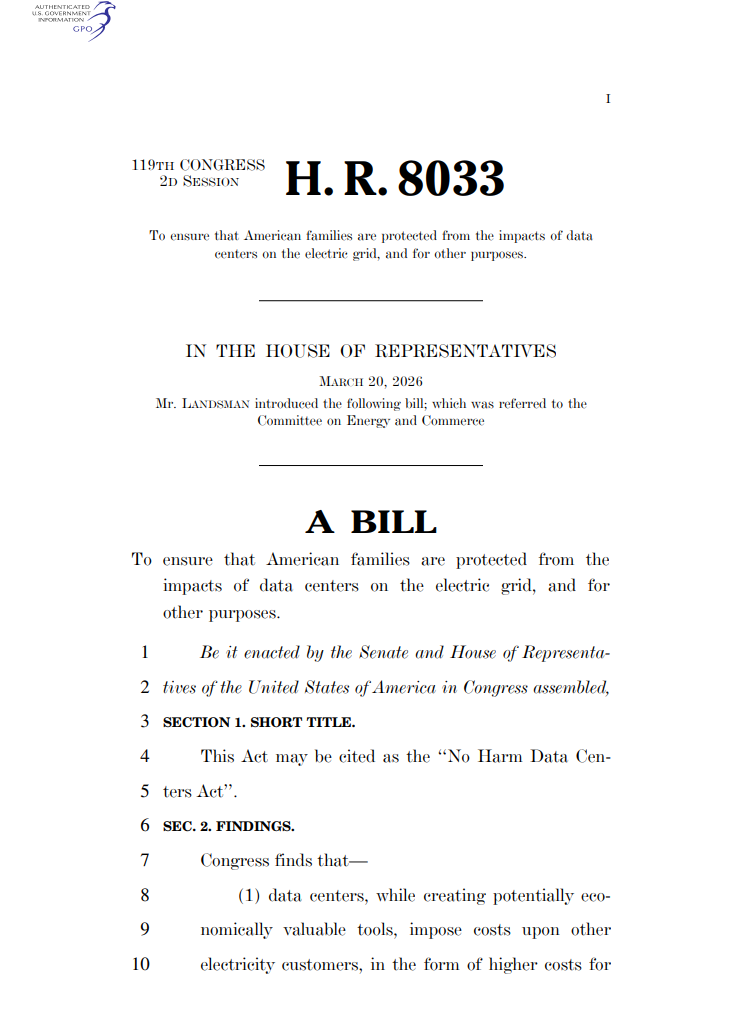
The bill applies to data centers pulling more than 50 megawatts at peak demand and tasks the Federal Energy Regulatory Commission with managing the process. It prohibits utilities from shifting data center costs to other consumers and mandates a study of environmental impacts.
MINNESOTA
Minnesota lawmakers took up a bill Tuesday that would require a full environmental study and permitting process for data centers, strengthening statewide guardrails as proposals spread across the state.
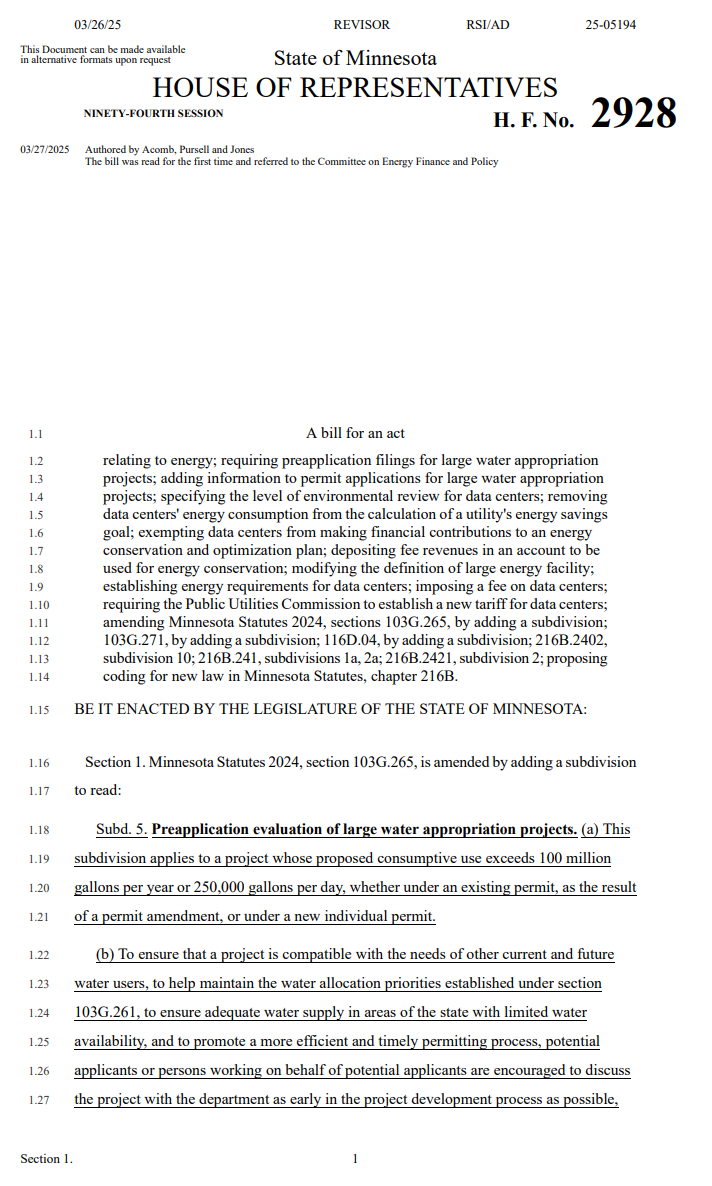
Companion bill to HF 2928, SF 3968 "Data centers provisions modification"...
A separate measure banning city officials from entering nondisclosure agreements with data center developers has stalled in the House, though a Senate committee is expected to hear a companion bill on Wednesday. The Minnesota Center for Environmental Advocacy has six pending lawsuits against data center projects from Pine Island to Hermantown.
WASHINGTON
Washington's Utilities and Transportation Commission announced a workshop for April 27 to study how investor-owned utilities should handle large new power demands from data centers and other facilities. Written comments are due April 21.
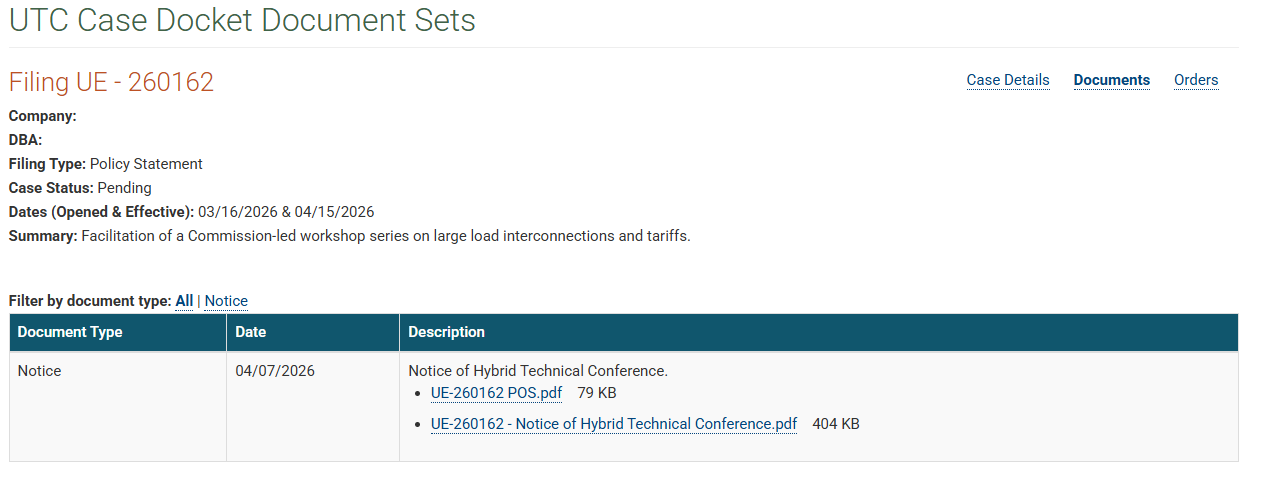
The review is the first step in a process expected to last six to eight months, ending with a policy statement on large-load connections for utilities. The commission said it wants to act early even though Washington hasn't yet seen the same level of large-load growth as other states.
NEW YORK
New York Sen. Elizabeth Krueger introduced S.9144, a bill that would impose a three-year statewide moratorium on new data center developments while requiring the state to study their impacts on water, electricity, emissions and local infrastructure.
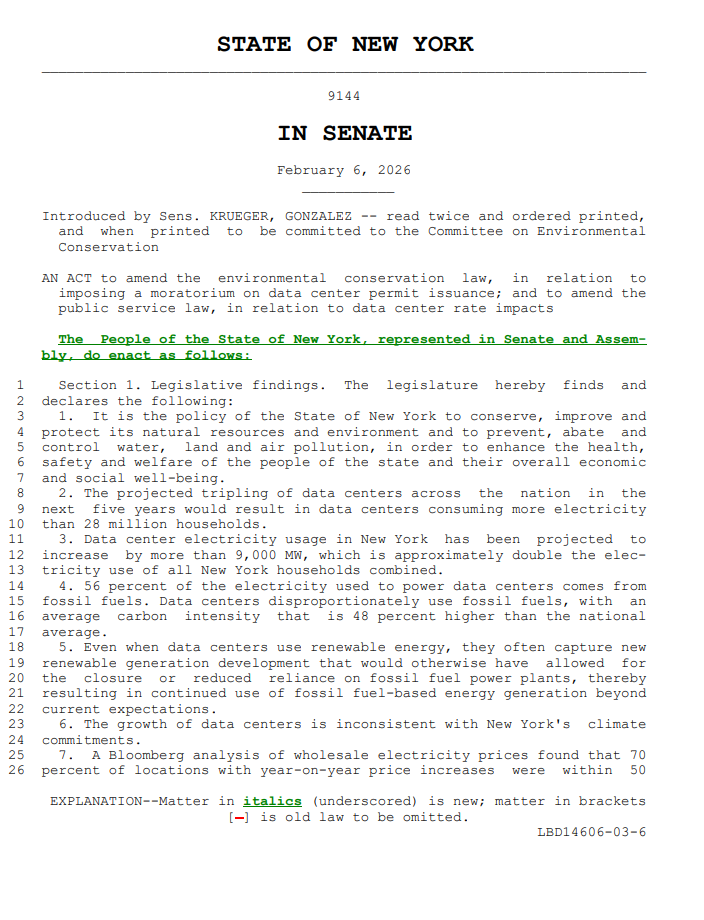
The bill is under review by the Environmental Conservation Committee. Food & Water Watch has backed the legislation, citing strain on electrical grids and increased reliance on fossil fuels. If enacted, the moratorium would be among the longest proposed at the state level, matching three-year proposals in Oklahoma while exceeding two-year pauses considered in Virginia.
PHILLIPSBURG, New Jersey
Phillipsburg's Town Council officially adopted an ordinance banning data centers in all zoning districts across the municipality. The ban (Ordinance 2026-08) received final approval on April 14.
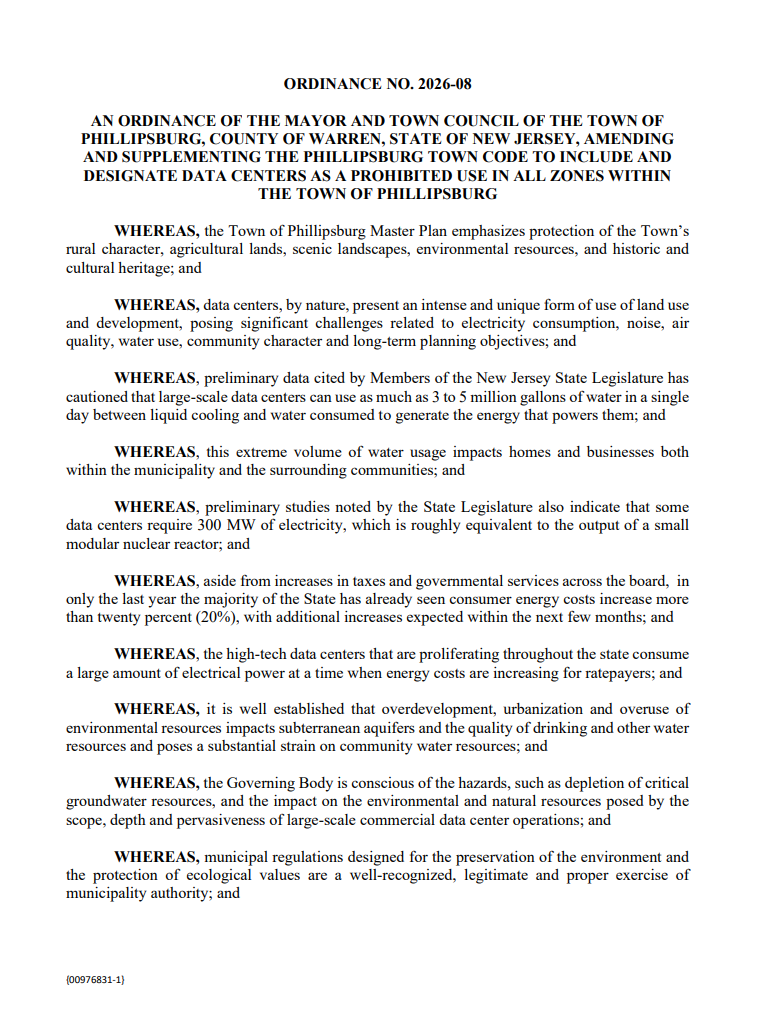
The ordinance was first introduced in February and unanimously approved on first reading. The Land Use Board found it consistent with the town's master plan, which emphasizes preserving rural character, agricultural lands and scenic landscapes. Existing facilities may continue as nonconforming uses but cannot expand. Officials cited estimates that large-scale data centers can consume 3 to 5 million gallons of water per day and require up to 300 megawatts of electricity.
OLYPHANT, Pennsylvania
Olyphant's council rejected a proposed data center zoning amendment last April 14 2026, then immediately introduced a curative amendment giving the borough 180 days to revise its zoning ordinance.
No formal data center application is pending, but under Pennsylvania law municipalities cannot outright ban a land use. Without defining where and how data centers are allowed, the borough could be vulnerable to a developer challenge. The rejected ordinance had included standards for setbacks, noise, water usage and environmental impact, but residents argued the regulations were too lax. The curative amendment protects Olyphant from legal challenges while officials draft stronger rules.
HARFORD COUNTY, Maryland
Harford County Councilman Jacob Bennett announced plans to introduce legislation imposing a moratorium on data centers in the county.
Bennett raised concerns about the facilities' resource footprint relative to their job creation, noting that a million-square-foot data center employs about as many people as a local elementary school while consuming far more electricity and water. County Executive Bob Cassilly countered that data centers aren't currently allowed in the county, but Bennett said he plans to introduce the moratorium legislation next week, citing reports of developer interest in local land.
📱 Social Finds
i made a map to monitor data centers all around the world
— isabelle (@isareksopuro) April 14, 2026
tracks construction + nearby power plants + local AI legislation, and follows the politicians behind their bans (+ if they're getting paid to do so!) pic.twitter.com/oKVjhXLGzv
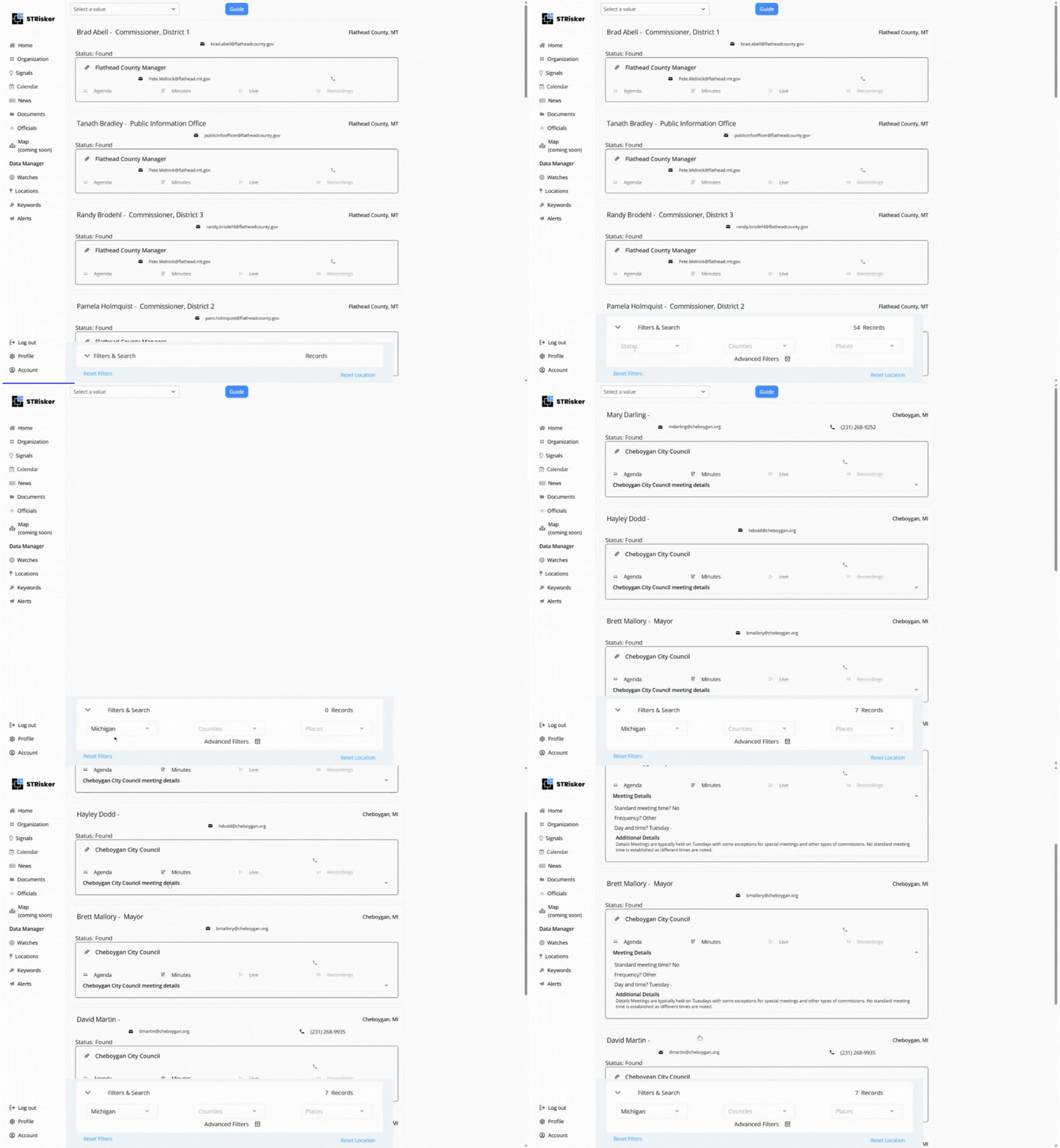
STRisker Government Office Dashboard
Trying to keep up with the main players in the STR game? Know your councilmembers, commissioners, committee chairs, and key staff that are part of the process.
Stay Updated with STRisker!
STRisker offers tools and features to keep you updated with the Short Term Rental movement (and now Data Centers!) movement across the world.
👍 We’d love your feedback.
Which stories hit? Which ones missed?
We're exploring a new branch of topics centered around Data Centers and want to make it even more useful for you.
✉️ Just reply directly to this email. We read and respond to every message!
-Will McClure
🙋 P.S.
Know someone else who should be reading Daily Notes? Feel free to forward this along. We’re opening a few more spots.