
Data Centers: Daily Notes | April 6, 2026
Cheyenne annexes county land to manage data center boom; Eastern Band of Cherokee Indians proposes indefinite ban on tribal lands; Tucson tightens rules with 400-ft setbacks and potable water ban.


At A Glance 🔽
- Cheyenne, WY annexes county land to manage data center growth; three major projects total billions in investment.
- Eastern Band of Cherokee Indians introduces ordinance to ban data centers on 57,000-acre Qualla Boundary.
- Tucson, AZ requires 400-ft setbacks from homes, bans potable water for cooling, and eliminates by-right approval paths.
- Lancaster, PA's $20M community benefit agreement questioned.
- Granbury, TX holds hearings on rezoning 2,100 acres for Bilateral Energy's data center power plant.
- East Rockhill, PA restricts data centers to airport industrial zones with 50-acre minimums and 45-ft height caps.
- Slocum Township, PA requires $5M water bonds and mandatory decommissioning plans in first zoning update since 1986.
- Columbia, MO City Council votes Monday on first data center use definitions and zoning criteria.
CHEYENNE, Wyoming
Cheyenne is annexing county land to manage explosive data center growth and fund infrastructure upgrades. The city makes up 65% of Laramie County's population and receives 65% of every sales tax dollar.
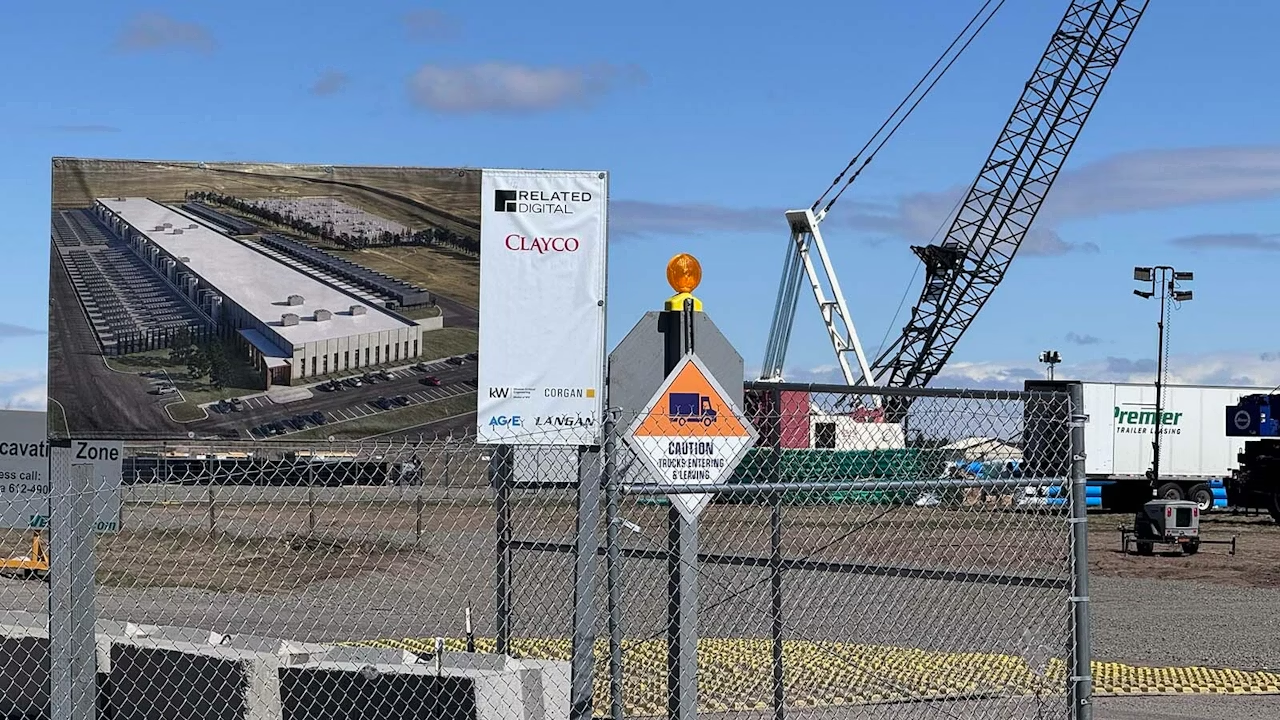
Three major projects are driving expansion:
- Tallgrass and Crusoe's Project Jade at 2.7 gigawatts of AI capacity,
- Related Digital's $1.2 billion, 302-megawatt facility that broke ground in October,
- and Meta's $800 million Project Cosmo spanning 715,000 square feet.
Annexation also lowers water and sewer rates for businesses; before being incorporated, companies in the North Range Business Park were paying 1.5 times the current rates. Microsoft first arrived in 2012.

EASTERN BAND OF CHEROKEE INDIANS, North Carolina
Four council members introduced an ordinance to ban data centers on the Qualla Boundary, calling them a "clear and present danger" to people and the environment. The 12-member tribal council voted unanimously to table the proposal for future discussion, a standard practice for new items. The draft ordinance proposes an indefinite moratorium and cites water as sacred, with additional concerns about noise and health impacts from nearby facilities.
TUCSON, Arizona

Tucson is drafting rules that would require large data centers to sit at least 400 feet from homes and schools, with no by-right approval path. Every application would need a neighborhood meeting, Zoning Examiner hearing, and mayor and Council vote.
Over 550 residents submitted feedback; the most common response was a call to ban data centers entirely. Large-scale facilities would be restricted to heavy industrial I-2 zones. The draft bans potable water for cooling, permits only Tier IV or natural gas generators, and limits maintenance runs to weekdays 9 a.m. to 5 p.m. Enhanced notice would reach property owners within a half-mile and associations within two miles.


LANCASTER, Pennsylvania

A $20 million community benefit agreement for two data center sites faces questions about enforceability and public input. Only the city can go to court to enforce the terms; residents have no direct recourse. Activist group Lancaster Stands Up asked for a seat at the negotiating table and received no response.
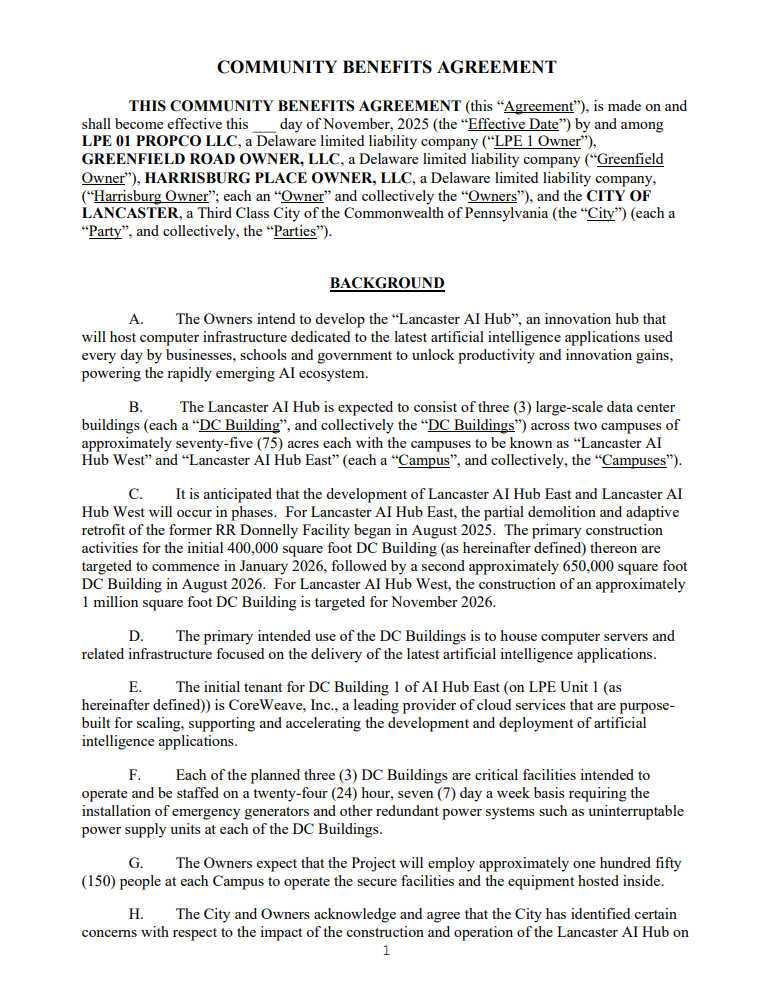
The agreement, approved with just two days of public notice, commits developers to 100% renewable energy and projects 2,000 construction and 350 permanent jobs. The city has received $7.8 million in building permit fees and holds a $10 million letter of credit as a performance guarantee.
GRANBURY, Texas
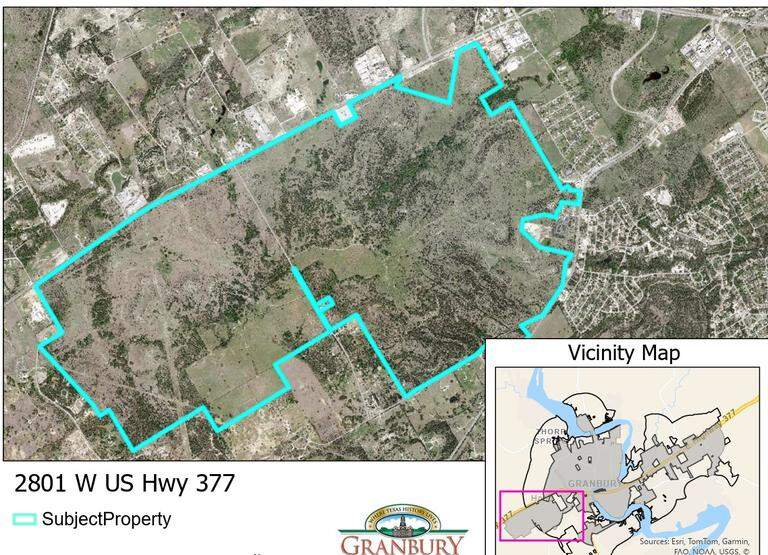
Granbury holds public hearings Tuesday on rezoning 2,100 acres of annexed ranchland for a data center power plant. Dallas-based Bilateral Energy LLC received TCEQ approval in July for eight simple-cycle turbines and 87 linear generators on the Knox Ranch property. The company designs private power infrastructure for data centers and AI. New design standards address noise, lighting, and concealment landscaping. A January meeting drew an overflow crowd fiercely opposed to the annexation. Hearings begin at 6 p.m. at City Hall.
Agenda Report
April 7, 2026
"Public Hearing - Consider adopting Ordinance No. 26-14 approving the request of... "
EAST ROCKHILL, Pennsylvania
East Rockhill's Board of Supervisors advanced an ordinance on March 24 restricting data centers to industrial zones at Pennridge Airport. The measure sets a 50-acre minimum lot size and a 45-foot height limit, a compromise between the proposed 60 feet and the township's standard 35.

Board of Supervisors Meeting | Tuesday, March 24, 2026
Pennsylvania law requires municipalities to permit every legitimate land use, the township solicitor noted, making an outright ban legally risky. No applications have been filed; the ordinance is preemptive. It now goes to township and county planning commissions for 30-day review.
SLOCUM TOWNSHIP, Pennsylvania
Slocum Township's planning commission voted March 23 to recommend a revised zoning code, the first update since 1986. Data centers would be limited to I-1 industrial zones as a conditional use, but the township currently has no industrial districts. The code adds distinctive provisions: a $5 million minimum bond for water infrastructure costs, mandatory decommissioning plans with financial assurance for full site restoration, and a requirement to begin removal within one year of cessation and complete it within 18 months. All above-ground structures must be demolished and sites restored.
COLUMBIA, Missouri
Columbia's City Council votes today (📆April 6, 2026) on amendments to regulate data centers by defining the use, establishing zoning criteria, and determining where facilities could be built. The vote is part of a broader Monday agenda that includes airport upgrades and downtown projects.
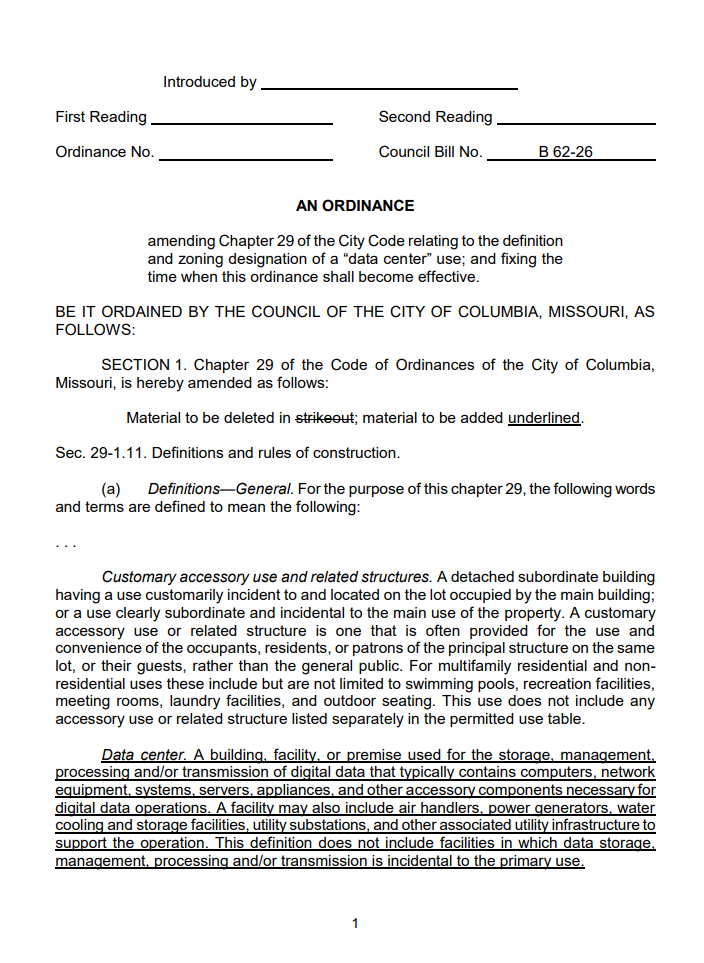
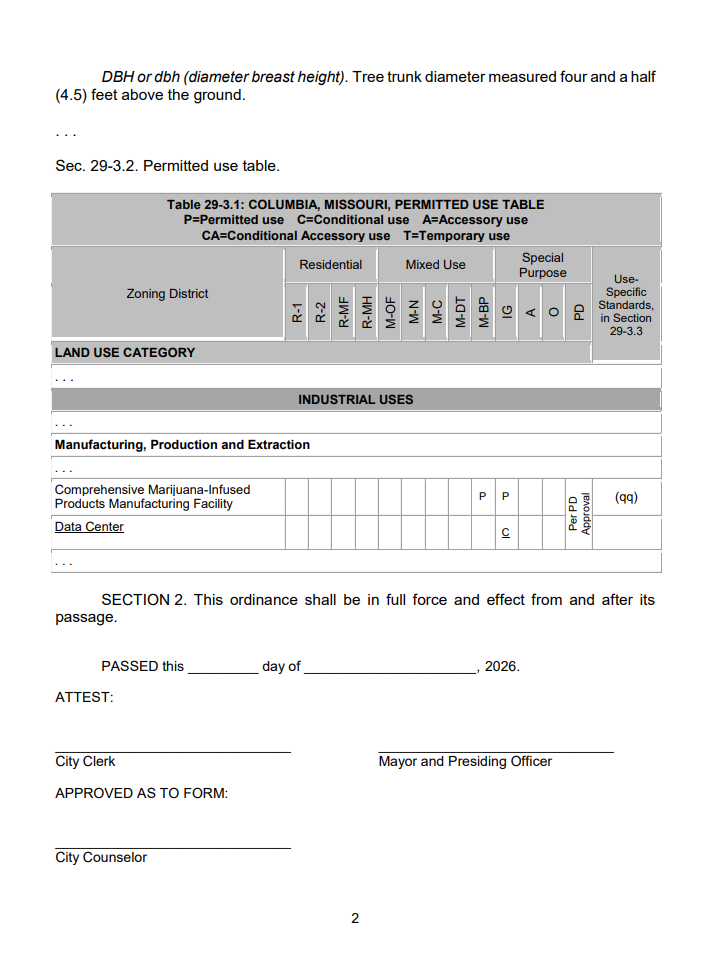
B62-26 Data Center Ordinance
🔎 Industry Trends
Third Way Report: Moratoriums and Ratepayer Pledges Fall Short on Grid Strain
A new policy memo from Third Way argues that moratoriums and voluntary ratepayer pledges are insufficient to address the electricity strain from data center growth. Data centers consumed 2% of U.S. electricity in 2010, doubled to 4%, and analysts expect that share to double again by 2030. The report calls for requiring data centers to pay for grid infrastructure upgrades, including new wires, transformers, and poles, and ensuring behind-the-meter facilities that generate their own power still contribute to the broader grid.
Ohio regulators are already requiring large data centers to bear 85% of estimated power demand costs even if capacity goes unused. Third Way also recommends permitting reform, an all-of-the-above energy strategy, and flexible governance mechanisms that can evolve as the sector matures. Microsoft, OpenAI, and Anthropic have pledged not to pass data center costs to other electricity customers, but the report notes the White House's ratepayer protection pledge is voluntary and lacks enforcement.
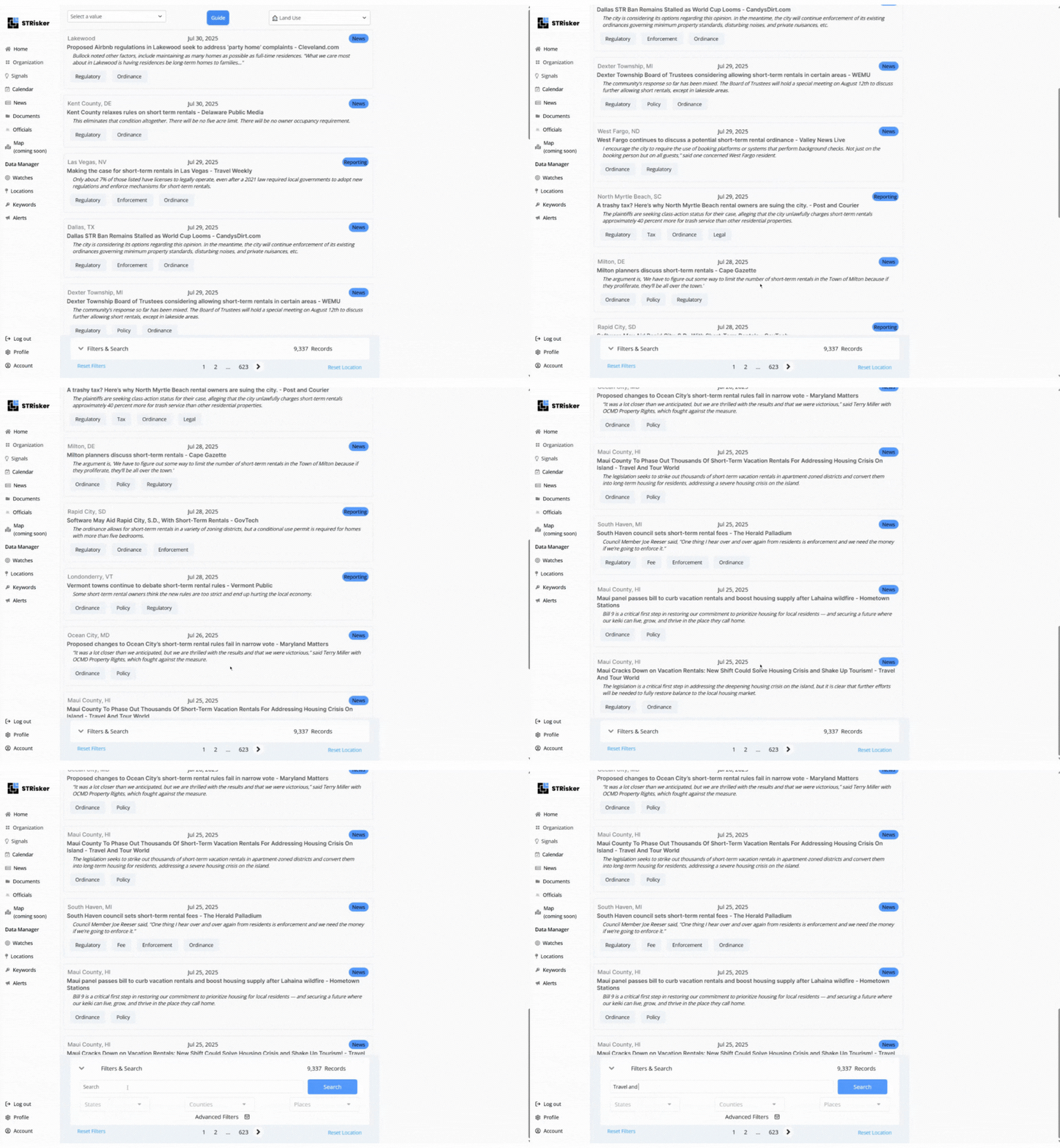
STRisker News Tracker
Trying to keep up with STR regulations across multiple cities and states? Our News Tracker makes it easier than ever. Filter by location, search a comprehensive database, and sort by impact level—this tool helps you focus on what matters most.
Stay Updated with STRisker!
STRisker offers tools and features to keep you updated with the Short Term Rental movement (and now Data Centers!) movement across the world.
👍 We’d love your feedback.
Which stories hit? Which ones missed?
We're exploring a new branch of topics centered around Data Centers and want to make it even more useful for you.
✉️ Just reply directly to this email. We read and respond to every message!
-Will McClure
🙋 P.S.
Know someone else who should be reading Daily Notes? Feel free to forward this along. We’re opening a few more spots.