
Data Centers: Daily Notes | February 12, 2026
New York lawmakers target rate impacts with three-year moratorium; residents in Missouri, Texas, Michigan demand answers on electricity costs; Anthropic pledges to cover price increases.


Key Takeaways (At A Glance)
- Statewide Action: New York - S9144 proposes minimum 3-year moratorium on facilities 20+ MW while PSC studies residential rate impacts
- Local Moratoriums: Canton, North Carolina - 1-year ban citing "present threat" to energy and water resources; Chatham County, North Carolina - 12-month moratorium through Feb 11, 2027.
- Major Decisions: Fort Worth, Texas - $10B Black Mountain project tabled until March 10, water usage concerns; Van Buren Township, Michigan - 280-acre, 1-gigawatt facility approved 5-2 after 5-hour debate.
- Rate Impact Battles: St. Louis, Missouri - Residents oppose zoning rules at 4-hour hearing, cite electricity rate fears; Independence, Missouri - 1,800-member group organizes against 1,200 MW Nebius campus.
- Industry Response: Anthropic pledges to cover 100% of grid costs and electricity price increases from its data centers, third major AI company to commit in 30 days
🔖New York
New York state lawmakers introduced Senate Bill S9144 on February 6, proposing a minimum three-year-and-ninety-day moratorium on new data center permits that what would become one of the most expansive state-level moratoriums in the country. The bill targets proposed data centers capable of consuming 20 megawatts or more.
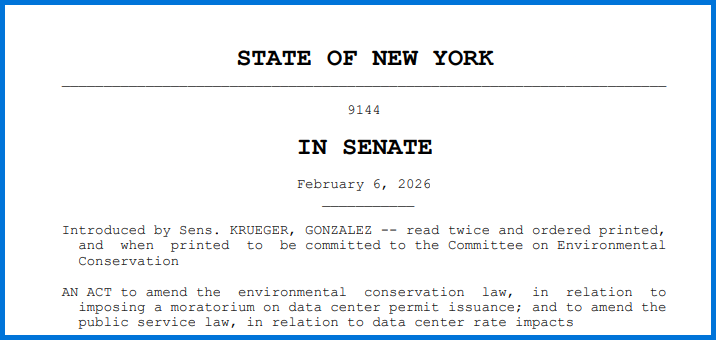
During the moratorium, the Department of Environmental Conservation must issue a generic environmental impact statement addressing energy consumption, grid impacts, water use, land use, pollution, and electronic waste. The Public Service Commission must produce a final report within 18 months on how data centers affect electricity and gas rates for residential, commercial, and industrial customers, then issue orders within three years to minimize rate impacts and ensure data centers bear all associated infrastructure costs.
🔖Fort Worth, Texas
Fort Worth City Council tabled a vote on rezoning 80 acres for Black Mountain's $10 billion data center on February 10, requesting more information before proceeding. CEO Rhett Bennett sought approval to rezone the land (which was split into parcels of 42 and 38 acres) from agricultural to light industrial, but Council member Chris Nettles asked the company to return March 10 with clarifications about whether additional parcels are needed for expanded construction.
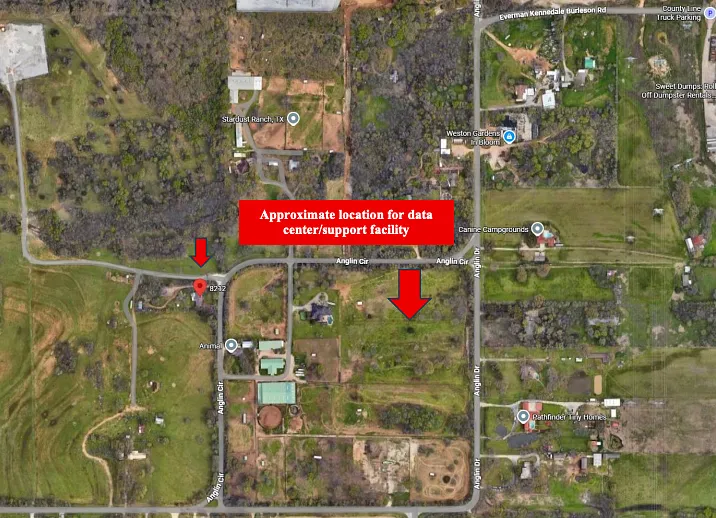
Black Mountain has already obtained and rezoned over 450 acres for the project in southeast Fort Worth. Residents, including nearby business owner Sue Weston whose Weston Gardens sits roughly 100 yards from the site, asked council members in September to reject the zoning change due to concerns about noise pollution, traffic congestion, and water usage. Large data centers can consume as much as 5 million gallons a day, enough water to supply a town between 10,000 and 50,000 people.


More about 🔗 Black Mountain.
🔖Canton, North Carolina
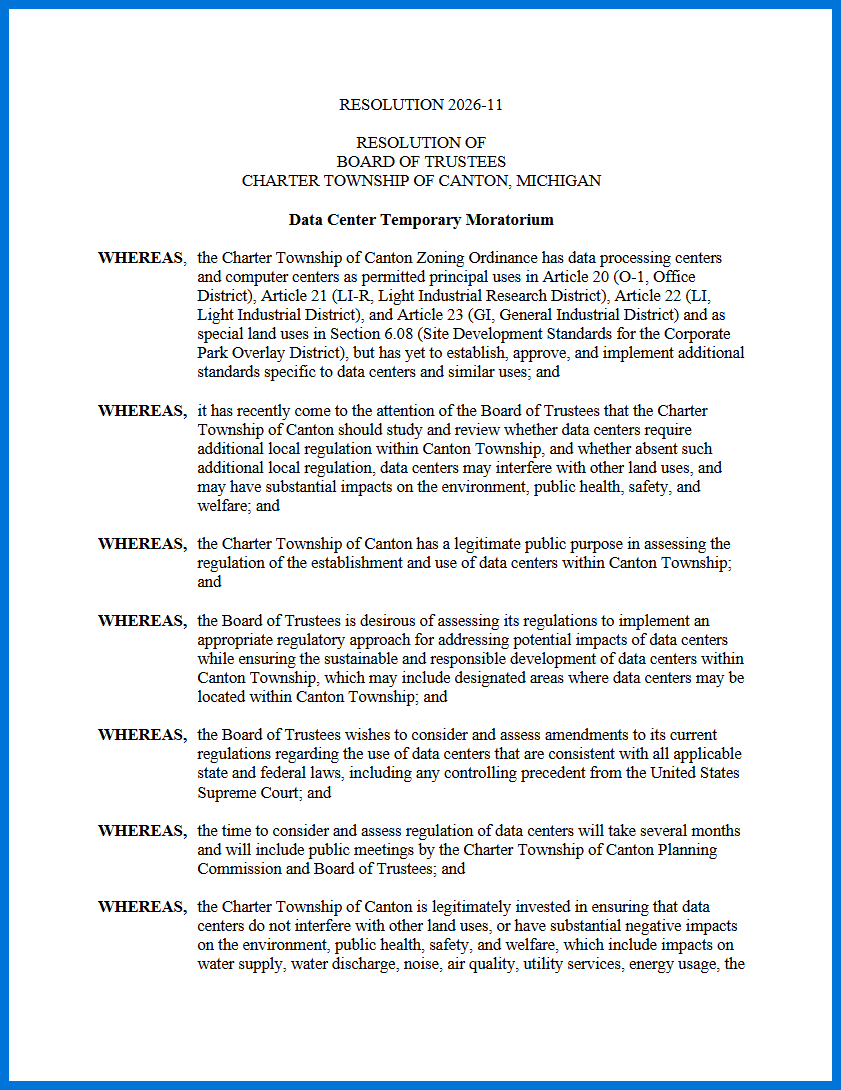
Canton approved a one-year moratorium on data center construction Wednesday night after around 50 people voiced concerns at a specially called meeting. The moratorium blocks new data centers, cryptocurrency mining facilities, and server farms while the town develops protective ordinances.
Mayor Zeb Smathers called data centers and crypto technology...
"a present threat to our community,"
citing resident concerns about draining energy and water resources, creating constant noise, and potentially polluting local waterways.
That said, not everyone opposed the facilities. One resident who works at a Facebook data center defended job creation, noting the parking lot is "pretty full" each morning. The moratorium remains in effect for the next year while Canton develops additional protective ordinances.
🔖Chatham County, North Carolina
Chatham County commissioners approved a moratorium Wednesday that bans construction of data centers and cryptocurrency mining for one year in the county. The moratorium applies to data centers, data processing facilities, cryptocurrency mining operations, and associated uses including web services, hosting, and genome sequencing in unincorporated areas.
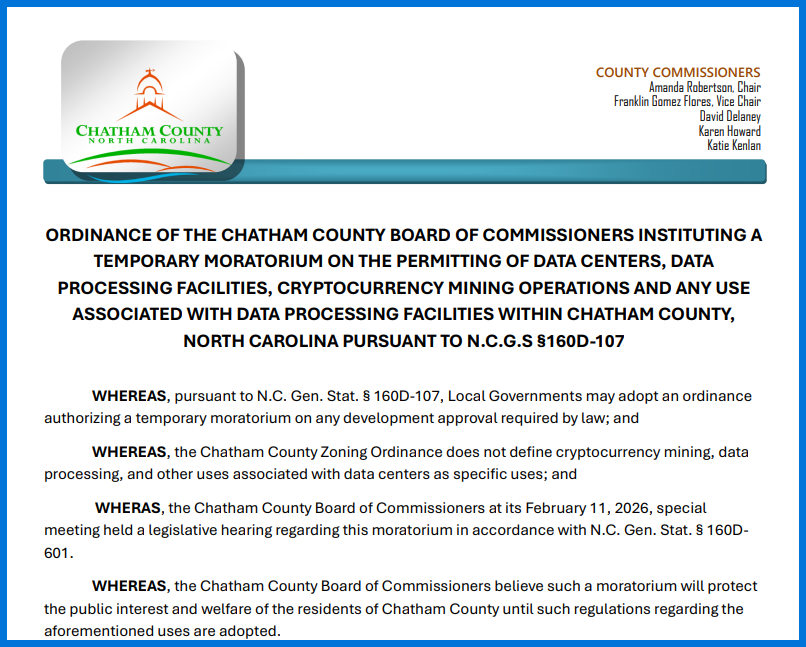
The move gives county leaders time to study environmental impacts and develop regulations to mitigate negative effects associated with data centers and crypto mining. A single 300-megawatt data center can use as much electricity as roughly 200,000 North Carolina homes running nonstop, based on U.S. Energy Information Administration household consumption data. The moratorium is set to expire on February 11, 2027.
🔖Van Buren Township, Michigan
Van Buren Township Planning Commission approved preliminary site plans for a one-gigawatt data center spanning over 280 acres in a 5-2 vote following a five-hour debate. Developer Panattoni is building the facility for an undisclosed Fortune 50 company on land east of Haggerty Road and north of I-94 North Service Drive.


Learn more about the🔗project here.
The development includes three data processing buildings, one administrative office, one network service building, and a seven-acre substation requiring separate approval. The facility will use the Great Lakes Water Authority transmission system rather than the residential distribution system. According to Panattoni's Adam Kramer, the project will become "the largest taxpayer in Van Buren Township and rank among the top five in Wayne County", even with tax abatements.
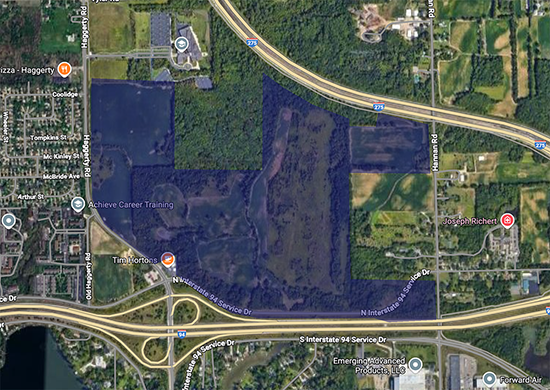
The project must now secure Township Board approval of the development agreement before returning to the Planning Commission for final site plan approval.
🔖St. Louis, Missouri
St. Louis planning officials heard hours of public comment Wednesday night on newly proposed zoning rules for data centers at a packed four-hour hearing. The draft rules would restrict where data centers can be built and set strict regulations for larger facilities, with each project requiring a conditional use permit.

The vast majority of speakers opposed any data center development in the city, expressing concerns over electricity rates and environmental issues. Several called for an outright ban. Ward 7 Alderwoman Alisha Sonnier said there weren't enough votes at the Board of Aldermen to pass a moratorium, noting Friday is the last day for legislative conversations until May.
The proposed framework, developed after Mayor Cara Spencer signed an executive order in September establishing an interim framework, must be reviewed by the Planning Commission before going to the Board of Aldermen for final consideration.
🔖Independence, Missouri
Residents formed the group "Stop the AI Data Center in Independence" and met Tuesday night to organize against Nebius's proposed 2.5-million-square-foot data center on a 398-acre site near Little Blue Parkway. The grassroots Facebook group grew to 1,800 members in just one month. Construction crews are already working on the site.
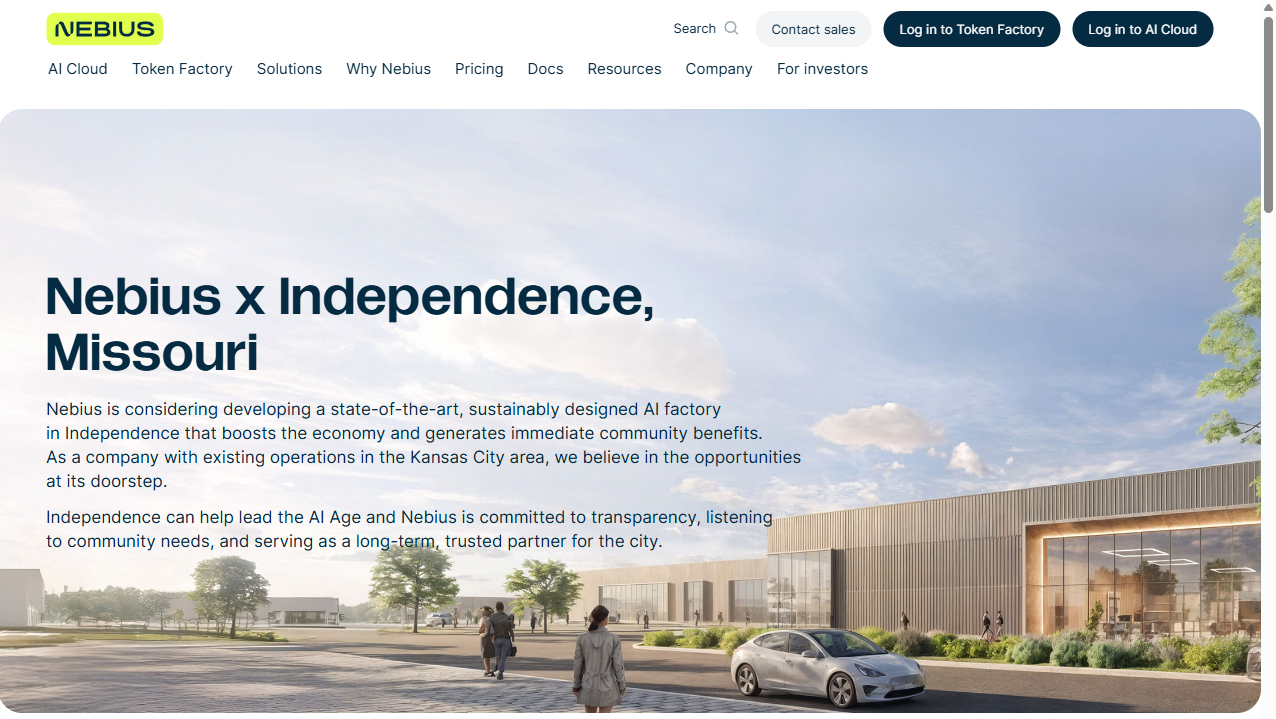
Learn about Nebius's project: 🔗 https://nebius.com/independencemo
The Dutch firm's project is planned to be one of the largest AI data center campuses in the United States, with power demands reaching up to 1,200 megawatts at full buildout. The city council will hold the first reading of Chapter 100 (authorizing tax abatements) on February 16, with a second reading and vote on March 2. The group is encouraging community members to rally at City Hall during the March 2 meeting.
The group also opened a change.org petition which you can find here: https://www.change.org/p/stop-the-ai-datacenter-in-independence-missouri
🎏Anthropic pledges to cover electricity price increases from data centers
On February 11, Anthropic announced it will pay 100% of the grid upgrade costs required to interconnect its data centers and will work to offset demand-driven electricity price effects where new generation is not yet online. It is the third major AI company in 30 days to make a similar pledge.
The announcement follows as the White House is drafting a voluntary compact that would require AI companies to pay the full cost of new power generation tied to their projects, amidst growing political scrutiny of data centers’ impact on consumer electricity prices.
We're committing to cover electricity price increases from our data centers.
— Anthropic (@AnthropicAI) February 11, 2026
To ensure ratepayers aren’t picking up the tab, we'll pay 100% of grid upgrade costs, work to bring new power online, and invest in systems to reduce grid strain.
Read more: https://t.co/avOFlvRNpa
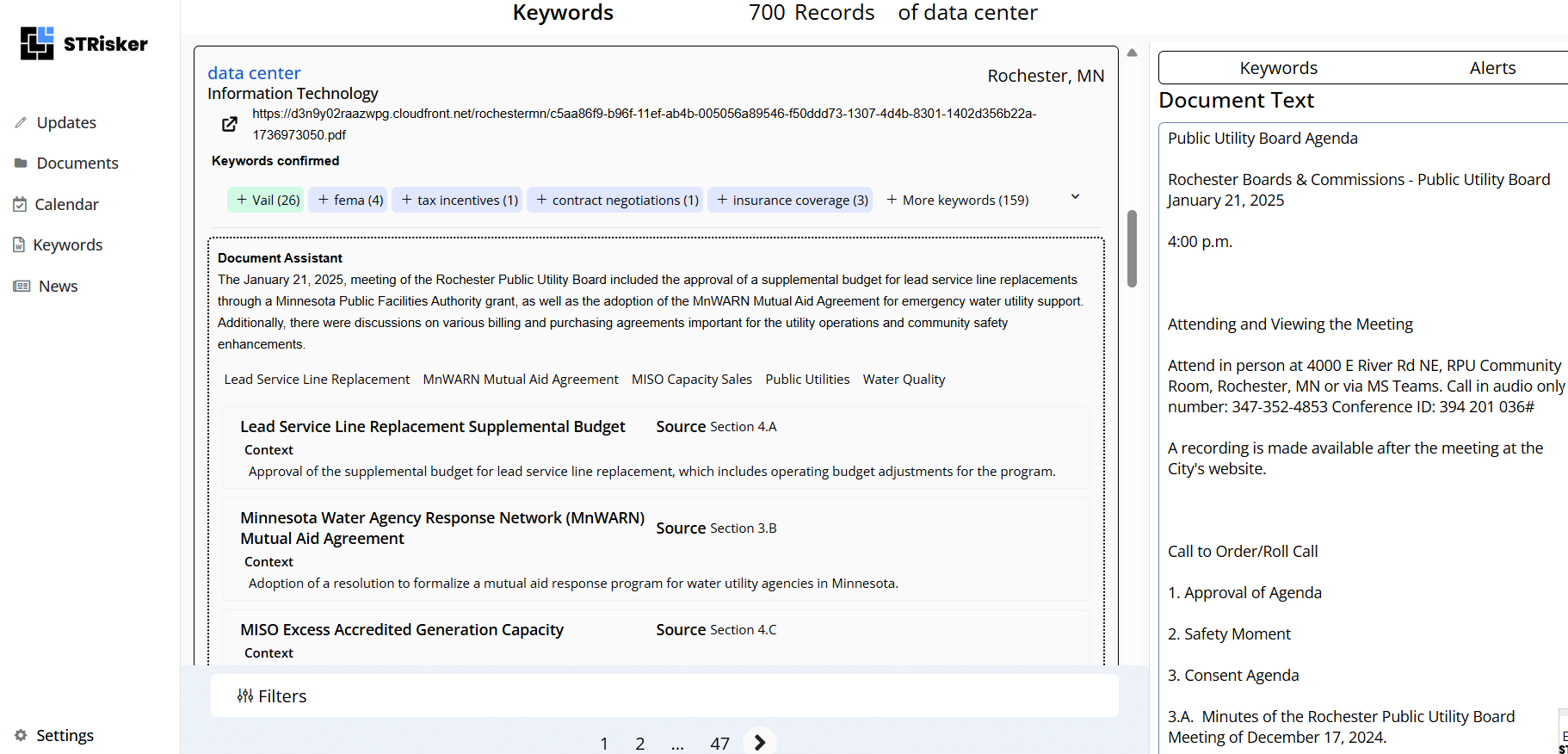
STRisker Keyword Searching
Finding the right keywords shouldn’t feel like digging through endless text—STRisker’s Keywords Searching tool cuts through the clutter for you. It tracks the essential keywords and terms across thousands of documents, highlighting information that matter most to you at a glance.
Stay Updated with STRisker!
STRisker offers tools and features to keep you updated with the Short Term Rental movement (and now Data Centers!) movement across the world.
👍 We’d love your feedback.
Which stories hit? Which ones missed?
We're exploring a new branch of topics centered around Data Centers and want to make it even more useful for you.
✉️ Just reply directly to this email. We read and respond to every message!
-Will McClure
🙋 P.S.
Know someone else who should be reading Daily Notes? Feel free to forward this along. We’re opening a few more spots.