
Data Centers: Daily Notes | October 14, 2026
Pauses and pushback are reshaping data center policy: Oregon’s governor froze pollution permits for new facilities until July, Milwaukee approved a one-year moratorium, Fort Wayne rejected one, and Lowndes County, Alabama approved agreements for Cloverleaf’s Project Red Clay.


At A Glance 🔽
- Oregon Gov. Tina Kotek directed state regulators to pause air and water pollution permits for new or expanding data centers until July, effectively halting most development statewide.
- Denver, Colorado has begun meeting its 26-member data center working group to develop policy recommendations, following the council’s approval of a one-year moratorium.
- Rogersville, Tennessee passed a data center ordinance on first reading by a 4-2 vote, which would limit facilities to the industrial district and set development standards.
- Stephens County, Georgia commissioners unanimously extended the moratorium on data center land use applications until Jan. 14, 2027, its second extension.
- Fort Wayne, Indiana City Council defeated both a proposed one-year data center moratorium and a resolution creating a task force, ending a push over Google’s southeast campus.
- Milwaukee, Wisconsin Common Council approved a one-year moratorium on new data centers and on enlarging existing ones.
- Hubbard Township, Ohio trustees heard from a packed room on proposed data center rules, taking no vote on a zoning commission recommendation to add more restrictions.
- Lowndes County, Alabama commissioners approved development and tax agreements with Cloverleaf Infrastructure for Project Red Clay, a proposed data center, over months of public opposition.
- Johnson County, Iowa supervisors will vote next week on a nine-month extension of the data center moratorium, which would carry the pause into 2027.
Oregon
Oregon Gov. Tina Kotek directed the Department of Environmental Quality to pause all air and water pollution permits for new or expanding data centers until July, a move that would effectively halt most data center development in the state.
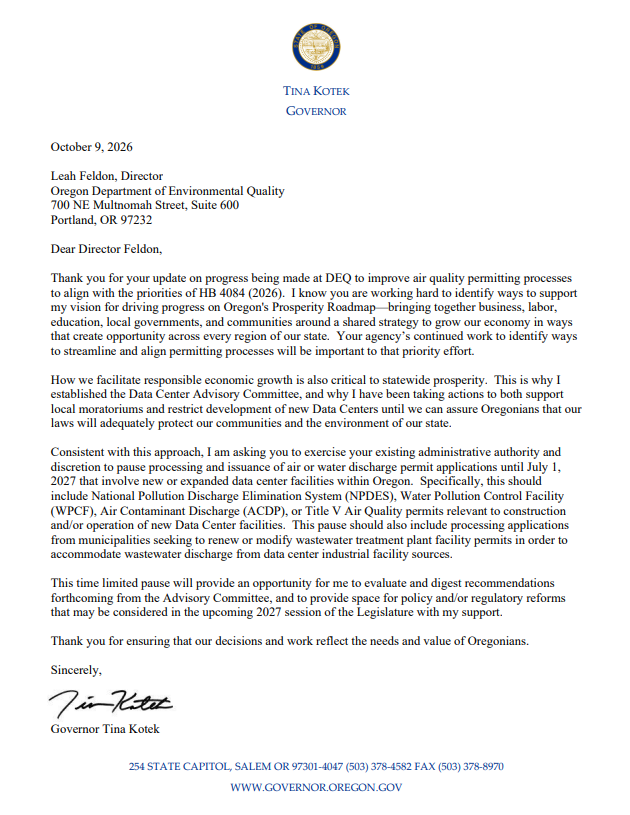
Kotek sent the directive in a Friday letter to DEQ Director Leah Feldon, responding to the agency’s update on its air permitting process. She also told DEQ to stop processing applications from cities and counties seeking to renew or modify wastewater permits to accommodate data centers. The pause expands an earlier moratorium on data center development on state-owned land, and without air or water permits most large hyperscale facilities could not build on public or private land. Kotek wrote that the pause gives her time to evaluate recommendations from her Data Center Advisory Committee and leaves room for policy or regulatory reforms in the 2027 legislative session, which she said she would support.
Amazon Web Services’ Shannon Kellogg said the directive was issued abruptly and without meaningful stakeholder engagement, and an Amazon executive said it could cost the state thousands of jobs and billions in planned investment. Oregon Rural Action’s Kaleb Lay said the pause should give lawmakers time to act, but that new laws are needed to protect the state, including on water, electricity use, transparency and nondisclosure agreements. The Legislature convenes in January.
Denver, Colorado
Denver’s data center working group has begun meeting to develop policy recommendations for the city, following the City Council’s approval of a one-year moratorium on data center construction.
 Chierstin Roth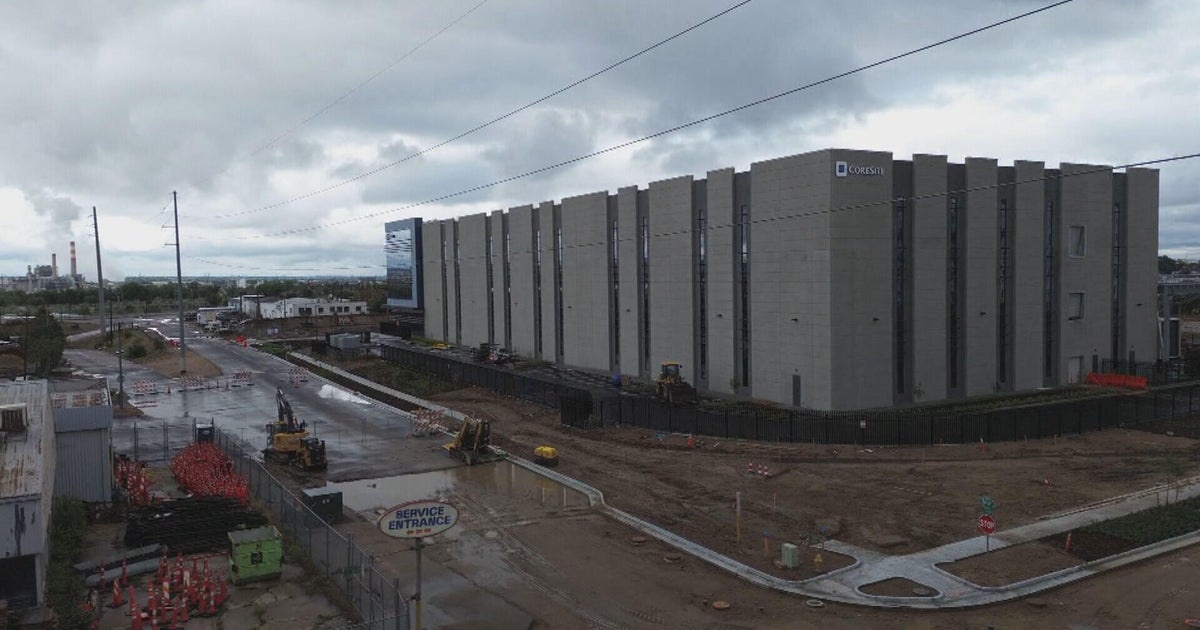
The 26 members were chosen from more than 250 applicants and include community members and experts from a range of industries. Mark Orrs, an associate professor at Colorado School of Mines who teaches responsible engineering, said the group has a chance to set rules the city has never had and to protect Denver’s resources. He said one core question is whether data centers can be sustainable, noting new technologies may help but that development to date has been largely unsustainable. The group first met last week, and Orrs said the meeting exceeded his expectations. The next meeting is Oct. 29.
Rogersville, Tennessee
Rogersville’s Board of Mayor and Aldermen passed a data center ordinance on first reading Tuesday night, with final action expected in November, that would allow data centers only in the town’s industrial district and set development standards.
 SARAH MONOSON smonoson@sixriversmedia.com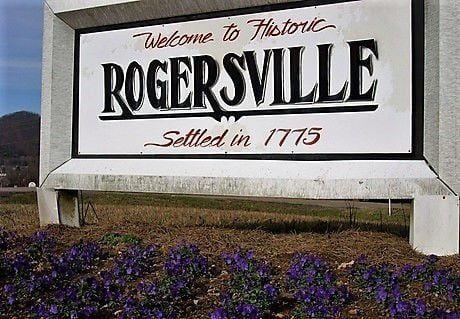
The vote was 4-2, with Aldermen Danny Brooks, Charlie Gibson, Andrew Poe and Brock Gladson in favor and Alderman Todd Biggs and Vice Mayor Brady Forgety opposed. Today, with no legislation in place, data centers are allowed in town without restriction. Mayor John Metz said the ordinance was six months in the making with the charter and ordinance committee, planning commission and Town Attorney Kevin Keeton, and that it can be amended as technology changes.
Biggs raised concerns about resource demands, especially water. Forgety, who said he personally favors a ban, suggested a moratorium to gather more information. Metz said prohibition has historically been ineffective, that extensive regulation creates its own kind of ban, and that a moratorium would only buy time for work already done.
Stephens County, Georgia
Stephens County’s Board of Commissioners unanimously voted Tuesday, Oct. 13, to extend its moratorium on accepting land use applications for data centers until Jan. 14, 2027.
County Administrator Christian Hamilton said the board is still working on text amendments to the land use ordinance and wants more time to hear from residents and community partners so a strong ordinance is in place before regulation begins. The county has not received any data center applications.
The board first set the moratorium April 14, running through July 14, then extended it to Oct. 14, and has now extended it a second time.
Fort Wayne, Indiana
Fort Wayne City Council on Tuesday defeated both a proposed one-year data center moratorium and a resolution creating a data center task force, ending a push by Councilwoman Rohli Booker that followed more than a year of controversy over Google’s southeast Fort Wayne campus.
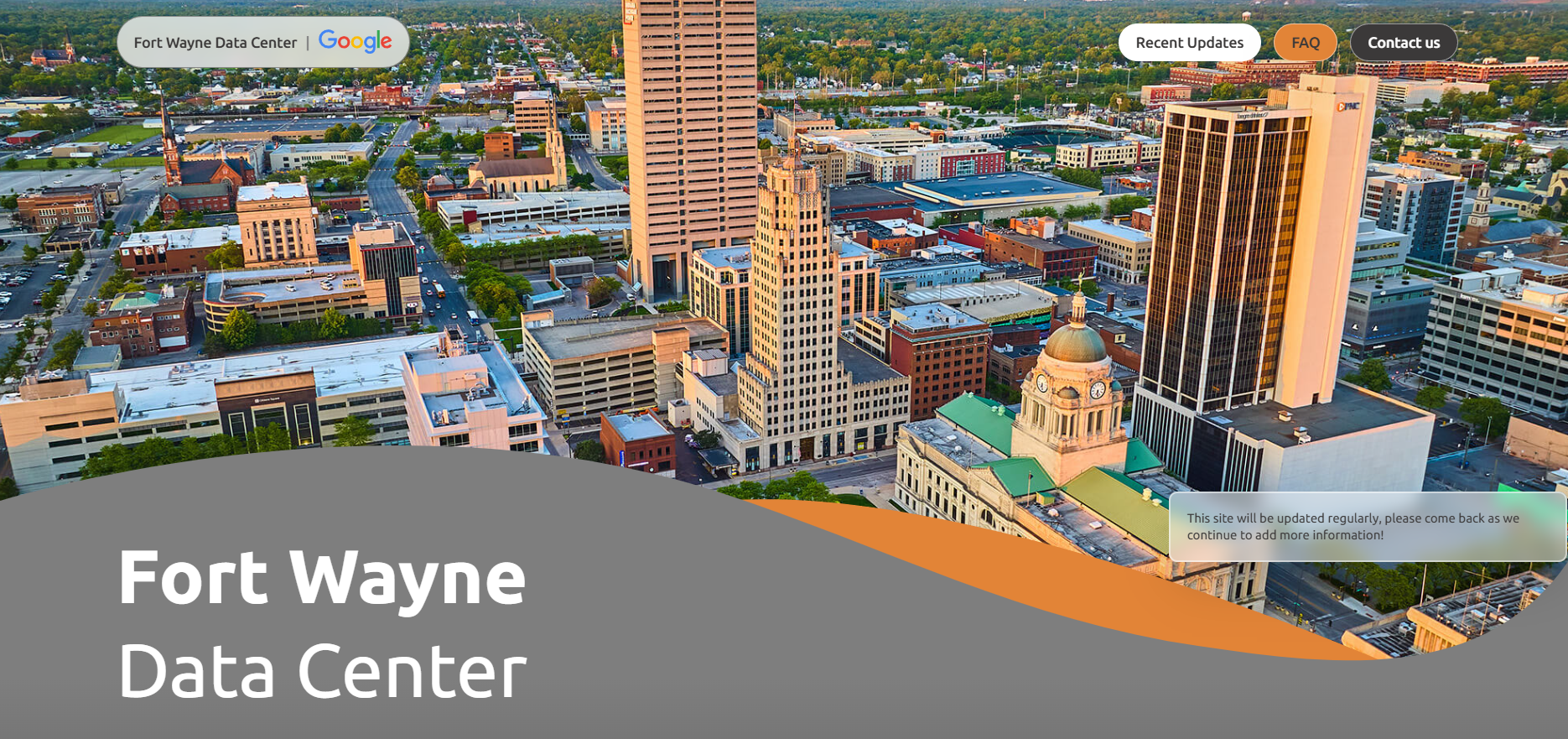

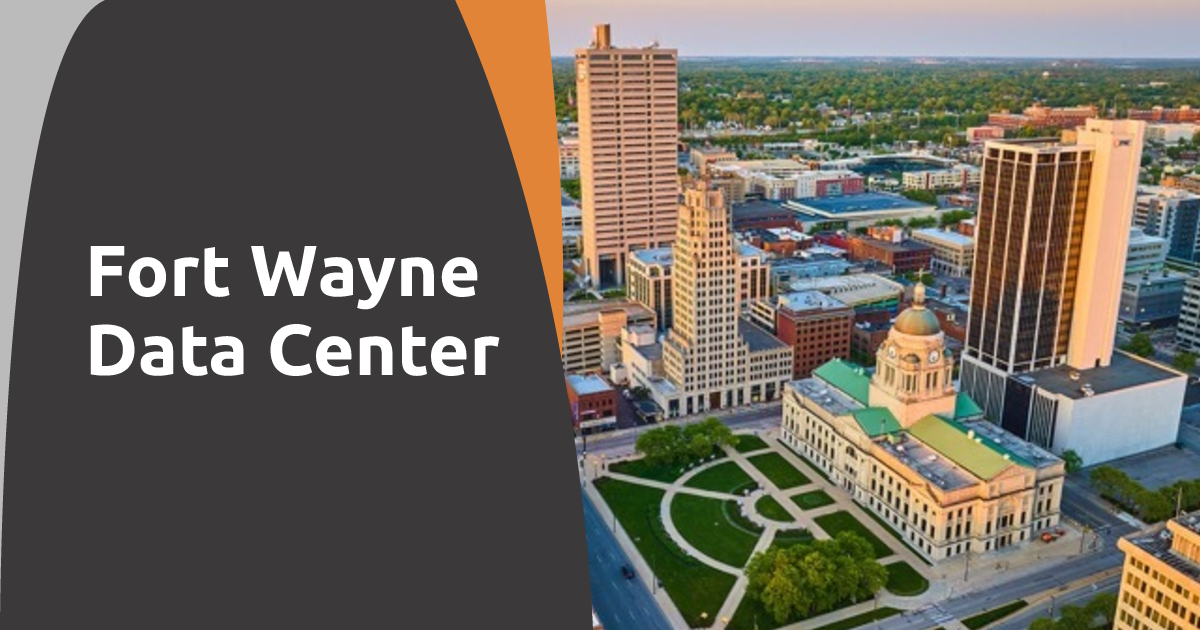
The moratorium failed 4-4, with Councilmen Nathan Hartman, Marty Bender, Paul Ensley and Scott Myers opposed and Councilman Tom Freistroffer absent. Ensley tried to table it so it wouldn’t die, but no one else supported the motion. The task force resolution failed 5-3, with Councilwoman Michelle Chambers joining those four in opposition after voting for it Sept. 22. The moratorium would have paused council approvals such as rezoning, annexations and tax abatements for large data centers, without affecting Google’s operating campus, and the nine-member commission would have studied large projects and reported to council.
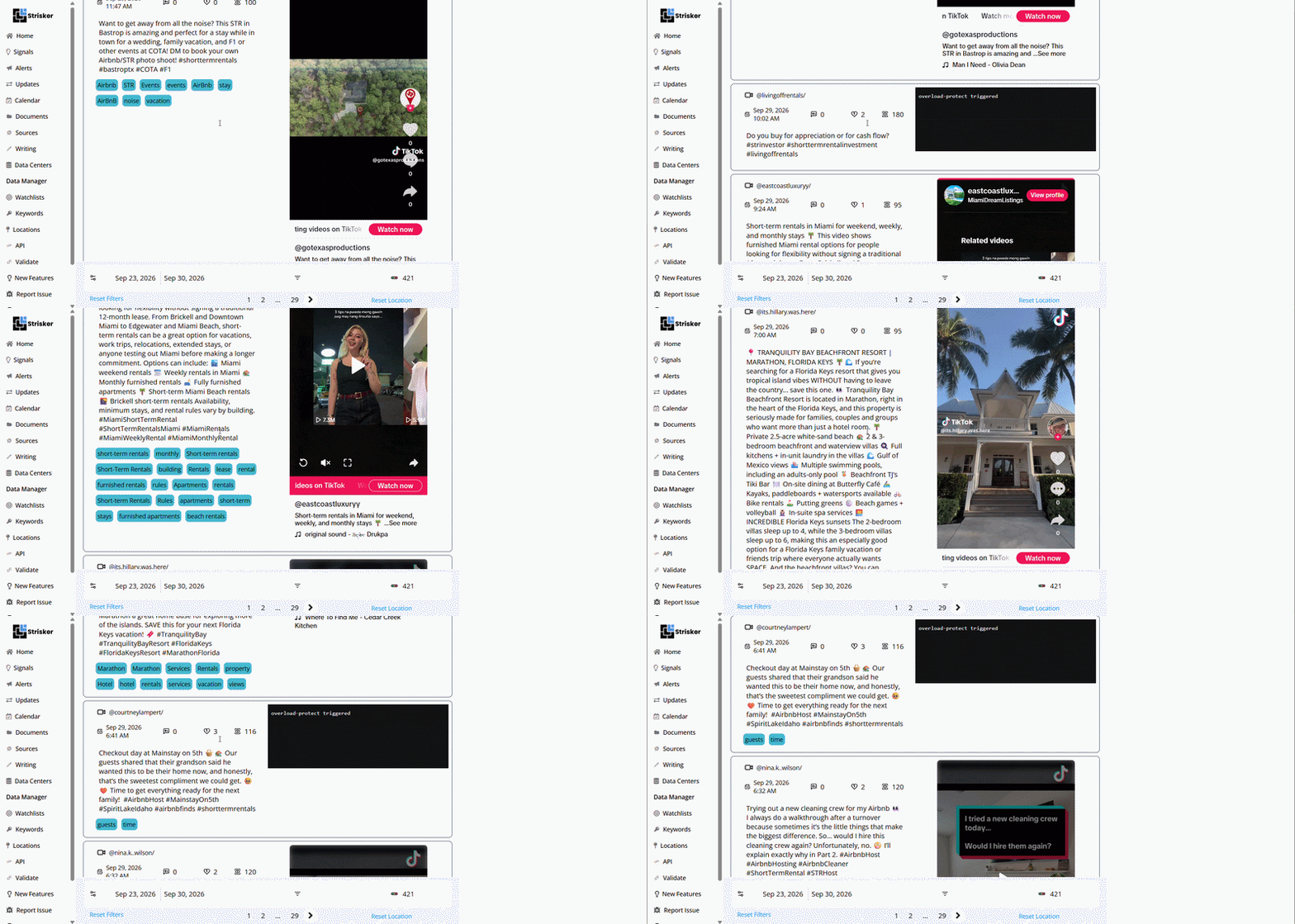
Social Listening📱: Tiktok
Regulatory discussions aren't limited to council chambers; they're also trending on TikTok. Strisker's TikTok Signal monitors short-form videos from residents, hosts, advocates, and officials, allowing you to gauge public sentiment on short-term rentals (STRs) and data centers before these topics appear on the agenda.
Milwaukee, Wisconsin
Milwaukee’s Common Council approved a one-year moratorium on new data centers and on enlarging existing ones at its Oct. 13 meeting, passing it unanimously among members present. Council members Robert Bauman and JoCasta Zamarripa were excused.
Chief sponsor Ald. Marina Dimitrijevic said the pause gives the city time to set regulations and argued that the industry is a bubble driven by corporate interests that will soon bust. The moratorium ends early if the council adopts new rules within 12 months. Regulations under consideration would ban data centers over 60,000 square feet, allow those under 20,000 square feet in industrial-heavy zones, and require Board of Zoning Appeals approval for facilities between 20,000 and 60,000 square feet.
Planning director Tanya Fonseca said Milwaukee lacks the space to attract hyperscale AI data centers like those in Mount Pleasant and Port Washington, though it has hosted smaller ones for years, including a 45,000-square-foot Forest County Potawatomi facility that opened in 2013. A proposed 19,000-square-foot data center at the former Walmart in Midtown Center was dropped after public backlash. Labor unions and business groups back data center development, and the Metropolitan Milwaukee Association of Commerce’s Andrew Davis said a pause would shut the city out of investment while other communities compete.
Hubbard Township, Ohio
Hubbard Township trustees heard from a packed room Tuesday night on a proposed nine-page resolution setting rules for data center developers, taking no vote on a Trumbull County Zoning Commission recommendation to add more restrictions.
Trustee Monica Baker unsealed and read the recommendation, which would expressly prohibit data centers in all residential R1, R2 and R3, agricultural A1, conservation and flood plain zoning districts. Residents opposed data centers outright, raising concerns about water pollution, including PFAS, and long-term health effects, and urged trustees to push the zoning commission to keep them out of the township. A zoning commission member said much of the proposed resolution addresses those concerns.
The township’s website should post the resolution in a few days. A hearing is set for Oct. 27 to discuss the matter further and unseal the Planning Commission’s response and suggestions on the resolution the Zoning Commission originally offered.
Lowndes County, Alabama
Lowndes County commissioners voted Tuesday morning to approve development and tax agreements with Cloverleaf Infrastructure for Project Red Clay, a proposed data center in Burkeville, over months of public opposition.
Lowndes County Commission approves deal for proposed data center
Cloverleaf CEO David Berry said the company projects about $124 million per year in taxes for local and state government, roughly $70 million a year of it for Lowndes County schools, along with 225 permanent jobs. Berry said the agreement locks in how the project will be built and what economic benefits the county and state receive, and lets elected officials set guidelines on the facility’s appearance, sound and construction. Cloverleaf says the agreement places strict limits on sound and water use.
The project’s website promises to minimize water use and environmental disruption, cover its own power costs so residents’ bills do not rise, and invest up to $10 million in profits in local needs. Construction could begin as early as the first quarter of 2027, with more stakeholder meetings and a public input process ahead.
Johnson County, Iowa
Johnson County’s Board of Supervisors will vote next week on a nine-month extension of its data center moratorium, which expires Nov. 8, a move that would carry the pause into 2027.
No supervisors have expressed support for building a data center in the county. The board held a combined session in July with the Planning and Zoning Commission to discuss requirements that would apply when a data center application surfaces. The issue has become a hot topic ahead of the November election, as protests and opposition spread in many parts of the country.
Neighboring Linn County began an 18-month moratorium July 1, while a QTS data center covering more than 600 acres, with projected investment of $10 billion, is under construction in Cedar Rapids, about six miles north of Johnson County.
📱 Social Buzz
Forest Grove City Council approves 120-day data center moratorium pic.twitter.com/U4mcJnRQ89
— Your Oregon News (@YourOregonNews) October 14, 2026
Today one of the men charged in a May deadly armed robbery that killed a McClellanville man will be appearing in court. Mount Pleasant has put a pause on data center development in the city. This week is earthquake preparedness week and tomorrow the "Great Southeast Shakeout"… pic.twitter.com/KYwpoF0E2k
— ABC News 4 (@ABCNews4) October 14, 2026
Leon County commissioners approve data center moratorium Read more at our link in bio. pic.twitter.com/MJx197MzcC
— ABC 27 (@abc27) October 14, 2026
Perry Proposes Statewide Data Center Moratorium Bill dlvr.it/TVvxz1 pic.twitter.com/F9ZlNtkBrO
— Potomac Local News (@PotomacLocal) October 14, 2026
Microsoft updates its Mount Pleasant data center project to seven buildings totaling nearly 5.9 million square feet, increasing overall size despite fewer buildings. https://t.co/OgFWgScheT
— DailyReporter (@DailyReporter) October 14, 2026
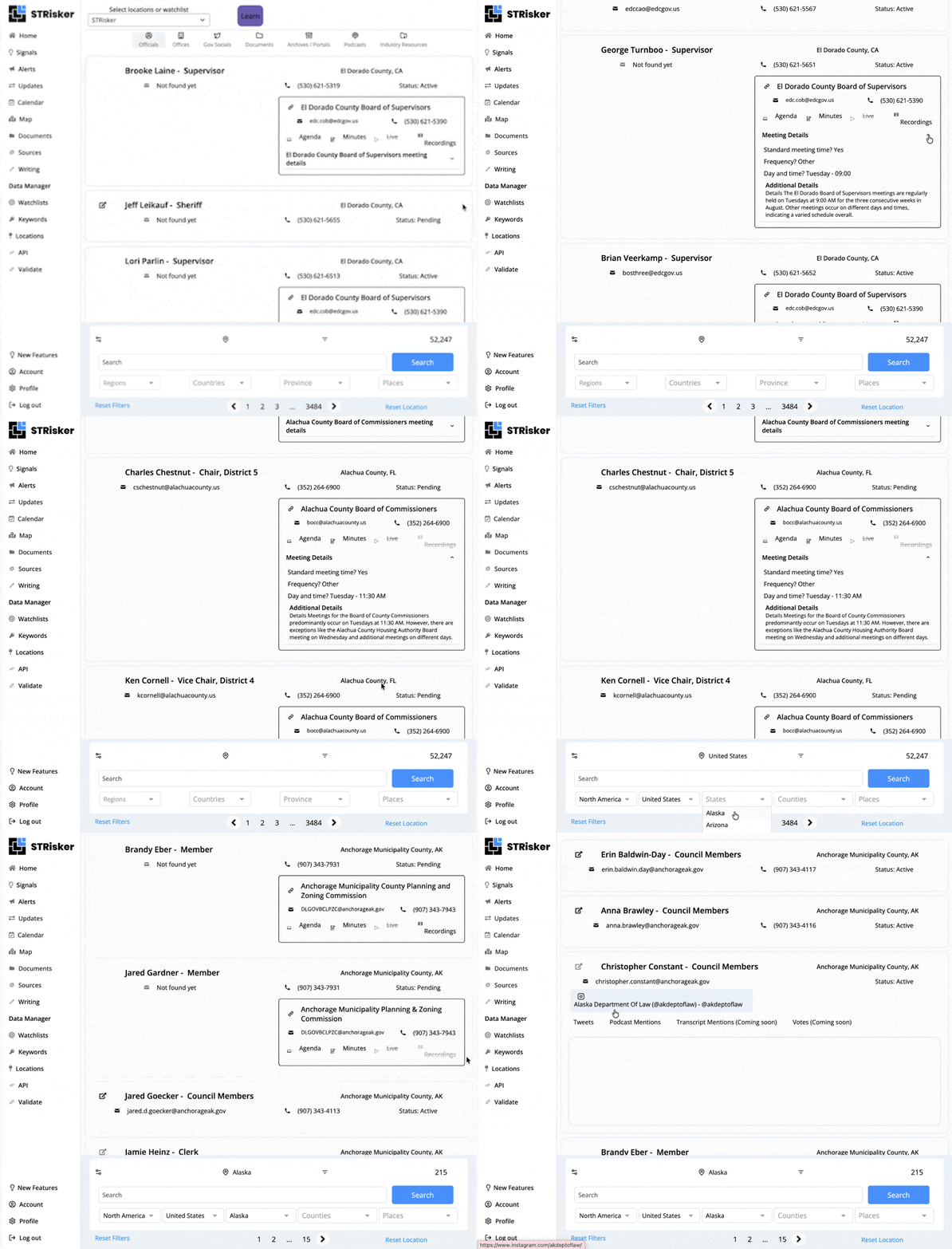
Strisker Government Officials Dashboard
Trying to keep up with the main players in the STR and Data Center game? Know your council members, commissioners, committee chairs, and key staff that are part of the process.
Stay Updated with Strisker!
Strisker offers tools and features to keep you updated with the Short Term Rental and Data Centers movement across the world.
👍 We’d love your feedback.
Which stories hit? Which ones missed?
We're exploring a new branch of topics centered around Data Centers and want to make it even more useful for you.
✉️ Just reply directly to this email. We read and respond to every message!
-Will McClure
🙋 P.S.
Know someone else who should be reading Daily Notes? Feel free to forward this along. We’re opening a few more spots.