
Data Centers: Weekly Briefing // April 20-24, 2026
Monterey Park becomes the first California city to permanently ban data centers. Arkansas kills all six data center regulation resolutions. A federal inquiry asks whether data centers are raising Georgia power bills. Colorado rewrites its incentive bill. READ MORE.


At A Glance 🔽
- Permanent bans are spreading. Monterey Park became the first California city to permanently ban data centers. Marshall County, IN enacted what may be the first permanent ban in Indiana.
- Moratoriums kept accelerating. Oklahoma City, Plainfield (IL), Orange County (NC), Rowan County (NC), and Ypsilanti (MI) all passed new moratoriums this week, ranging from 180 days to one year.
- State legislatures went in opposite directions. Oklahoma and Colorado advanced bills with ratepayer protections and mandatory tariffs. Arkansas killed all six of its regulation resolutions. North Carolina and Virginia are rethinking tax exemptions worth hundreds of millions annually.
- Federal action expanded. Sen. Ossoff opened a FERC inquiry into whether data centers are driving up electricity costs in Georgia.
- Michigan stayed hot. AG Nessel appealed state approval of DTE contracts for a 1.4-gigawatt Oracle data center. Ypsilanti's utility authority blocked water and sewer service to a $1.2 billion supercomputing facility.
- Subsidies drew scrutiny. Rockland County, NY approved a $77 million tax break for a data center expansion that will create one permanent job.
📋 This Week's Decisions
State Legislation
- Oklahoma: The Senate Energy Committee unanimously advanced 📜HB 2992, requiring the Corporation Commission to create separate terms, conditions, and tariffs for data center companies. The measure applies to all electricity providers, including cooperatives and municipal utilities. The bill is now eligible for a Senate floor vote.
- Colorado: The rewritten data center incentive bill (HB 1030) headed to its first committee hearing after three months on ice. The 50-page rewrite keeps a 100% state sales-tax exemption on construction materials for 30 years but adds a mandatory tariff for facilities over 50 MW, requiring them to cover all costs of new energy generation, transmission, and distribution. The bill also requires 75% renewable energy through 2039 (100% by 2040), water transparency reports, and prevailing wage requirements.
- Arkansas: All six of Sen. Bryan King's data center regulation resolutions failed in the Senate. The resolutions would have given local communities the power to decide whether data centers are built in their area and addressed environmental impacts. Two were approved to be filed as non-appropriation bills, but none advanced as regulations.
- North Carolina: Lawmakers returned to session with data center sales tax exemptions expected to be a bipartisan target. The state Department of Commerce estimates data centers currently receive about $50 million per year, with a full repeal potentially yielding up to $450 million annually.
Moratoriums Approved
- Oklahoma City, OK: City Council unanimously passed an emergency moratorium blocking new data center zoning and development applications through December 31, 2026. The ordinance exempts two data centers with pending rezoning. The moratorium was first discussed at an October 2025 special planning session.
- Plainfield, IL: Village trustees unanimously approved a 180-day moratorium while the village drafts a new Unified Development Ordinance. The moratorium can be extended if the update is not completed within the initial period.
- Orange County, NC: The Board of Commissioners approved a one-year moratorium on data centers, including AI facilities, cryptocurrency mining operations, and data processing centers. Staff were directed to prepare amendments to the Unified Development Ordinance.
- Rowan County, NC: Commissioners passed a one-year moratorium after over 100 residents rallied outside the meeting. The moratorium does not apply to a proposed Long Ferry Road development due to state law limiting moratoriums on active projects. The commission must vote again on May 4 because one commissioner left before the vote.
- Ypsilanti, MI (YCUA): The Ypsilanti Community Utilities Authority approved a 12-month moratorium on water and sewer services for data centers, blocking service to a planned $1.2 billion University of Michigan and Los Alamos National Laboratory supercomputing facility. The project would use an estimated 500,000 gallons of water per day.
Bans
- Monterey Park, CA: The city became the first in California to permanently ban data center construction, passing three ordinances that label data centers a public nuisance. The ban follows a successful campaign to block a 250,000-square-foot facility proposed by HMC StratCap. A June 2 ballot measure would enshrine the ban so it can only be overturned by public vote.
- Marshall County, IN: Commissioners permanently banned data centers and imposed strict new regulations on large-scale solar and battery storage, in what officials said may be the first permanent ban of its kind in Indiana. The ban replaces a one-year moratorium previously in place.
Regulations Passed
- West Rockhill Township, PA: Supervisors unanimously approved a zoning ordinance limiting data centers to the Planned Industrial zoning district and requiring special permission from the zoning hearing board. Standards include a 25-acre minimum lot size, 35-foot height limit, 150-foot parking setback from residential lots, on-site solar power generation, and underground utility lines. Amendments based on public feedback are directed for May 20.
- Centralia, MO: The Board of Aldermen unanimously passed an ordinance defining and establishing rules for data centers preemptively, though no developer has proposed a project. The rules require a conditional use permit and permanent buildings.
Projects Approved
- Rockland County, NY: The Industrial Development Agency approved a $77 million tax break for a JPMorganChase data center expansion in Orangeburg that will create one permanent job. The tax break covers sales taxes on materials and equipment for the billion-dollar project, with roughly $40 million withheld from the state and the rest from local governments.
💬 Catch Up on Discussions

- Georgia: Sen. Jon Ossoff opened a Federal Energy Regulatory Commission inquiry asking whether AI data centers are contributing to rising electricity costs. Georgia has received more than $4.5 billion in AI investments since 2019. In December 2025, the Georgia Public Service Commission approved a plan allowing Georgia Power to generate 9,885 megawatts of new energy to serve data centers.
- Pittsylvania County, VA: A $73 billion Stack Americas data center investment projected to create 2,050 jobs is in jeopardy as Virginia Democrats debate phasing out the state's data center tax exemption. Secretary of Finance Mark Sickles told the Senate Finance Committee the project would not proceed if the exemption ends. The exemption costs the state an estimated $1.9 billion annually.
- Nassau County, FL: Commissioners directed staff to draft a 12-month moratorium on data center development. An initial discussion is set for April 27, followed by public hearings on May 11 and June 8.
- Nobles County, MN: Commissioners were expected to vote on a zoning amendment that would allow data centers in agricultural preservation districts, which cover 70 to 80 percent of the county. The planning commission previously voted down the measure after roughly 300 residents attended the April 8 meeting. Approval would clear the way for Geronimo Power's $4 billion data center on about 950 acres of farmland.
- Reno, NV: City Council voted unanimously to move forward with new data center regulations. Staff are expected to bring a moratorium vote to a future special meeting. Over 40 data centers have been approved across the northern Nevada region.
- Michigan: Attorney General Nessel filed a challenge with the Court of Appeals aimed at invalidating state regulators' approval of contracts allowing DTE Energy to supply power to a 1.4-gigawatt Oracle data center in Saline Township. Nessel argued the commission was required to hold a contested case hearing.
- Horry County, SC: Officials are drafting data center regulations proactively before proposals arrive. Facilities up to 200,000 square feet would be allowed in districts zoned for general manufacturing and heavy industry.
- Fort Meade, FL: Florida Commerce Secretary Alex Kelly called a proposed 4.4 million-square-foot data center "fundamentally flawed," citing risks to energy, water, and transportation infrastructure. The Southwest Florida Water Management District noted that projected water demand had not been included in the permit application.
- Jackson, MS: The City Council is considering a temporary moratorium on data center development while it establishes a regulatory framework. A vote date has not been set.
- Indianapolis, IN: Decatur Township residents filed a lawsuit to overturn the city's approval of Sabey's multi-billion-dollar data center, arguing the process violated due process rights. The city approved the project through a variance rather than a full rezoning.
- Port Washington, WI: Nearly 550 people commented on Wisconsin DNR air permits for 45 backup diesel generators at Vantage's $15 billion data center housing OpenAI and Oracle operations. An independent analysis found the generators could exceed federal air quality standards within a 10-mile radius during full emergency use.
📅 Watch out for

- Nassau County, FL: Initial moratorium discussion, April 27.
- Rowan County, NC: Second moratorium vote, May 4.
- Marshall County, IN: Final vote on solar farm regulations, May 4.
- Nassau County, FL: Public hearings on moratorium, May 11 and June 8.
- West Rockhill Township, PA: Zoning ordinance amendments, May 20.
- Monterey Park, CA: Ballot measure to enshrine data center ban, June 2.
📱 Social Finds
🚀 DeepSeek-V4 Preview is officially live & open-sourced! Welcome to the era of cost-effective 1M context length.
— DeepSeek (@deepseek_ai) April 24, 2026
🔹 DeepSeek-V4-Pro: 1.6T total / 49B active params. Performance rivaling the world's top closed-source models.
🔹 DeepSeek-V4-Flash: 284B total / 13B active params.… pic.twitter.com/n1AgwMIymu
DeepSeek has dropped an open-sourced V4, releasing two models that both default to 1 million tokens of context: V4-Pro (1.6 trillion parameters) and V4-Flash (284 billion). DeepSeek says Pro rivals the top closed-source models, and the weights are fully public. What makes this notable is "sparse activation", which means that instead of running the entire model on every query, V4-Pro only fires 49 billion of its 1.6 trillion parameters at a time, and Flash fires just 13 billion of 284 billion.
For data centers, that could change a lot. Open-source models at this performance and cost are new territory, and sparse activation dramatically cuts the compute needed per request. If the approach holds at scale, it raises a real question about how much total data center capacity AI actually requires. Right now, every infrastructure plan assumes demand only goes up. Models like V4 suggest efficiency gains could absorb some of that growth. Too early to say how much, but worth keeping an eye on. 👀
In case you missed it...
This week in the Data Center space.
 Dane Artisola
 Dane ArtisolaDane ArtisolaDane Artisola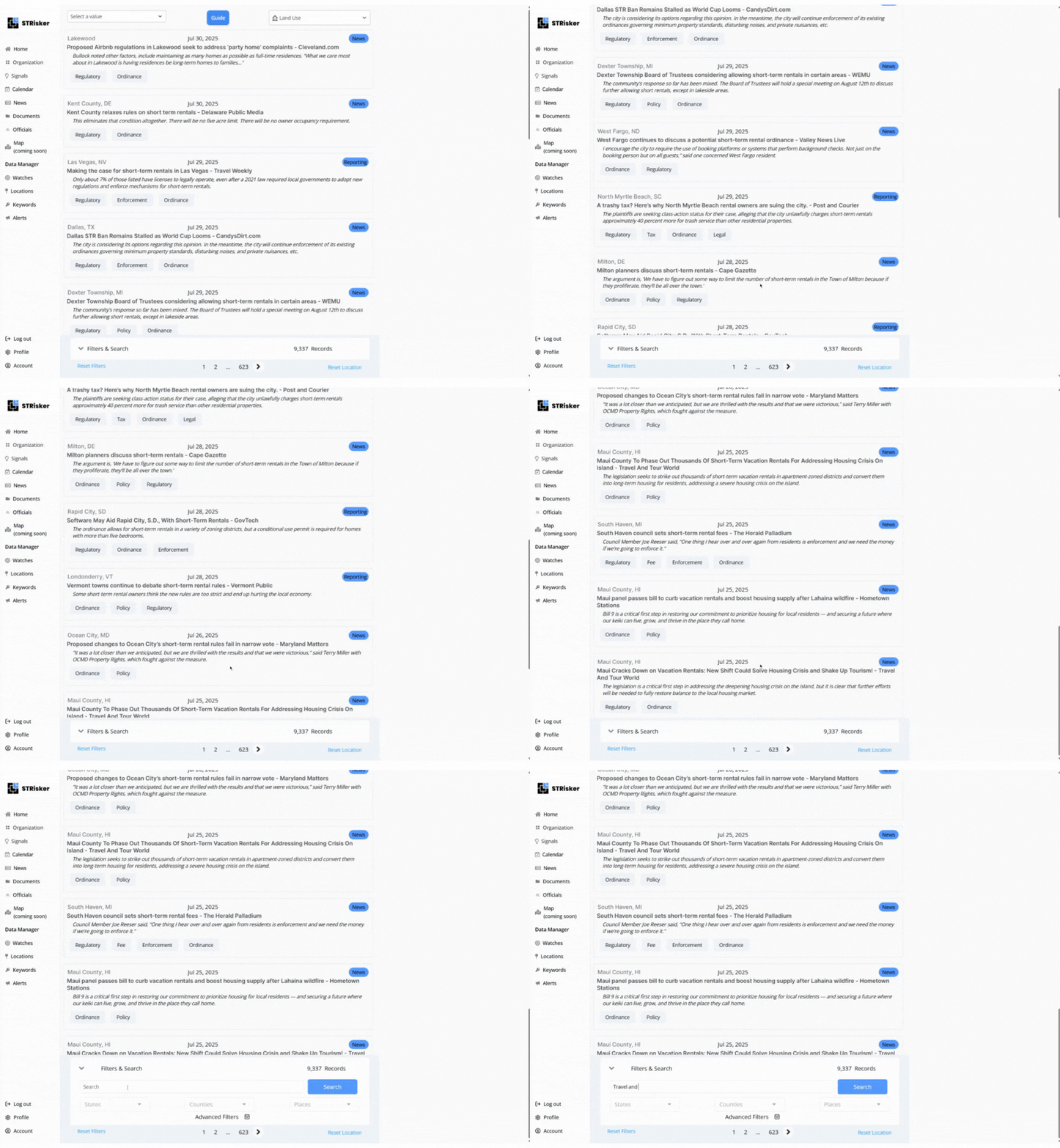
STRisker News Tracker
Trying to keep up with STR regulations across multiple cities and states? Our News Tracker makes it easier than ever. Filter by location, search a comprehensive database, and sort by impact level—this tool helps you focus on what matters most.
Stay Updated with STRisker!
STRisker offers tools and features to keep you updated with the Short Term Rental movement (and now Data Centers!) movement across the world.
👍 We’d love your feedback.
Which stories hit? Which ones missed?
We're constantly refining Weekly Briefing to make it even more useful for you.
✉️ Just reply directly to this email. We read and respond to every message!
-Will McClure
🙋 P.S.
Know someone else who should be reading Weekly Briefing? Feel free to forward this along. It is the easiest way to stay ahead of regulation changes in short-term and vacation rentals.