
Looking back: How Elections Shaped STR Markets in 2025
We look back on how elections have shaped STR markets in 2025 and bringing takeaways into 2026.
2025 makes one thing clear: Elections don't just change who's in office; they change what gets prioritized. And the past year has provided clear examples of how ballot boxes can shape operational environments.
Here, we examined key elections across the US and internationally to identify patterns that reveal what's next. These examples best illustrate how electoral outcomes translate into concrete policy changes.
New York City: When Platform Meets Electoral Strategy
The most dramatic US example came from New York City, where Airbnb became the single largest spender in local elections.
What led to this:
NYC's regulatory environment has been hostile since 2022's Local Law 18 created strict registration requirements. By 2025, only around 3,800 units remained registered out of roughly 22,000 previously active listings. With this, Airbnb pivoted: if they couldn't change the law through lobbying, they could try to influence who sits in the council.
What happened:
Through a SuperPAC* called "Affordable New York", Airbnb reportedly invested about $5 million in the 2025 City Council races, making it the single biggest spender in the campaign season. They targeted more than a dozen council races, focusing on candidates who supported Bill Intro 1107, which would allow one- and two-family homeowners to list on STR platforms.
*A SuperPAC is a political committee that can raise money from individuals, corporations, and unions to support or oppose candidates, as long as it operates independently of any candidate’s campaign.
What to take away:
Corporate electoral spending in local races reached unprecedented levels in 2025. Whether this actually changes the policies remains to be seen, but the investment signals show a new phase of direct involvement by key players in the space.
Dallas: Testing the Same Strategy in Texas
Dallas provided another test case similar to New York's, with more modest spending and mixed results.
What led to this:
Dallas had recently banned STRs in single-family neighborhoods, responding to resident complaints about noise, parking, and homes becoming what one candidate called "mini-hotels." The 2025 City Council races became a referendum on whether that policy would stick.
What happened:
Airbnb created "Revitalize Dallas PAC" and spent approximately $500,000 backing candidates they believed would be friendlier to STR interests.
Results varied. While Maxie Johnson won decisively with nearly 75% of the votes, Erik Wilson made the runoff but lost to Lorie Blair, who supported keeping STRs out of single-family areas.
What to take away:
Money helps, but doesn't guarantee outcomes. Other factors, such as local issues and candidate quality, can still drive results. Blair's victory despite facing a well-funded opponent shows community sentiment can override the backing advantage.
Barcelona: When Courts Back Electoral Mandates
Meanwhile, Barcelona's story shows how electoral outcomes can lead to transformative policy when backed by judicial authority.
What led to this:
Mayor Jaume Collboni, elected in 2024, made housing affordability central to his campaign. In June 2024, he announced a plan to phase out all 10,000 licensed STRs by November 2028.
The thing is, property owners immediately challenged the plan, arguing that it violated private property rights and exceeded municipal authority.
What happened:
In March 2025, Spain's Constitutional Court upheld Barcelona's phase-out plan, dismissing the constitutional challenges. The ruling provided legal clarity that the city had the authority to eliminate STR licenses entirely in pursuit of housing policy goals.
What to take away:
Electoral mandates combined with judicial backing create the most durable policy changes. Barcelona's approach is now a template other European cities are studying. If you operate in tourist-heavy European markets, this matters because it shows courts are willing to prioritize housing policy over property rights.
Lisbon: Elections and Referendums on Parallel Tracks
Lisbon's 2025 story shows how official elections and direct democracy can both target STR policy simultaneously.
Municipal Elections (October 12, 2025)
Carlos Moedas of the Social Democratic Party was re-elected as mayor with housing policy at the top of the voters' agenda. His platform included regulating STRs by setting proportional limits in high-pressure areas and implementing stronger inspections.
In the weeks following the election, Moedas’ administration advanced these goals: the City Council proposed stricter containment ratios for holiday rentals, reducing the allowable share of short-term units relative to permanent residences and expanding the geographic scope of these limits.
Pending Referendum
Simultaneously, a grassroots movement called "Movement for Housing Referendum" gathered over 11,000 signatures calling for a ban on STRs in residential buildings (which would affect approximately 20,000 units or 8% of the city's housing stock).
Lisbon's Municipal Assembly initially approved their referendum proposal in December 2024. However, Portugal's Constitutional Court blocked it in January 2025, citing "absence of effective control of the signatures" and failure to meet minimum requirements for verification. When this happened, the city pivoted to traditional regulation instead and banned new STR licenses in 19 neighborhoods where STRs exceed 5% of the housing stock.
What to take away:
Even when candidates win on housing platforms, citizen-led referendum movements can push for more aggressive action. Operators in Lisbon face uncertainty from both the elected government's regulatory approach and the potential referendum outcome. This dual-track pressure is increasingly common in housing-stressed European cities.
Smaller Markets, Clear Outcomes
While big cities grabbed headlines with council races, smaller US markets used direct democracy to address STR issues through ballot measures. The results were instructive.
Ocean City, Maryland
This was 2025's clearest test of voter sentiment towards STR restriction. In March, Ocean City Council passed Ordinance 2025-04, requiring 5-night minimum stays in single-family (R-1) and mobile home districts, increasing to 31 nights in 2027. Property owners gathered 1,300+ signatures forcing a referendum. Voters rejected the restrictions in July by 34 votes (834 against, 800 for), and the ordinance was overturned. That said, there might be plans for the Council to revisit this in the near future.
Vail, Colorado
In November 2025, voters narrowly defeated Ballot Issue 2A by just 32 votes. The measure, if approved, would have increased STR taxes from 10.8% to 16.8%, generating $7.2 million annually for affordable housing. Interestingly, similar to early examples, Airbnb donated $30,000 to opposition efforts.
2024 measures, shaping 2025.
And while not strictly 2025, several November 2024 ballot measures took effect this year and set important precedents. Some examples:
Norfolk, Arkansas
Voters rejected a measure that would have repealed the city's STR ordinance and effectively banned short-term rentals citywide. The final tally: 137 votes against, 89 in favor. The relatively close margin (60-40 split) signals ongoing community division even though the ban failed.
Dana Point, California
Voters rejected Measure T, which would have slashed STR permits by half. The measure would have also reduced city revenue by $450,000 annually, a consideration that likely influenced the outcome.
Fort Bragg, California
Measure U, which increased the transient occupancy tax from 12% to 14%, passed with 80% support. The 2% increase would generate $400,000 annually for services that "mitigate tourist impacts, keep public spaces, parks, beaches, and bathrooms safe, clean, and litter-free, and support local businesses".
Del Mar, California
Measure M extended transient occupancy tax to all STR properties and passed with nearly 72% support. The measure allows platforms like Airbnb to collect the tax directly rather than requiring individual hosts to remit it. Effective January 1, 2025, it generates an additional $775,000 annually for public safety, emergency services, street and park maintenance, libraries, and recreation.
What to take away:
Surprisingly, communities have shown that they would be more comfortable about taxing STRs rather than outright banning them. This might be because when STRs are framed as a revenue source rather than a problem to eliminate, benefits are more clearly highlighted, which helps pass with strong majorities. On the other hand, when measures seek to eliminate or drastically reduce STRs, the outcomes tend to be mixed.
Beyond: EU Policy Taking Shape
Meanwhile, the European Union made significant moves on short-term rentals in 2025, transforming what used to be purely local decisions into coordinated continental policy.
The most concrete development came from EU Regulation 2024/1028, which was finalized in March 2024 and would take effect in May 2026. Under these rules, every host renting property short-term across the EU must register through a Single Digital Entry Point in their member state and receive a unique registration number that appears on all listings. Online platforms must share monthly data with national authorities on host activity, bookings, and listings. The regulation becomes binding across all member states in May 2026, creating the first truly harmonized STR framework in Europe.
Not only that but the 2025 State of the Union address by European Commission President Ursula von der Leyen shows even bigger signals. She announced plans to introduce additional legal measures to regulate short-term rentals as part of efforts to tackle Europe's housing crisis. This means a second wave of regulation beyond data transparency rules that have already been introduced.
This matters because it follows the 2024 European Parliament elections, where the cost of living was the dominant factor shaping voter choices. That electoral pressure is now translating into policy development. The EU's Housing Advisory Board issued formal recommendations in 2025 calling for mandatory STR regulation across all member states, with platforms held liable for illegal listings. They went further, recommending platforms "make a solidarity contribution" given they "pay little or no tax in Europe."
What to take away:
The 2024 regulation creates EU-wide registration and data-sharing requirements starting May 2026, regardless of national rules. And Von der Leyen's September announcement signals additional measures that may expand municipal authority to regulate STRs beyond what national governments currently permit. All of this coming in the next 12-18 months.
What These Patterns Mean for 2026 Planning
Looking at this year's electoral activity reveals several actionable insights going into 2026.
Corporate spending is now part of the landscape. Airbnb's donations in cities like NYC and Dallas show that platforms are no longer just lobbying; they're actively trying to influence electoral outcomes. Expect this to expand to more competitive markets in 2026, particularly where STR regulations are on shaky ground.
Courts matter as much as ballots. Barcelona's constitutional court victory and Lisbon's referendum rejection both show that judicial outcomes create or block the most significant policy changes. If regulations in your market are being challenged legally, those court cases deserve as much attention as city council meetings.
Tax increases face less resistance than bans. US ballot measures showed voters were comfortable with TOT increases (Fort Bragg: 80%, Del Mar: 72%) but divided or opposed to restrictions (Ocean City: 51-49 against ban, Vail: defeated by 32 votes). Communities seem to lean more on using STRs to help fund infrastructure rather than outright banning.
What We're Watching in Early 2026

Several situations bear close monitoring as we move into 2026 👀
New York City Council: Will Airbnb's investment translate into actual policy changes around Bill Intro 1107? The new council convenes in January.
EU Regulatory Implementation: Beyond von der Leyen's announced policy proposals, the May 2026 implementation of EU Regulation 2024/1028 will require all hosts to register through national Single Digital Entry Points. How member states build these systems will determine the complexity of compliance.
Dallas Policy Adjustments: With mixed council election results, will the single-family ban remain intact or face modification?
Barcelona's Template Effect: As the November 2028 phase-out approaches, which other European cities will adopt similar approaches now that the Constitutional Court has validated this regulatory path?
The Bottom Line
The 2025 election cycle revealed that STR regulations follow predictable patterns: electoral outcomes trigger policy changes, corporate spending in local races has reached unprecedented levels, and judicial backing determines which policies actually stick.
Understanding these patterns gives you a practical advantage.
When elections happen in your market, you now have a timeline to work with.
When you see PACs entering local races, you know it might impact the regulatory landscape.
When court cases are filed against STR ordinances, you know those decisions will matter more than any single council vote.
The goal isn't to predict every change. It's to build awareness of the signals that precede them. That awareness creates time: time to adjust your portfolio strategy, time to engage with local officials before votes happen, time to plan compliance rather than scramble for it.
Here's to staying ahead in 2026.
Want to stay ahead of regulatory changes in your market?
Subscribe to STRisker for real-time updates on local ordinances, compliance strategies, and policy analysis that keep you operating smoothly no matter what comes next.
STRisker Updates Tracker
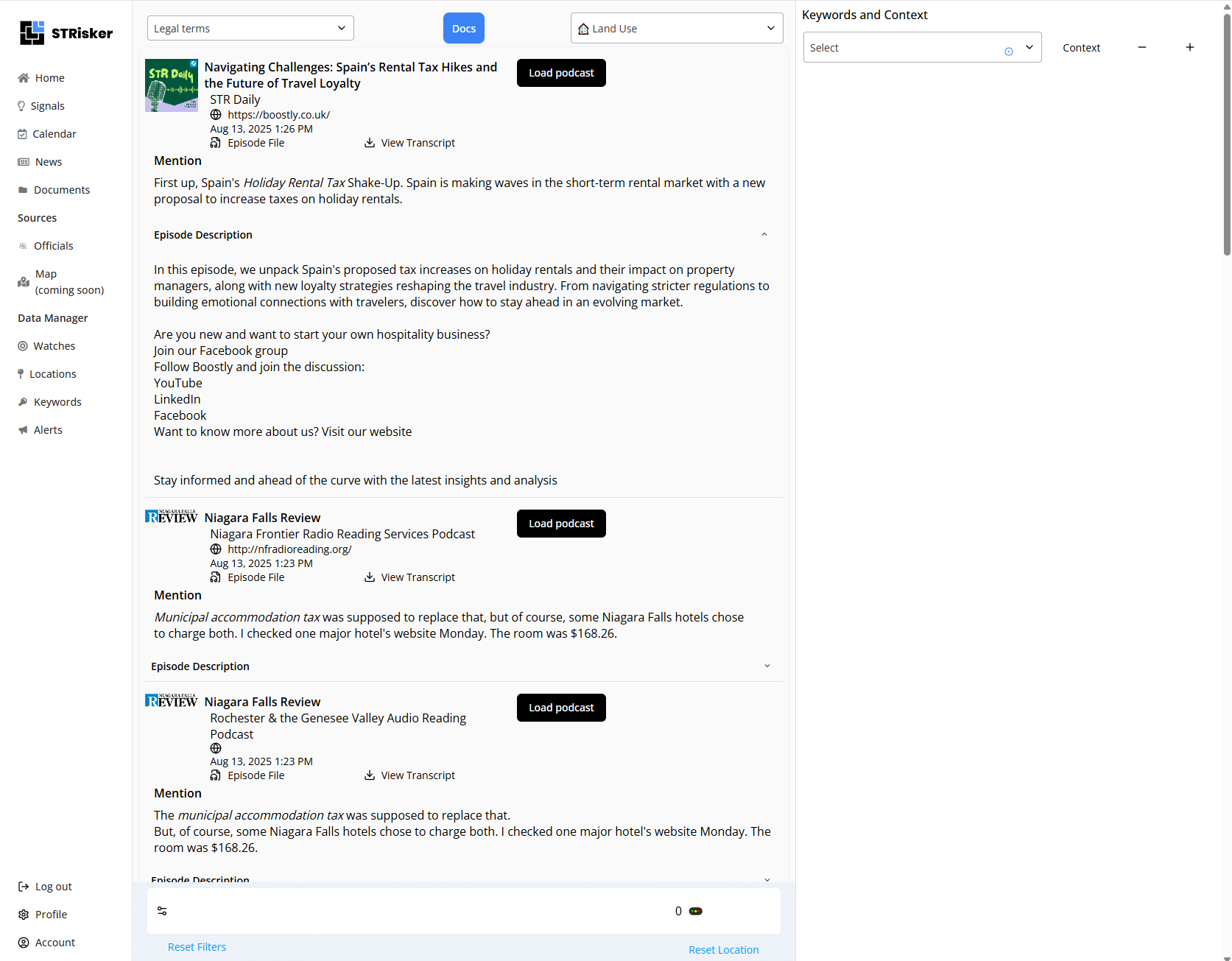
How do you keep up with the regulatory rollercoaster in your market? STRisker's Updates Tracker can be your guide - start tracking latest events as they happen and get access to essential documents as they come in. We know the struggle, which is why we built this product to capture every twist and turn in the regulatory saga so you never miss a beat.
👍 We’d love your feedback.
We're always looking for ways to improve our content.
Was this one useful to you? Other topics you'd like to see get covered?
✉️ Just reply directly to this email. We read and respond to every message!
-Will McClure
🙋 P.S.
Know someone else who might be interested in this content? Feel free to forward this along.