
🎯 STRisker: Bulletin - Kentucky
Kentucky Cities Say No to STR State Control: League of Cities warns bill could worsen housing affordability



Property Rights vs. Local Control: Kentucky’s STR Debate
Photo by redfin.com
A new Kentucky bill is drawing sharp lines between property owners and local governments.
Senate Bill 112, sponsored by Sen. Jordan Redman, would prevent cities and counties from requiring conditional use permits or density restrictions on short-term rentals.
For communities like Glasgow, where zoning rules currently limit short-term rentals to certain districts and require conditional use approval, the bill represents a major shift. Joint City-County Planning Commission Director Kevin Myatt warns it could “set a dangerous precedent,” stripping away public input and forcing cities to rewrite zoning codes. Glasgow’s rules, for example, prevent rentals within 1,000 feet of each other, or 1,500 feet in low-density zones. Those protections would vanish under SB 112.
 gpz-admin
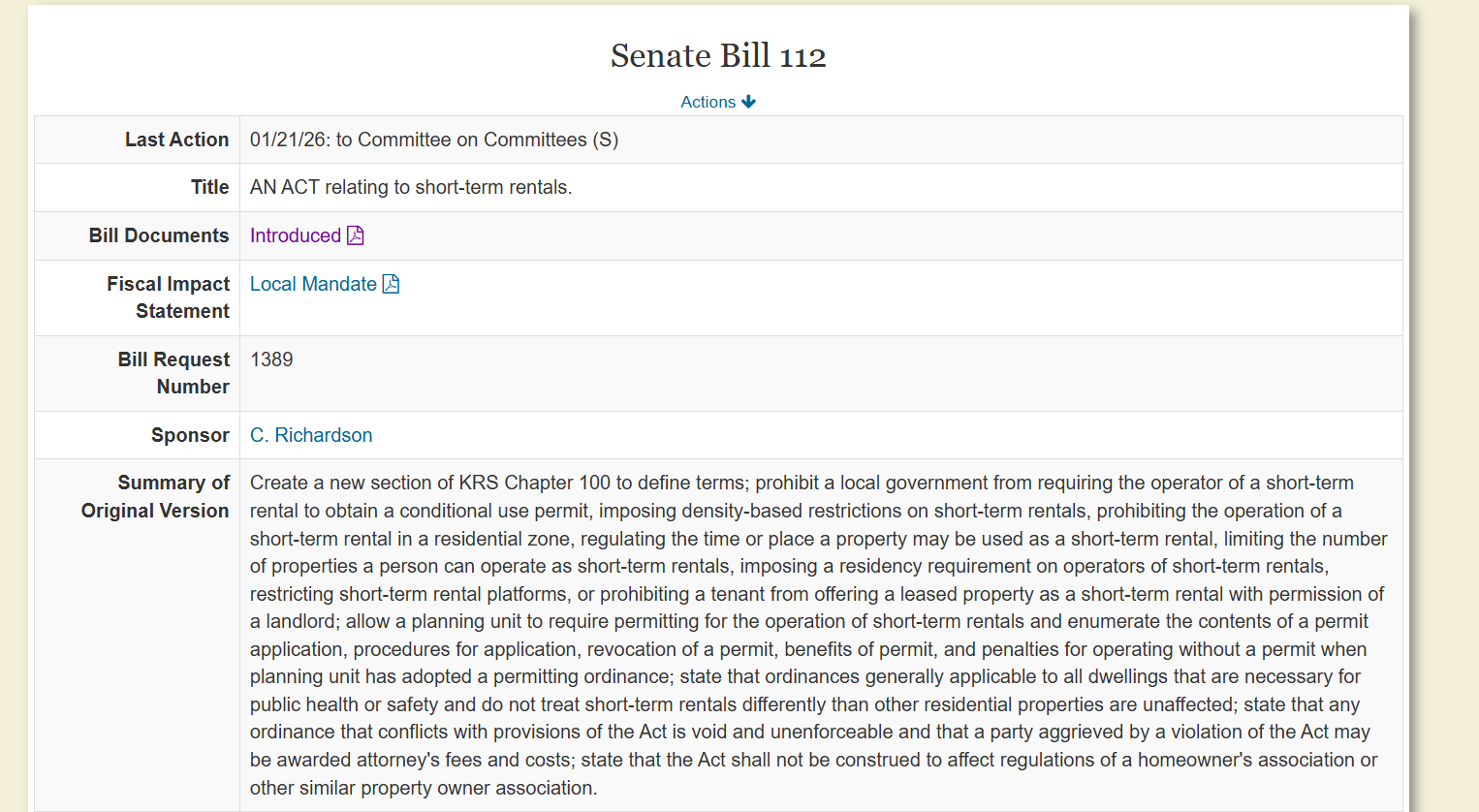
While SB 112 bars density and conditional use restrictions, it does allow local governments to require permits for each STR property. Myatt noted that STRs often trigger additional oversight, from fire marshals requiring exit signs to health departments monitoring food service.
“If any portion of this proposed bill is passed by the legislators, our requirement would be to write the [zoning regulations] applying the new language to them,” Myatt said. “That isn’t done behind closed doors, we have to hold public meetings for public input…then once the planning commission holds a public meeting, we hold a public hearing to officially change the language…and then we forward that to the city councils for two readings to approve our recommendations.”
Opposition is mounting beyond Glasgow. Fort Wright joined other Northern Kentucky cities in formally opposing the bill, with Mayor Dave Hatter authorized to send letters of opposition. The Kenton County Mayors Group also raised concerns that removing local oversight could lead to unchecked proliferation of STRs.
Housing advocates warn of broader impacts. Mallory Baker of the Kentucky League of Cities said SB 112 could worsen affordability by reducing long-term housing stock.
“It undermines local zoning authority by limiting cities’ ability to regulate STRs based on housing, infrastructure, and neighborhood needs,” she said.
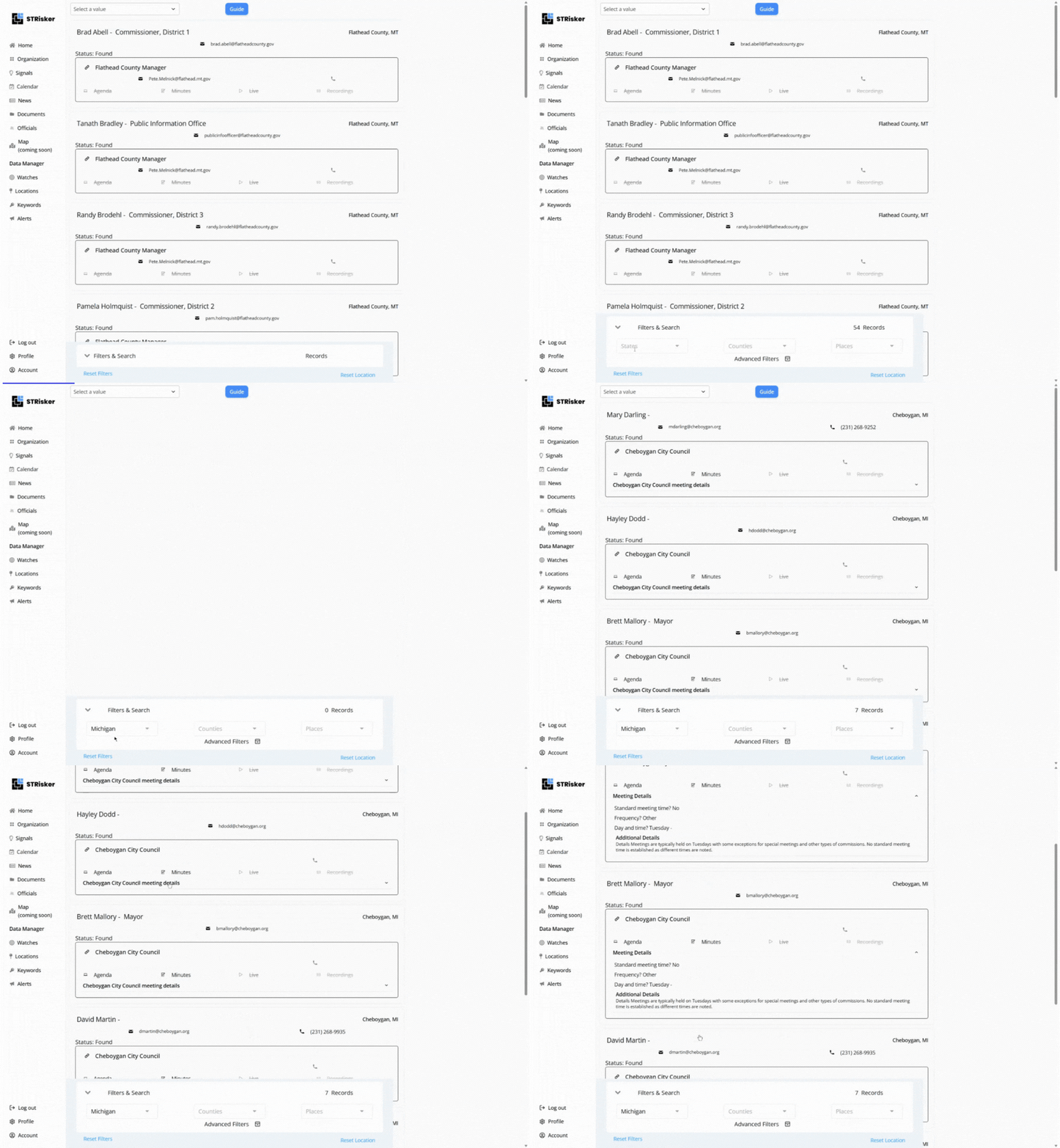
STRisker Government Office Dashboard
Trying to keep up with the main players in the STR game? Know your councilmembers, commissioners, committee chairs, and key staff that are part of the process.
✔️ For now, SB 112 remains in committee. But if it advances, cities like Glasgow, Cave City, and Park City would have to overhaul zoning codes, hold public hearings, and adapt to new state rules. The debate highlights a growing divide: property rights versus local control, and whether STRs should be treated as homes or businesses.
Stay Updated with STRisker
STRisker offers tools and features to keep you updated with the Short-Term Rental movement across the globe.
👍 We’d love your feedback.
We're always looking for ways to improve Bulletins.
Was this one useful to you? Other topics you'd like to see get covered?
✉️ Just reply directly to this email. We read and respond to every message!
-Will McClure
🙋 P.S.
Know someone else who should be reading this Bulletin? Feel free to forward this along. We want to make sure operators and stakeholders are aware of regulatory changes in their area.