
🎯 STRisker: Bulletin - Kentucky
SB 9 Stalls Amid Legislative Wrangling: Lawmakers left key reforms unfinished as the session adjourned, leaving advocates worried about worsening shortages



Kentucky Housing Bill Faces Uncertain Path Amid Short‑Term Rental Clash
Photo by www.louisvillerealestate.com
Kentucky lawmakers worked late into the night on April 1, sending a flurry of bills to the governor’s desk before breaking for the veto period. But one of the most pressing issues remains unresolved – the state’s worsening housing shortage.
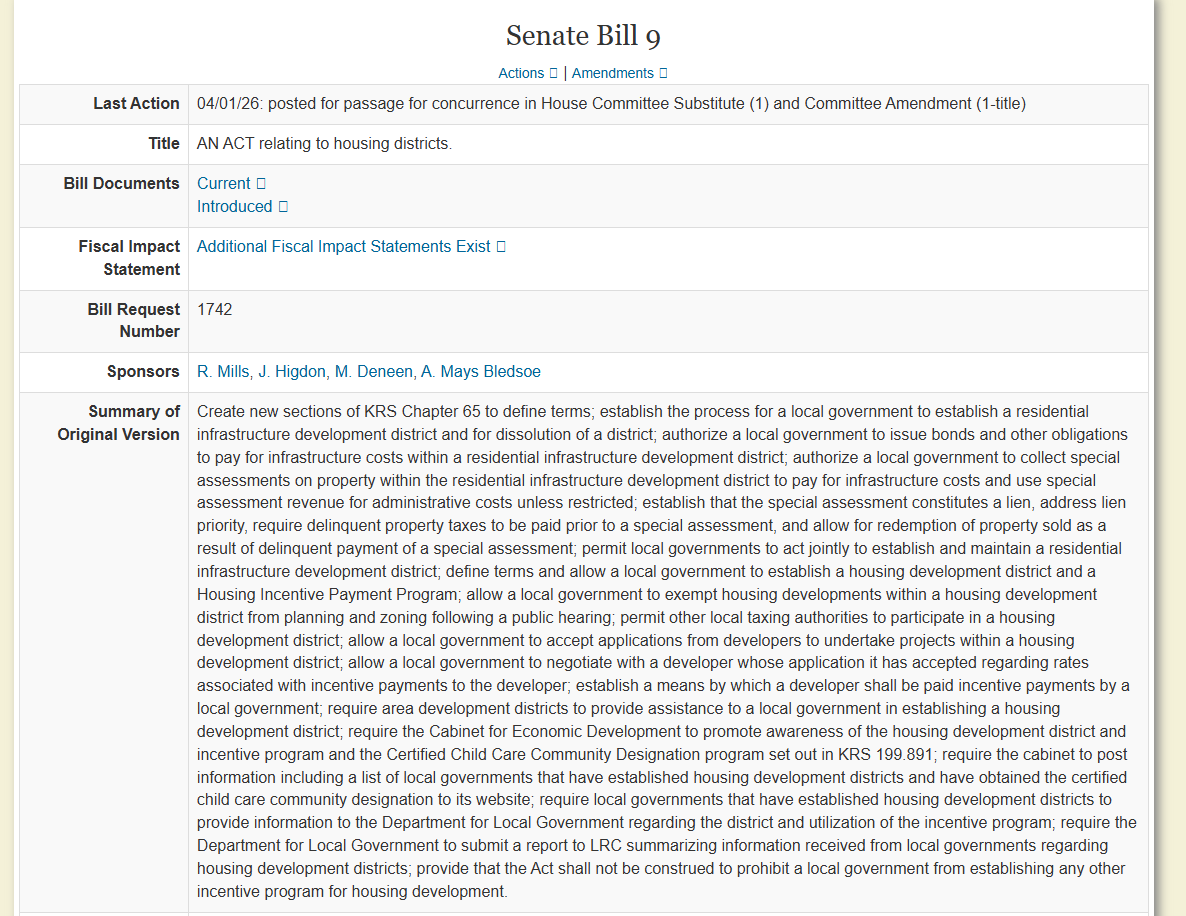
Awaiting action is Senate Bill 9, a housing measure that ballooned from 14 pages to 60 as the House stitched together provisions from multiple bills. What began as a straightforward proposal to help local governments finance housing infrastructure has morphed into a sprawling package of reforms, incentives, and controversial restrictions.
💊 "A Poison Pill"
The most divisive addition is a House amendment banning local governments from regulating short‑term rentals such as Airbnb and Vrbo. While cities could still create registries and penalize non‑compliant owners, they would lose the ability to set neighborhood caps or impose stricter rules.
That provision would void ordinances already in place in Louisville, Lexington, and several Northern Kentucky cities. For housing advocates, it undermines local control and worsens the housing crunch.
Rep. Lindsey Burke, D‑Lexington, praised SB 9’s reforms but said she could not support the bill with the STR preemption included.
“For every single single‑family home that turns into a short‑term rental, that’s a Kentucky family that can’t purchase their first home,” she said. “Our choice to prioritize short‑term rentals over Kentucky families is unfortunately the nail for me that is sealing my ‘no’ vote.”
Last year, House Speaker David Osborne attempted a similar preemption, but it failed. This year’s effort has reignited debate over whether STRs contribute to rising rents and housing instability. Research from the Urban Institute found STR proliferation does increase rents, though Harvard and Penn scholars note STRs are not the biggest driver. Adrienne Bush of the Homeless and Housing Coalition of Kentucky said more study is needed, but emphasized that SB 9’s density‑friendly provisions remain critical.
With an Abundance of Short-Term Rentals, Who Wins and Who Loses?
What Does Banning Short-Term Rentals Really Accomplish?
🧾Building Density, Expunging Records
Beyond the STR fight, SB 9 contains reforms widely supported by housing advocates. Rep. Susan Witten, R‑Louisville, co‑chair of the legislative housing task force, championed measures to reduce minimum parking requirements for new housing developments and to expunge eviction records in cases dismissed by the courts. Both changes aim to lower barriers for renters and developers alike.
The bill also incorporates incentives for developers, protections for vested property rights, and mechanisms for local governments to spread infrastructure costs over time. Together, these provisions reflect months of work by lawmakers, builders, and advocates to address Kentucky’s housing shortage.
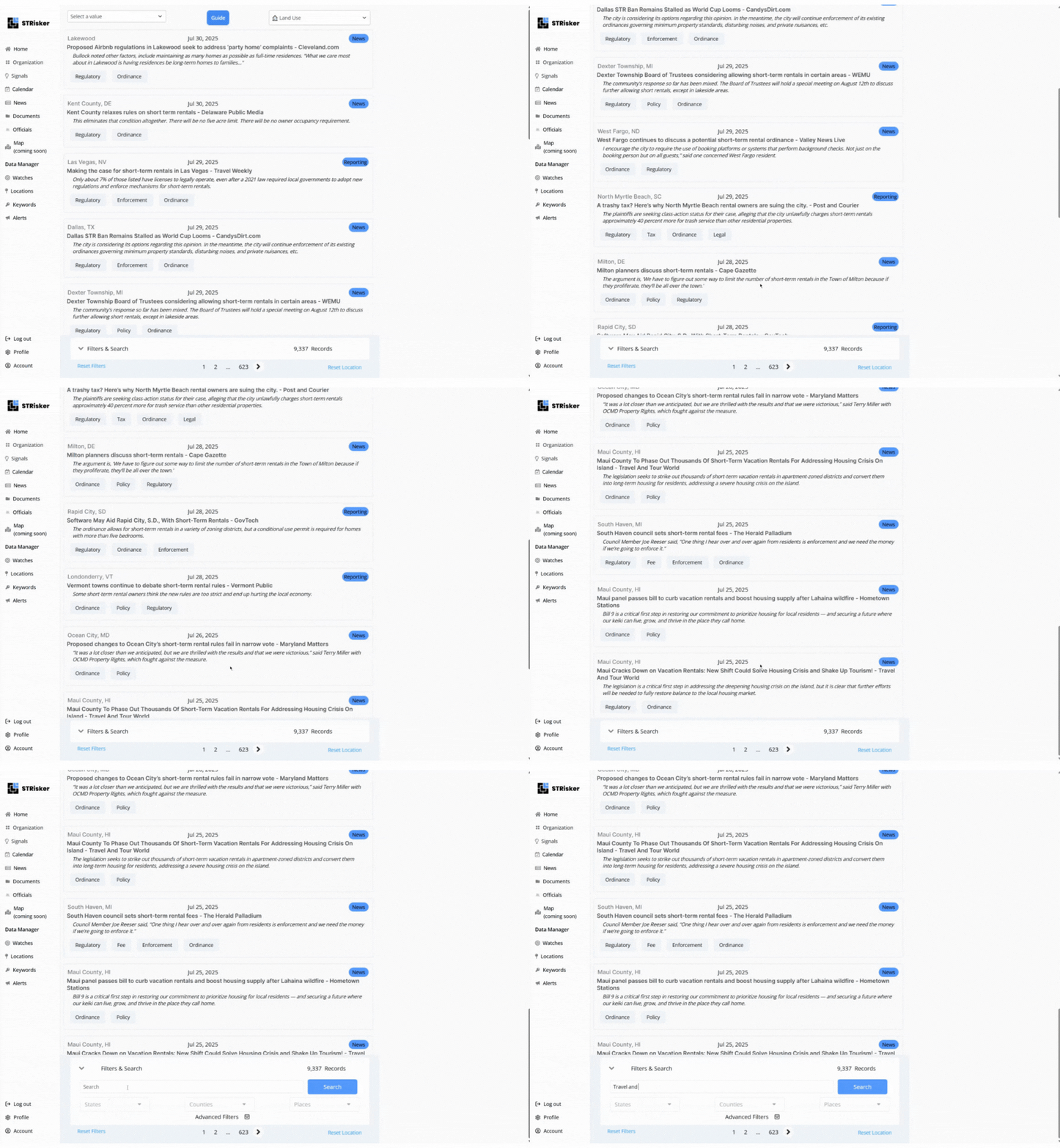
STRisker News Tracker
Trying to keep up with STR regulations across multiple cities and states? Our News Tracker makes it easier than ever. Filter by location, search a comprehensive database, and sort by impact level—this tool helps you focus on what matters most.
📊 Funding Falls Short
Yet even as lawmakers debate policy, funding remains a sticking point. Advocates have long pushed to increase the fee on home sales that supports the Affordable Housing Trust Fund, arguing the current $6 fee has not kept pace with inflation. A bipartisan bill would have raised it to $23, indexed to inflation.
But Realtors opposed the increase, and the House left it out of SB 9. Instead, lawmakers approved a one‑time $5 million appropriation to the trust fund and another $10 million for a revolving loan fund. In total, $15 million was earmarked for housing as part of a $1.7 billion spending package drawn from the state’s “rainy day” fund.
For advocates, the amount is disappointing. “When you look at the scale of the problem that’s been studied and documented, and then you look at what’s come out of the legislature, there’s a real disconnect,” said Scott McReynolds, executive director of the Housing Development Alliance in Perry County. He noted that while incentives help in strong markets, subsidies are essential for building affordable housing in rural and low‑income communities.
Democrats, including Gov. Andy Beshear, had called for more than $100 million for the trust fund, echoing advocates’ pleas for a transformative investment.
🧑🏫 Legislative Maneuvering
SB 9 passed the Senate in its original form in February, but stalled in the House. On April 1, a House committee revived it with sweeping amendments, only for Senate Republicans to decline action before adjournment. Sen. Robby Mills, R‑Henderson, the bill’s sponsor, said members needed more time to digest the changes. “We just typically don’t try to jam things down our members’ throats,” he said.


The bill now awaits consideration when lawmakers return to override vetoes. But timing is tight. Under the Kentucky Constitution, bills passed in the final two days cannot be vetoed and overridden before adjournment. That means if SB 9 passes this week, Gov. Beshear could veto it outright, leaving no chance for override.
Witten acknowledged the risk, saying the bill must be crafted to avoid a veto. “If we’re going to work so hard to put forward a housing bill that’s going to be meaningful, it really has to be something that is not going to get vetoed,” she said.
Stay Updated with STRisker
STRisker offers tools and features to keep you updated with the Short-Term Rental movement across the globe.
👍 We’d love your feedback.
We're always looking for ways to improve Bulletins.
Was this one useful to you? Other topics you'd like to see get covered?
✉️ Just reply directly to this email. We read and respond to every message!
-Will McClure
🙋 P.S.
Know someone else who should be reading this Bulletin? Feel free to forward this along. We want to make sure operators and stakeholders are aware of regulatory changes in their area.