
🎯 STRisker: Bulletin - Niagara Falls, Canada
The city's flat nightly fee gives way to a 4% room-rate charge, with a 5% escalation already scheduled for 2027



Niagara Falls Moves STR Tax to Percentage Model, VRU Hosts Face Higher Costs Under New MAT Rate
Photo by Rikin Katyal on Unsplash

City of Niagara Falls Report on Municipal Accommodation Tax (MAT) update
As of April 1, 2026, the City of Niagara Falls' Municipal Accommodation Tax converted from a tiered flat-fee structure to a 4% charge on the total room rate. The change applies to all short-term accommodation properties in the city including Vacation Rental Units (VRUs) and Owner Occupied Short-Term Rentals (OOSTRs), which are the two STR licence categories the city formally recognizes. For hosts charging anywhere near market rates, the shift means a meaningfully larger tax bill than the flat fee it replaces.
Latest council meeting underscores new tax rules and policy direction for Niagara Falls STR operators.
This is the official council agenda package that was reviewed and discussed during the March 31, 2026 City Council meeting.
Check out the key takeaways from the March 31st City Council Meeting, including:
— Niagara Falls Canada (@NiagaraFalls) April 6, 2026
🌳 Niagara Falls Tourism Plans for 2026
➡️ Code of Conduct for Human Trafficking Prevention in Niagara
🏘️ Motel Conversions and New Apartment at 7800 Lundy’s Lane
Read the full update ⬇️…
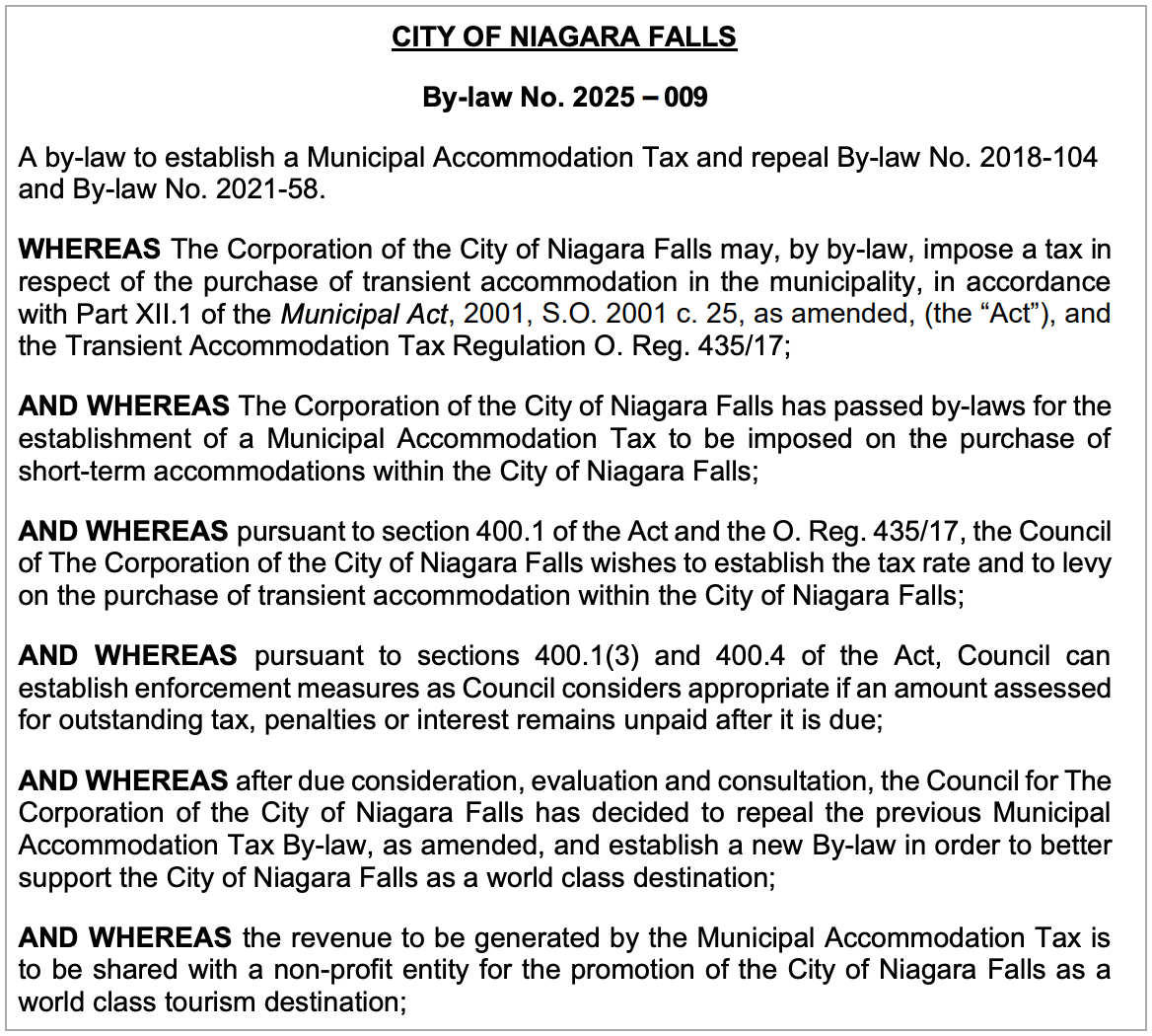
By-law 2025-009, approved by City Council on January 14, 2025, governs the MAT and covers all short-term stays of 28 consecutive days or less. The tax has gone through three versions in under two years. It started as a flat $2/night charge, moved to a tiered star-rating system in June 2025 with nightly fees ranging from $4 to $7, and has now landed on a straight 4% of the room rate. Each change was a response to criticism that the previous model was inequitable across properties with different price points.
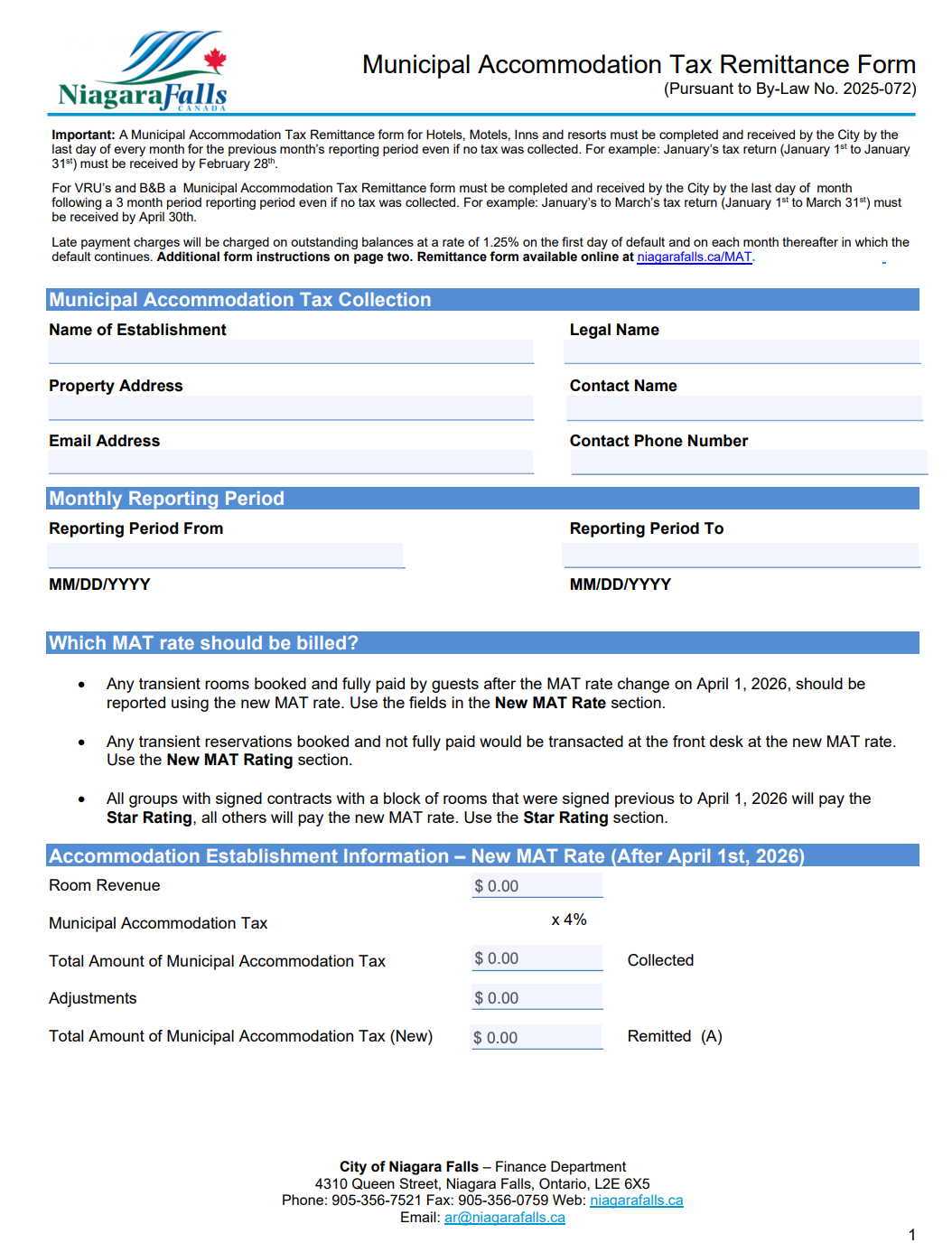
Every STR operator in Niagara Falls is affected, and the tax is mandatory with no opt-out available for either hosts or guests. Remittance is quarterly for VRUs and OOSTRs with payments due at the end of April, July, October, and January for tax collected in the preceding quarter. Late payments attract a 1.25% monthly charge from the first day of default and accounts that remain overdue for more than 60 days are transferred to tax receivables. The MAT is charged on top of the 13% Harmonized Sales Tax that already applies to rental income.
Separate from the MAT changes, the VRU licensing framework remains exactly as it was. Operators still need a city-issued licence ($500 to obtain, $250 to renew annually), and properties must sit within Tourist, General, or Commercial zones while residential areas remain off-limits for standard VRUs. The penalty for running without a licence has not changed either: up to $50,000 for a first offence and $100,000 for any violation after that.
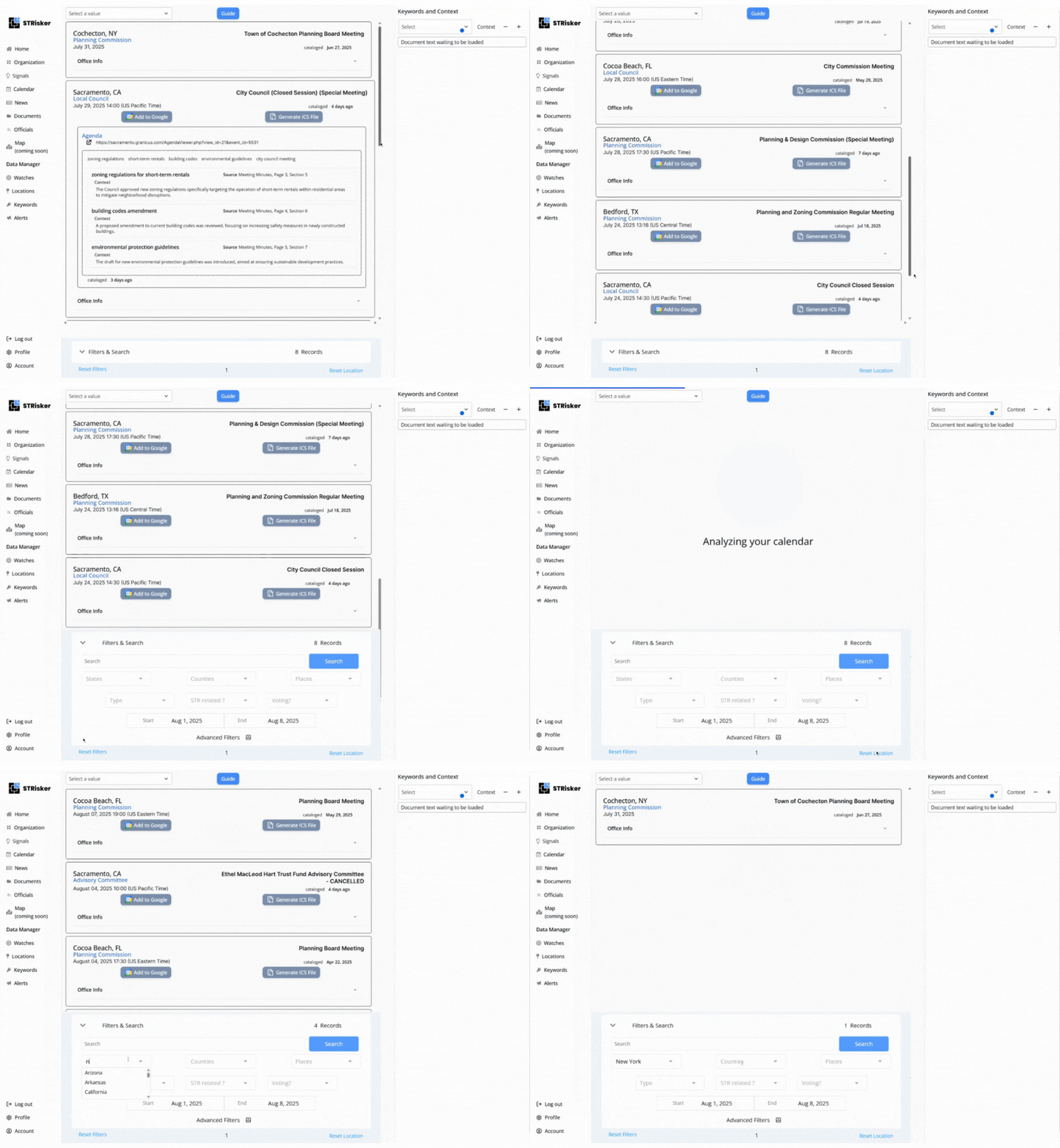
STRisker Calendar Tracker
Staying ahead of STR regulations isn’t just about deadlines—it’s about knowing what’s coming. Our Calendar Tracker keeps you informed on upcoming meetings, key votes, and policy changes, so you never miss a critical update.
Given how quickly the MAT has evolved, going from a $2 flat fee to tiered rates to a percentage model in under two years, the already-legislated jump to 5% in April 2027 should not catch anyone off guard. The city is also leaning into demand generation with a New Year's Eve concert returning to Queen Victoria Park for the first time since 2019, a move city officials say is designed to fill hotel rooms and drive visitor spending. Hosts locking in pricing or entering multi-year agreements today are working with a known number on both the tax and the demand side, and ignoring either would be a costly oversight.
The full MAT rate schedule and remittance requirements are published on the City of Niagara Falls revenue page.
⦿ Effective date: April 1, 2026 (4% MAT); April 1, 2027 (5% MAT)
⦿ Licence required: Yes, Vacation Rental Unit (VRU) licence or Owner Occupied Short-Term Rental (OOSTR) licence
⦿ Licence fees: $500 initial/$250 annual renewal (VRU); OOSTR pilot applications open through September 2026
⦿ MAT rate: 4% of total room rate (as of April 1, 2026)
⦿ Night cap: None specified
⦿ Permitted zones: Tourist Commercial, General Commercial, Central Business (residential zones excluded for standard VRUs)
⦿ Penalty for unlicensed operation: Up to $50,000 (first offence); up to $100,000 (repeat offences)
⦿ Platform responsibility: Partial; Airbnb may collect MAT in some cases, but hosts remain responsible for accurate reporting and remittance
⦿ Remittance schedule: Quarterly (STR operators); monthly (hotels/motels/inns)
⦿ Late payment fee: 1.25% per month
Stay Updated with STRisker
STRisker offers tools and features to keep you updated with Short Term Rental movement across the globe.
👍 We’d love your feedback.
We're always looking for ways to improve Bulletins.
Was this one useful to you? Other topics you'd like to see get covered?
✉️ Just reply directly to this email. We read and respond to every message!
-Will McClure
🙋 P.S.
Know someone else who should be reading this Bulletin? Feel free to forward this along. We want to make sure operators and stakeholders are aware of regulatory changes in their area.