
Understanding Data Center Public Hearing: How Communities Participate in Decisions About New Facilities
Learn about what a data center public hearing is, its significance, the concerns expressed by participants, and its structure.
At A Glance 🔽
- A data center public hearing is a scheduled and formal session of a public meeting where a local decision-making body, usually a planning commission, board of supervisors, county commission, or city council, opens the floor to residents, applicants, and other interested parties before deciding on data center developments.
- A data center public hearing is important because it is a legal prerequisite for land-use decisions, a protection against procedural errors, a permanent record for future review, and a means of providing transparency and community trust.
- Some of the concerns raised at the hearing involve noise and backup generators, water consumption and cooling, electricity demand and grid strain, land use, jobs, and property values
- The structure of the public hearing includes participants, notice and advance materials, presentations and public comment, legislative vs. quasi-judicial hearings, and the continuance and closing of the hearing.
Definition
A data center public hearing is a scheduled, formal part of a public meeting where a local decision-making body opens the floor to residents, applicants, and other interested parties before it decides on a data center development. The hearing may cover a site-specific rezoning, a special use permit, a new zoning ordinance that sets where data centers can be built, or a moratorium on new applications. State laws and local zoning codes govern these hearings, so notice periods, speaking limits, and the weight given to public input vary by jurisdiction.
✅Importance
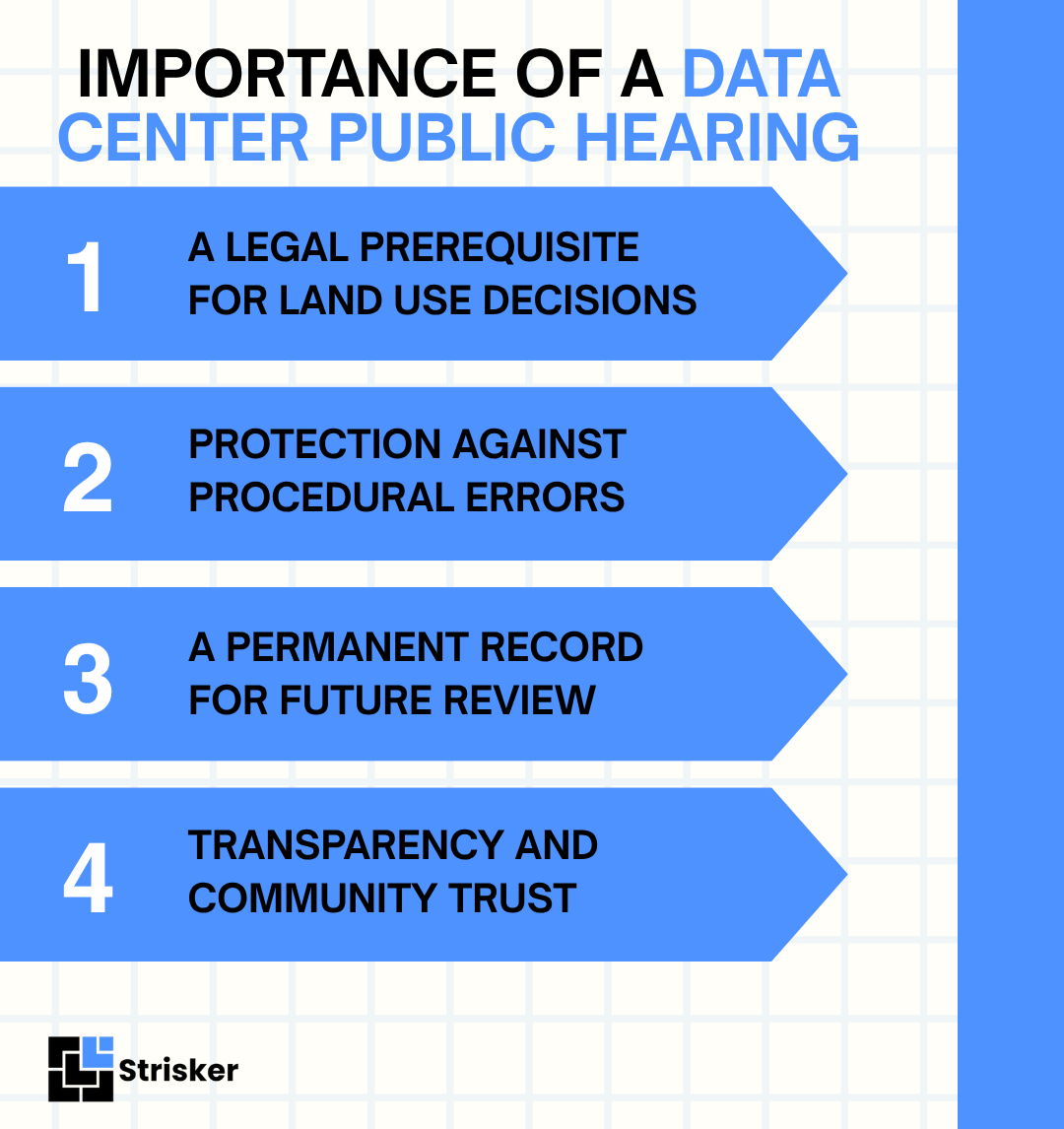
For residents near a proposed site, a public hearing is often the main formal opportunity to put concerns on the official record before a binding vote. It works as both a civic forum and a legal checkpoint. A properly conducted hearing helps achieve the following:
A Legal Prerequisite for Land Use Decisions
Local governments generally cannot adopt or amend zoning rules without first advertising the proposal and holding a hearing. Most data centers need either a rezoning or a special permit, so the hearing is a required step, not optional outreach. In Virginia, for example, Va. Code § 15.2-2204 prevents a planning commission or governing body from acting on a plan, ordinance, or amendment until notice has been published twice.
Protection Against Procedural Errors
If a locality skips a required step or advertises a hearing incorrectly, its approval can be challenged in court. In 2026, the Court of Appeals of Virginia upheld a ruling that three data center rezonings in Prince William County's Digital Gateway area were void because the county did not meet state advertising requirements. Rules like these give residents time to review a proposal and help prevent rushed decisions.
A Permanent Record for Future Review
Every statement and submission made during the hearing becomes part of the official record. If the decision is appealed, the court reviews that record. In quasi-judicial matters in North Carolina, for instance, the board must base its decision on competent, material, and substantial evidence in the record.
Transparency and Community Trust
A hearing lets officials hear directly from neighbors and weigh competing interests. It also shows how a proposal fits local plans. As a result, the community can more easily accept the final decision, whether the project is approved or denied.
⚠️Concerns Raised
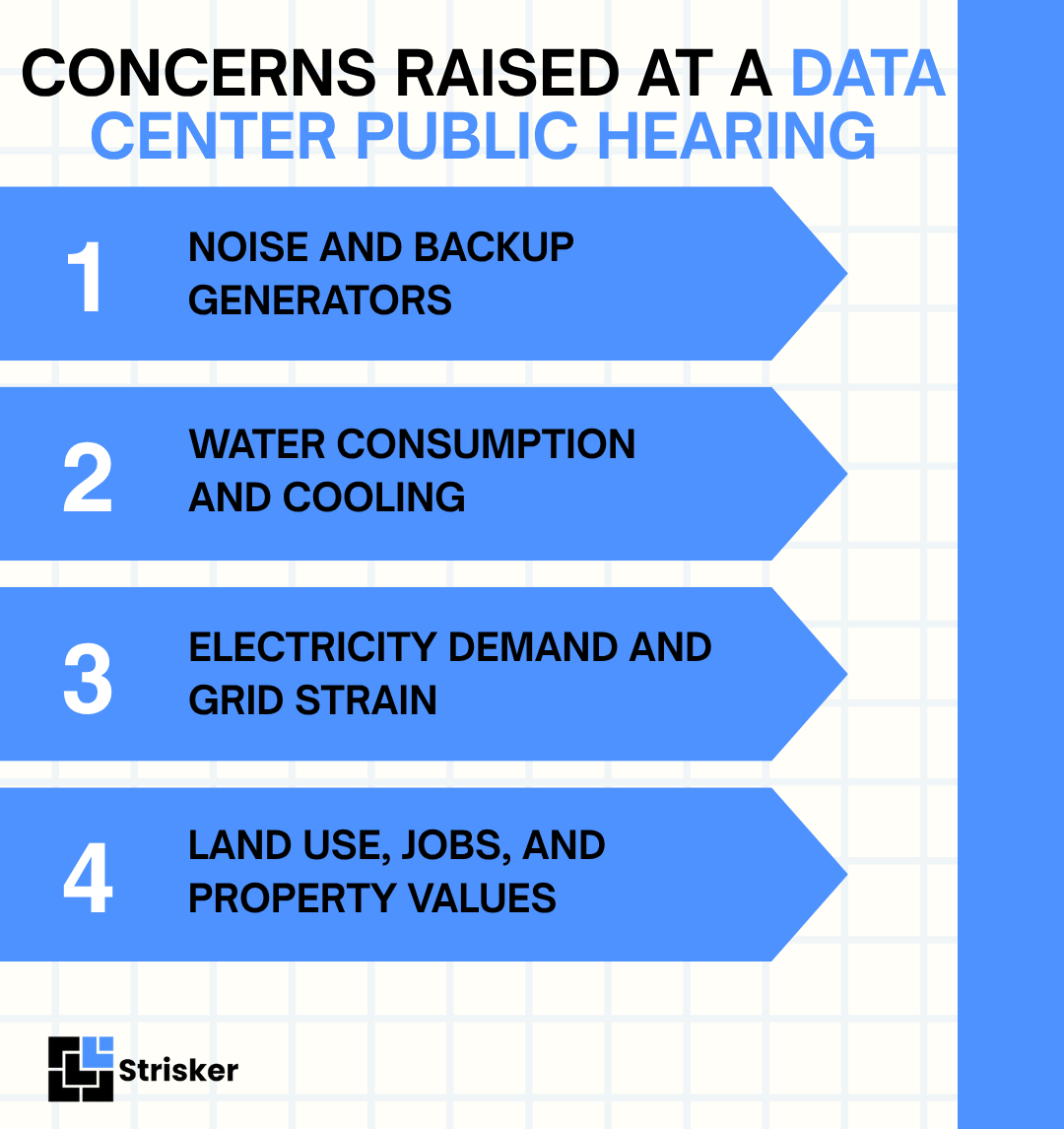
The concerns raised during public hearings about data centers generally focus on a specific set of physical and economic impacts. These impacts change based on factors such as a community's water supply, grid capacity, and proximity to residential areas. The most common concerns include:
Noise and Backup Generators
Cooling equipment and backup generators can produce constant mechanical noise. In a 2026 City of Aurora survey on a proposed moratorium, residents described noise from existing facilities as "unbearable" and said it disrupts their sleep. Some asked for enclosed, soundproofed generator buildings. Guidance for local governments, such as the ACCG's 15 best practices, also recommends noise studies before and after construction.
Water Consumption and Cooling
Water-based cooling can put pressure on local supplies, which makes it a sensitive issue in places already under drought or watering limits. Respondents to a 2026 Wichita–Sedgwick County community survey pointed to existing watering restrictions when they raised concerns about data center water use. The ACCG advises localities to find out a facility's annual water use, its cooling method, and whether it will use potable or reclaimed water. In Provo, Utah, for example, the Planning Commission recommended a data center rezoning tied to a development agreement that caps water use at 4.38 million gallons per year.
Electricity Demand and Grid Strain
Data centers are among the fastest-growing sources of electricity demand in the US 2024 Lawrence Berkeley National Laboratory report estimated that data centers used about 4.4% of U.S. electricity in 2023 and could use between 6.7% and 12% by 2028, with AI-related servers driving much of that growth. At local hearings, residents often ask about new substations and transmission lines, and whether household utility rates could rise to pay for grid upgrades.
Land Use, Jobs, and Property Values
Speakers often question whether a large industrial facility fits the surrounding area. At an April 2026 Ravenna City Council committee meeting, residents raised air pollution from generators and the small number of permanent jobs, while council members noted property values and stormwater. Local governments often respond with tighter standards. Fairfax County, for example, proposed new rules on setbacks, building design, and noise in 2024.
🧩Structure of the Hearing
Although the formats of hearings differ by jurisdiction, most data center hearings share the same core participants and follow a similar process: advance notice, presentations from staff and the applicant, public comments, and then deliberation.
Participants (Who Takes Part)
A data center hearing brings together the officials who review and decide on a proposal and the community members who may be affected by it. Each group plays a different role in shaping the record before a vote:
- Planning staff present the staff report and explain how the proposal fits the zoning ordinance and comprehensive plan.
- Data center developers present the application and answer questions about site design, power demand, water use, noise mitigation, and similar topics.
- Landowners near the site may receive mailed notice. In Virginia, for example, owners of the affected parcels and adjoining properties must be notified of zoning map changes.
- Residents explain how the project could affect their neighborhoods, from noise and traffic to water supply and utility rates.
- Business owners weigh in on local economic effects, including tax revenue, construction activity, and the number of long-term jobs.
- Civic and community groups, such as homeowners associations, often speak through a single spokesperson, who may get more time than individual speakers.
Notice and Advance Materials
Before the hearing, the local government publishes a hearing notice with the date, time, location, and purpose of the meeting. Notices usually run in a local newspaper or on the locality's website, and some areas also mail them to nearby property owners. The notice also tells residents where they can review the proposal ahead of time, as Va. Code § 15.2-2204 requires in Virginia. A 2026 notice from Adams County, Iowa, for example, directed residents to the auditor's office to review materials on a proposed data center moratorium.
Presentation and Public Comment
Planning staff and the applicant present the proposal first. The chair then opens the floor for public comment, and speakers are expected to stay on topic. Many boards also accept written comments, and some set speaking limits. The Fairfax County Board of Supervisors, for example, gives individuals three minutes and group spokespersons five minutes, and it accepts written testimony until the hearing closes.
Legislative vs Quasi-Judicial Hearings
The type of decision shapes how the hearing runs. Rezonings and moratoriums are usually legislative matters, so speakers can share opinions and make policy arguments. Special or conditional use permits, on the other hand, are generally quasi-judicial. In those hearings the board acts much like a trial court and bases its decision on the evidence and testimony in the record. The exact rules vary by state.
Continuances and Closing the Hearing
A hearing doesn't always end in a vote. The board may grant a continuance and move the hearing to a later date, usually at its own discretion when there is good cause, such as missing information. Notice rules still apply when a hearing is continued. In Virginia, mailed notice has to be sent again under Va. Code § 15.2-2204. In North Carolina, by contrast, a hearing doesn't need to be re-advertised if the new date is announced before it closes. Once the hearing closes, the board will vote, defer action, or send its recommendation to the governing body.
Conclusion
The data center public hearing is where communities debate the impacts of data centers, especially hyperscale facilities, on grid capacity, water supply, and land use. Residents use it to put their concerns on the record, and that record can shape whether and how a project moves forward.
Since hearings are often advertised only days or weeks ahead, residents, landowners, developers, and officials benefit from following local agendas early. Strisker offers tools, features, and newsletters that keep you updated on newly advertised data center public hearings in your jurisdiction.
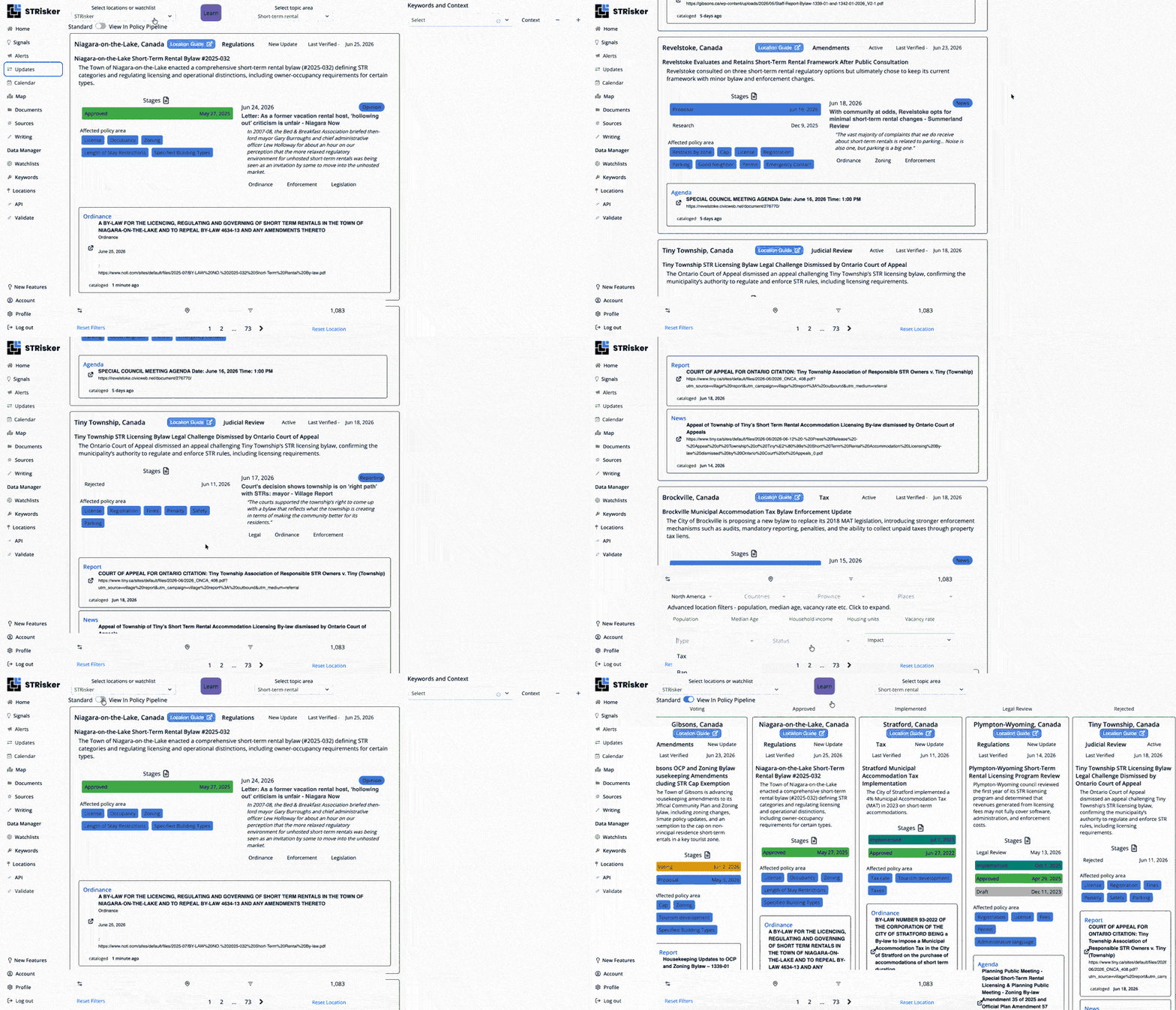
Strisker Updates Tracker
How do you keep up with the regulatory rollercoaster in your market? Strisker's Updates Tracker can be your guide - start tracking latest events as they happen and get access to essential documents as they come in. We know the struggle, which is why we built this product to capture every twist and turn in the regulatory saga so you never miss a beat.
FAQs
What happens after a data center public hearing?
Once the hearing closes, the body may vote, defer action, or forward a recommendation. A planning commission usually sends its recommendation to the governing body, which makes the final decision. Quasi-judicial decisions can be hard to reopen once they're made, and boards are often reluctant to rehear a case. Further challenges usually move to court.
How can I speak at a data center public hearing?
Each local government sets its own rules for public comment, so check those first. To prepare and speak:
- Review the hearing materials and guidelines
- Check the hearing notice and the clerk's website for sign-up rules
- Register to speak
- Draft your comments
- Deliver your testimony
What documents should I read before a data center hearing?
Before a hearing, it helps to review the main regulatory, environmental, and technical documents behind the project. These include:
- Project and application documents: zoning and land-use applications, site plans and layout drawings, and community benefit agreements
- Environmental and resource impact reports: environmental impact assessments (EIA), water use and discharge reports, noise studies, and air quality and emissions permits
- Infrastructure and grid impact: power feasibility and grid studies, and decommissioning plans
Stay Updated with Strisker!
Strisker offers tools and features to keep you updated with the Short Term Rental movement (and now Data Centers!) movement across the world.
👍 We’d love your feedback.
We're always looking for ways to improve our content.
Was this one useful to you? Other topics you'd like to see get covered?
✉️ Just reply directly to this email. We read and respond to every message!
-Will McClure
🙋 P.S.
Know someone else who might be interested in this content? Feel free to forward this along.