
Understanding the Reasons and Impacts of a Data Center Moratorium
Explore the reasoning behind a data center moratorium, its impact to the communities and data center developers, and some states with moratorium bills.

At A Glance 🔽
- A data center moratorium is a temporary pause, not necessarily a ban. Most state moratoriums halt new permissions and approvals for a defined period instead of prohibiting data center construction permanently.
- Some of the common factors that contribute to moratorium bills, whether from locals or states, are the concerns raised by residents, such as power rates, water resources, and noise issues.
- With these restrictions, several hyperscale data centers are expected to modify their financing timelines, site selection plans, and even investor trust in these projects.
- With the signed Executive Number 62, New York became the first state to push through with the state-level moratorium.
- Several states are also choosing to delay their data center projects as their moratorium bills advance.
Definition
A data center moratorium refers to a temporary hold or pause imposed by a state or local government on data center construction. This temporary pause means that officials cease on also issuing permits, zoning approvals, and other authorization documents and requirements that a data center developer needs to build data centers.
Passing moratorium aims to provide developers and government officials time to examine how these large-scale data centers influence the local electric grid, water supply, land use, and even household utilities bills before construction begins.
Since there are no federal standards or regulations for data centers, moratoriums are discussed by different levels of government. Local moratoriums refer to bills submitted by a city council or county board, which focus on holding permits within their own jurisdiction only. State moratoriums, on the other hand, refer to bills passed by a state legislature that apply statewide.
💡Reasons
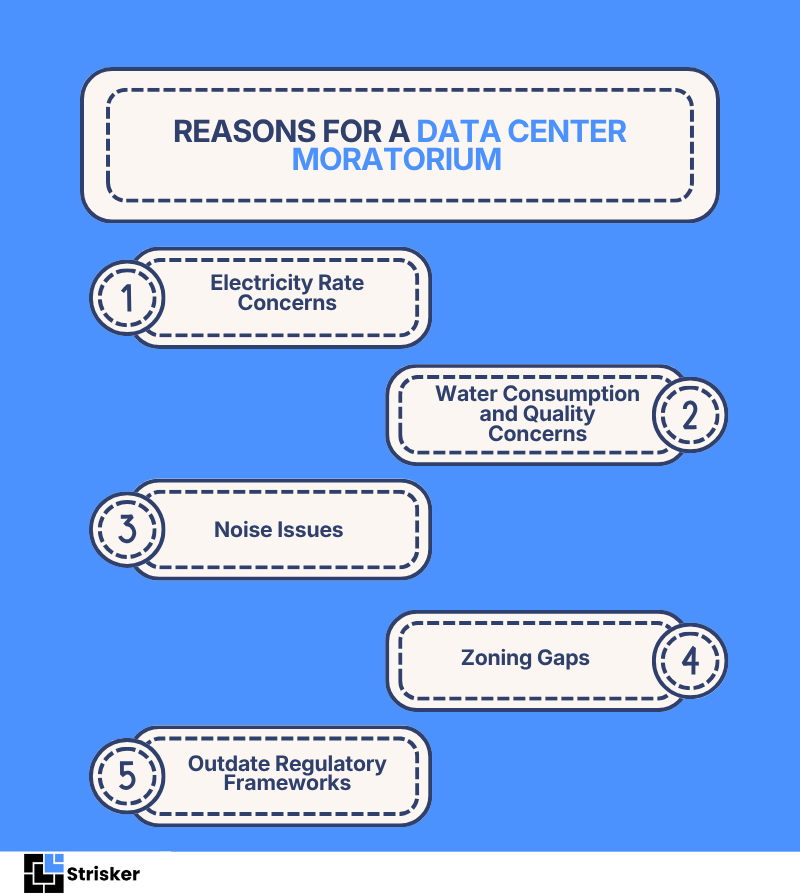
Albeit the differences among the political background of the legislature of several states and localities, the reasoning behind passing moratorium bills is remarkably common. Here are some of the reasons that support different legislators in pushing through with these temporary bans:
Electricity Rate Concerns
Modern and hyperscale data centers require 100 to 500+ megawatts compared to the previous 5 to 15 megawatts a decade ago. With these vast amounts of electricity requirements, communities are concerned with the changes for the utility rates and costs for the new power plants, transmission lines, and grid capacity upgrades needed to accommodate the electricity demand. Household ratepayers expect that they will be burdened with these additional costs rather than being covered by the companies building these facilities.
Water Consumption and Quality Concerns
These concerns are common in drought-prone or already stressed water system locations, where water consumption is already scarce. A 2026 NC State University analysis shows that an estimated 3.4 trillion gallons of water were used in a single year to power data centers across seven states, particularly in areas already facing water supply shortages. This is because many data centers require water for cooling their data center units.
Noise Issues
Large data centers, including their backup generators and cooling equipment, generate loud noise that can disrupt nearby residential areas. Additionally, the low-frequency hum and cooling vibrations they produce usually run 24/7. Residents report these noises because they disrupt their sleep and cause them stress.
Zoning Gaps
In the past, most jurisdictions treated data centers as standard warehouses or industrial buildings rather than massive modern technological campuses. As a result, they were not included in zoning codes. The data center moratorium provides time for these codes to be updated, offering clear definitions and boundaries for constructing data centers, especially if they are near residential areas.
Outdated Regulatory Frameworks
Like zoning gaps, other regulatory frameworks for data center construction were written before the rise of hyperscale data center facilities. Lawmakers use these moratoriums as a pause to update these rules and standards, rather than approving projects under outdated regulations.
🎯Impacts of a Data Center Moratorium
The most direct impact of a data center moratorium is that all operations and approvals are frozen until a final decision is made about the development. This decision could result in a permanent ban or allow operations to continue, but the moratorium keeps these plans on hold until then.
Existing projects that received prior approval are usually exempt from the effects of moratorium regulations. For example, New York’s Responsible Data Center Development Act specifies that its moratorium does not apply to projects already under construction before the bill was passed.
Still, it is best to review regulations for ongoing projects in specific locations rather than assume exemptions. On the other hand, for data center projects currently in the planning phase, the effects are not simply a delay.
Developers must consider several impacts while the moratorium is in effect. These include shifts in financial timelines that investors and lenders must account for, since moratorium bills influence the closing and operations of the capital they have invested in these projects. Some moratorium bills also force planned data center projects to change their site selection strategies, leading developers to choose locations where moratoriums have not yet been enacted.
🏛️States with Moratorium Bills
As of September 2026, there have been more than 500 data center-related bills submitted in more than 40 states. At least 11 or 12 states have introduced statewide moratorium bills. Here are some of the passed moratorium bills from different states:
Conclusion
A data center moratorium is a provisional ban that prevents officials from issuing permits and approvals for a set period of time. This period allows lawmakers to review the potential impacts of data center construction on electricity rates, water resources, noise levels, and zoning boundaries in surrounding communities. Since approvals are currently on hold, data center developers must also adjust to the impacts of these temporary bans on their applications.
Some developers are forced to switch to other site locations where no moratorium bills have yet been submitted. Following New York as the first state to sign a statewide data center moratorium bill, more states are now introducing their own bills for consideration. Strisker offers tools, features, and newsletters that keep you updated on new decisions regarding data center moratoriums.
FAQs
Will a data center moratorium stop a project that already has permits?
As previously mentioned, a data center moratorium does not necessarily halt a project that has already been approved and issued legal permits and documents before the restriction started. This is supported by the Grandfather Clause or Vested Rights Thresholds, which protect projects backed by financial investments that are approved by certain jurisdictions.
How long can a data center moratorium last?
A data center moratorium usually lasts from 30 days to two years, depending on the jurisdiction and the complexity of the decisions lawmakers must make regarding data center projects. Common durations include:
- Short-term pause: Lasts from 30 to 150 days, allowing time to review data center zoning rules and utility strains.
- Medium-term pause: Lasts from 6 to 12 months, during which local governments use the one-year period to evaluate the impacts of data center construction on the environment, water, and power to nearby communities.
- Long-term or extended pause: Lasts from 1 to 2 years, where some counties or states extend the temporary ban to determine whether an extensive overhaul of their regulatory framework is necessary.
What happens when a data center moratorium expires?
Once a data center moratorium expires, local or state governments continue their previous processes and activities before the ban, such as:
- new facility applications approvals and processing,
- drafting zoning rules
- setting noise limits
- developing energy and water efficiency standards
Likewise, some data center moratoriums may also open discussions for potential extensions, especially if the research collected is not sufficient to support a decision.
How is a data center moratorium different from a permanent ban?
Moratorium is a temporary pause on new projects while a permanent ban pertains to complete prohibition. A moratorium gives time for lawmakers to study their regulations and potential impacts of data center projects while a permanent ban stops new projects entirely.
Stay Updated with Strisker!
Strisker offers tools and features to keep you updated with the Short Term Rental movement (and now Data Centers!) movement across the world.
👍 We’d love your feedback.
We're always looking for ways to improve our content.
Was this one useful to you? Other topics you'd like to see get covered?
✉️ Just reply directly to this email. We read and respond to every message!
-Will McClure
🙋 P.S.
Know someone else who might be interested in this content? Feel free to forward this along.