
Data Center City Council: Members, Voting Process, and Decision Factors
Understand what a data center city council is, the members involved, the voting process of the council, and the factors influencing the council’s decisions.

At A Glance 🔽
- A data center city council refers to the elected governing body of a city or town that sets local rules and regulations governing where data centers can be built, reviews data center proposals, and, in many localities, votes on whether a data center project can proceed.
- A data center city council is made up of elected officials: the council members and, in many cities, the mayor. They act with input from the city manager and staff, the city attorney, the planning commission and advisory boards, and state and regional agencies.
- The typical process for a data center city council vote includes application and staff review, a planning commission hearing, placement on the council agenda, and negotiation of the development agreement. Instead of acting on separate individual projects, some councils adopt a temporary moratorium on data center approvals while amending and updating their rules.
- The key factors in a city council vote on data centers usually include water and power demand, tax revenue, economic development, land-use compatibility, neighborhood impacts, legal exposure, and regulatory readiness.
Definition
A data center city council refers to the elected governing body of a city or town that sets local rules and regulations governing where data centers can be built, reviews data center proposals, and, in many localities, votes on whether a data center project can proceed. Comparable bodies include a town board or, at the county level, a board of supervisors or county commission. It plays a significant role in determining whether hyperscale data center infrastructure can be constructed in specific locations, how it utilizes local resources, and what regulations it must follow.
🏛️ Authority Members of a Data Center City Council
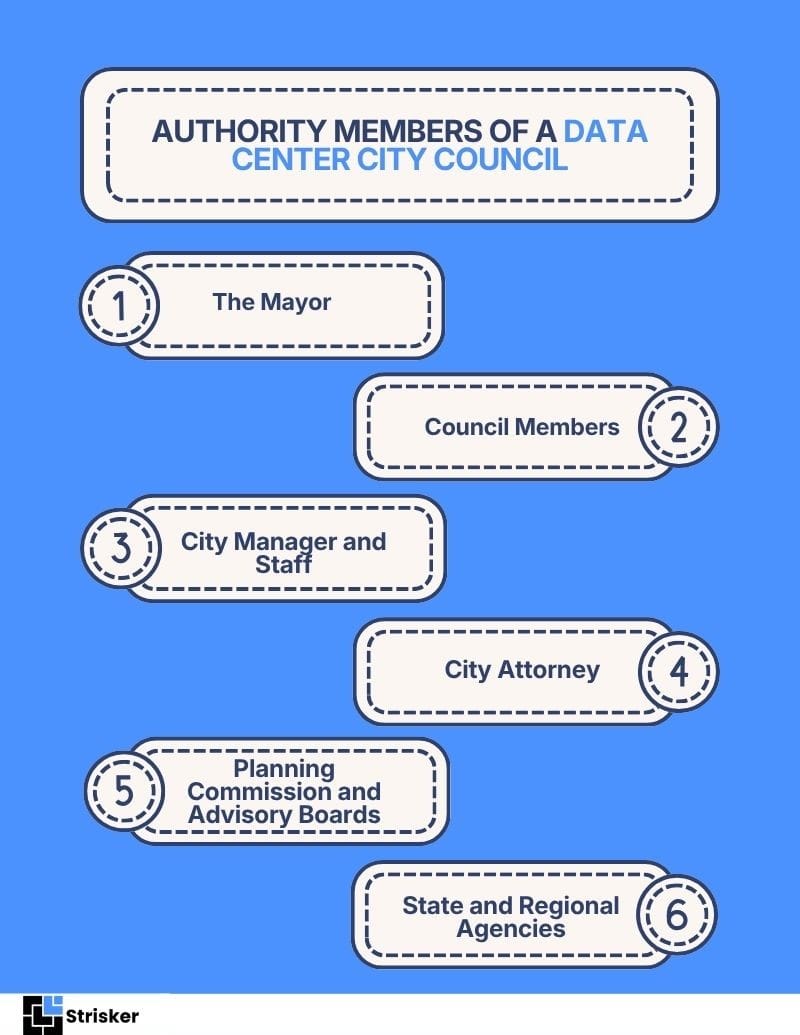
No single person has the authority to decide whether a data center gets built. Several individuals and professionals share decision-making power. However, the exact roles depend on each city's charter and state law. Here are the officials and bodies involved in the council’s decisions:
The Mayor
The mayor’s role differs from city to city. In some cities, the mayor leads the meetings, proposes policies, and has the power to veto actions taken by the council. The National League of Cities identifies five historic forms of municipal government: council-manager, mayor-council, commission, town meeting, and representative town meeting. Of these five, mayor-council and council-manager are the two most common. In a strong-mayor-council city, the mayor serves as the chief executive and can veto council actions. On the other hand, in a council-manager city, the mayor is a voting member of the council who presides over meetings but has few powers beyond those of other members.
Council Members
Council members cast the final vote on most land-use decisions, including zoning ordinances, rezoning approvals, and special use permit grants. For instance, the National League of Cities reports that Harrisonburg, Virginia, replaced its by-right allowance with a special-use permit requirement for data centers in industrial zones. Under this new rule, every data center application requires public hearings and city council approval.
City Manager and Staff
Staff review data center applications, assess them against zoning codes, and write reports for commissioners and council members. While their recommendations and evaluations are not binding, they influence and shape discussions.
City Attorney
The city attorney advises the council on legal limitations, including local power restrictions and the enforceability of proposed conditions. They also check whether proposed conditions, denials, or even moratoriums would withstand legal challenge.
Planning Commission and Advisory Boards
Most data center city councils rely on appointed planning commissions to hold the first public hearing on land-use matters and provide recommendations. The council can accept, modify, or reject these recommendations. Some other boards, such as the sustainability, utility, and water boards, sometimes contribute to the council’s reviews. These boards bring expertise on power, cooling, and environmental impacts.
State and Regional Agencies
Some data center issues are not covered within a council. For example, the City of Minneapolis states that Minnesota cities cannot set their own rules for building components or systems because state building codes govern them. The NLC also suggests that cities should work with utilities, regional partners, and public utility commissions on grid impacts and resource availability.
🗳️Path to a Council Vote
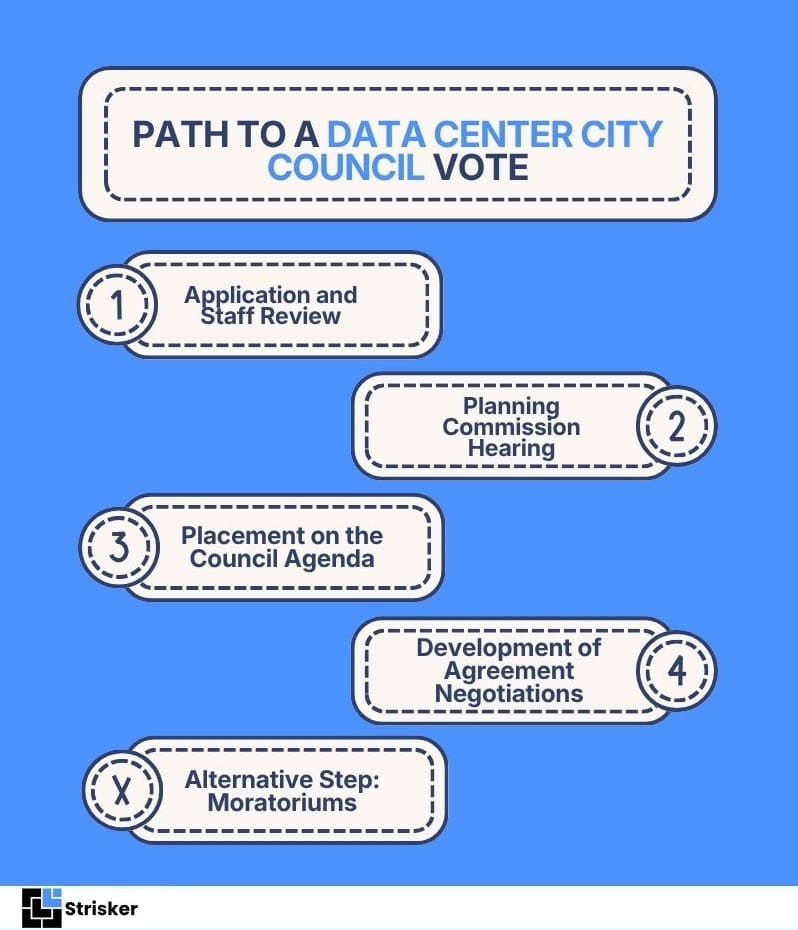
Even if there are differences in each city’s code and state’s enacted laws that determine the specific steps and timelines, a data center development proposal reaches the city council through a fairly consistent sequence:
Step 1: Application and Staff Review
The process formally starts when a developer applies for rezoning, permits, or site plan approvals. This often comes months after quieter pre-application meetings with staff. The staff evaluates and compares the proposal against the comprehensive plan, the zoning code, and grid capacity. Some may also require additional studies on traffic, noise, water resources, and electrical capacity before it moves forward.
Step 2: Planning Commission Hearing
After the application is completed, it will be forwarded to the planning commission for a noticed public hearing. This will provide the residents an initial opportunity to testify on the record, and the commission’s written recommendations will be included in the file for later review by the data center city council.
Step 3: Placement on the Council Agenda
After the planning commission issues its recommendations, the data center proposal is placed on the council agenda. State open-meeting laws usually require cities to publish agendas in advance. For example, Washington (RCW 42.30.077) requires that agendas for regular meetings be posted online at least 24 hours in advance. Most councils will initially discuss the proposal in a work session or committee before providing a schedule for action.
Step 4: Development of Agreement Negotiations
For large campuses, the city and the developer may negotiate a development agreement. This contract establishes a set of rules to be followed for a specified period in exchange for commitments like infrastructure payments, water recycling requirements, and phased construction. Some states have statutes authorizing development agreements, while approval processes vary. In California, a development agreement is a legislative action that requires approval by ordinance following a public hearing. That requirement brings the agreement before the council.
Alternative Step: Moratoriums
A data center city council does not always approve specific projects. Some cities choose to temporarily pause approvals and discussions of data center projects to allow time to revise rules and codes. In June 2026, the Spokane City Council passed Ordinance C36887, which imposes a one-year citywide temporary moratorium on the acceptance, processing, review, and approval of building permit applications for new data centers. This ordinance directs the city’s Climate Resilience and Sustainability Board and the Plan Commission to develop a Data Center Impact Review and Policy Framework.
This moratorium provides an opportunity for the city’s Climate Resilience and Sustainability Board and Plan Commissions to develop a Data Center Impact Review and Policy Framework.
⚖️ Council Decisions Factors
Council members evaluate the legal limits, public input and comments, and the details of each data center proposal. These are some of the factors that mostly come up when it comes to council decisions:
Water and Power Demand
This factor relates to the amount of water required for a data center's cooling systems and the electrical load placed on the local grid. These considerations are important because the resources involved are shared with homes and businesses. Developing a data center could disrupt water supplies, especially in drought-prone areas. Serving a large data center can also require new generation and transmission infrastructure. Even when data centers pay their full cost of service today, rising demand can raise system-wide costs that may fall on other ratepayers.
Tax Revenue and Economic Development
This factor examines the potential property tax revenue, investment, and job opportunities that a data center can bring to a city. The revenue generated can help fund local services while placing relatively low demands on schools, roads, and infrastructure. However, a data center employs fewer people once it starts its operations after construction. Councils should weigh the potential revenue against any tax abatements the developers request and the small number of permanent jobs the facility offers.
Land Use Compatibility and Neighborhood Impacts
It addresses how a data center interacts with its surroundings, focusing on several important factors. These include noise from cooling equipment and backup generators, the scale of the building, nighttime lighting, and construction traffic. All of these elements are crucial, as they can affect nearby residents and lead to public opposition. This is why the council will take these factors into account and impose setbacks, sound limits, and landscaped buffers to mitigate the potential impacts of data centers.
Legal Exposure and Regulatory Readiness
This factor focuses on whether the city's existing regulations are sufficient to manage a proposed data center facility. The council will also consider whether their decision can withstand a legal challenge. These elements are important because they could expose the city to lawsuits if a data center is approved or denied under laws that are not clearly defined.
Conclusion
The growth of the data center industry has underscored the importance of a data center city council, which plays a crucial role in establishing and enforcing regulations, restrictions, and guidelines for these developments at the local level. Various members and authorities make up a data center city council, which follows specific procedures before taking a vote.
It mitigates the impact of data centers on different aspects, including the power grid, water resources, environmental impact, and public sentiment. The council members, staff, and advisory board also ensure awareness and compliance with data center city council decisions. Strisker provides tools, features, and newsletters to keep you informed about new data center city council meetings and decisions.
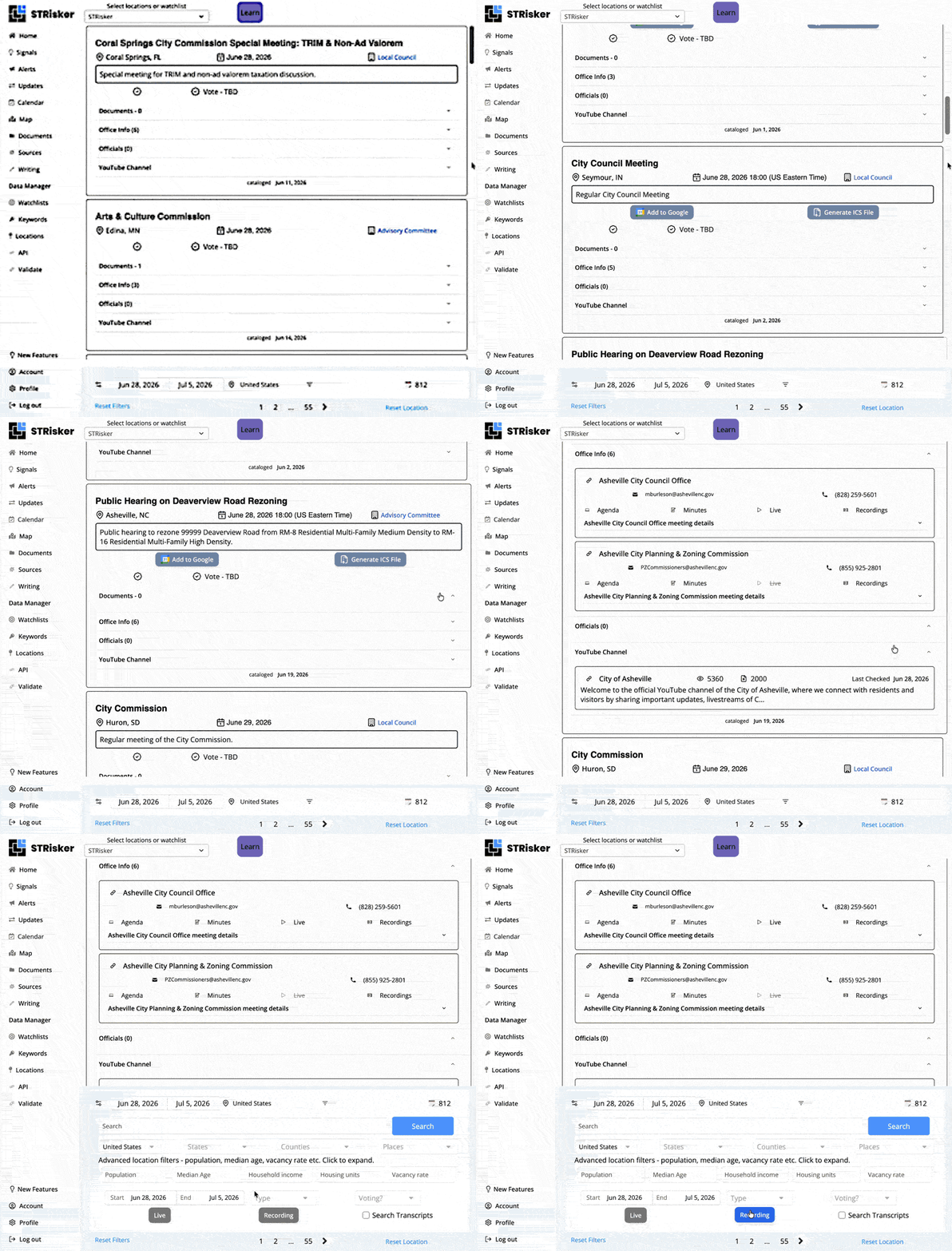
Strisker Calendar Tracker
Staying ahead of STR and data center regulations isn’t just about deadlines—it’s about knowing what’s coming. Our Calendar Tracker keeps you informed on upcoming meetings, key votes, and policy changes, so you never miss a critical update.
FAQs
What power does a city council have over a proposed data center?
A city council typically has the final authority on land-use decisions required for many data centers. These decisions can include rezonings and amendments to the zoning ordinance, such as defining data centers, establishing setbacks, and setting noise limits. Depending on the city, the council may also vote on special use permits; in some cities, these are delegated to a planning commission or zoning approval board. Additionally, councils can adopt temporary moratoriums where permitted by state law. They can negotiate community benefits through development agreements or incorporate them as conditions for approvals.
How can residents influence a city council vote on a data center?
Residents can influence a city council vote on a data center by doing the following:
- Get involved early at the planning commission stage before the proposal reaches the council
- Monitor council and planning agendas and submit written comments
- Testify at public hearings and keep testimony factual and on the record, since some permit hearings bar council members from discussing the case privately with residents
- File public record requests and push for disclosure policies that regulate non-disclosure agreements (NDAs) with developers
- Promote zoning rules on data centers such as setbacks, noise limits, and water-use standards
- Organize and form coalitions and push for community benefit agreements (CBAs) or binding approval conditions
- Utilize referendums or ballot measures where state law allows, taking into account that these often apply to rezoning or have strict petition deadlines.
What should residents ask before a city council approves a data center?
Prior to the city council's approval of data centers, residents and their local leaders may request more detailed information regarding the data center's energy, water, financial, and environmental impacts to safeguard their community. Here are some of the details they may request:
- Energy and grid impact: How much power will it use? Who pays for grid upgrades? Could those costs be passed on to other customers?
- Water usage and cooling requirements: How much water will it use? Where is the source of that water? What happens during a drought?
- Noise levels, emissions, and setbacks: How many backup diesel generators will it have? How often will they run for testing? How far will buildings sit from homes?
- Financial aspects, taxes, and job stability: What tax breaks is the developer asking for? How long do these breaks last? Can they be revoked?
Stay Updated with Strisker!
Strisker offers tools and features to keep you updated with the Short Term Rental movement (and now Data Centers!) movement across the world.
👍 We’d love your feedback.
We're always looking for ways to improve our content.
Was this one useful to you? Other topics you'd like to see get covered?
✉️ Just reply directly to this email. We read and respond to every message!
-Will McClure
🙋 P.S.
Know someone else who might be interested in this content? Feel free to forward this along.