
Data Center Ordinance: Benefits, Key Topics, and Common Requirements
Learn what a data center ordinance is, its benefits to developers, residents and municipalities, and the topics and common requirements it covers.
At A Glance 🔽
- A data center ordinance is a local law or municipal code amendment that designates data centers as their own land‑use category instead of including them in generic industrial or commercial zoning.
- These ordinances exist because data centers do not align with previous zoning categories. Categories such as power, noise, and water use require general benchmarks that some industrial zones do not cover.
- A data center ordinance also establishes standards for zoning districts, setbacks and buffers, site and building design, noise and light, utility capacity, and environmental reviews.
- Common ordinance requirements, such as setback distances, noise limits, acoustical studies, generator emissions and testing, water use agreements and studies, security and fencing, decommissioning bonds, and renewable energy and reporting conditions, can vary depending on the assessment of the local governments.
Definition
A data center ordinance is a local law, usually part of a municipality’s zoning rules, that governs where and how data centers can be constructed and operated within a jurisdiction. These ordinances provide and set definitions based on square footage, from minor, medium, major, to even campus-scale buildings) instead of just setting data centers like other industrial buildings and warehouses.
It is also worth noting that a data center ordinance is different from a data center moratorium. A moratorium is a temporary ban on new approvals and permits to give jurisdictions more time to evaluate the impacts of a data center in a location. An ordinance, on the other hand, is a permanent framework that can replace this pause.
➕Benefits
A data center ordinance provides a clear, published set of rules in advance for the different sides of data center debates. Developers and owners can identify what a data center construction has to deliver before land acquisition or data center application. On the other hand, residents can be assured that their protection is in writing instead of just relying on promises from public hearings.
Here are some of the benefits of having a data center ordinance:
For Developers
A clear and explicit ordinance outlines the standards and guidelines a data center project must meet before submitting applications. Identifying setback, height, and review requirements from the start, rather than discovering them mid‑application, reduces timelines and prevents confusion over undefined standards. This allows developers to assess site feasibility before investing in land options and conducting engineering studies. Simply to say, a data center ordinance also helps them avoid negotiating every term from scratch.
For Residents
A data center ordinance safeguards residents by defining strict noise and light limits, ensuring that these facilities do not disturb their sleep or quality of life. These ordinances also set buffers and data center zoning boundaries that keep large data centers away from homes. The tax revenues secured from these data centers can also be distributed to schools, roads, and emergency services, supporting community growth.
For Municipalities
Having an established ordinance sets case-to-case negotiations into a standard process. It provides staff and elected officials with distinct criteria in assessing data center applications instead of having debates every time a new data center project arrives. This ordinance also protects the fiscal upside where research from the Municipal Research and Services Center shows that jurisdictions like Quincy, Washington, and Henrico County, Virginia presented data center tax revenue directly into the infrastructure and affordable housing funds. Meaning to say, a data center tax revenue is useful for local development if jurisdictions set up distinct structures to control and manage it.
📚Topics Covered in Data Center Ordinance
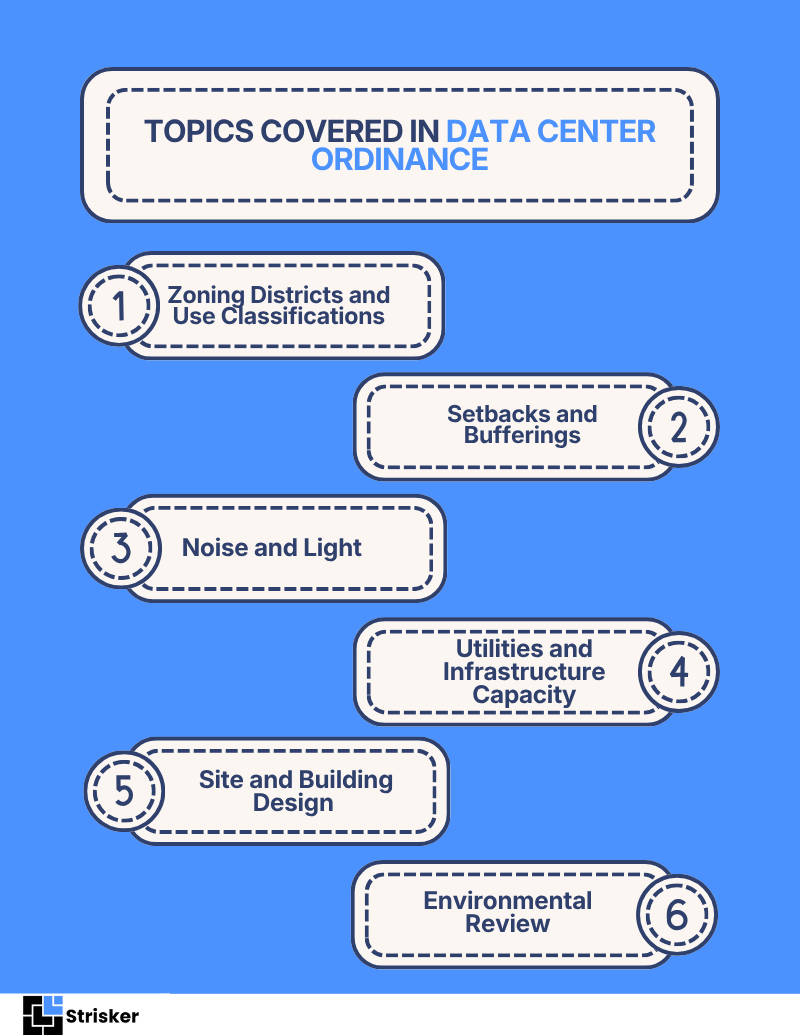
Most data center ordinances are established by determining where facilities are permitted to be built and then adding physical and operational benchmarks for additional facilities constructed there. The physical benchmarks focus on the impacts the surrounding communities might notice, such as property lines, noise, and water resources. Operational benchmarks address the life of the facility and its conditions after shutdown. The following are the common subject areas that a data center ordinance usually covers:
Zoning Districts and Use Classifications
This specifies which zoning districts explicitly allow data centers, which zoning districts require conditional use permits and public hearings, and which zoning districts ban them entirely. Zoning districts are usually the first element an ordinance defines, since other standards rely on this classification.
Setbacks and Bufferings
This topic pertains to the minimum distance a data center facility and its equipment must maintain from residential, commercial, or agricultural property lines. These buffer requirements prevent noise, lighting, and visual impacts from affecting the surrounding neighborhood.
Noise and Light
It focuses on restricting the sound generated by generators and cooling systems, along with the lighting levels of data center facilities near schools, hospitals, and communities. These restrictions are imposed immediately after a facility opens, since they are the first things nearby residents notice.
Utilities and Infrastructure Capacity
A data center ordinance requires developers to provide written confirmation from the utility providers that the local electric grid, water supply, and sewer system can handle the load without affecting service to existing customers. It ensures that the local government approves only these projects if the infrastructures can actually be supported.
Site and Building Design
This topic discusses height limits, minimum and maximum lot sizes, screening requirements for rooftop or ground‑mounted equipment, and external materials. These design standards ensure that large industrial‑scale buildings are visually compatible with neighboring areas.
Environmental Review
It focuses on stormwater management, air quality compliance, and, in some locations, groundwater studies for data centers that rely on evaporative cooling. These reviews ensure that the environmental footprints of the facilities are evaluated before construction.
📋Common Ordinance Requirements
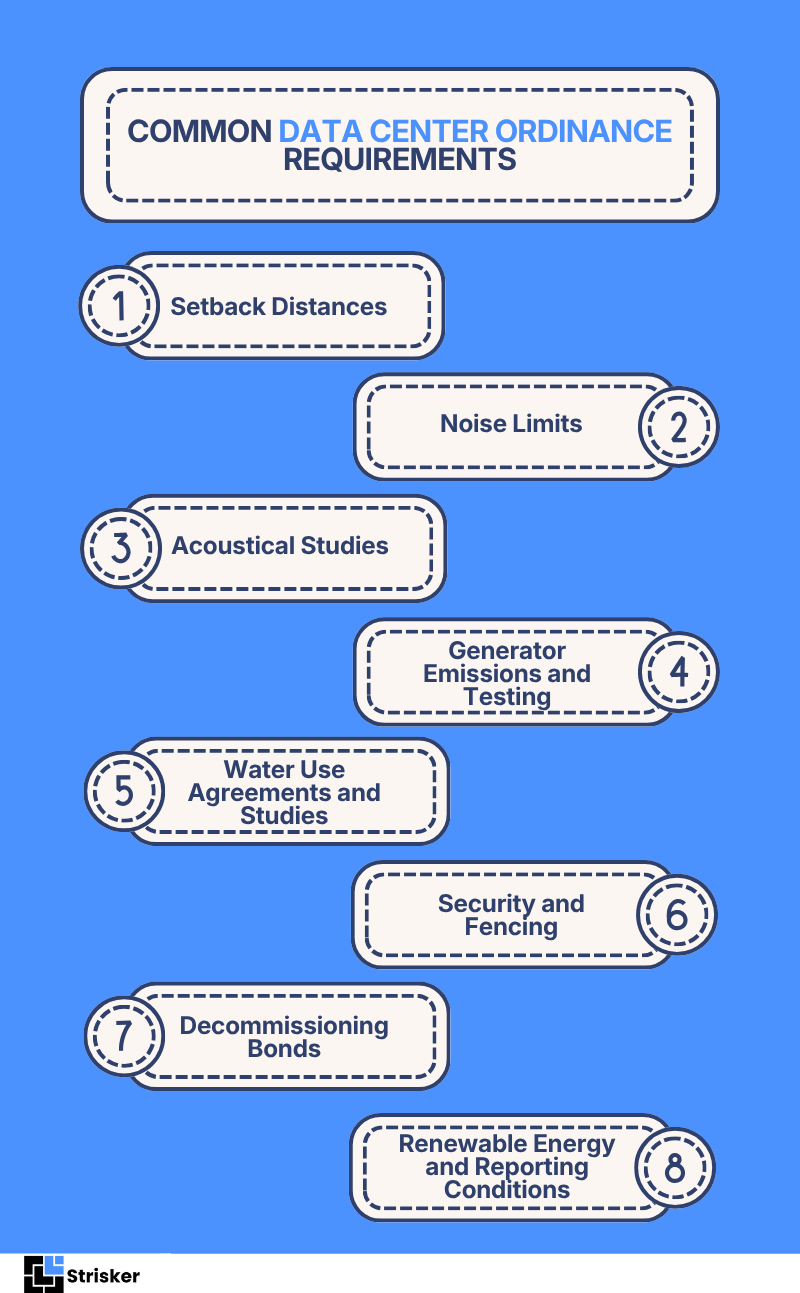
A jurisdiction with larger open land can manage larger setbacks than a small municipality with limited industrial estates, making exact thresholds differ from one jurisdiction to another. However, ordinances passed across different states from 2025 to 2026 tend to have similar numeric standards for distance, noise, and other factors. The example requirements below illustrate how those standards are typically defined:
- Setback Distances - The National Association of Counties(NACo) determines that some jurisdictions are setting setback requirements from 200 feet to up to 500 feet from a residential property or zoning district. Some localities even extend this setback as high as 1,000 feet for largest data center projects.
- Noise Limits - NACo also sets maximum levels at around 65 decibels in general areas and 55 decibels in residential or quieter areas. However, this can still vary across jurisdictions, with some setting the limit at 50 decibels, such as Henry County, Virginia, while others extend it up to 75 decibels, as in Calvert County, Maryland.
- Acoustical Studies - This is a requirement where a third-party acoustical engineer executes pre-construction sound study or post-construction study. They may also conduct annual noise testing for the life of the data center facility.
- Generator Emissions and Testing - This requirement verifies that backup diesel generators comply with the U.S. Environmental Protection Agency Tier 4 emissions standards, which are supported by annual testing and reporting to the local government.
- Water Use Agreements and Studies - This requirement pertains to a water availability study completed to large projects, while developers must also sign a water use agreement with the local government.
- Security and Fencing - This specifies the minimum fence height, which is usually around seven feet, with anti‑climb features typically required to be placed inside the landscaped buffer.
- Decommissioning Bonds - If the facility is later abandoned or closed, a financial guarantee posted before construction can help cover the cost of removing equipment and restoring the site.
- Renewable Energy and Reporting Conditions - It focuses on submitting the energy sourcing or renewable energy procurement of facilities instead of drawing down capacity committed to the local grid.
Conclusion
Data center ordinances are determined because the older zoning playbook that treats hyperscale data centers like any other industrial buildings no longer suits the scale of what’s being constructed. The details for these ordinances vary by jurisdiction, but the purpose is still consistent. This is to give developers a standard framework to follow, assure residents of protection, and provide local governments with conventional benchmarks.
Municipalities, developers, and residents need to comprehend the topics and requirements that influence these ordinances, since details and decisions differ from one jurisdiction to the others. Strisker provides tools, features, and newsletters that will provide you recent updates on these evolving ordinances.
FAQs
How can residents influence a proposed data center ordinance?
Residents can influence a proposed data center ordinance in the following ways:
- Actively participating in public hearings
- Pressing local officials for specific rules on noise, water, and zoning
- Advocating for temporary moratoriums
- Forming and organizing grassroots coalitions
- Demanding conditional use and special use permits
What happens to existing data centers when a new ordinance passes?
Through grandfathered rights, existing data centers generally retain their legal status as non‑conforming uses even if a new local zoning ordinance or moratorium is passed. This allows them to continue operations unless a law or regulation mandates retroactive compliance for ongoing facilities.
How are data center ordinance violations enforced?
Data center ordinance violations are usually enforced by municipal code enforcement officers, state environmental regulators, and local zoning boards. Some of the mechanisms for these violations include:
- Permit denials
- Financial penalties
- Legal and criminal cases
- Code enforcement actions
Stay Updated with Strisker!
Strisker offers tools and features to keep you updated with the Short Term Rental movement (and now Data Centers!) movement across the world.
👍 We’d love your feedback.
We're always looking for ways to improve our content.
Was this one useful to you? Other topics you'd like to see get covered?
✉️ Just reply directly to this email. We read and respond to every message!
-Will McClure
🙋 P.S.
Know someone else who might be interested in this content? Feel free to forward this along.