
Data Centers: Daily Notes | August 12, 2026
Missouri lawmakers announced plans for AI and data center legislation in 2027; New Mexico Democratic lawmakers got a first hearing on a proposed statewide data center moratorium; Moffat County commissioners weighed a possible data center moratorium. READ MORE.


At A Glance 🔽
- Missouri lawmakers announced plans for AI and data center legislation in 2027, releasing an evaluation framework in the meantime to help local governments assess proposals.
- New Mexico Democratic lawmakers got a first hearing on a proposed statewide data center moratorium.
- Stowe Township, Pennsylvania officials moved to quash rumors of a planned data center at a former industrial site, clarifying that the property owner is only clearing land for future industrial buildings.
- Moffat County, Colorado commissioners weighed a possible data center moratorium while the commission chair defended her disclosure of prior conversations with companies eyeing a former mine site.
- Broken Bow, Nebraska heard the first reading of an ordinance imposing strict requirements on data center construction, including decommissioning bonds and disclosure of foreign ownership.
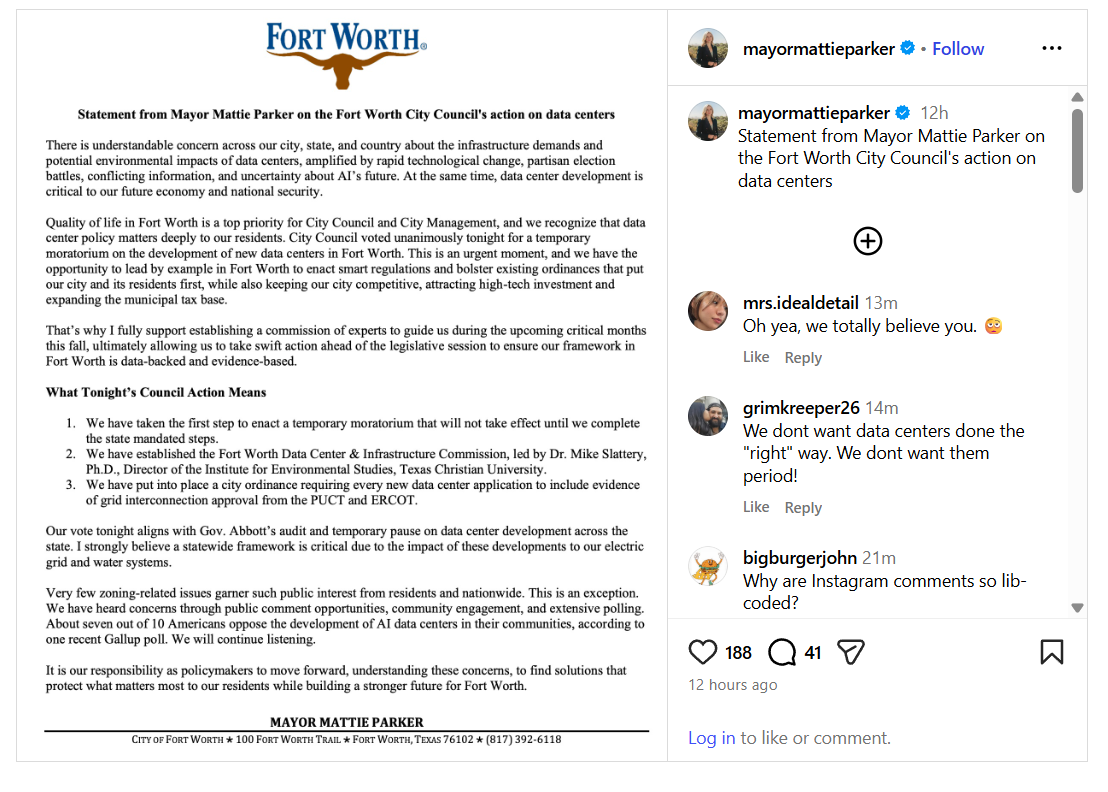
- Fort Worth, Texas laid out a formal plan to regulate data centers, including beginning the legal process for a temporary moratorium after its Zoning Commission rejected earlier rule changes.
- Pulaski County, Arkansas advanced a new regulatory ordinance classifying large-scale data centers as heavy industrial and requiring a Conditional Use Permit, ahead of a full vote set for Aug. 25.
- Independence County, Arkansas enacted a data center moratorium running until 2031, acting preemptively despite having no specific project currently proposed.
- Montgomery County, Georgia completed a first reading of an unusually strict data center ordinance featuring steep buffers, noise caps and a ban on seeking tax abatements.
- Conneaut, Ohio City Council voted against a one-year data center moratorium, rejecting the measure despite months of resident pressure over noise and utility concerns.
Missouri
A bipartisan group of Missouri lawmakers announced plans to introduce artificial intelligence and data center legislation once the legislature reconvenes in January 2027, unveiling a new evaluation framework in the meantime to help local governments assess data center proposals.
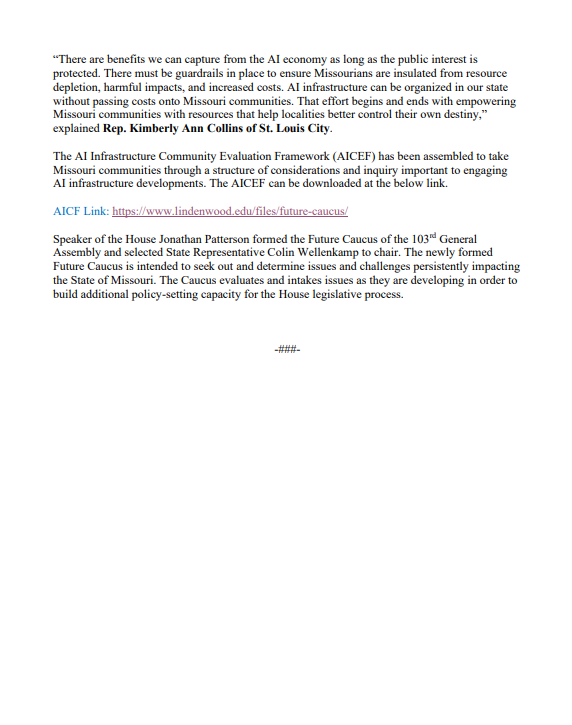
House Future Caucus Unveils Strategy to Empower and Protect Communities Engaging the AI Economy
The Missouri House Future Caucus released the AI Infrastructure Community Evaluation Framework at Lindenwood University in St. Charles, alongside plans for future bills covering residential energy customer protections, limits on AI's use in healthcare, and liability rules for AI-related mistakes. Caucus chair and Republican Rep. Colin Wellenkamp said the framework is meant to let communities engage with the AI economy proactively while lawmakers work through the slower legislative process; he said a special session is unlikely, a position Gov. Mike Kehoe has also taken given the issue's complexity. Democratic Rep. Kimberly Ann Collins said caucus members broadly agree on the need for regulation, and Republican Rep. Mike Costlow said Missouri should learn from other states that gave data centers incentives at residents' expense.
New Mexico
New Mexico Democratic lawmakers got a first hearing Tuesday on a proposed statewide moratorium on data centers, an idea Republicans on the legislative committee met with skepticism.
 Jordan Honeycutt
Reps. Micaela Lara Cadena and Angelica Rubio, both Doña Ana County Democrats, said they plan to introduce the moratorium bill in the session starting January, citing Project Jupiter, the Oracle- and OpenAI-backed data center project in their county, as the reason. Oracle has said the project is on pace to create 7,000 construction jobs and 1,500 ongoing jobs once built, and had delivered $80 million in tax revenue as of July. Republican Rep. Joshua Hernandez argued data centers are inevitable given the growth of AI and said New Mexico shouldn't miss out on the investment, while Lara Cadena said that inevitability doesn't mean the state should "roll out red carpets" for the industry.
Rubio criticized the Doña Ana County Commission's approval of $165 million in industrial revenue bonds for Project Jupiter last September as insufficiently transparent, and said the project exemplifies why a statewide pause is needed. Lara Cadena noted that Santa Fe, Sierra and Socorro counties have already adopted their own year-to-18-month moratoriums, and Bernalillo County has passed a resolution establishing guardrails. Republican Sen. Nicole Tobiassen called for more fact-finding before legislation moves forward, and Sen. Jay Block requested a formal economic impact analysis on potential job and tax revenue losses from a moratorium.
New Mexico Democratic lawmakers discuss possibilities for proposed statewide data center moratorium https://t.co/5LLFBt5zXc
— William Brown (@brkingsmtnwest) August 12, 2026
Stowe Township, Pennsylvania
Officials in Stowe Township, Pennsylvania moved to quash rumors of a planned data center at a 72-acre former industrial site along the Ohio River at Tuesday's commissioners meeting, after months of confusion fueled by social media and news reports.
 Mia Hollie
Township Solicitor Bradley Matta said there's no data center proposal before the board, and SunCap Property Group's Matt Virgin, whose company owns the former Pressed Steel Car Company site, said the firm is still just clearing and grading the property for potential future industrial buildings, with no data center ever in the works. Commissioner Tyler Kochirka said he pressed SunCap representatives repeatedly to confirm this before the meeting. SunCap had lobbied the township last year to add data centers as an allowable industrial use, citing shifting market conditions and slower site progress, and commissioners approved an ordinance in December permitting them in the township's industrial areas.
Residents including Sara Eve Rivera attributed the confusion to inadequate direct communication from local government, saying they often turn to Facebook for updates instead. Commissioner Shyanne Rippole said the township has struggled with transparency for years, noting she could only access 2024 meeting minutes while campaigning for her seat, and said current officials are working to fix that through a newly updated website and plans to stream meetings online.
Moffat County, Colorado
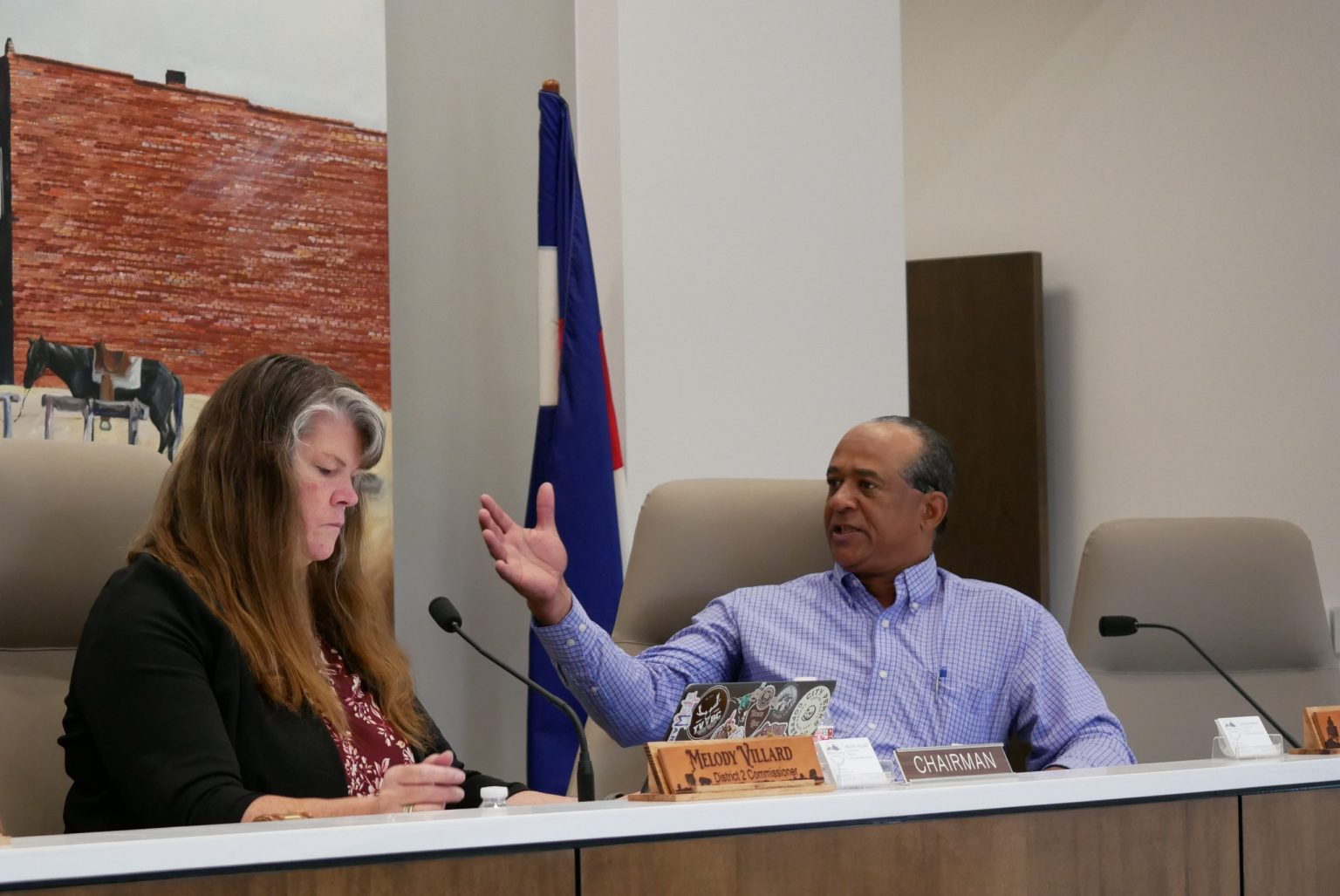
Moffat County, Colorado commissioners weighed a possible moratorium on data center development at Tuesday's meeting, as Commission Chair Melody Villard kept defending the county's disclosure of prior conversations with companies eyeing the Trapper area.
Both Commissioner Tony Bohrer and Commissioner Donald Broom said they'd back a pause on development while the county collects information and public feedback, with Bohrer floating a timeframe of two to five years; the board did not formally introduce or vote on a moratorium. The talks followed revelations that Villard and Natural Resources Director Jeff Comstock had met with representatives from Pure-Green and Toto Labs before an Aug. 5 public meeting, and that Villard had signed letters in April and July referencing Pure-Green's interest in redeveloping the Trapper Mine property for geothermal energy and advanced computing, without using the term "data center" in either. Villard said the county has to remain receptive to economic development inquiries given the upcoming closures of Craig Station and Trapper Mine, and argued that disclosing every early-stage conversation risked alarming residents over ideas that might never go anywhere.
Broken Bow, Nebraska
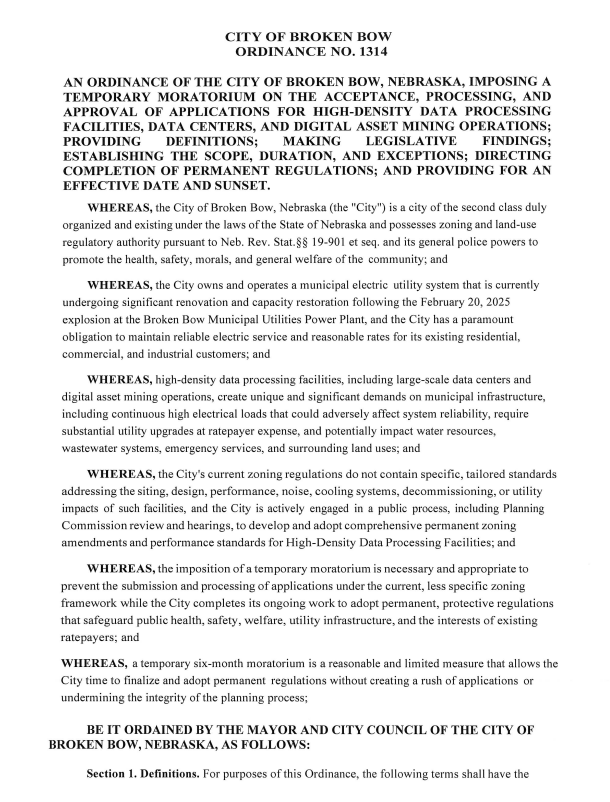
The Broken Bow, Nebraska City Council heard the first reading of an ordinance imposing strict requirements on data center construction at its Aug. 11 meeting, part of a broader package addressing both data centers and license plate reader cameras.
 Doug
Doug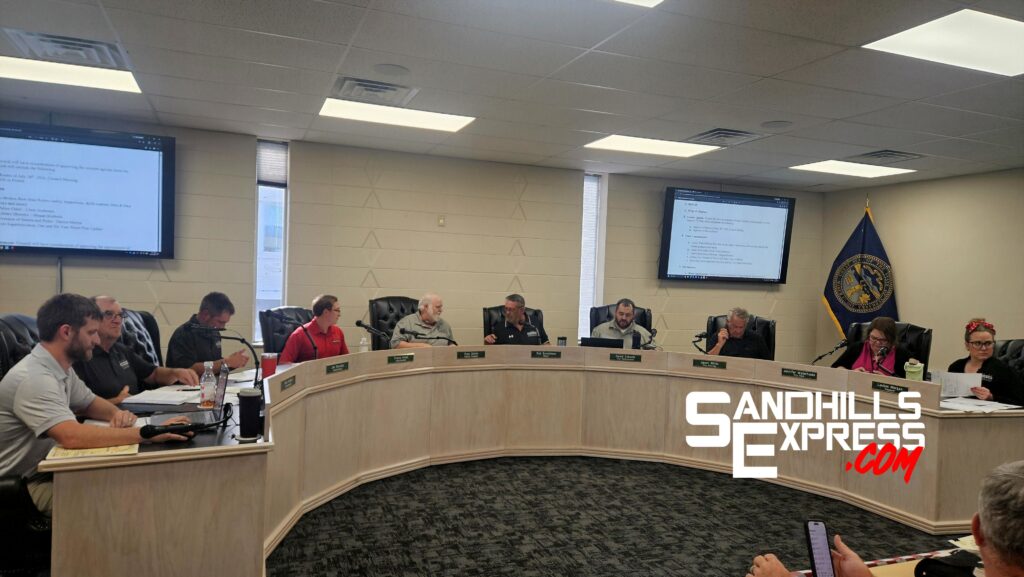
Ordinance 1317, presented by Zoning Administrator Jacob Holcomb, would require pre-development and ongoing noise studies, close regulation of water and electric usage, and mandate that companies cover 100% of any municipal infrastructure upgrades needed for the facility. Developers would also have to post a decommissioning bond equal to 150% of anticipated costs, undergo criminal background checks for major owners, and disclose any foreign ownership or control. Holcomb said the city can't outright ban data centers but can use zoning authority to regulate them, and said the ordinance has drawn interest from multiple counties, cities and villages using it as a template.
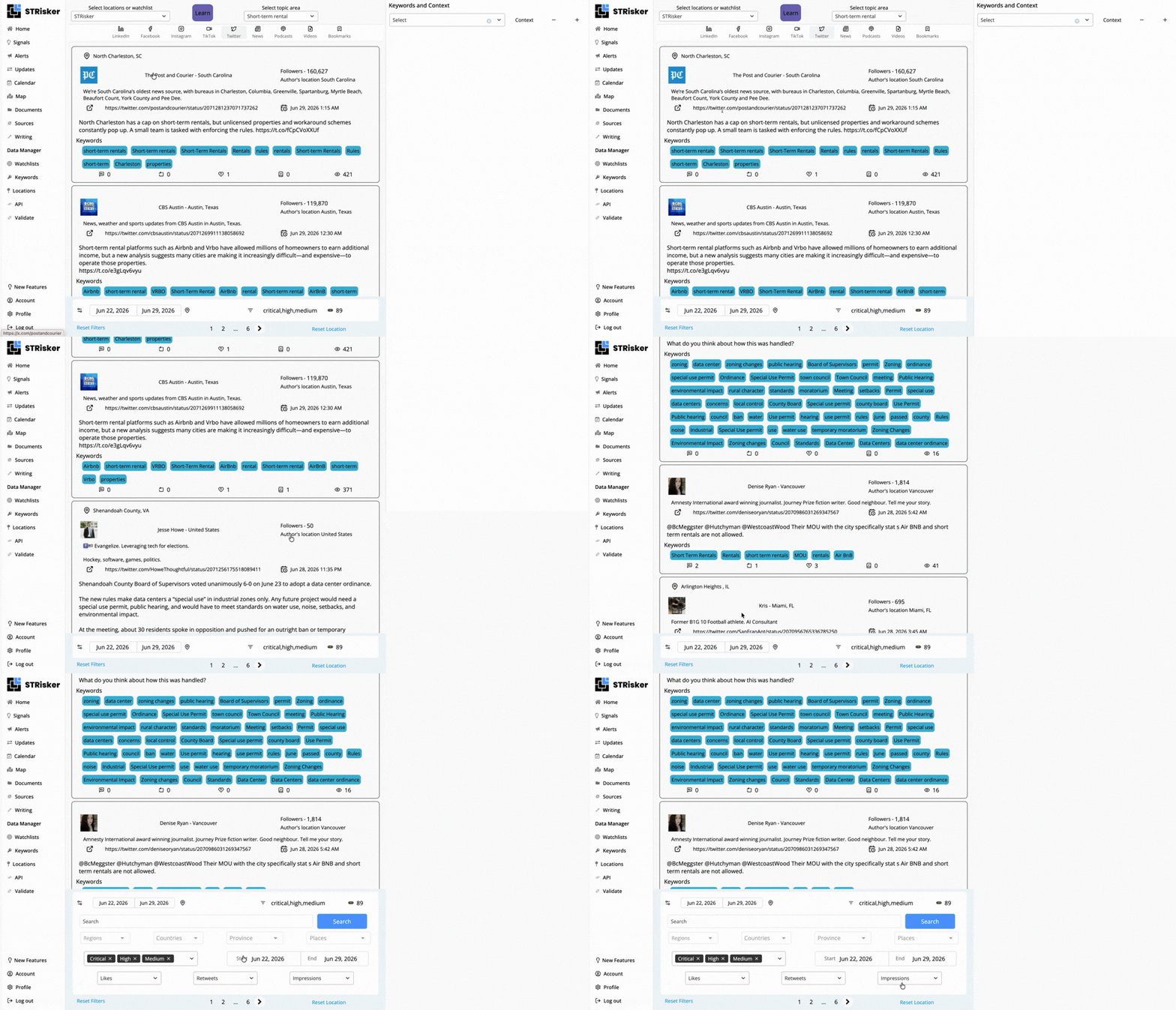
Social Listening📱: Twitter
Strisker’s Twitter Signal pulls real-time posts from officials, agencies, advocacy groups, and local influencers—so you see emerging sentiment and policy signals the moment they surface. Track conversations by place, people, and topics, then zero in on what actually matters.
Fort Worth, Texas
Fort Worth city leaders laid out a formal plan to regulate data centers, including beginning the legal process for a temporary moratorium, after the city's Zoning Commission voted earlier this summer against amending zoning rules to address the facilities.
Assistant City Manager Jesica McEachern outlined three possible actions:
starting the moratorium process
creating an 11-member Data Center and Infrastructure Commission
requiring developers to show proof of state grid interconnection approval before building.
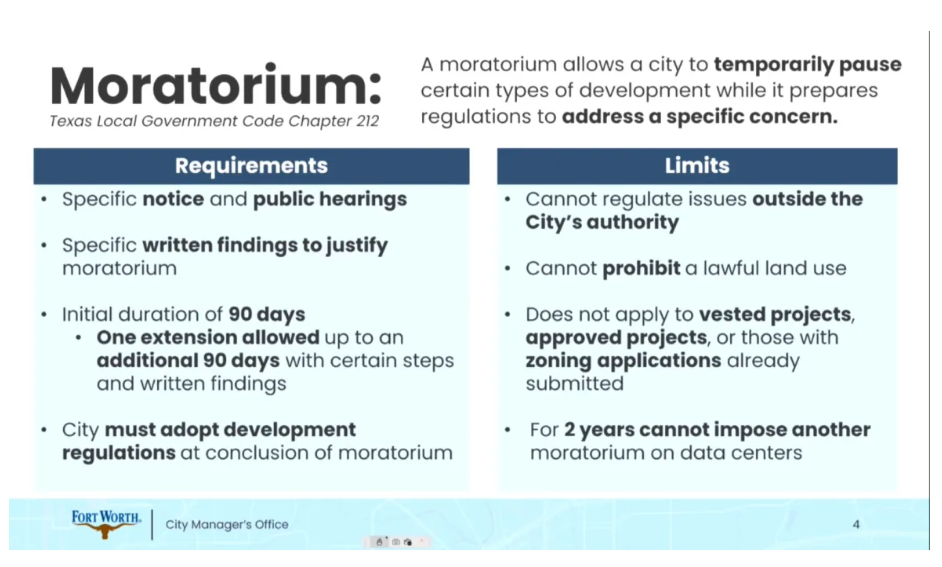
Under Texas law, the city can't simply pause development without submitting written findings showing existing regulations are inadequate to prevent harm to public health, safety or welfare; any moratorium would be capped at 90 days initially, extendable to 180 with additional hearings, and the city would then be barred from another moratorium for two years. Projects already in the development pipeline before any new rules take effect could retain the right to build under current standards.
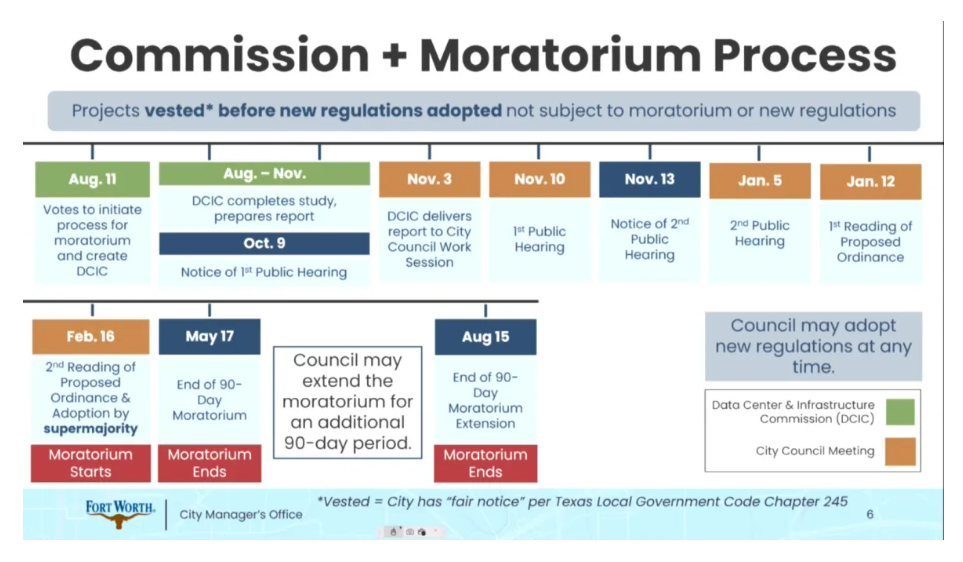
The proposed data center commission, potentially chaired by TCU's Dr. Mike Slattery, would study electricity and water demand, land use and neighborhood impacts, and economic effects, presenting findings to the council Nov. 3 ahead of moratorium public hearings and a possible final vote Feb. 16.
Pulaski County, Arkansas
Pulaski County justices advance new regulations for large-scale data centers
The Pulaski County, Arkansas Quorum Court advanced a new regulatory ordinance for large-scale data centers Tuesday at an agenda-setting vote, drawing a large crowd ahead of a full vote scheduled for Aug. 25.
The ordinance, sponsored by Justices Julie Blackwood, Capps, Davis and Massey, would classify qualifying facilities, so-called "High-Intensity Digital Infrastructure Uses," as heavy industrial and require a Conditional Use Permit before construction or operation. A project would qualify if it meets thresholds including 10 megawatts of continuous electrical demand, 100,000 square feet of computing infrastructure, 100,000 gallons of daily water use, or 3 megawatts of on-site generation or battery storage, and facilities could not be split into smaller pieces to dodge the rules.
The measure sets a 500-foot setback from residential property for major components, caps noise at 65 decibels by day and 55 at night at the nearest nonindustrial property line, and requires a $25,000 non-refundable application fee plus a $100,000 review escrow that could grow with project size, along with a decommissioning plan and financial assurance to cover eventual removal costs. The ordinance carries an emergency clause taking effect immediately upon passage, and county officials say it's meant to close a regulatory gap while large projects are pending.
Independence County, Arkansas
Independence County enacted a data center moratorium set to run until 2031, despite having no specific project currently proposed for the county.
County Judge Kevin Jeffery said officials wanted to act preemptively rather than face a decision that couldn't easily be reversed, citing uncertainty around data centers' water and power consumption. He pointed to existing strain on local water supply, noting poultry farms in the county have already had to have water trucked in. Justice of the Peace Brad Covington described the move as a preventative measure, saying data centers demand significant water and electricity the county can't afford to take for granted, and questioned what the county would actually gain given the facilities typically bring few jobs or direct revenue.
Montgomery County, Georgia
Montgomery County, Georgia commissioners completed a first reading Monday of an unusually strict data center ordinance, which County Attorney Ron Daniels called perhaps the most restrictive special use permit for data centers among Georgia counties without zoning.
 Makaylee Randolph News Editor and mrandolphadvance@gmail.com
The ordinance requires a $10,000 application fee, disclosure of ownership and foreign control, a sworn statement that the applicant won't seek a tax abatement, an independent environmental impact study, and two public community meetings held between 5 and 8 p.m. before commissioners review any application. Physical requirements include a 1,500-foot buffer from property lines, a 3-mile distance from bodies of water and irrigated farmland, a cap of 35 decibels measured 25 feet from the property line, mandatory "Go Away Green" paint, and a rule that three acres must remain undisturbed for every acre developed. The ordinance is now open for review for a month before the next commission meeting.
Conneaut, Ohio
Conneaut City Council voted 2-4 against a one-year moratorium on data centers Monday, rejecting the measure on its third reading despite months of resident pressure.
The moratorium, proposed by Councilperson-at-large Mariana Branch, had support from Branch and Third Ward Councilperson Oakey Emery, while Councilperson-at-large Nick Perkoski voted to declare it an emergency but against final passage; First Ward Councilperson Rick Gaugh was absent. No official data center proposal has been filed with the city, though a firm is studying feasibility at the Conneaut East Industrial Park, and residents including Robert Campbell and Sandy Shellenberger raised concerns about noise, utility costs and air quality.
Council separately failed to gather enough votes to waive the three-reading requirement for a ballot measure that would cap data centers in the city at 25 megawatts, sending that ordinance to a third reading as well; City Law Director John Lewis said a special election may be needed if the charter amendment moves forward, at the city's full expense. Council did unanimously approve amendments strengthening the ad hoc committee's ordinance and plans to hold public forums as the committee continues its work.
📱 Social Buzz
Episode Title: Ohio GOP Scramble | Who Replaces D.J. Swearingen in House District 89?
Episode: Ohio Political News
Listen:https://www.spreaker.com/episode/ohio-gop-scramble-who-replaces-d-j-swearingen-in-house-district-89--73790347
Spotsylvania County has joined the call for a data center moratorium. We need to pump the brakes and take the time to put Virginia’s interests first. https://t.co/q2DwooSwbr
— Glen Sturtevant (@GlenSturtevant) August 12, 2026
(10/) Data centers are not the problem. Bad policy is.
— Texas Policy Research (@TXPolResearch) August 12, 2026
We break down Fort Worth's proposed moratorium, Abbott's statewide pause, & what it could mean for competition, property rights, infrastructure, & innovation in Texas. #txlege ⤵️https://t.co/C1cccg4CYl
Marshalltown city council passes first reading of data center moratorium — Motion to waive second and third readings fails with lack of 3/4 supermajorityhttps://t.co/frzNyVPiFQ pic.twitter.com/JIFiaLR1ml
— Times-Republican (@marshalltowntr) August 12, 2026
What started as a policy paper on transparency for data center water usage out of the Aspen Institute became a law in Utah. This is pretty cool. https://t.co/zePJEI4FCy
— Chris Teale (@chris_teale) August 12, 2026
The Aurora City Council passed a resolution giving the city manager 35 days to draft data center regulations. https://t.co/MCYYq6SOCz
— Denver Business Journal (@denbizjournal) August 12, 2026
Stay Updated with STRisker!
STRisker offers tools and features to keep you updated with the Short Term Rental and Data Centers movement across the world.
👍 We’d love your feedback.
Which stories hit? Which ones missed?
We're exploring a new branch of topics centered around Data Centers and want to make it even more useful for you.
✉️ Just reply directly to this email. We read and respond to every message!
-Will McClure
🙋 P.S.
Know someone else who should be reading Daily Notes? Feel free to forward this along. We’re opening a few more spots.