
Data Centers: Daily Notes | August 20, 2026
Tulsa County is seeing Google confirmed as the end user behind Project Clydesdale; Bay City is developing data center zoning standards; Nye County, Nevada banned data centers; Butte-Silver Bow County; St. Joseph County; Tulare County; Piedmont; Austin; Sioux Falls. READ MORE.


At A Glance 🔽
- Tulsa County, Oklahoma is seeing Google confirmed as the end user behind Project Clydesdale, a 506-acre data center campus under construction, as community concerns continue over the project's rezoning, water infrastructure, and limited public engagement.
- Bay City, Michigan is developing data center zoning standards covering facility size, power demand, water use, noise, and decommissioning, with a planning commission subcommittee set to study the draft before revisiting it in October.
- Nye County, Nevada banned data centers in the Pahrump Valley groundwater basin while preparing separate land-use and permitting standards for potential facilities elsewhere in the county.
- Butte-Silver Bow County, Montana is awaiting a court ruling on whether residents can revive a data center ballot initiative after county officials rejected thousands of petition signatures under a recently adopted state law.
- St. Joseph County, Indiana postponed a vote on expanding a TIF district to include Microsoft's data center project as officials and residents seek greater clarity on how the resulting tax revenue would be used.
- Tulare County, California is facing calls for a permanent data center ban after residents welcomed the county's 45-day moratorium on new facilities and continued raising concerns over public health, infrastructure, land, air, and water resources.
- Piedmont, Oklahoma residents are gathering signatures for initiatives that could impose a temporary data center moratorium, establish impact studies, and require voter approval for Project Open Sky amid concerns over agricultural water use.
- Austin, Texas is preparing new data center regulations addressing siting, zoning, water efficiency, noise, and lighting as officials anticipate larger facilities seeking to locate in the city.
- Sioux Falls, South Dakota is opposing a proposed data center moratorium in favor of establishing clear regulatory guardrails that would allow the city to evaluate future projects while remaining open to development.
Tulsa County, Oklahoma
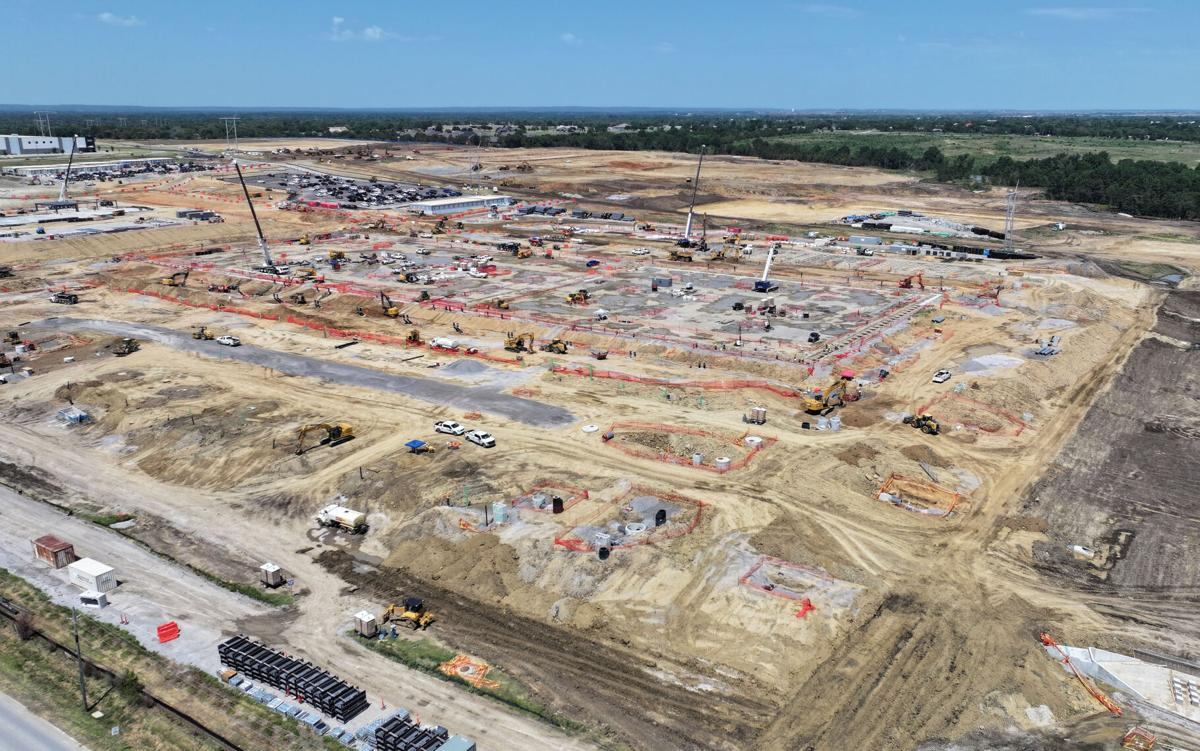
Google confirmed Wednesday that it's the end user behind Project Clydesdale, a 506-acre data center campus under construction in unincorporated Tulsa County, Oklahoma, just west of Owasso, ending months of speculation about the company's identity.
 Daniela Julio-Cano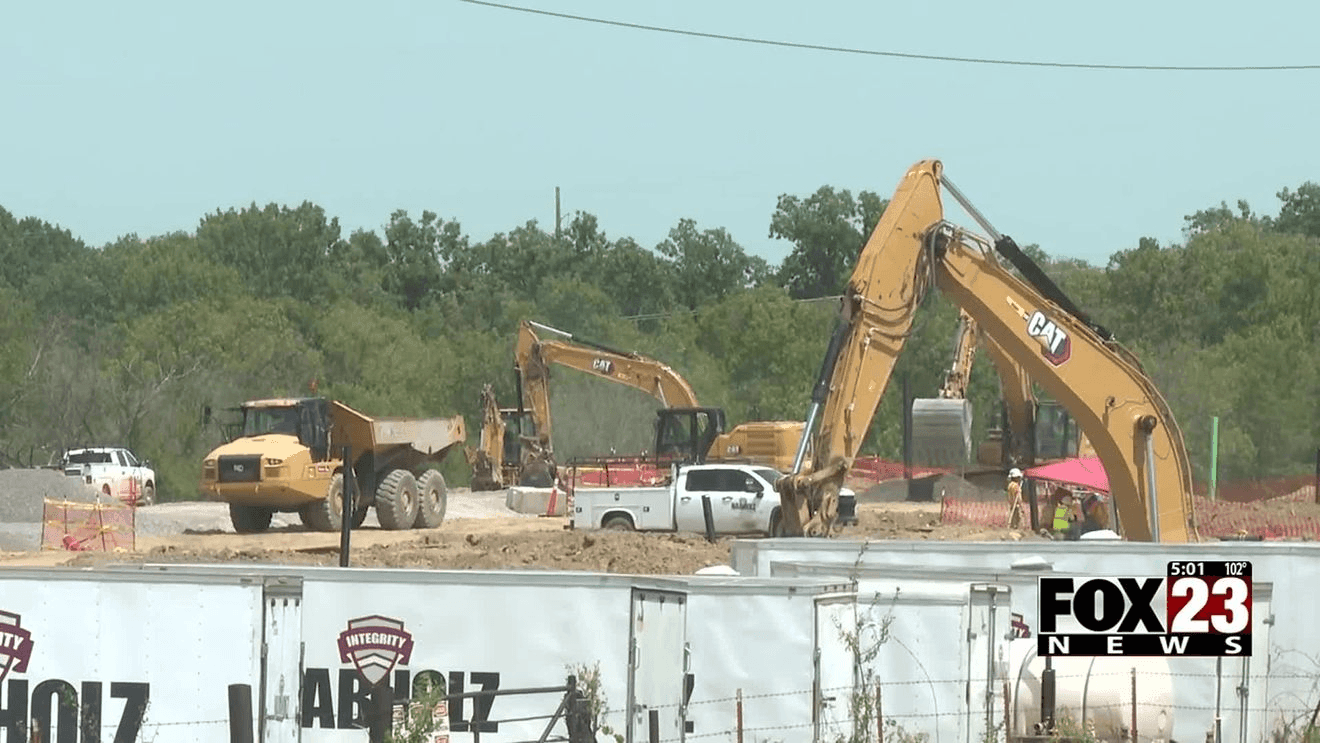
Beale Infrastructure broke ground on the project in October 2025, and Google said the campus will join its global data center network. Google's Trystine Payfer said the company has invested more than $15 billion in Oklahoma since 2011, with 2025 investments supporting $2.6 billion in state economic activity, and said it plans to add electrical apprenticeship training that will bring more than 160 apprentices into the state by 2030. Tulsa County Commissioner Stan Sallee called the announcement a major boost for northeast Oklahoma, citing the site's zoning, water access and utility infrastructure as key factors in the location decision, while Tulsa Regional Chamber's Stacy Smith said the project underwent a vetting process lasting more than two years.

Not everyone welcomed the news. Cheyenne Morgan of Stop Data Colonialism said she became involved during the project's rezoning more than a year ago, when the identity of the end user remained unknown to residents, and said she doesn't believe there was genuine community consent or engagement before the project moved forward. The project includes a new onsite substation and roughly 1.5 miles of new water lines serving Washington County Rural Water District No. 3.
Bay City, Michigan
More than a dozen residents attended a Bay City, Michigan planning commission meeting Wednesday to voice concerns as the commission reviewed draft regulations for data centers, before deciding to form a subcommittee to further study the ordinance and revisit it in October.
The regulatory push began with a resolution from Mayor Chris Girard and the city commission directing staff to work with the planning commission on zoning and operational standards for data centers, which current code treats as heavy industrial uses with few restrictions. Bay City Planning and Zoning Manager Adam Pruett described the draft ordinance as creating "guardrails" covering facility size, power demand, water use, noise and decommissioning. Resident Paul Klainau noted the draft doesn't currently limit square footage or power usage and pressed for details on wastewater disposal, air pollution monitoring and enforcement, while Marilee White urged the commission to address infrasound, arguing the low-frequency sound could affect human and animal health even though it's inaudible.
Nye County, Nevada
The Nye County Commission voted 5-0 Tuesday to ban data centers in the Pahrump Valley and Basin 162, following a meeting that drew hundreds of attendees and more than two hours of public comment despite a two-minute limit per speaker.
Commissioner Ian Bayne, who made the motion to adopt the ban under Nye County Bill No. 2026-11, amended it to apply only to the Pahrump Valley groundwater basin rather than the whole county, a scope Commissioner Bruce Jabbour said he preferred since other parts of Nye County may still welcome data centers. Resident Teresa Redl urged commissioners to enact an outright ban, saying the community had grown "frantic" over the issue, while resident Susie Hertz argued there was little support locally for allowing data centers.
Commissioners separately voted 4-1 to set a public hearing on a companion bill, No. 2026-14, that would establish land use regulations, special use permitting and development standards for data centers in the rest of the county outside Pahrump. A proposal to hold a special election letting voters decide on a ban received no motion and died without action.
Butte-Silver Bow County, Montana
A Butte-Silver Bow County, Montana district court judge is seeking additional briefing before ruling on a lawsuit over rejected signatures for a ballot initiative on data centers, with a decision expected next week.
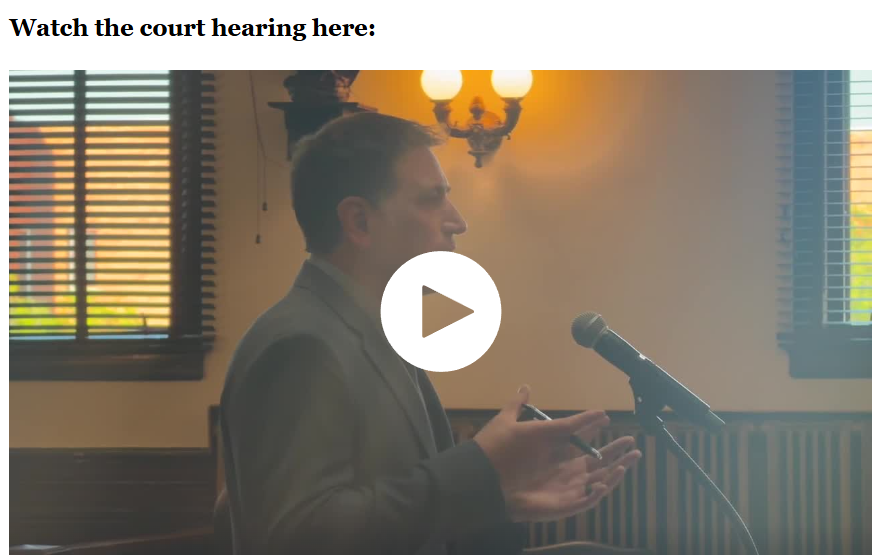
The county clerk initially accepted 3,652 signatures from the group 406 People First on July 31, but later rejected the initiative on Aug. 10 for not meeting requirements under a Montana law adopted in late 2025. Attorney John Meyer, representing the group, argued that the statute governing the initiative process is unconstitutional and that residents, not the legislature, hold the power of initiative under the state constitution, saying no level of government has yet protected Butte from data centers. District Court Judge Frank Joseph said from the bench he was struggling to find grounds that would override the statute as currently applied, but wanted more information before deciding.


The Butte-Silver Bow County Attorney's office said it wasn't consulted before the election administrator rejected the signatures and told the judge it wouldn't present an argument, standing on the facts as presented. Concerned citizen Evan Barrett attended the hearing carrying a pocket Constitution, arguing the power of initiative belongs to the people rather than any branch of government. The ruling follows a similar case last week in which a Billings judge sided with the county.
St. Joseph County, Indiana
A vote to expand St. Joseph County, Indiana's AM General TIF District to include the Microsoft Data Center project has been postponed until Sept. 22, giving officials and the public more time to weigh in.
The expansion would allow the county to borrow up to $4 million by freezing current property tax levels within the district and capturing future tax growth for use there. County council candidate Jan Cervelli held a public education session ahead of the vote, saying she wants clarity on how the money would be distributed and what projects it could fund, noting the county council has no direct say since those decisions rest with the redevelopment commission, an unelected body she said raises accountability questions.
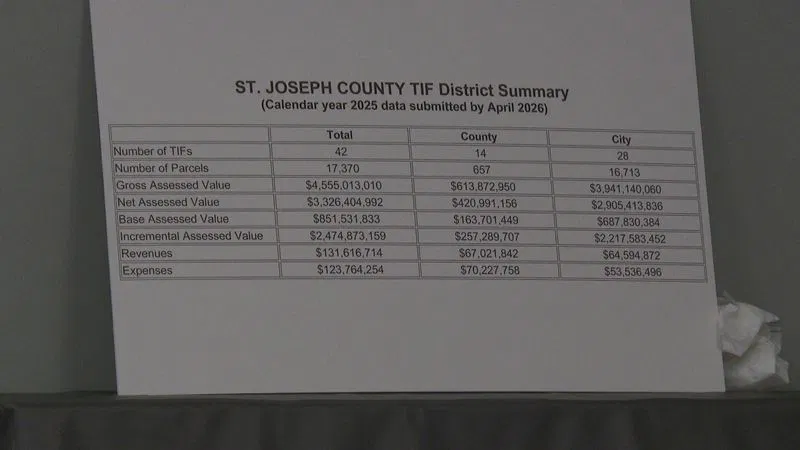
Councilwoman Amy Drake raised her own concerns in an Aug. 12 letter, saying that while the TIF expansion could bring significant development, locking the data center's tax revenue into the TIF district prevents it from reducing residents' property tax bills, calling it unfortunate that one of the state's biggest projects wouldn't benefit the county more broadly.
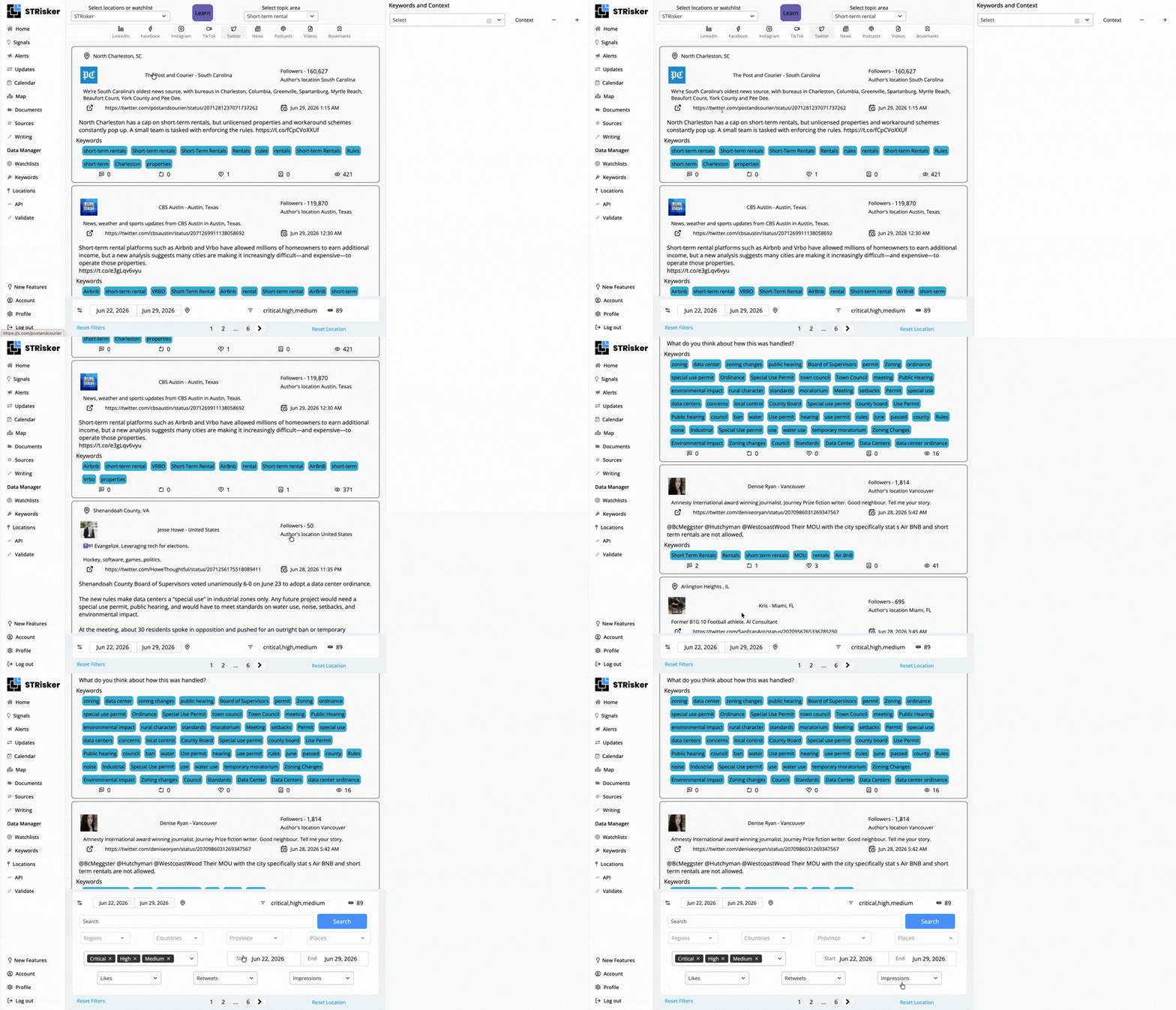
Social Listening📱: Twitter
Strisker’s Twitter Signal pulls real-time posts from officials, agencies, advocacy groups, and local influencers—so you see emerging sentiment and policy signals the moment they surface. Track conversations by place, people, and topics, then zero in on what actually matters.
Tulare County, California
Tulare County, California residents and activists welcomed a 45-day moratorium on data center development in unincorporated areas approved by the Board of Supervisors Tuesday, but immediately pushed for a permanent ban instead.
 Karis Caddell
The moratorium is meant to give officials time to evaluate data centers' impact on public health, safety and infrastructure before permanent regulations are set. Joe Delgado of Power California called the moratorium a step in the right direction but said organizers won't stop until a permanent ban is in place, speaking at an evening rally at the Tulare County Fairgrounds where the county fair board and Kings County fairgrounds are separately weighing a proposed partnership with Global Stack LLC. That proposal would place a network of compact, 8- to 10-megawatt edge computing systems, roughly the size of shipping containers, on two to five acres of fairground land to help fund the venue's long-term operations.
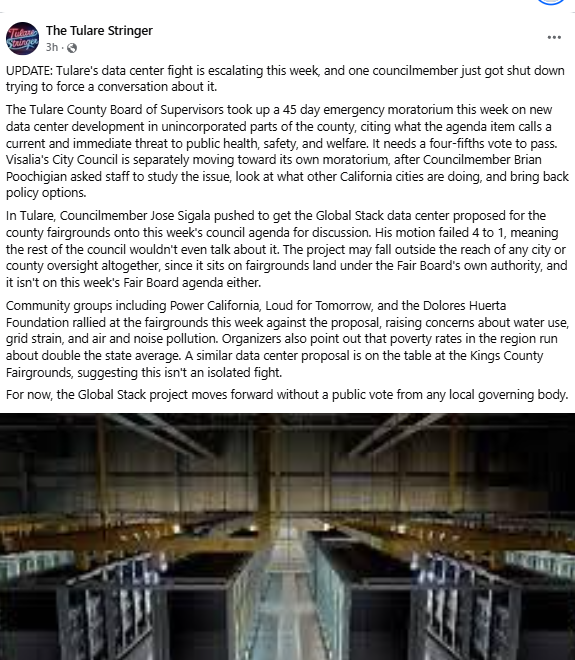
Fair Board President Gary Castro reiterated that the board hasn't approved, proposed or formally considered any commercial data center at the fairgrounds, after tabling a decision on the Global Stack lease last month. Amy Wilkinson of the Hanford No Data Centers Townhall group praised Tulare County's action and called on Kings County and other Central Valley jurisdictions to follow suit, saying long-term protection of land, air and water resources requires more than temporary measures.
Piedmont, Oklahoma
Piedmont residents push back against data center project ahead of city council vote
Piedmont, Oklahoma residents are gathering signatures on three citizen initiative petitions aimed at blocking or requiring a public vote on the proposed "Project Open Sky" data center, ahead of a City Council vote Monday on the project's rezoning application.
 Louis
Louis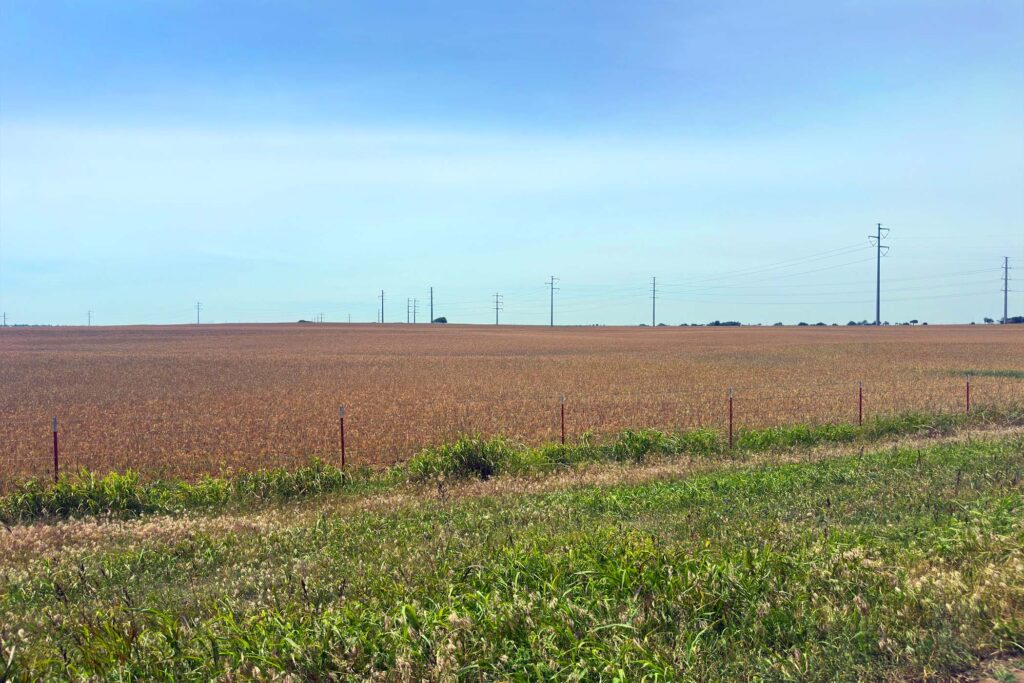
Resident Ali Taylor, part of a group opposing data centers locally, said the petitions cover a temporary moratorium paired with impact studies, a complete ban on noise levels exceeding specific standards, and a requirement that citizens approve any project based on those study results. The group needs 172 valid signatures to place the issue on a ballot. Taylor said water use is a central concern in the agricultural town, arguing water should go toward farming and livestock rather than industrial use.
David Berry, CEO of developer Cloverleaf Infrastructure, said the project would use a closed-loop cooling system rather than continuously drawing new water, comparing it to an air conditioner. He said Piedmont was chosen partly because the local grid is already strong enough to avoid major transmission rebuilding, and confirmed the project would involve multiple buildings functioning as a campus.
Austin, Texas
Austin, Texas city leaders are weighing new regulations for data centers as officials prepare for the possibility of much larger facilities seeking to locate in the city, with a dedicated council work session set for Aug. 25.
 Stephanie Gonzalez
Austin currently has 10 data centers ranging from 1 to 20 megawatts, none meeting the state's 75-megawatt threshold for "large-load" customers, though Austin Energy has fielded inquiries for projects between 20 and 74 megawatts. City staff noted some hyperscale data centers elsewhere now exceed 100 or even 300 megawatts, and recommended updating land-use rules, creating new siting and zoning standards for higher-impact facilities, and establishing requirements around water efficiency, noise and lighting.
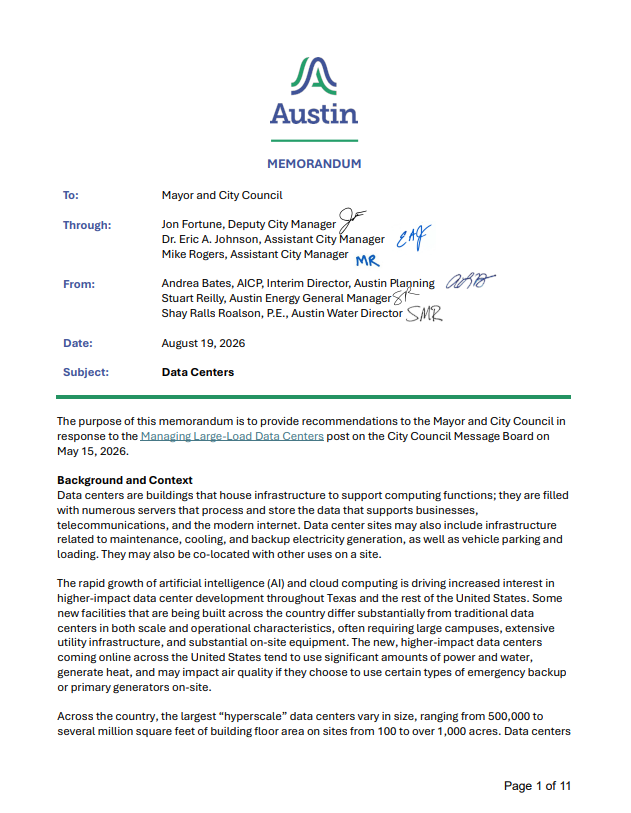
Water use has emerged as a particular focus even though existing data centers accounted for less than 0.3% of Austin Water's total use in 2025; officials said they want to prepare ahead of potential future growth. The discussion follows a City Council resolution passed in July directing staff to develop recommendations for greater oversight of large-volume water users, with potential council action to begin amending Austin's Land Development Code expected Aug. 27.
Managing Large-Load Data Centers
Sioux Falls, South Dakota
Sioux Falls, South Dakota Mayor Christine Erickson said she opposes a moratorium on data centers, telling reporters at a Wednesday media briefing that she'd rather establish clear regulatory guardrails than signal the city is "not open for business."
Erickson said she wants rules in place that developers understand upfront, while acknowledging Sioux Falls, Lincoln County or Minnehaha County might not ultimately be the right fit for every data center project. Her comments came during an update marking her first month in office, where she also discussed her proposed $794 million 2027 city budget, which she said grows only 2.4% below inflation and centers on public safety, infrastructure and maintaining quality of life.
The 2027 budget's first and second readings are scheduled for the first two weeks of September.
📱 Social Buzz
Residents are helping shape the future of White Plains Road as the city considers zoning changes that could bring more housing to the north Bronx. @NYCPlanning is working to develop a neighborhood plan for under the 2 and 5 train lines:https://t.co/CuKLSEKamr
— Bronx Times (@bronxtimes) August 20, 2026
EVENT Aug 20: Northfield Planning Commission will hold a public hearing on data center regulations https://t.co/GNiGElbOI7
— Ann Treacy (@AnnT) August 20, 2026
Accurate Information: Will proposed legislation affect the proposed data center project?
— Ypsilanti Township (@YpsilantiTwp) August 20, 2026
Learn more and stay informed: https://t.co/hUBw4alGey pic.twitter.com/wPRly8xU6X
Group asks New Mexico Supreme Court to step in as the fight continues over the $165 billion Project Jupiter data center project. https://t.co/h0w037f1dt
— Susan Montoya Bryan (@SMBNewMexico) August 20, 2026
Austin leaders look to regulate data center development pic.twitter.com/BysqZzf4ob
— Nathan (@L8ngley) August 20, 2026
Stay Updated with STRisker!
STRisker offers tools and features to keep you updated with the Short Term Rental and Data Centers movement across the world.
👍 We’d love your feedback.
Which stories hit? Which ones missed?
We're exploring a new branch of topics centered around Data Centers and want to make it even more useful for you.
✉️ Just reply directly to this email. We read and respond to every message!
-Will McClure
🙋 P.S.
Know someone else who should be reading Daily Notes? Feel free to forward this along. We’re opening a few more spots.