
Data Centers: Daily Notes | July 1, 2026
San Marcos becomes the first Texas city to ban data centers, Gov. Spanberger signs a Virginia energy package aimed at data center costs, and a former House Majority Leader is dragged out of an Amazon hearing in Pennsylvania.


At A Glance 🔽
- San Marcos, TX becomes the first Texas city to ban data centers; a state senator vows to challenge it.
- Virginia Gov. Spanberger signs an energy package to keep data centers from driving up costs for families.
- Burien, WA council enacts an immediate one-year moratorium on new data centers.
- Somerville, AL passes an 18-month moratorium amid a fight over a proposed bitcoin mining facility.
- Santa Fe County, NM commissioners advance a one-year moratorium ordinance over water and energy concerns.
- Broken Bow, NE planning commission floats a data center ordinance and at least a six-month moratorium.
- Kline Township, PA police forcibly remove a former House Majority Leader from an Amazon data center hearing.
- Yukon, OK residents pack city hall demanding the mayor resign over a $1 billion data center.
- Pocatello, ID Hoku site AI data center appeal heads to City Council on July 16 after a permit denial.
- Festus, MO developer scales a $6 billion project from 12 buildings to four; opponents remain unmoved.
San Marcos, Texas
San Marcos has become the first Texas city to ban data centers within its limits to define the facilities in its zoning code and make them ineligible for any part of the city. Council members cited concerns that the developments would pull water and energy from the local community.
City Council on 2026-06-16
The city has no data center proposed within its limits, though at least two have surfaced in unincorporated parts of surrounding Hays County. San Marcos is testing its home rule powers, which let 352 larger Texas cities write their own zoning codes. Council member Amanda Rodriguez first proposed the ban in March; it was revived when Lorenzo Gonzalez moved to reconsider, seconded by Alyssa Garza.
 Government Websites by CivicPlus
State Sen. Paul Bettencourt, who chairs the Senate Committee on Local Government, plans to challenge the ban, arguing it violates 2025's House Bill 2559 and the 2023 "Death Star" law. Land use experts counter that HB 2559 covers moratoriums, not zoning changes, so it may not apply. Other cities including Lockhart and Kerrville are tightening zoning instead of banning outright to avoid lawsuits.
Virginia
Gov. Abigail Spanberger signed a package of energy legislation on Tuesday, including bipartisan bills meant to keep data centers and other high-load customers from driving up costs for Virginia families.
As follows (click to open):
Legislation Package Signed
- HB2 , SB72: directs Dominion Energy and Appalachian Power to deliver energy efficiency upgrades to at least 30% of qualifying low-income households by the end of 2031 (subject to State Corporation Commission approval) and to report their progress annually starting January 2028.
- HB284 , SB371: directs Dominion Energy and Appalachian Power to petition the State Corporation Commission by January 2027 to create voluntary demand flexibility programs for high energy demand customers (with cooperatives required to follow by 2029), backed by recurring status reports.
- HB397: directs the Department of Environmental Quality and State Air Pollution Control Board to establish a market-based carbon trading program consistent with the Regional Greenhouse Gas Initiative to cut CO2 emissions from the state's power plants.
- HB434, SB621: requires Dominion Energy and Appalachian Power to petition the State Corporation Commission by October 15, 2026 for approval of grid utilization metrics that assess how well existing grid assets are being used, with the Commission analyzing each utility's potential to boost grid utilization through non-wires alternatives in its annual report.
- HB628, SB175: updates Dominion Energy's renewable portfolio standard requirements by pushing back to 2027 the year when at least 75% of its renewable energy certificates must come from in-state resources, easing rules for small solar and wind projects under third-party power purchase agreements, and encouraging solar development on previously used sites to limit land impacts.
- HB892: requires Dominion Energy to include renewable portfolio standard compliance forecasting in its integrated resource plan and directs the State Corporation Commission to open a proceeding by March 1, 2027 to investigate the electric load forecasting practices of Dominion, Appalachian Power, and distribution cooperatives.
- HB895, SB448: raises and extends energy storage targets for Dominion Energy (16,000 MW short-duration and 4,000 MW long-duration by 2045) and Appalachian Power (780 MW short-duration by 2040 and 520 MW long-duration by 2045), directs the Department of Energy to develop model local ordinances by December 2026, and requires the State Corporation Commission to run a long-duration storage demonstration program and confirm the targets' viability by March 2031.
- HB1191: lets electric cooperatives enter agreements with large members (at least 20 MW of demand requiring a 230 kV or higher interconnection) to build a substation, which the member then transfers to the cooperative to operate at the member's sole expense, keeping those costs off other ratepayers' bills.
- HB1256: directs the State Corporation Commission to review how effectively Dominion Energy and Appalachian Power mitigate fuel and purchased power cost risk in certain cost recovery proceedings and annual filings, and to include related legislative recommendations in an existing report.
- HB1360: requires investor-owned electric utilities to provide specific information about their coal- and oil-fueled generating units in fuel factor proceedings, and directs the State Corporation Commission to base its reasonableness and prudence determinations for cost recovery on that information.
One measure protects ratepayers from shouldering the cost of new energy infrastructure built for data centers and other large energy users. Others set goals to expand energy storage and lower heating and energy costs for households that need help most. Spanberger said the state is also setting stricter emissions standards on data center backup generators and giving localities new tools to weigh a project's impact on homes, schools, and farmland.
The package also rejoins the Regional Greenhouse Gas Initiative, paired with a consumer credit the administration says will offset the program's cost on utility bills. The state is separately implementing a first-of-its-kind energy consumption tax through the budget, which Spanberger framed as making data centers pay their fair share.
Burien, Washington
The Burien City Council approved an emergency one-year moratorium on new data centers at its June 29 meeting, effective immediately.
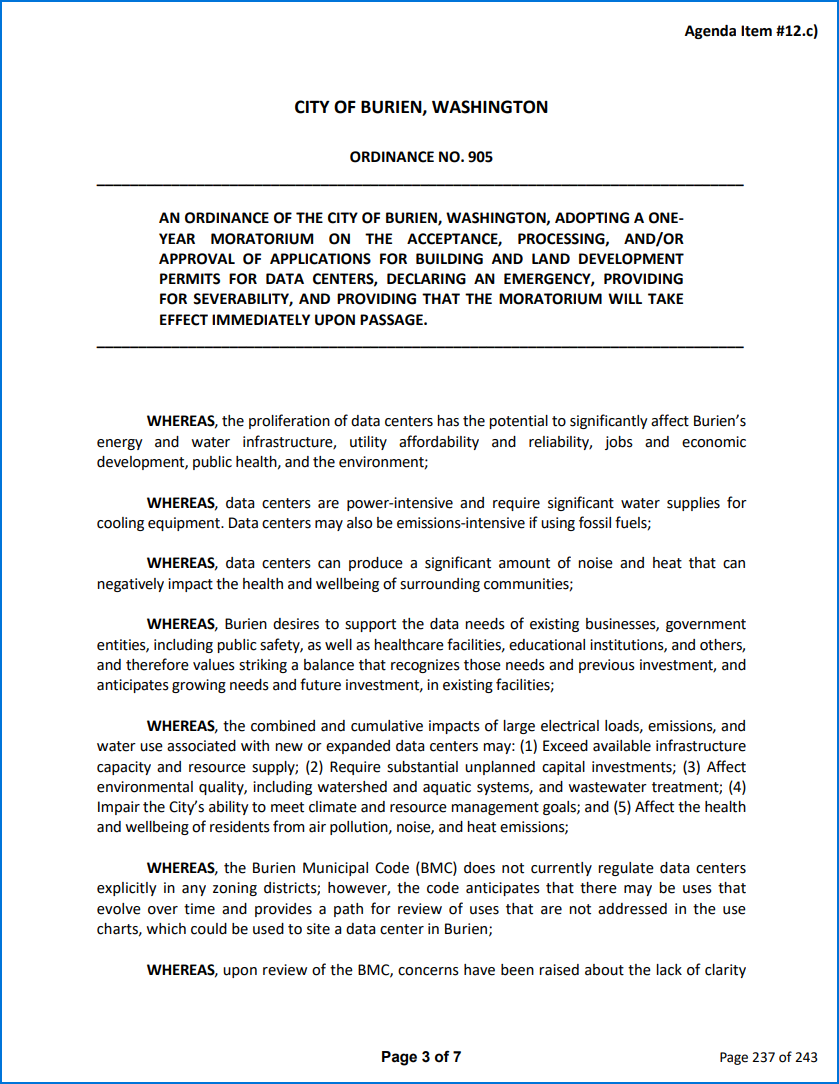
The pause gives staff time to research the drawbacks and benefits of data centers, including resource use and job creation. Interim City Attorney Ann Marie Soto said Burien has no one on staff with data center expertise, so the definition used in the moratorium was borrowed from Seattle. The vote came the same night the council took up broader Comprehensive Plan and zoning updates, with a public hearing on those changes set for the July 8 Planning Commission meeting.
Somerville, Alabama
The Somerville Town Council approved an 18-month moratorium on data centers Tuesday night, following weeks of petitions and pushback over a proposed bitcoin mining facility near Union Road.
Mayor Darren Tucker said the town has no zoning laws, so nothing would normally stop a company from building on any parcel without going through town hall. The moratorium gives officials time to study the impact, and during the window the town plans to confirm with the Alabama League of Municipalities whether a city without zoning can legally block a data center. Residents have raised concerns about noise, infrastructure strain, and the town's rural character. A possible annexation of homes along Union Road was postponed.
Santa Fe County, New Mexico
Santa Fe County commissioners are advancing a one-year moratorium on large-scale data center projects citing water and energy concerns.
Commissioners Lisa Cacari Stone and Hank Hughes are leading the ordinance, which would pause data center projects for a year while the county explores its own guardrails on energy and water use, economic impact, and air quality. The county has yet to see a proposal, but commissioners pointed to Project Jupiter in Doña Ana County, which drew heavy criticism over environmental concerns. The ordinance was set for the commission's Tuesday night meeting.
Broken Bow, Nebraska
Nearly 50 people turned out as the Broken Bow Planning Commission took up data center zoning at a public hearing Tuesday.
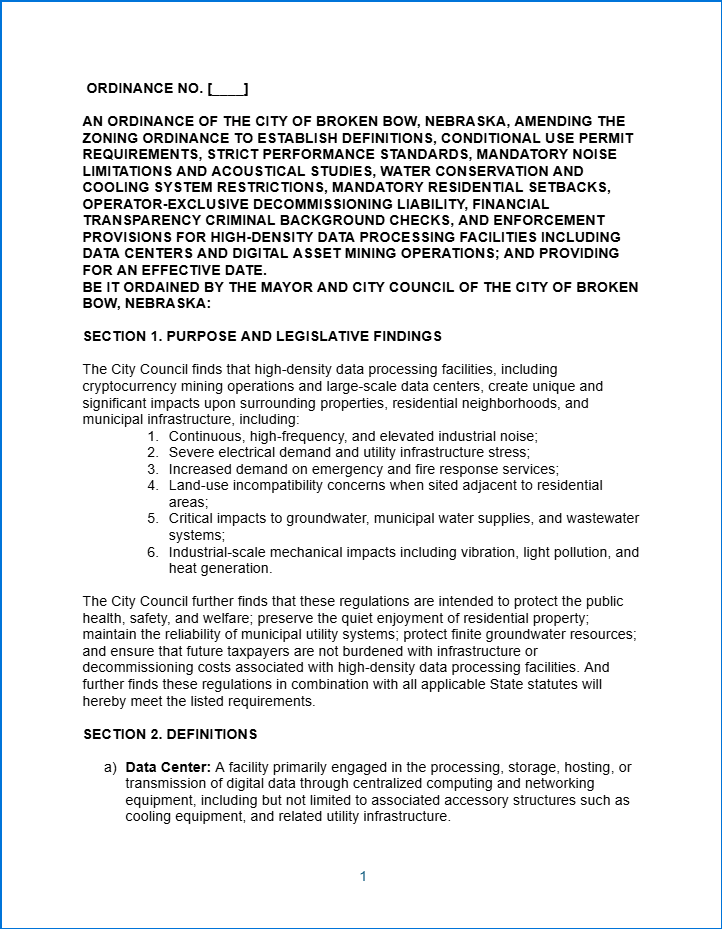
Zoning Administrator Jacob Holcomb walked through a proposed ordinance that would regulate any facility drawing more than 65 kilowatts at peak demand. To get a conditional use permit, an operator would face limits on noise and light, an outright ban on water-intensive cooling, and a requirement to post financial assurances covering utility use and eventual decommissioning. Operators would also cover 100% of any utility upgrades needed to power the site. The rules would apply within city limits and a one-mile extraterritorial zone. The Planning Commission is recommending the City Council adopt at least a six-month moratorium while work on the ordinance continues.
Kline Township, Pennsylvania
A former state representative was forcibly removed from a Kline Township Planning Commission hearing on a planned Amazon data center campus Tuesday night. The meeting ran under heightened security, with metal detectors and searches, after police cited a credible threat.
Todd Eachus, a Democrat who served in the Pennsylvania House from 1997 to 2010 and was House Majority Leader in his final years, stepped to the podium after the commission restricted public comment to township residents and property owners. Eachus lives in Drums, outside the township. A commission member began shouting "no" before he finished, and three township police officers carried him out after a brief exchange.


The hearing itself covered Amazon Web Services' "Project Brewster", a 2.1 million-square-foot campus with nine data centers off Lofty Road. Amazon representatives said the site could use up to 100,000 gallons of water a day for cooling but could not estimate annual use, and asked that diesel backup generators be exempted from the township's noise ordinance.
Yukon, Oklahoma
Yukon residents packed city hall demanding Mayor Brian Pillmore resign over a $1 billion data center Tuesday night.
The city has already approved selling city-owned land to BLE Landholdings, the developer behind the proposed campus, a decision that has split the town for months. Outside chambers, organizers kept collecting signatures for a recall petition, saying they have passed the 1,449 signatures the city code requires and plan to file before Thursday's deadline. Many residents took the podium to say leaders had ignored their concerns for two years. The council did not vote on the project.


Pocatello, Idaho
The fight over an AI data center at the former Hoku site is headed to the Pocatello City Council on July 16, when the council will hear Lex Developments LLC's appeal of a denied conditional use permit.
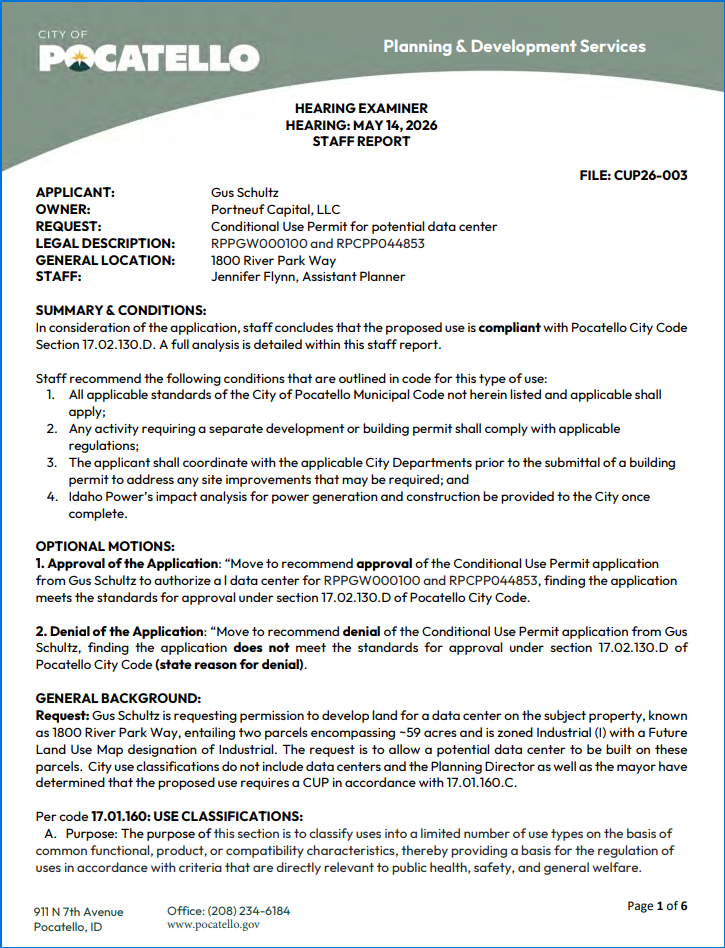
Hearing Examiner Kathleen Lewis rejected the application after a packed May 14 hearing, finding it fell short on public facilities, environmental impact, and public health and welfare, and overruling a staff recommendation to approve. Lex Developments wants to build seven 100,000-square-foot data center buildings on the roughly 59-acre site, projecting a $2.26 billion construction investment and 150 to 300 permanent jobs. The land has sat largely idle since the $700 million Hoku polysilicon plant went bankrupt in 2013. The council's review is limited to the existing record, and either side could take the matter to district court.
Festus, Missouri
 Dane Artisola
Previously covered...
The developer behind a proposed $6 billion data center in Festus has unveiled a scaled-back design after sustained opposition, though critics say it does not resolve their core concern.


CRG, the data center arm of Clayco, cut the plan from 12 two-story buildings to four one-story buildings with a larger setback, and raised the voluntary buyout offer for the 12 nearest homes from fair market value plus 10% to plus 15%, with a $10,000 moving allowance. Mayor Sam Richards said the changes address residents' biggest concerns. Opponents disagree. "Put lipstick on a pig and make it look better," said Lori Merriman, who leads a citizen group against the project, arguing the residential location is still the problem. Opposition has already ousted three council members, and a judge recently signed a writ of mandamus pushing a recall election forward. The city plans a public hearing in late July or early August.
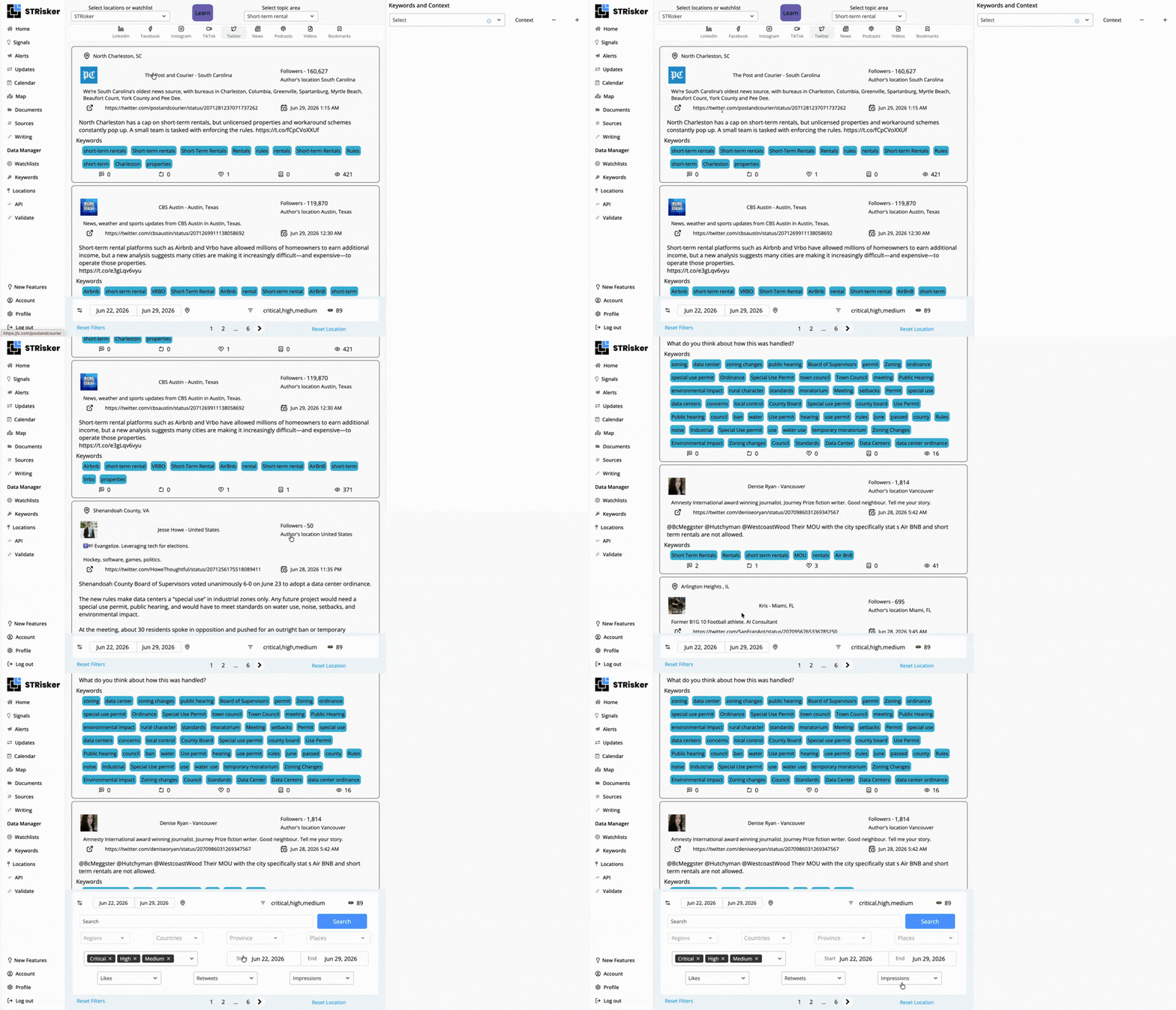
Social Listening📱: Twitter
Strisker’s Twitter Signal pulls real-time posts from officials, agencies, advocacy groups, and local influencers—so you see emerging sentiment and policy signals the moment they surface. Track conversations by place, people, and topics, then zero in on what actually matters.
Stay Updated with STRisker!
STRisker offers tools and features to keep you updated with the Short Term Rental and Data Centers movement across the world.
👍 We’d love your feedback.
Which stories hit? Which ones missed?
We're exploring a new branch of topics centered around Data Centers and want to make it even more useful for you.
✉️ Just reply directly to this email. We read and respond to every message!
-Will McClure
🙋 P.S.
Know someone else who should be reading Daily Notes? Feel free to forward this along. We’re opening a few more spots.