
Data Centers: Daily Notes | July 15, 2026
New York became the first state to impose a statewide data center moratorium, Putnam County commissioners approved a policy requiring staff to report all data center development inquiries publicly within 72 hours; Rural Hall residents gathered to oppose a proposed 129-acre data center.


At A Glance 🔽
- New York became the first state to impose a statewide data center moratorium after Gov. Hochul signed an executive order pausing permitting for new hyperscale facilities for up to a year.
- Putnam County, Florida commissioners approved a policy requiring staff to report all data center development inquiries publicly within 72 hours, short of pursuing a full moratorium.
- Rural Hall, North Carolina residents gathered to oppose a proposed 129-acre data center ahead of a final rezoning vote, despite local leaders already giving the project initial approval.
- Pulaski County, Arkansas advanced a weakened data center moratorium that exempts the $6 billion AVAIO Digital project, after a stronger version failed to pass.
- Oshkosh, Wisconsin advanced a pause on data center construction, directing staff to draft a formal moratorium ordinance even though no project has been proposed for the city.
- Imperial County, California saw a judge reject a defamation lawsuit from a data center developer against a public radio station over its coverage of a proposed project.
- Broken Bow, Nebraska approved a six-month moratorium on new data center construction applications to give officials time to draft formal regulations.
- Wausau, Wisconsin approved an ordinance creating data center zoning regulations, limiting facilities to industrial areas and requiring a conditional use permit.
- Americus, Kansas council held a listening session on the proposed Flint Hills Digital Campus data center without taking formal action, gathering community input instead.
- Delhi, Louisiana will continue supplying water to Meta's expanding data center, with Meta covering all associated infrastructure costs so local ratepayers aren't affected.
New York
New York officially becomes first state to put moratorium on new AI data centers
New York became the first state to impose a statewide data center moratorium Tuesday, after Gov. Kathy Hochul signed an executive order pausing state permitting for new hyperscale facilities for up to a year while regulators develop rules addressing energy, water and environmental concerns.
Hochul said progress shouldn't come with higher utility bills, depleted water supplies or noise pollution, framing the order as necessary to address those risks. The move follows the state Legislature's own moratorium bill passed earlier this year, which Hochul's office described as complex and in need of further work, prompting her to act by executive order instead. State Sen. Kristen Gonzalez, who sponsored the legislative version, joined Hochul at the signing and said any data center development should happen on the state's terms.
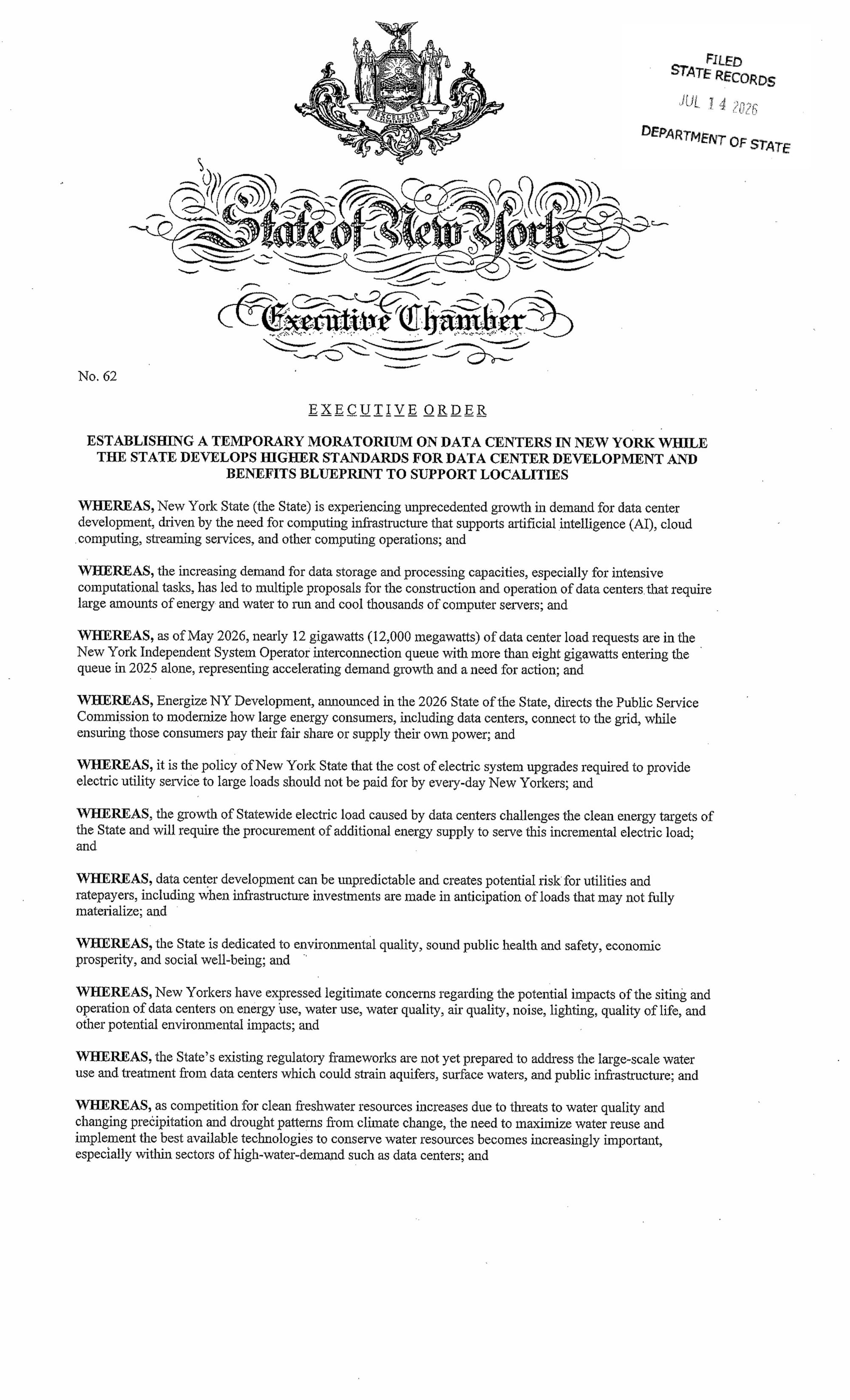
Dan Diorio of the Data Center Coalition warned the moratorium would push investment, jobs and economic activity to other states. Hochul's Republican gubernatorial opponent, Nassau County Executive Bruce Blakeman, opposes the statewide approach and says local governments should be free to negotiate their own data center deals, criticizing Hochul for not working more closely with local officials and businesses. New York has not so far been a major destination for the largest hyperscale data centers.
Putnam County, Florida
Putnam County commissioners unanimously approved a policy change Tuesday requiring county staff to report all inquiries and conversations about potential data center development to County Administrator Terry Suggs, who must then share that information with all five commissioners and post it online within 72 hours.
 Sarah Cavacini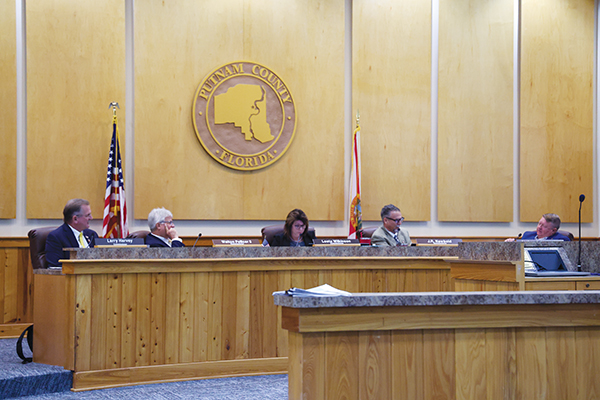
Commissioner Josh Alexander, who proposed the measure, said it's meant to give residents transparency into who may be scouting the county for a data center site. The policy took effect immediately upon approval, unlike a moratorium, which would require action at more than one board meeting.
Interlachen attorney Michael Woodward urged caution on a full moratorium, pointing to conflicting state laws, Senate Bill 180 limits local governments' ability to deny certain land-use changes, while Senate Bill 484 tightens data center permitting requirements. County Attorney Rich Komando said he's still researching how the county could impose a moratorium without exposing itself to legal risk, and the board plans to take up the issue again at its July 28 meeting.
Rural Hall, North Carolina
Rural Hall residents gathered at Rural Hall Moravian Church to discuss a proposed 129-acre data center ahead of a final rezoning vote scheduled for July 30, with many expressing opposition despite local leaders having already given the project initial approval.
"Breaking down the plan:" Rural Hall residents discuss proposed data center at community meeting
The group No Data Center Rural Hall said it has been compiling information weekly since April to help residents understand the potential impact, while working to prevent the project from moving forward. Members said they'd be comfortable with data centers located in industrial areas but not in Rural Hall, and several attendees said they support the idea of a moratorium to allow more time for the community to understand the issue. One member said the group is largely united in not wanting the facility in their community.
Several residents said they plan to recommend commissioners deny the project based on its current development plans. The meeting came the same day New York became the first U.S. state to ban AI data centers using 50 megawatts or more, a move some attendees said they'd welcome locally. The group said it will spend the coming days working to answer any remaining questions raised at the meeting before the July 30 hearing.
Pulaski County, Arkansas
Pulaski County's Quorum Court advanced a weaker data center moratorium Tuesday that exempts the $6 billion AVAIO Digital project in Wrightsville, voting 8-1 for the carve-out version after the original, more sweeping moratorium failed 6-3.
 — Butch Lee, City of Brandon MayorBrandon, MS
Justice of the Peace Diane Curry introduced the alternative ordinance, saying it was drafted to protect the county from litigation and avoid overstepping the authority of other regulatory bodies under state Act 851, which limits local control over data centers. JP Donna Massey called Curry's version a maneuver designed simply to defeat the original moratorium's purpose of halting AVAIO without regulation.
 Tyre White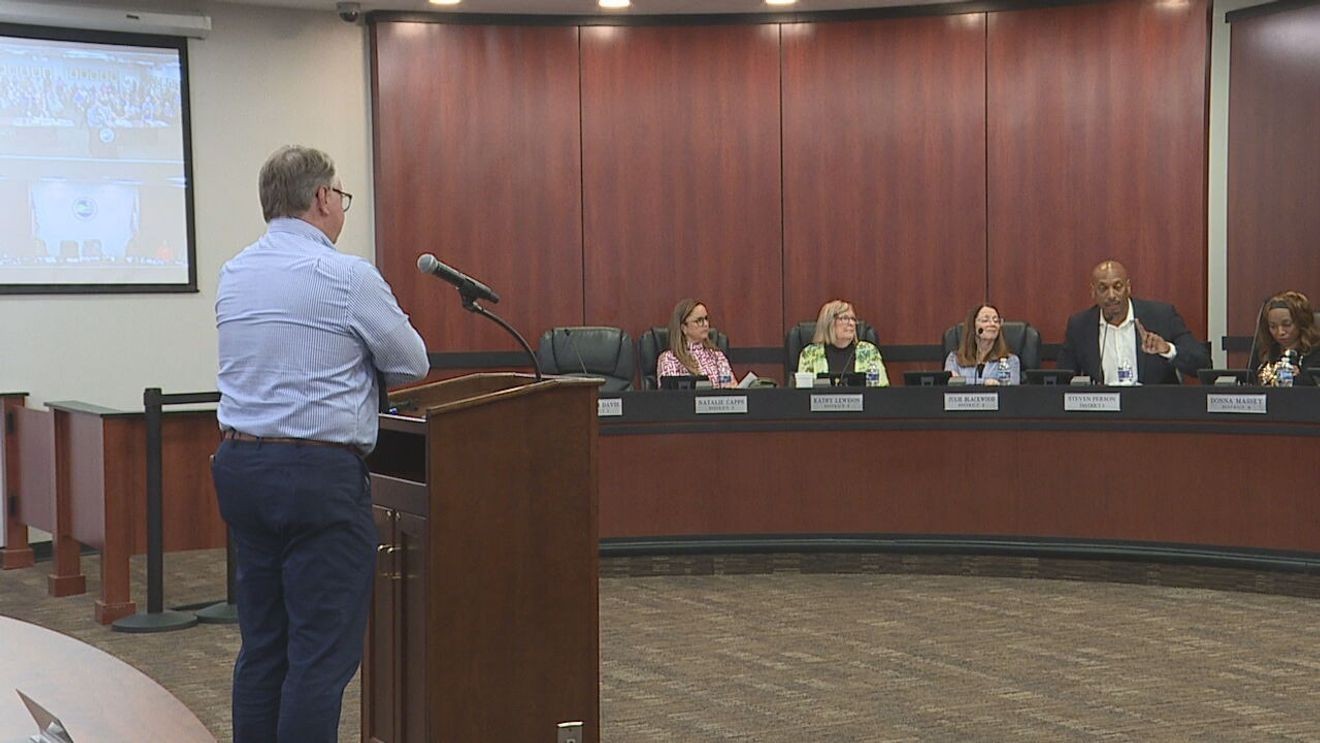
The original proposal, sponsored by JP Tina Ward with backing from JP Julie Blackwood, lost momentum when Blackwood left the meeting due to illness, leaving it without enough votes. Deputy County Attorney Dominique Lane told the court neither ordinance fully protects the county from lawsuits, though she said Curry's version carries somewhat lower legal risk, and warned that AVAIO could sue over project delays under either measure.
Oshkosh, Wisconsin
Oshkosh's Common Council voted to advance a pause on data center construction in the city, directing staff to draft a formal moratorium ordinance, coordinate with other local governments on data center policy, and continue studying the issue.
Oshkosh, Omro push back on data centers to protect water
Council Member Alec Lefeber, who initiated the resolution, said water usage and quality sit at the center of his concerns, alongside broader worries about environmental impact, utility rates, air quality and noise. The council also amended the resolution to encourage expanded regional cooperation on data center regulations. City officials emphasized that no data center has actually been proposed for Oshkosh or anywhere else in Winnebago County.
A local petition opposing data centers has drawn over 1,500 signatures in Oshkosh, reflecting growing public concern in the area even without a specific project on the table.
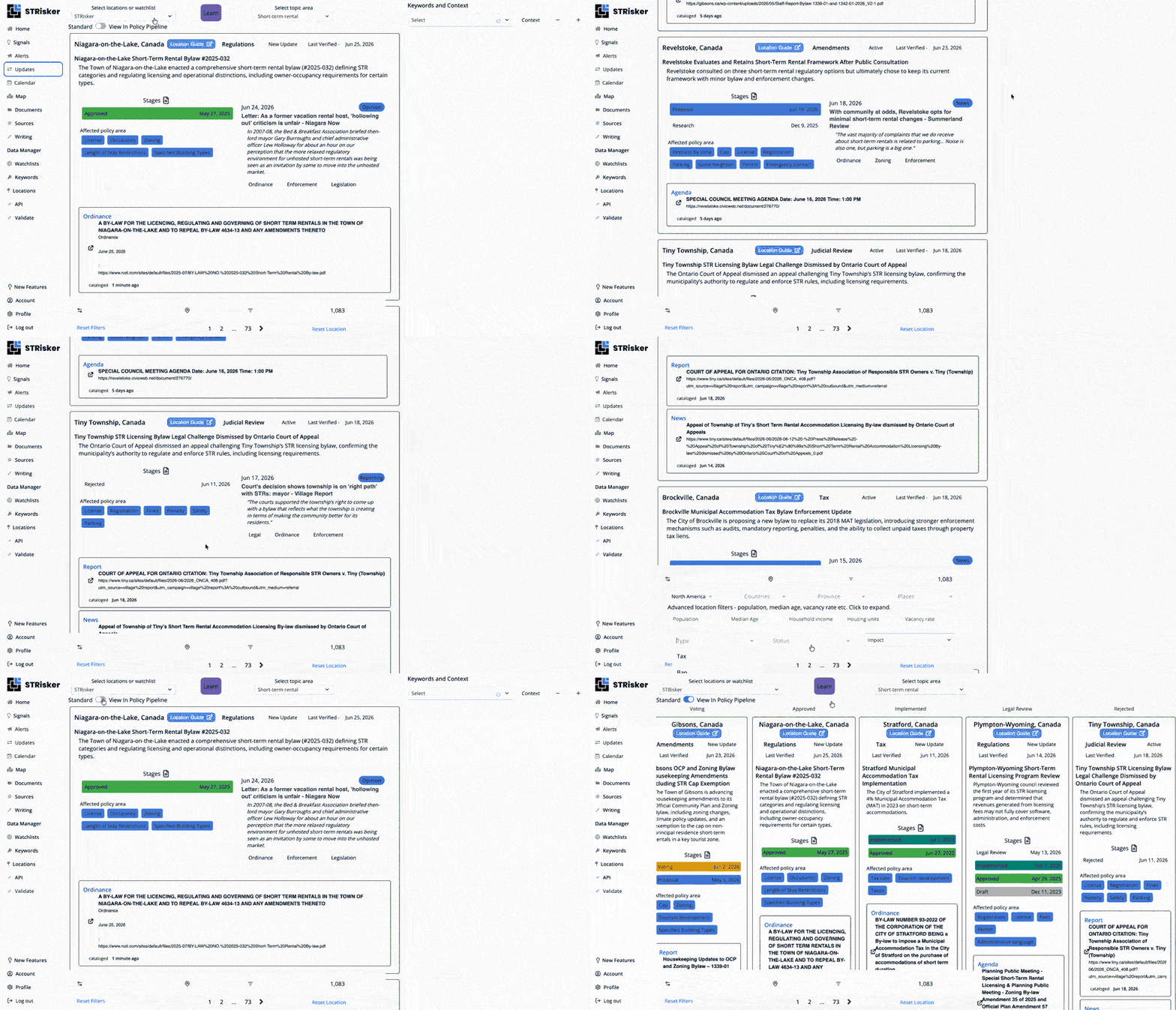
Strisker Updates Tracker
How do you keep up with the regulatory rollercoaster in your market? Strisker's Updates Tracker can be your guide - start tracking latest events as they happen and get access to essential documents as they come in. We know the struggle, which is why we built this product to capture every twist and turn in the regulatory saga so you never miss a beat.
Imperial County, California
A San Diego judge rejected a defamation lawsuit Friday filed by developer Sebastian Rucci and Imperial Valley Computer Manufacturing, LLC against KPBS and reporter Kori Suzuki over coverage of a proposed data center in Imperial County.
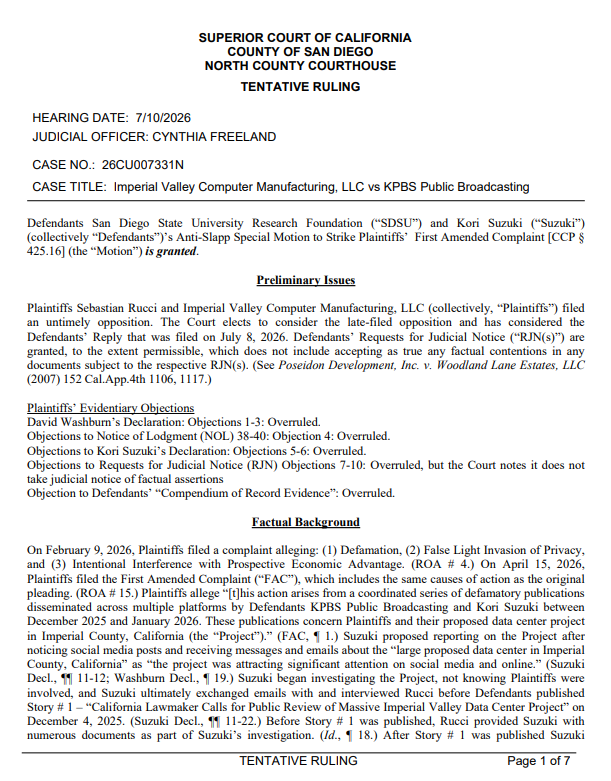
Judge Cynthia Freeland granted KPBS's request to strike the complaint under California's anti-SLAPP statute, finding the claims lacked legal or factual support. The suit centered on three points: Suzuki's reporting that the project would require 750,000 gallons of water daily, his description of the developer's effort to have the project classified as "ministerial" to avoid environmental review under CEQA, and his account of Rucci's past criminal charges. Freeland found none of the reporting false, noting that other data center projects approved without CEQA review didn't make Suzuki's statements about this project misleading.
Broken Bow, Nebraska
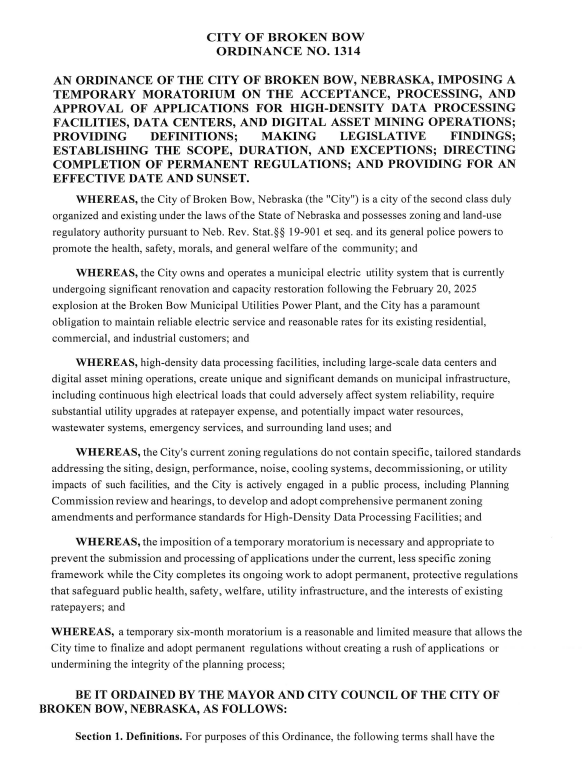
Broken Bow City Council approved a moratorium Tuesday on new data center construction applications within city limits, giving officials more time to draft formal regulations for high-capacity data processing facilities.
 Dave Birnie
City Zoning Administrator Jacob Holcomb told the council the city is off to a good start on developing rules but needs additional time for research before finalizing them. Mayor Rod Sonnichsen urged swift action, saying the moratorium is the only way to protect residents and infrastructure given the city currently has no data center regulations on the books. The initial pause will last six months, with the option to extend another 12 months, and will end early if the council approves a data center ordinance before then.
Wausau, Wisconsin
Wausau City Council approved an ordinance creating data center zoning regulations, limiting the facilities to areas zoned medium or heavy industrial and requiring developers to secure a conditional use permit that lets city leaders review water and power usage, noise and light impacts.
Assistant City Planner Carrie Edmondson said the ordinance drew on seven months of work with a data center group within the state's Local Government Climate Coalition, tracking how other communities are handling the issue. Alders amended the measure to require at least 200 feet of separation between any future data center and residential areas. The ordinance deliberately avoids defining specific data center types that would trigger a CUP, Edmondson said, so the rules stay focused on environmental and quality-of-life impacts rather than becoming outdated as the technology evolves.
Americus, Kansas
The Americus City Council heard from residents and Emporia Neighbors United about the proposed Flint Hills Digital Campus data center, though members announced beforehand they would not file a motion on any resolution, using the meeting instead to gather community input.

Emporia Neighbors United founder Jay Vehige told the council the community should take its time and do thorough research rather than make a rash decision, noting the group had gathered nearly 1,850 signatures over the past week opposing high-impact data centers and battery energy storage. Emporia native Anna Delong said residents feel unheard by Emporia leaders on the issue, cited a Gallup poll showing seven in ten Americans oppose data centers, and said the group had wanted to circulate a ballot ordinance petition but were told that wasn't an option. Delong argued data centers don't belong in rural areas, saying farmland can always be improved but is permanently lost once paved over.
The council's decision to hold a listening session rather than take formal action signals the debate has expanded beyond Emporia itself into the broader Lyon County community, with officials saying the conversation is likely to continue as more residents get involved.
Delhi, Louisiana
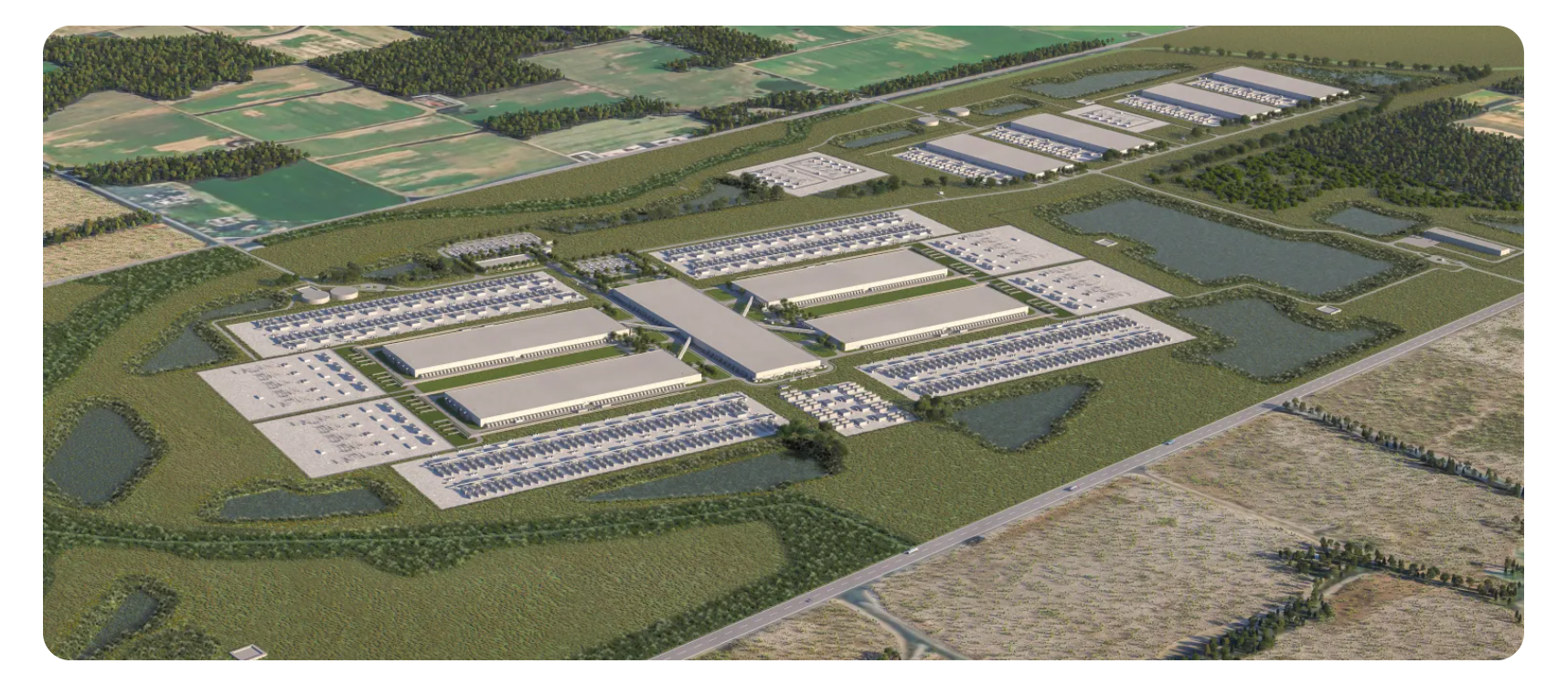
Delhi Mayor Jesse Washington confirmed the town will continue supplying water to the expanding Meta data center in Richland Parish, with Meta covering all associated costs so local ratepayers won't be affected.
Washington said the arrangement is strictly a Meta-funded project and that the town has agreed to upgrade its current water system as well as build a new water treatment plant, expected to open sometime next year. He said the plant would bring in new revenue for the town from water and sewage service tied to Meta's operations.
Margie Vicknair-Pray of the Sierra Club raised concerns that the facility's water use could compete with local agriculture, saying the data center will require significant amounts of water and that the impact on nearby farming operations is worth monitoring closely.
📱 Social Buzz
Pasco County has approved a moratorium on new data center construction and development. https://t.co/0YqtYK8wnT
— Tampa Bay Business Journal (@TBBJnewsroom) July 15, 2026
TeraWulf said New York’s data center permitting pause will not affect its projects, as the firm continues to expand its AI and HPC business despite shares falling by over 7%.https://t.co/jIzTYdtgie
— 36crypto (@36Crypto2) July 15, 2026
New York becomes the first state to impose a data center moratorium
— ARY NEWS (@ARYNEWSOFFICIAL) July 15, 2026
Read More: https://t.co/zeQtCMtaNu#ARYNews pic.twitter.com/abOi7VTpon
Gov. Greg Abbott calls for ban on data center development in rural Texas neighborhoods https://t.co/UwcRV32uJs
— Chuck Sherwood (@ChuckSherwood1) July 15, 2026
Stay Updated with STRisker!
STRisker offers tools and features to keep you updated with the Short Term Rental and Data Centers movement across the world.
👍 We’d love your feedback.
Which stories hit? Which ones missed?
We're exploring a new branch of topics centered around Data Centers and want to make it even more useful for you.
✉️ Just reply directly to this email. We read and respond to every message!
-Will McClure
🙋 P.S.
Know someone else who should be reading Daily Notes? Feel free to forward this along. We’re opening a few more spots.