
Data Centers: Daily Notes | July 2, 2026
New Jersey and Delaware lawmakers move to strip data center tax breaks and shield ratepayers, East Fishkill freezes big projects until 2029, and a Fort Worth-area proposal eyes 5 million gallons a day from the region's main drinking water source.


At A Glance 🔽
- New Jersey committees advance bills to end AI data center tax credits and redirect $125 million to electricity relief.
- Delaware passes a trio of energy bills, including one requiring data centers to supply their own power within 10 years.
- East Fishkill, NY freezes data centers over 20 MW until July 2029 in a vote.
- Indianapolis zoning rules for data centers advance to the City-County Council on a commission vote.
- Prince George's County, MD council to vote next week on a 2-year moratorium as rival rallies fill Largo.
- Union County, AR approves a one-year pause in an emergency Quorum Court vote.
- Fort Worth, TX faces a proposed data center that would draw up to 5 million gallons a day from Cedar Creek Lake.
- Linn County, IA supervisors approve an 18-month moratorium in a vote, months after passing a strict ordinance.
- Missoula County, MT sets a July 9 hearing on interim zoning that would pause new data centers.
- Paris, TN commission enacts a temporary moratorium on data processing centers.
New Jersey
New Jersey lawmakers are moving to end a key tax break for AI data centers and steer the money toward lowering residents' power costs instead.
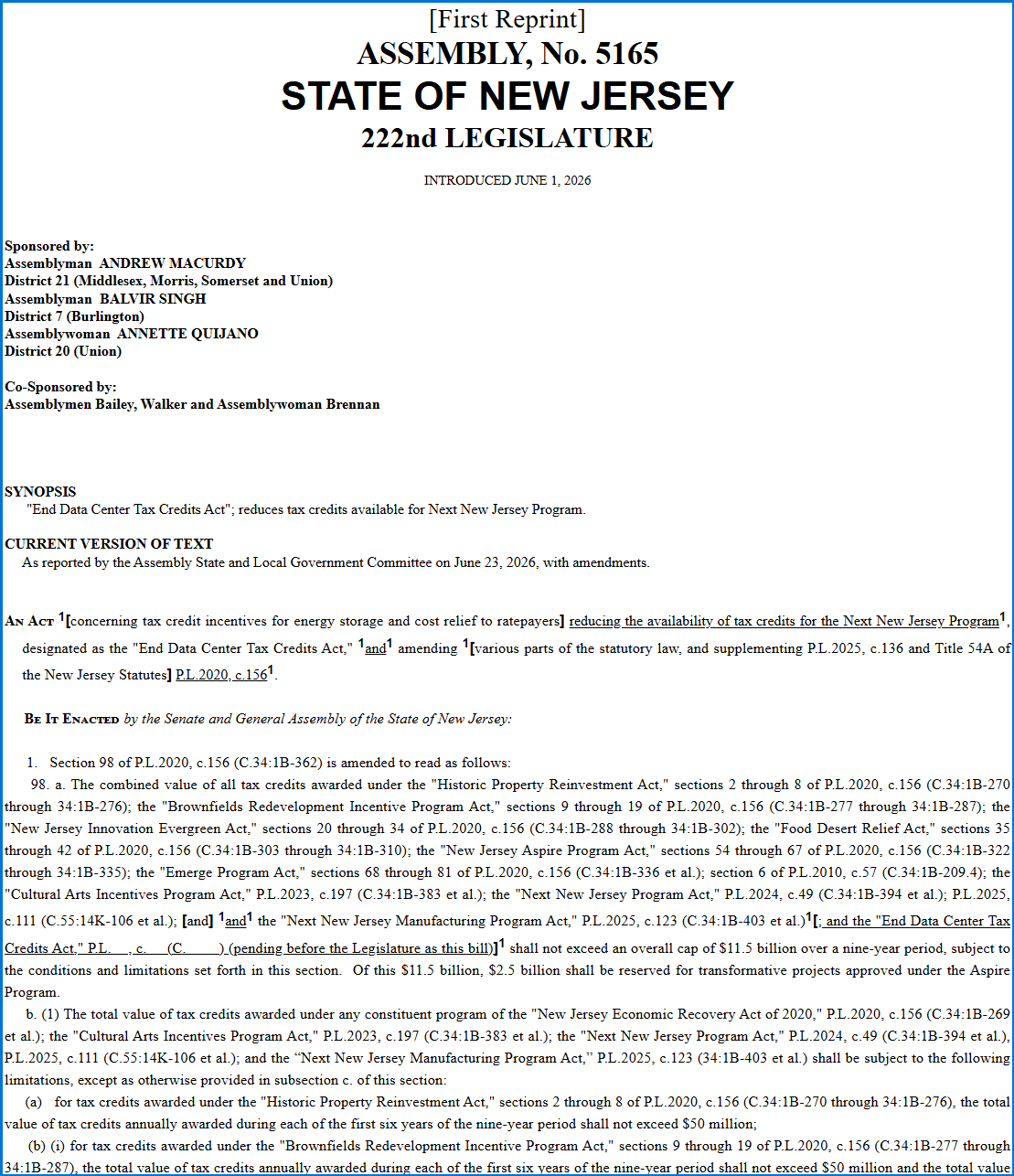
Assembly Bill 5165, the End Data Center Tax Credits Act, cleared the State and Local Government Committee. Its Senate counterpart, S4390, won unanimous approval from the Budget and Appropriations Committee. The measure takes tax credits approved for AI data center development but never used and redirects them, making $125 million available to the New Jersey Economic Development Authority for programs designed to cut electricity costs.
Sponsor Balvir Singh of Burlington said AI data centers backed by wealthy corporations don't need additional subsidies on the backs of New Jersey taxpayers. The push comes amid rising backlash statewide, including complaints about a persistent hum from a newly built facility in Vineland. Gov. Mikie Sherrill has proposed new rules for AI data center development.
Delaware
A trio of energy bills passed Delaware's General Assembly on Tuesday, the final day of the session, in the latest legislative pushback against data center growth.
Senate Bill 326 would limit how much infrastructure spending Delmarva Power can pass on to customers and mandate audits of the utility's management.
House Bill 233 would make data centers the first cut off from power in a blackout and strengthen requirements that they pay the full cost of the energy they use.
House Bill 445 would require data center developers to supply all the power they consume within 10 years of starting operations, some of it renewable.
New data center proposals in Delaware carry a combined energy demand that could double the state's electricity usage, and an independent analysis found that could raise wholesale prices by as much as 80%. Gov. Matt Meyer supports the first two bills but hasn't said whether he backs the power-supply requirement. The Senate passed the data center bills on party lines after Sen. Eric Buckson's separate seven-month moratorium proposal was voted down.
East Fishkill, New York
East Fishkill officials voted on June 25 to freeze large data centers, barring the town from reviewing or allowing any facility over 20 megawatts until July 2029.
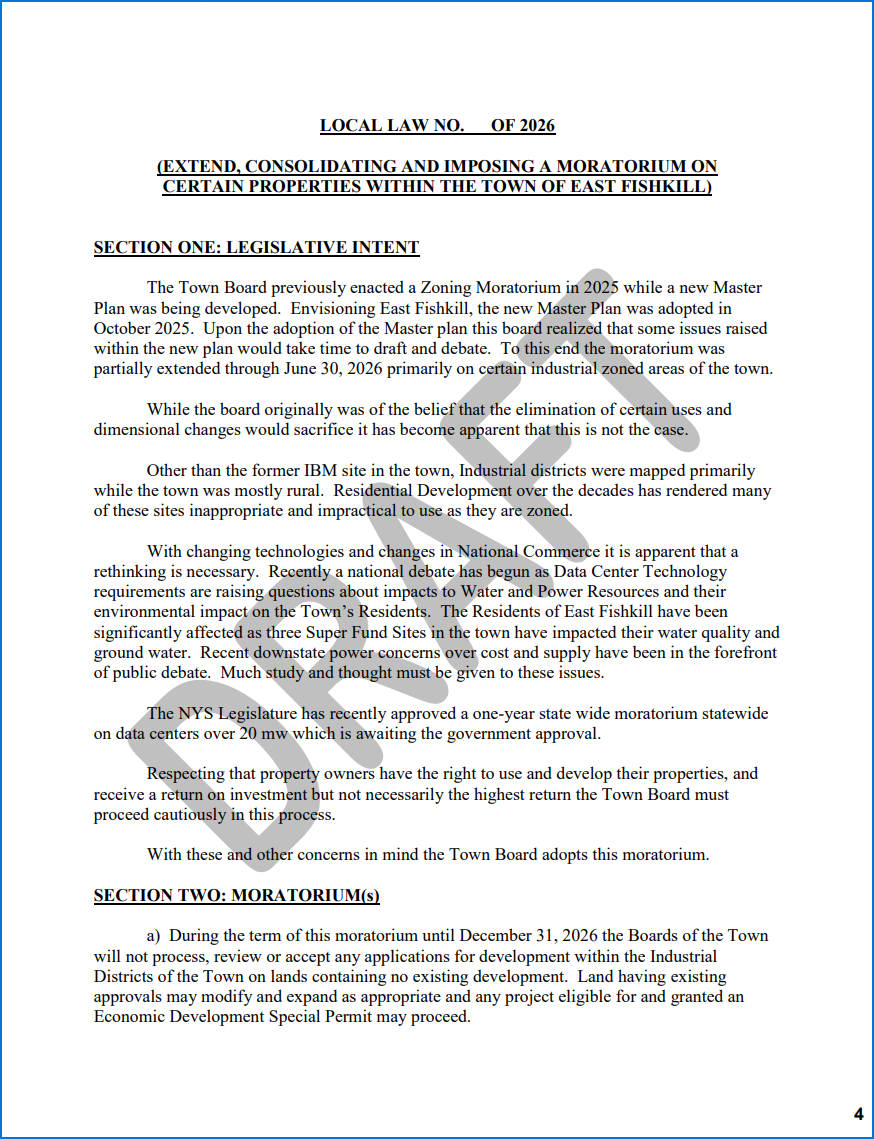
The three-year pause followed Treetop Development's floated plans for a 1,000-megawatt facility, a project that would have been more than 10 times larger than New York's biggest existing data center. Although the proposal no longer appears on the New York Independent System Operator's interconnection queue, residents filled a public hearing to press the town to act, chanting "We can't drink data" outside town hall.
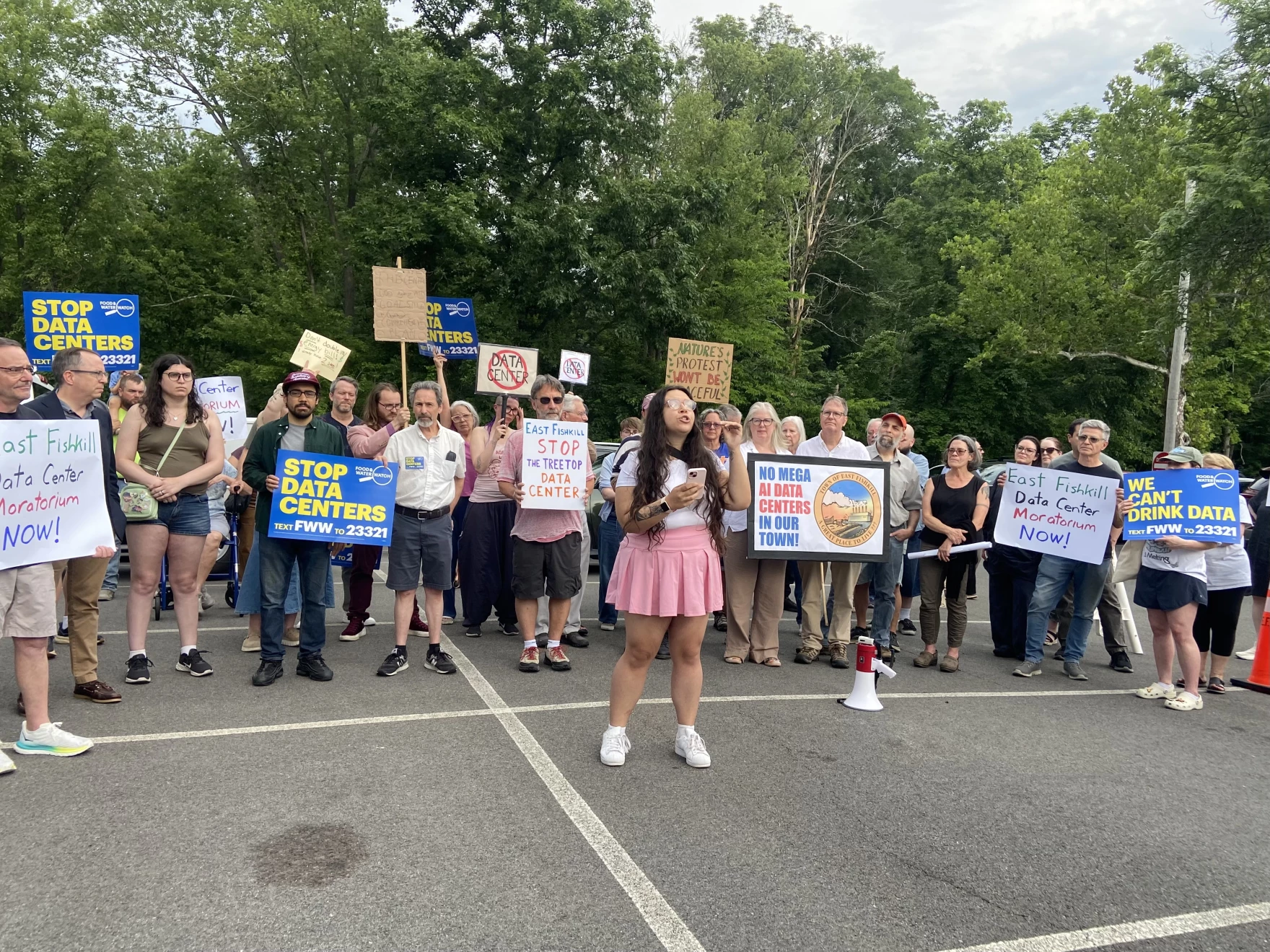
The town's resolution cites concerns about higher energy bills and existing water-quality problems, including three Superfund sites in the area. Councilmember Marianne Flores stressed the measure is temporary and said she hopes it creates space to build a task force of planning, utility, and environmental experts to evaluate future proposals.
Indianapolis, Indiana
Indianapolis's Metropolitan Development Commission voted Wednesday to advance proposed data center zoning rules to the City-County Council.
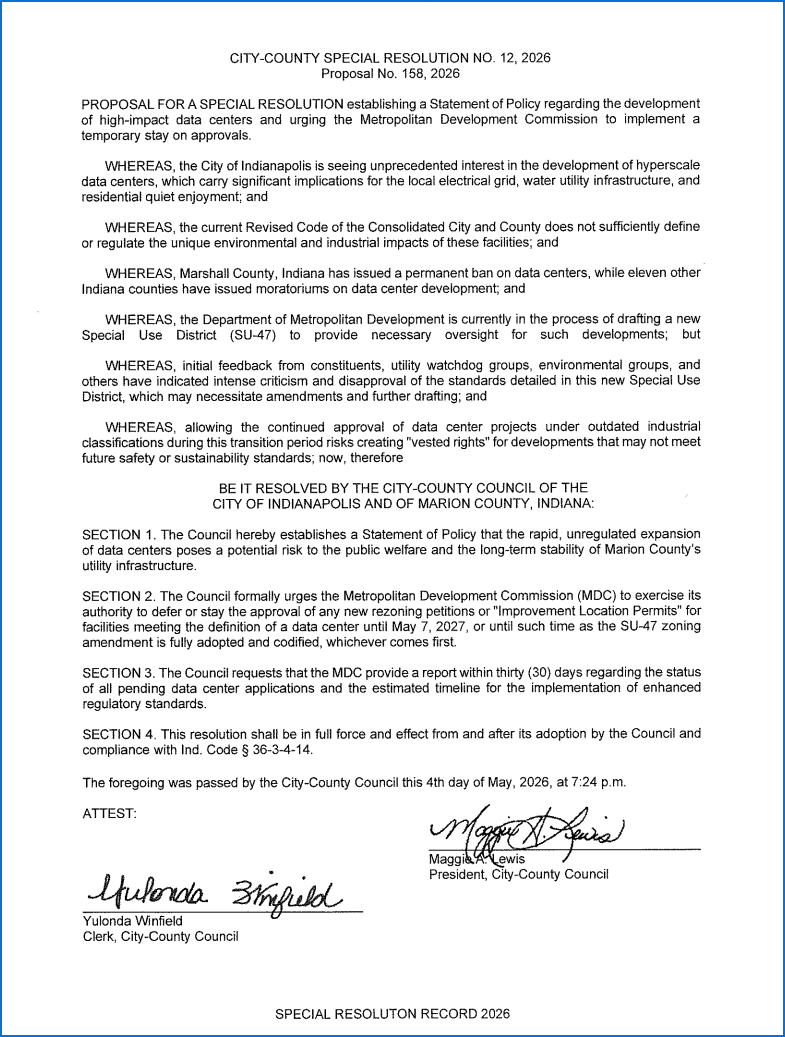
The proposal, called SU-47, would create a new special use district and require new data center projects to go through a rezoning process. It sets requirements including setbacks from protected districts, noise limits, operations plans, utility reports, decommissioning plans, and public reporting. Commissioners amended the noise cap from 55 dBA to 65 dBA and approved a separate amendment grandfathering in existing or previously approved data center uses.
The ordinance is expected to reach the council July 6, with a committee public hearing anticipated July 13 and a possible final vote Aug. 10. If approved, it would be the city's first zoning standards written specifically for data centers. Pike Township resident Tina Oakes said the current draft doesn't adequately protect residents and wants the council to consider a moratorium instead.
Prince George's County, Maryland
An anti-data center rally in Prince George's County drew counter-protesters Wednesday night as the council prepares to vote next week on a two-year moratorium.


Dozens gathered outside the Wayne K. Curry Administration Building in Largo to push for a ban, while a group in matching orange shirts rallied in support of the facilities. A previous moratorium on AI data centers expired Tuesday. Council Member Wala Blegay said she expects the votes to approve the multi-year pause, and Council Chair Krystal Oriadha confirmed the vote is coming next week.


The county is currently home to five data centers. County Executive Aisha Braveboy issued an executive order pausing permitting in September 2025, months after the planning board approved a plan for a large data center at the old Landover Mall, a project still on hold. Some residents said a temporary moratorium falls short of the permanent ban they want.
Union County, Arkansas
Union County leaders approved a one-year pause on new data center development after an emergency Quorum Court meeting that officials described as the largest crowd the court has ever hosted.
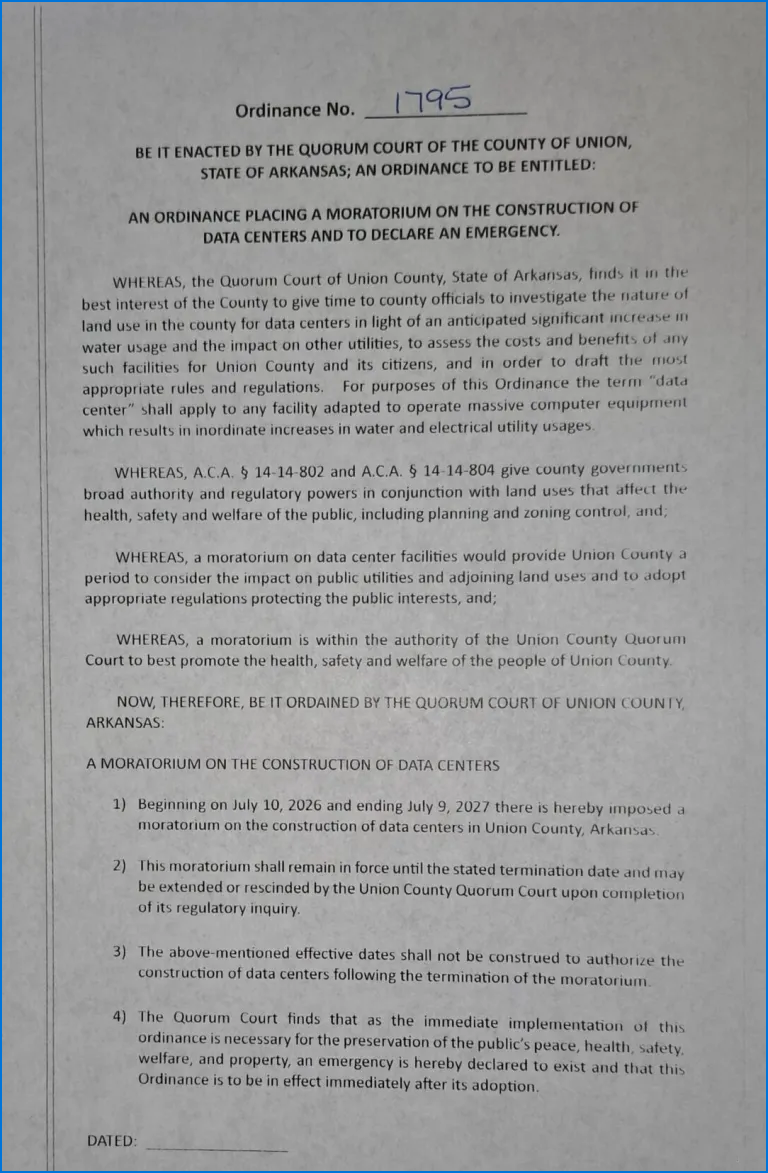
County Judge Mike Loftin called the special meeting for the morning of Tuesday, June 30, amid growing public discussion of proposed data centers, crypto-mining, and power use. Every member of the Quorum Court voted for the ordinance, which runs from July 10, 2026, through July 9, 2027. An emergency clause let the county put it into effect without the usual waiting period.
Officials said the year will give them time to study effects on water, electrical demand, public utilities, emergency services, and surrounding property, and to weigh zoning rules and operating standards before more projects advance.
Fort Worth, Texas
Residents are fighting a proposed North Texas data center that would pull up to 5 million gallons of water a day from Cedar Creek Lake, the reservoir that supplies most of Fort Worth's drinking water.
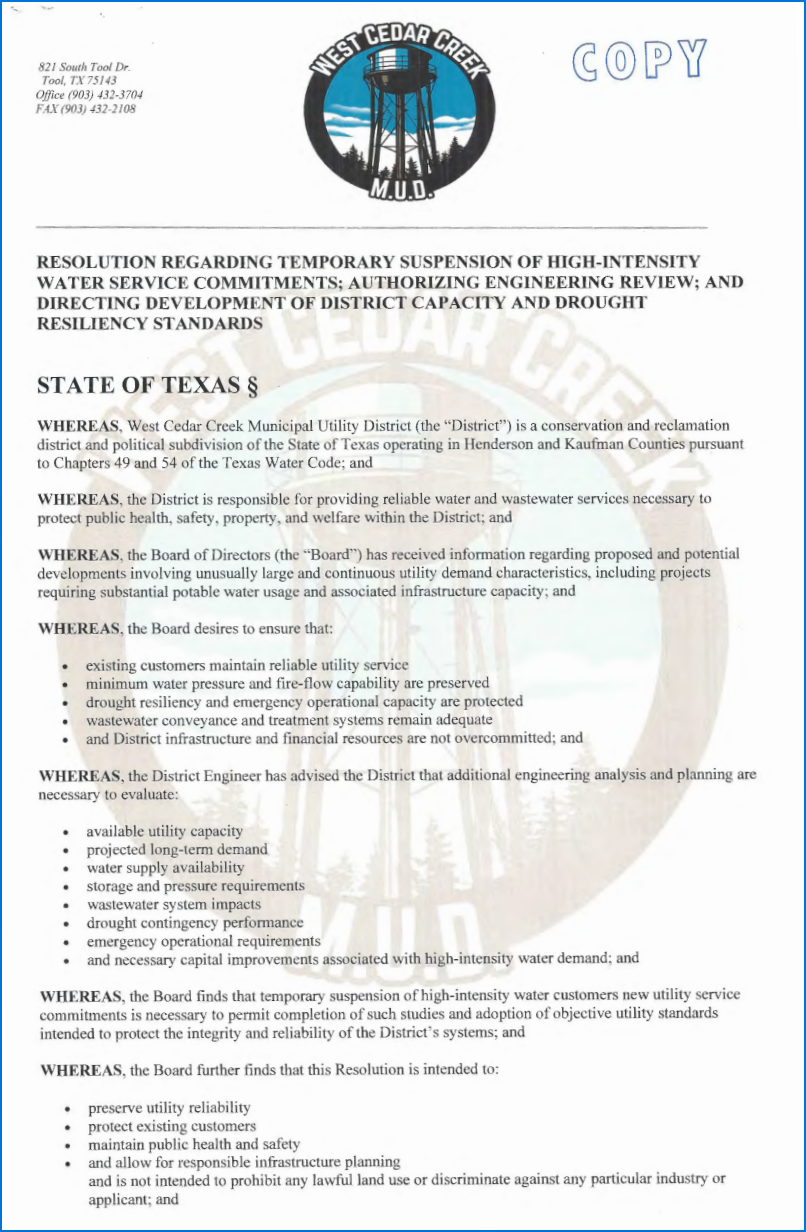
Kansas-based Diode Ventures proposed the facility, sited west of the lake between Trinidad and Tool in Henderson County. The company says its site review is in very early stages and many details aren't set. On May 21, the West Cedar Creek Municipal Utility District advanced a temporary suspension on "high-intensity water service commitments", effective through April 1, 2027, to protect system reliability during drought.
Cedar Creek Reservoir, owned by the Tarrant Regional Water District, is one of two East Texas lakes that supply 80% to 85% of the district's raw water. Diode has an incomplete application on file, and no contract has been issued. Advocacy group Save Cedar Creek and other residents say the company hasn't been transparent about the project's scope.
Linn County, Iowa
The Linn County Board of Supervisors voted Wednesday to approve an 18-month moratorium on new applications to rezone unincorporated property into the county's new EU-3 large-scale data center district.
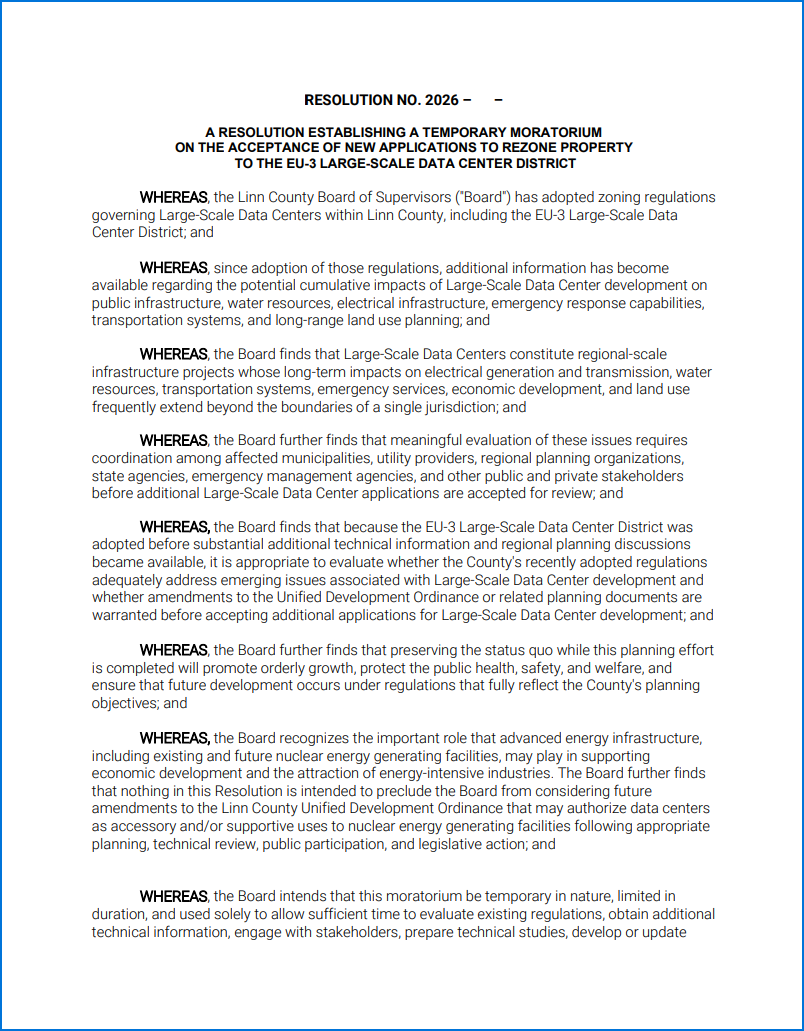
The pause, set to run through Jan. 1, 2028, came just months after the board adopted what several speakers called one of the state's most comprehensive and restrictive data center ordinances in February. Supervisor Brandy Meisheid, who proposed the resolution as a "pause", said the county now has roughly 3,500 acres tied to data center development and that officials lack accurate data to judge what the community can sustain.
 Government Websites by CivicPlus®
Supervisor Sami Scheetz cast the lone no vote, arguing the board would be suspending an ordinance it had never once applied and could push projects toward jurisdictions with weaker rules. Meisheid outlined goals for the period including a regional water study, a comprehensive plan update, and state legislation to keep data center power costs off ordinary ratepayers.
Missoula County, Montana
Missoula County commissioners will hold a public hearing July 9 to consider interim zoning that would place a temporary pause on new data center development or expansion.
- Missoula County Commissioners to Consider Interim Zoning for Data Centers
Officials say the move buys time to write updated zoning rules addressing energy and water use, noise, and heat. For now, the measure would affect one active proposal: Krambu's plan to open a center at the former Stimson Mill site in Bonner, using existing buildings and infrastructure. The location previously drew opposition when a bitcoin mining operation moved in a few years ago.
 KD
KD
Hundreds of residents have signed a petition raising concerns about the power and water demands and whether heavy industrial use still fits Bonner's growth as a place for homes and recreation. The hearing begins at 2 p.m. at the Missoula County Courthouse.
Paris, Tennessee
The Paris City Commission voted to place a temporary moratorium on data processing centers within city limits on second and final reading.
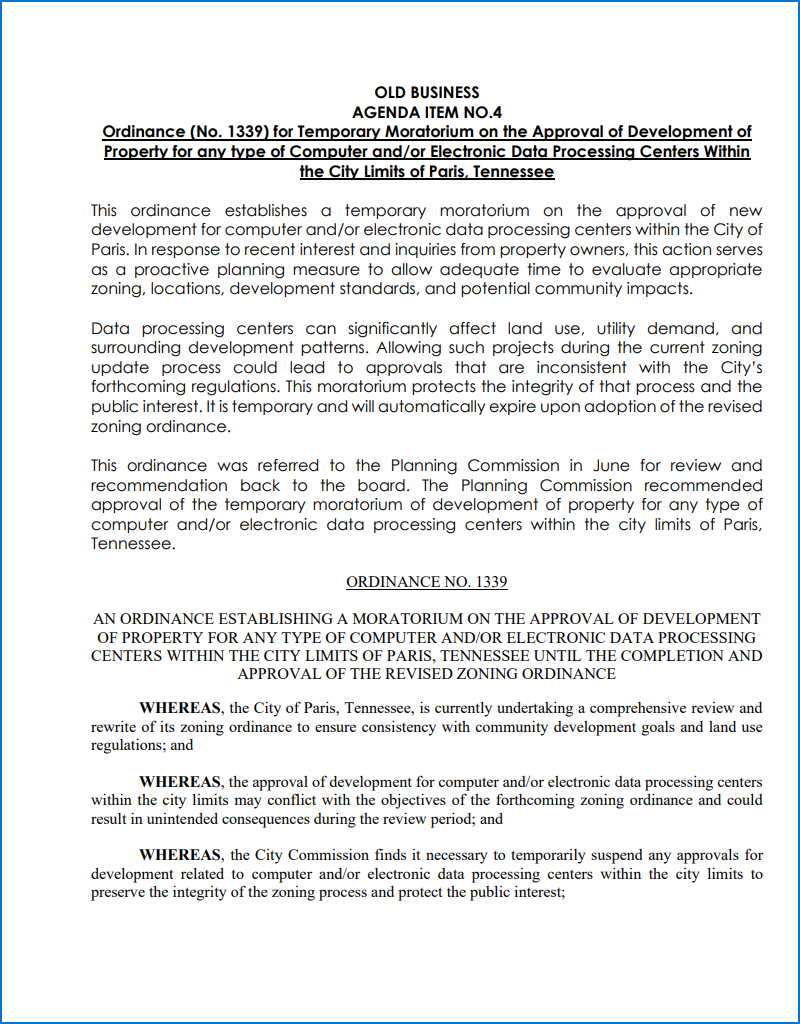
City Attorney James Smith said the measure is meant to pause development until the city can study the issue, a process expected to take up the better part of a year. The resolution frames the pause as a proactive planning step to evaluate zoning, locations, development standards, and community impacts, following recent interest from property owners.
At a packed meeting, residents including Brandi Valentine of Henry backed the moratorium but pushed for a firm end date and stronger zoning, citing environmental concerns and effects on the county water table. Others raised stormwater damage and road wear as related worries.
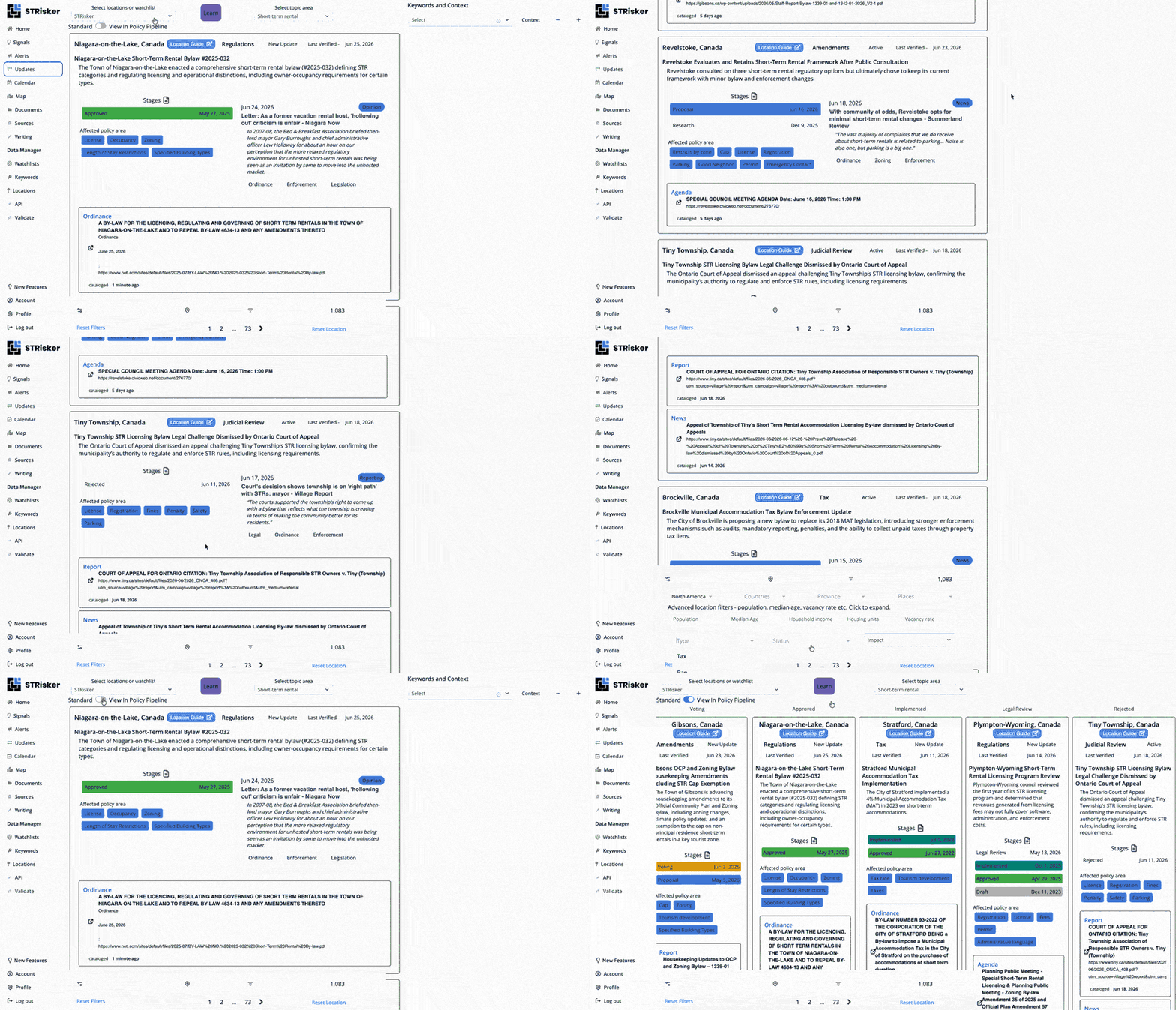
Strisker Updates Tracker
How do you keep up with the regulatory rollercoaster in your market? Strisker's Updates Tracker can be your guide - start tracking latest events as they happen and get access to essential documents as they come in. We know the struggle, which is why we built this product to capture every twist and turn in the regulatory saga so you never miss a beat.
Stay Updated with STRisker!
STRisker offers tools and features to keep you updated with the Short Term Rental and Data Centers movement across the world.
👍 We’d love your feedback.
Which stories hit? Which ones missed?
We're exploring a new branch of topics centered around Data Centers and want to make it even more useful for you.
✉️ Just reply directly to this email. We read and respond to every message!
-Will McClure
🙋 P.S.
Know someone else who should be reading Daily Notes? Feel free to forward this along. We’re opening a few more spots.