
Data Centers: Daily Notes | July 7, 2026
Delta County enacts 12-month moratorium. Joplin tables proposed ordinance requiring special use permits. New Albany advances a one-year moratorium with a final vote set for July 16. Massillon delays zoning data ordinance. North Mankato and Lakeland consider one-year moratorium.


At A Glance 🔽
- Delta County, Michigan enacted a 12-month moratorium on data center and cryptocurrency mining construction to give officials time to craft new ordinances addressing infrastructure, resource and tourism concerns.
- Joplin, Missouri tabled a proposed data center ordinance requiring special use permits, sending it back for revisions on pollution standards, wastewater rules and utility rate protections.
- Prince William County, Virginia faces a vote on a comprehensive plan amendment for the nearly 2,000-acre Dulles South Innovation Center.
- Albany, New York saw its Common Council back a proposed statewide data center moratorium in a 12-0 vote, pressuring Gov. Hochul to sign the pending state bill.
- Jackson, Mississippi held two meetings to weigh a temporary data center moratorium, with officials citing unresolved questions and competing priorities like schools and grocery access.
- New Albany, Indiana advanced a one-year data center moratorium that would block new facilities or campuses over 100,000 square feet, with a final vote set for July 16.
- Massillon, Ohio delayed its data center zoning ordinance by at least two weeks after adding amendments restricting facilities to heavy-industrial zoning and expanding residential setbacks to 400 feet.
- North Mankato, Minnesota discussed a proposed one-year moratorium on new or expanded data centers without taking a formal vote.
- Lakeland, Florida is considering a one-year moratorium on data centers requiring 50 megawatts or more, driven by opposition to the proposed Project Swan facility, with a final vote scheduled for Aug. 3.
- Bell County, Texas heard residents call for scrapping data center tax abatements entirely, though commissioners stopped short of ending the incentives and instead planned workshops to revise the policy.
Delta County, Michigan
Delta County's Planning Commission passed a 12-month moratorium on data center and cryptocurrency mining construction Monday, giving the county time to craft ordinances addressing community concerns about the technologies.
 Daniel Howell
Commissioners said the pause responds to worries over strain on electrical infrastructure, impacts on natural resources, and potential harm to the area's tourism-based economy. Commissioners said they heard the concerns and welcomed continued feedback over the coming year.
CUPPAD Community Planner Ryan Carrig also presented an updated Master Plan and future land use framework as part of the county's broader zoning review. The planning commission forwarded its moratorium decision to the county board, with its next meeting scheduled for Aug. 27.
Joplin, Missouri
Joplin City Council voted 9-0 Monday to table a proposed data center ordinance, sending it back to the Planning and Zoning Commission for revisions after staff said new research and public feedback could strengthen the measure.
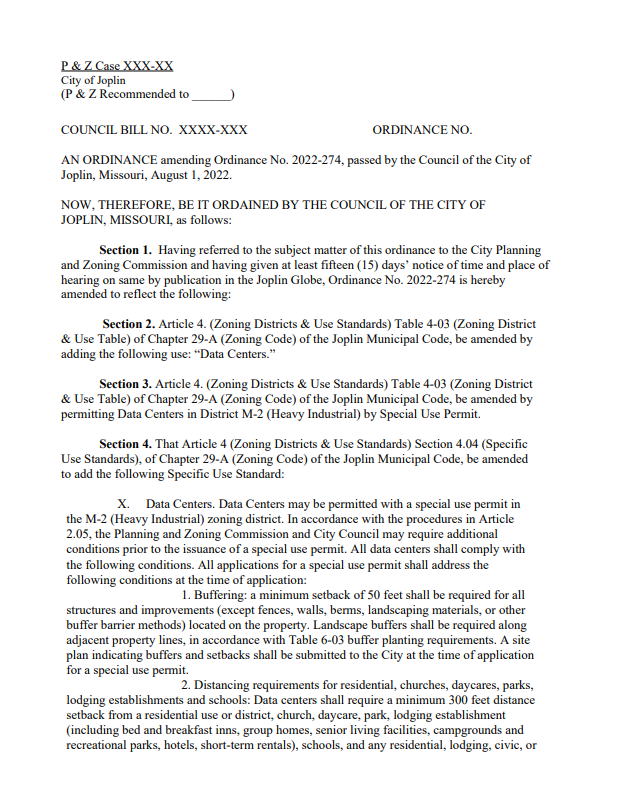
The draft ordinance would require data centers to obtain a special use permit rather than being allowed by right in heavy industrial zones, and already covers setbacks, landscaping buffers, noise limits, lighting controls, air pollution standards and utility infrastructure planning.
Development Director Troy Bolander said staff wants to refine the proposal after a recent Missouri Municipal League workshop featuring officials from Loudoun County, Virginia, the world's most data-center-dense region. Planned revisions include clarifying rules for accessory structures like guard shacks, strengthening pollution standards, addressing wastewater, and requiring developers to show that infrastructure upgrades won't raise base utility rates for existing customers.
The revised ordinance is expected to return to the Planning and Zoning Commission this month before coming back to the council, likely in early August.
Prince William County, Virginia
Prince William County supervisors are set to vote Tuesday on a comprehensive plan amendment for the nearly 2,000-acre Dulles South Innovation Center, a proposed 43 million-square-foot data center campus in the Gainesville District.
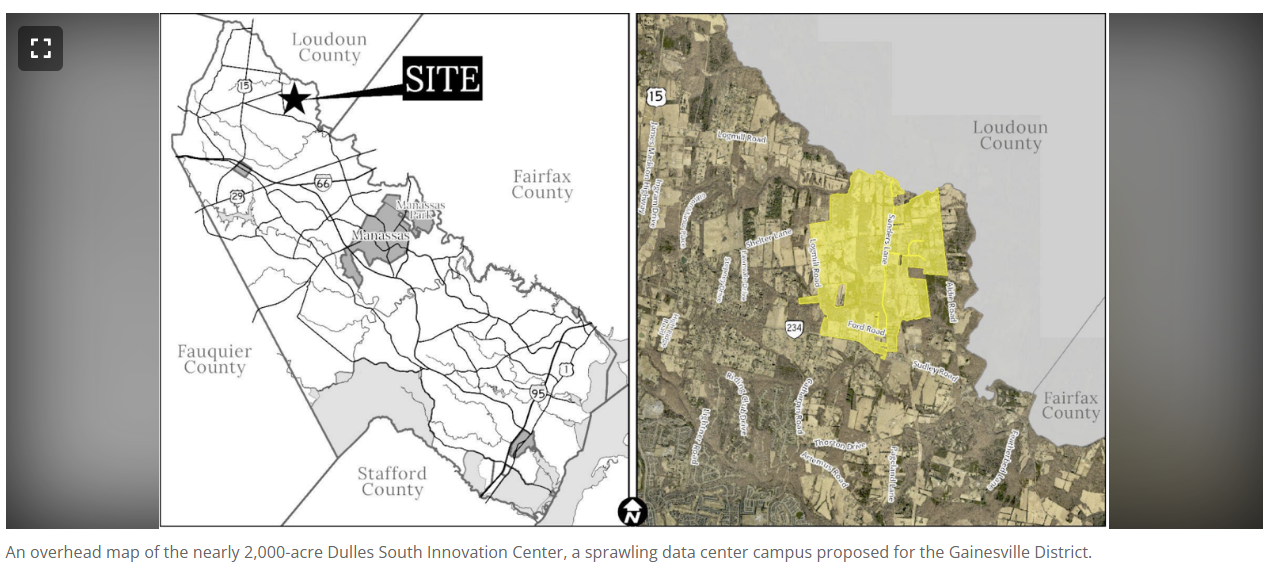
County staff is recommending denial, noting the site falls outside the county's Data Center Opportunity Zone Overlay District and arguing the project would not promote a harmonious pattern of development for the area. The amendment would shift roughly 1,940 acres across 252 parcels from agricultural and forestry designation to industrial and mixed-use hamlet, with a rezoning from agricultural to planned business district to follow if approved.
🔗Prince William County leaders to discuss Dulles South data center campus
Local advocacy groups, including the Coalition to Protect Prince William County and the Prince William Conservation Alliance, planned a rally and news conference against the amendment Tuesday, joined by U.S. Rep. Suhas Subramanyam, state Sen. Danica Roem and Del. Josh Thomas.
Albany, New York
Albany's Common Council voted 12-0 Monday night to back a proposed one-year statewide moratorium on data centers, with Councilmember John Williamson abstaining, after demonstrators from the No Kings Collective rallied outside city hall beforehand.
Senate Bill S10642: Enacts the responsible data center development act
The resolution doesn't ban data centers in Albany itself, but signals support for the state Legislature's moratorium bill, which passed both chambers but has not yet been signed by Gov. Kathy Hochul. No Kings Collective's Bryan Paz-Hernandez said the group aimed to pressure the governor to sign it while backing the council resolution. City officials said no formal data center proposal has been submitted to the council, only informal ideas and rumors about a potential facility's size.
Councilmember Deborah Zamer said the uncertainty around those rumors is exactly why the city needs a comprehensive plan for large-scale data centers rather than handling projects piecemeal.
Jackson, Mississippi
🔗Jackson leaders consider temporary moratorium on data centers after two meetings
Jackson city leaders held two meetings Monday to discuss establishing a temporary moratorium on data center development, first through the Planning and Economic Development Committee and then a special City Council session.
City Council President Brian Grizzell said officials still need to consult engineers and environmentalists and answer a range of unresolved questions before deciding whether or where data centers should be allowed in Jackson. He noted Mississippi and the broader Southeast attract developers with cheap land and labor, but said the city needs more groundwork before approving any projects. Grizzell added that data centers could bring economic benefits, but that Jackson also has to weigh other priorities like improving schools and expanding grocery access in underserved neighborhoods.
The discussions come as the Mississippi Department of Environmental Quality prepares to hold a July 14 public hearing on an air permit application tied to a proposed data center project.
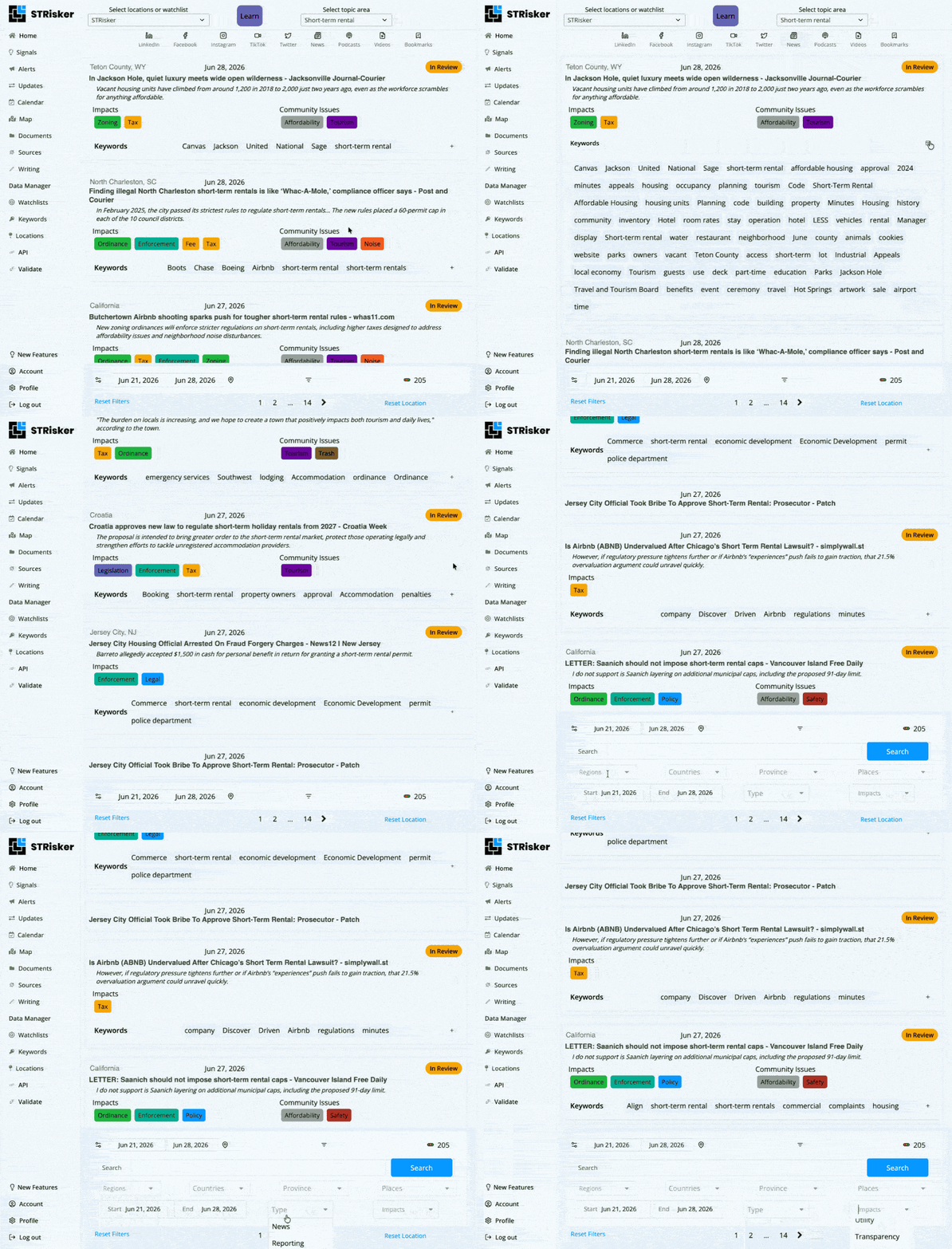
Strisker News Tracker
Trying to keep up with STR and data center regulations across multiple cities and states? Our News Tracker makes it easier than ever. Filter by location, search a comprehensive database, and sort by impact level—this tool helps you focus on what matters most.
New Albany, Indiana
New Albany's City Council advanced a proposed one-year data center moratorium Monday, setting up a final vote for July 16 on an ordinance that would block new data centers or multi-building campuses larger than 100,000 square feet.
 WDRB Digital Staff and Richard Essex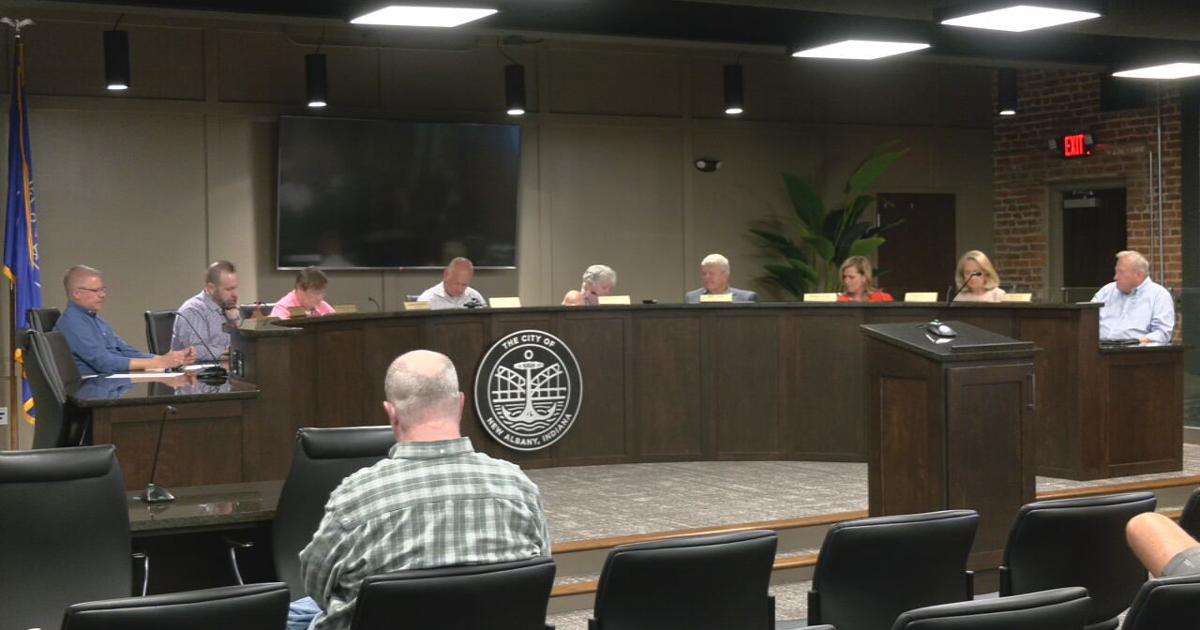
Mayor Jeff Gahan proposed the moratorium June 9, saying it would give the city time to thoroughly examine data centers' impacts. The New Albany Plan Commission recommended the measure last month after hearing from residents at a public meeting. City leaders said New Albany lacks room for a massive campus like the $800 million Meta data center under construction in nearby Jeffersonville, but noted smaller facilities could still move forward under current zoning.
Officials pointed to resident feedback, including responses to a survey sent with recent sewer bills, showing many want clearer zoning rules in place before any new data center projects are allowed. The council is expected to finalize its decision at the July 16 meeting.
Massillon, Ohio
Massillon City Council delayed final action on its data center zoning ordinance by at least two weeks, sending the measure back to first reading after adding a series of amendments on July 6.
 , Canton Repository
The revised proposal defines smaller data centers as 100,000 square feet or less per parcel and larger ones above that threshold, and would restrict all data centers to heavy-industrial (I-2) zoning, eliminating light-industrial areas as an option since I-2 parcels sit farther from residential neighborhoods. Setbacks from residential districts grew to at least 400 feet, up from 200 feet in earlier drafts. Developers will also need to show adequate water, electric and wastewater capacity in their site plans before construction, along with noise and decibel certifications, and the city's site plan review committee will retain authority to revisit utility-related issues after construction begins.
The delay lines up with a 60-day extension of a separate data center stay the council approved in mid-June, and comes as council prepares for a July 13 work session to keep refining the rules.
North Mankato, Minnesota
North Mankato City Council members discussed a proposed one-year moratorium on new or expanded data centers during a Monday work session, though no formal vote was taken.
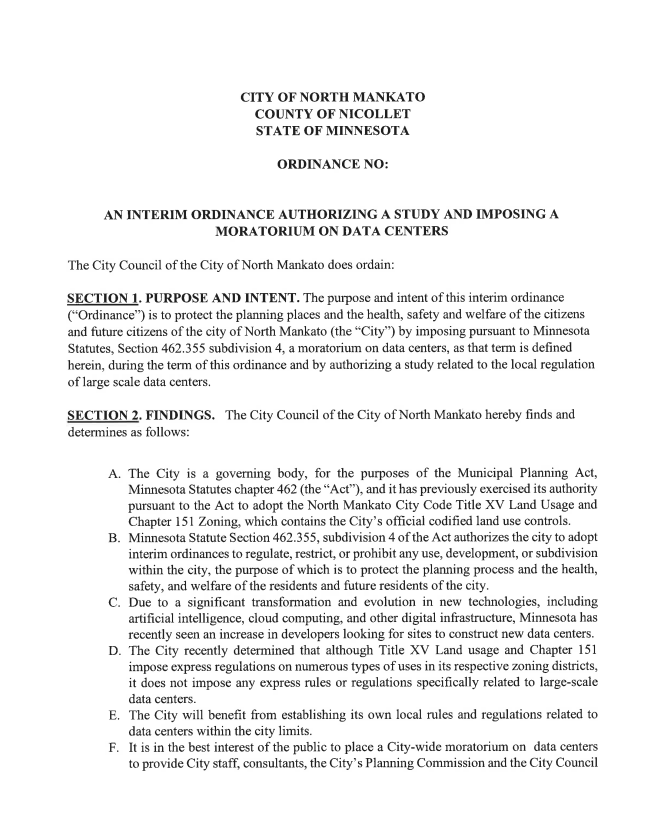
City Attorney Chris Kennedy said the pause would give the city time to define what qualifies as a data center and study issues like water consumption, electrical demand, noise, lighting and appropriate locations, with the cost of that study ranging anywhere from $5,000 to $50,000 depending on its scope.
The draft ordinance uses 1,500 square feet as a placeholder threshold for a large-scale facility. Council member Sandra Oachs raised concerns the threshold could inadvertently limit expansion by existing employers like Taylor Corp. or South Central College, while Council member Jim Whitlock said the study should examine whether newer data centers use less water and electricity than older designs.
Lakeland, Florida
Lakeland officials heard from residents and developers Monday over a proposed one-year moratorium on data centers and large-scale industrial facilities requiring 50 megawatts or more of power, with a final vote set for Aug. 3.
Legal Notice: Proposed Moratorium On Data Center And Large Load Customers
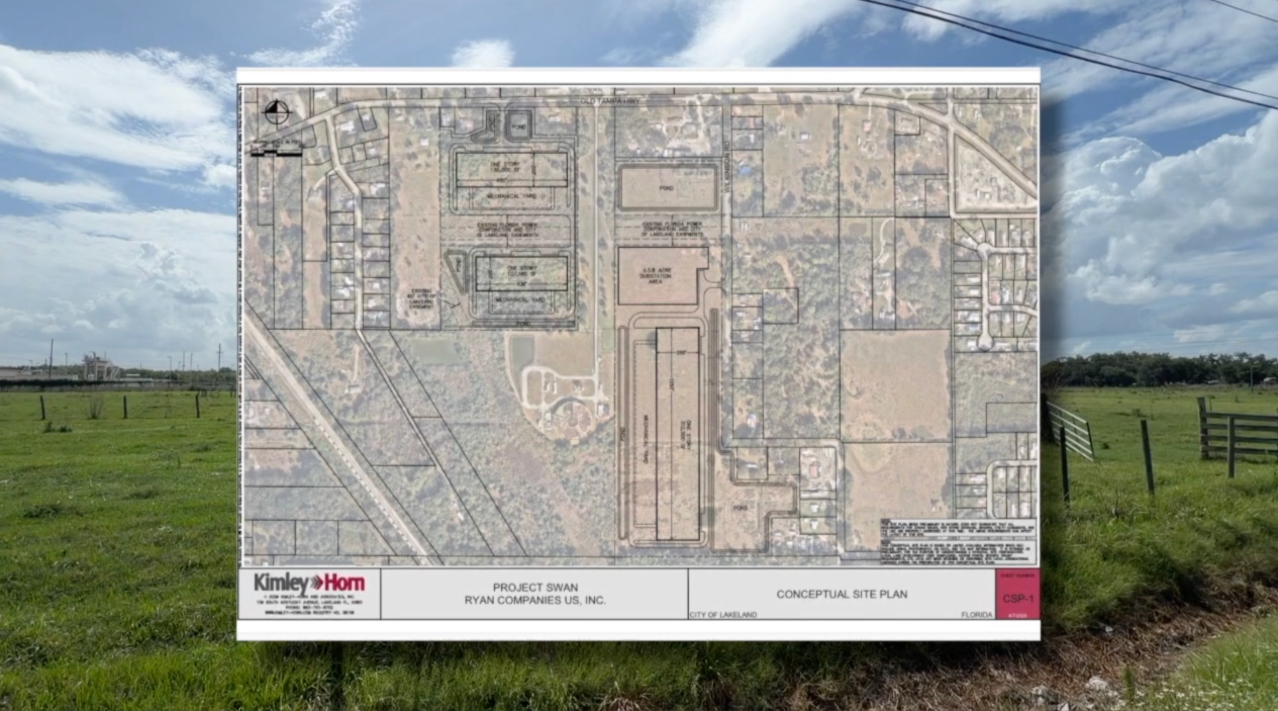
The proposal follows weeks of opposition to Project Swan, a planned 600,000-square-foot hyperscale data center in west Lakeland. Resident Kristie Poma, who lives near the proposed site and manages a heart and lung condition, said she worries about breathing in emissions from the facility's diesel generators. Mayor Sara Robert McCarley said the city's largest current power user draws just 18 megawatts, well short of the 50 megawatts a qualifying facility would need, and questioned whether Lakeland's grid or water system could support a project that size, pointing to a recently approved facility in Fort Meade that could use up to a gigawatt.
 , The Ledger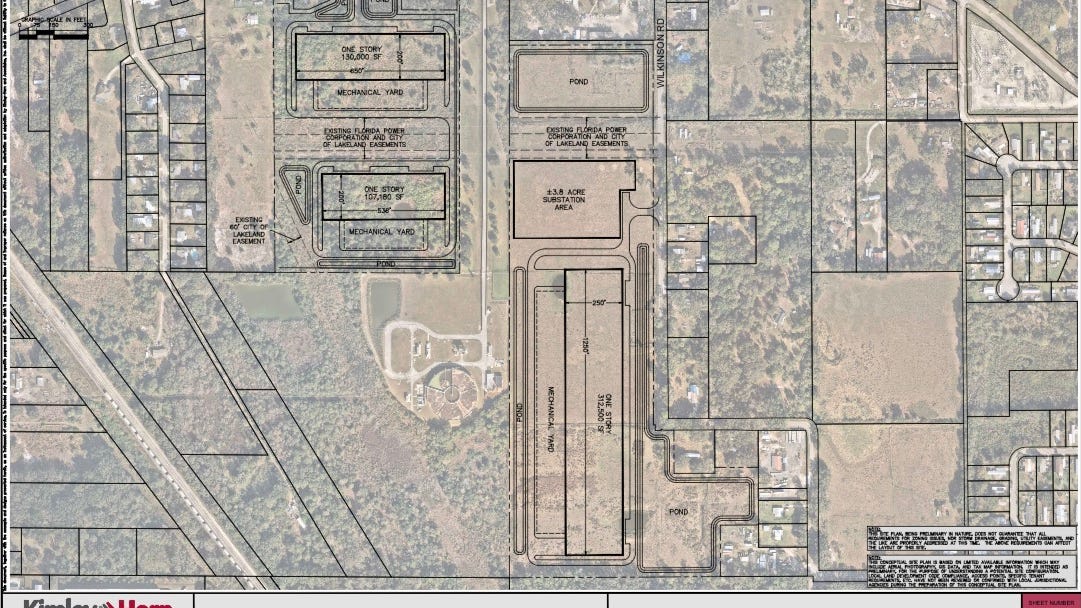
Ryan Companies developer Tyler Lohmiller said Project Swan would need roughly 100 megawatts, contingent on Lakeland Electric's ability to supply it, and said the project would use water only for standard building needs rather than server cooling. The city has scheduled another public hearing for July 20 ahead of the August vote.
Bell County, Texas
Bell County residents pressed commissioners Tuesday to scrap tax abatements for data centers altogether, arguing the incentives are what draws hyperscale companies to the area in the first place.
 Jasmine Lotts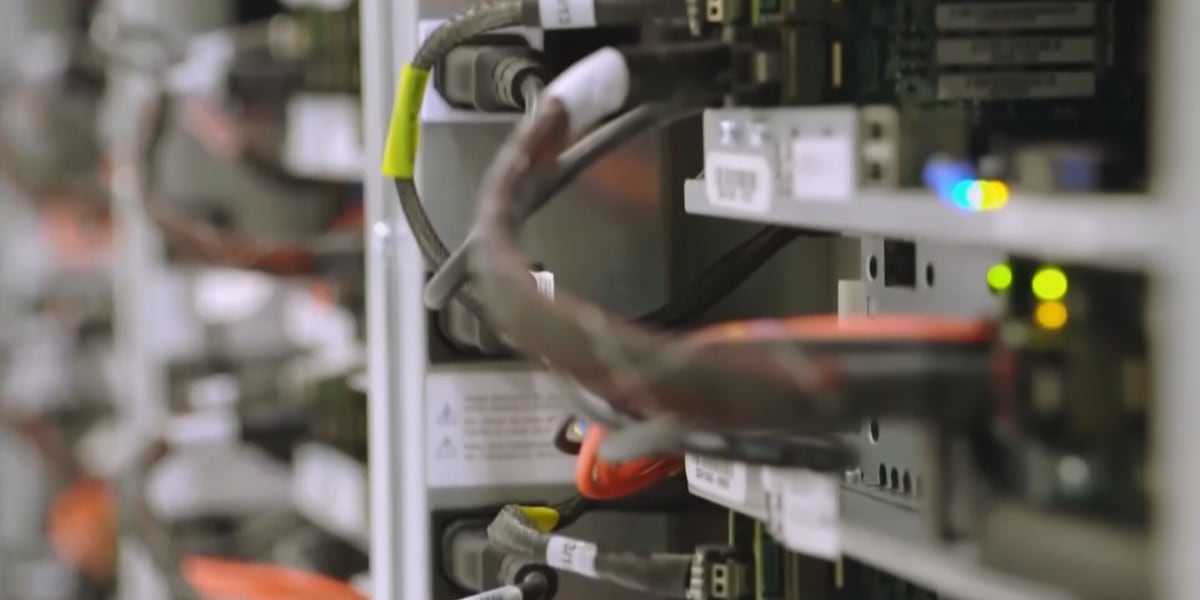
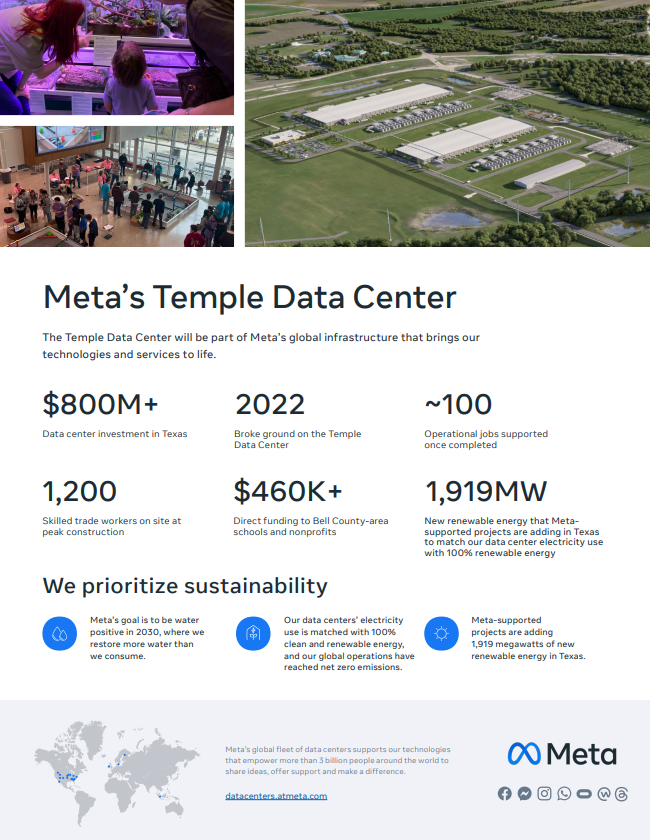
Farmer Alton Fowler told the Commissioners Court no data center should receive an abatement since the companies are "already ahead" once granted breaks they otherwise wouldn't get. Resident Joe Royer argued no hyperscale facility has been built in the area without one, and questioned why the county issued a separate abatement for Meta's Temple facility on top of one the city had already granted. Precinct 2 Commissioner Bobby Whitson responded that most of that Meta tax revenue sits in a Tax Increment Reinvestment Zone the county recently renewed for another 40 years, meaning it wouldn't have reached county coffers for decades regardless.
Commissioners said that without zoning authority outside city limits, a tax abatement is one of the few tools they have to impose conditions like noise limits, water use rules or diesel generator bans on a project. They did not commit to ending abatements, but agreed the current policy needs revision, with workshops planned for July 27, Aug. 3 and Aug. 17 ahead of a public hearing and adoption of an amended policy by Sept. 8.
📱 Social Buzz
Episode Title: Episode 31: How The Left Should Approach Data Centers with Winston Yau
Episode: The Rift
Listen:https://www.spreaker.com/episode/episode-31-how-the-left-should-approach-data-centers-with-winston-yau--72832216
Episode Title: Virginia Residents Defeat World's Largest Data Center at Manassas Battlefield
Episode: Virginia Insider
Listen:https://rss.com/podcasts/virginia-insider/2963301
Stay Updated with STRisker!
STRisker offers tools and features to keep you updated with the Short Term Rental and Data Centers movement across the world.
👍 We’d love your feedback.
Which stories hit? Which ones missed?
We're exploring a new branch of topics centered around Data Centers and want to make it even more useful for you.
✉️ Just reply directly to this email. We read and respond to every message!
-Will McClure
🙋 P.S.
Know someone else who should be reading Daily Notes? Feel free to forward this along. We’re opening a few more spots.