
Data Centers: Daily Notes | June 17, 2026
New York's first-in-the-nation moratorium lands on Hochul's desk as Holyoke bans data centers outright and communities from California to Nebraska hit pause.


At A Glance 🔽
- New York's first-in-the-nation data center moratorium reaches Gov. Hochul's desk.
- Holyoke, MA council votes to ban data centers from every zoning district.
- Imperial County, CA supervisors pause data centers for 45 days; a developer vows to sue.
- Henderson, NV introduces a 180-day moratorium.
- Gage County, NE planning commission backs an 18-month moratorium as a Google project looms.
- Urbana, OH council reverses the 2025 zoning change that allowed data centers.
- Carroll County, AR Quorum Court passes a 1-year emergency moratorium.
- North Tonawanda, NY extends its AI data center moratorium another year.
- Van Buren Township, MI faces a state hearing over a hyperscale project's wetland permit.
- Bowling Green, KY adopts data center zoning rules and rejects a moratorium for a second time.
New York
New York's legislature has passed what would be the nation's first statewide data center moratorium, and the bill now sits on Gov. Kathy Hochul's desk with roughly $10 billion in projects hanging in the balance.
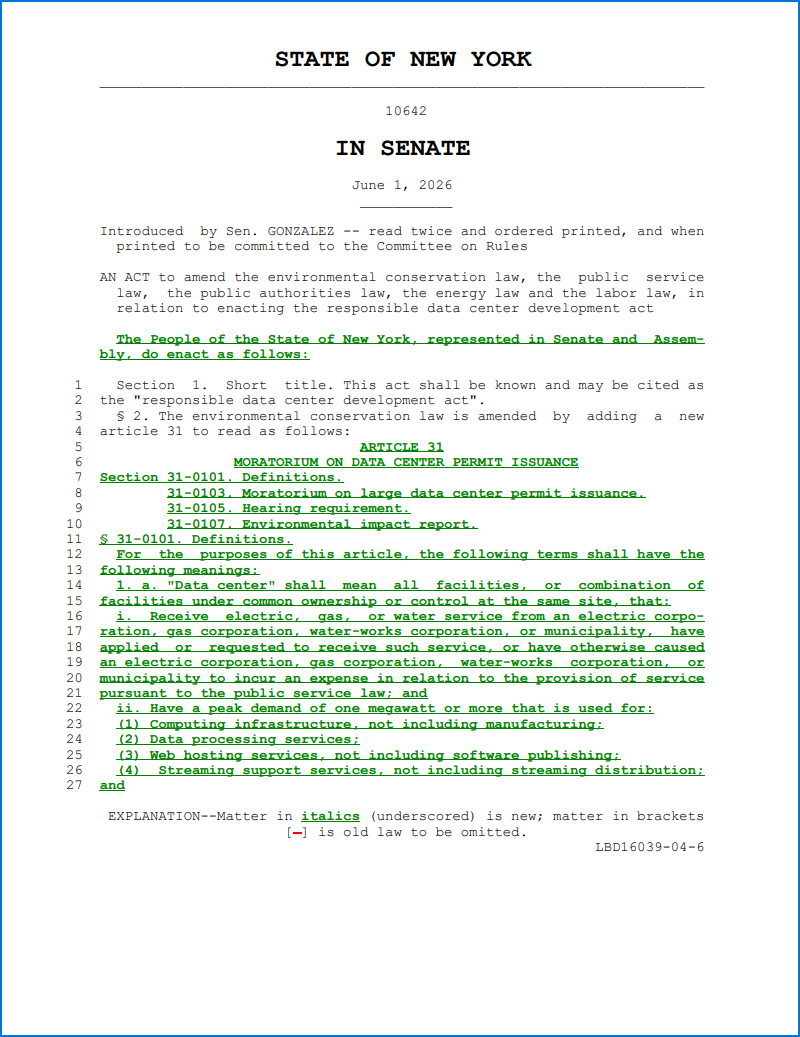
The Responsible Data Center Development Act would halt new permits for data centers with a peak load above 20 megawatts for at least a year. Projects that size would fall under a new electric and water rate class and have to provide community benefits, while developments over 5 MW would face new energy-efficiency goals and prevailing wage requirements. Every new project would also require a local public hearing. During the pause, the Department of Environmental Conservation would study statewide impacts on energy, water, pollution, and electronic waste.
Hochul has until the end of the year to decide, a choice complicated by her reelection bid and years of state investment in chipmaking and AI infrastructure. As of May, 51 large-load projects totaling 12,670 MW were seeking to connect to the state's grid by 2030, though only one was under construction. A spokesperson said she will review the bill.
Holyoke, Massachusetts
The Holyoke City Council voted Tuesday night to ban data centers from every zoning district in the city, ending a fight over a proposed $200 million project.
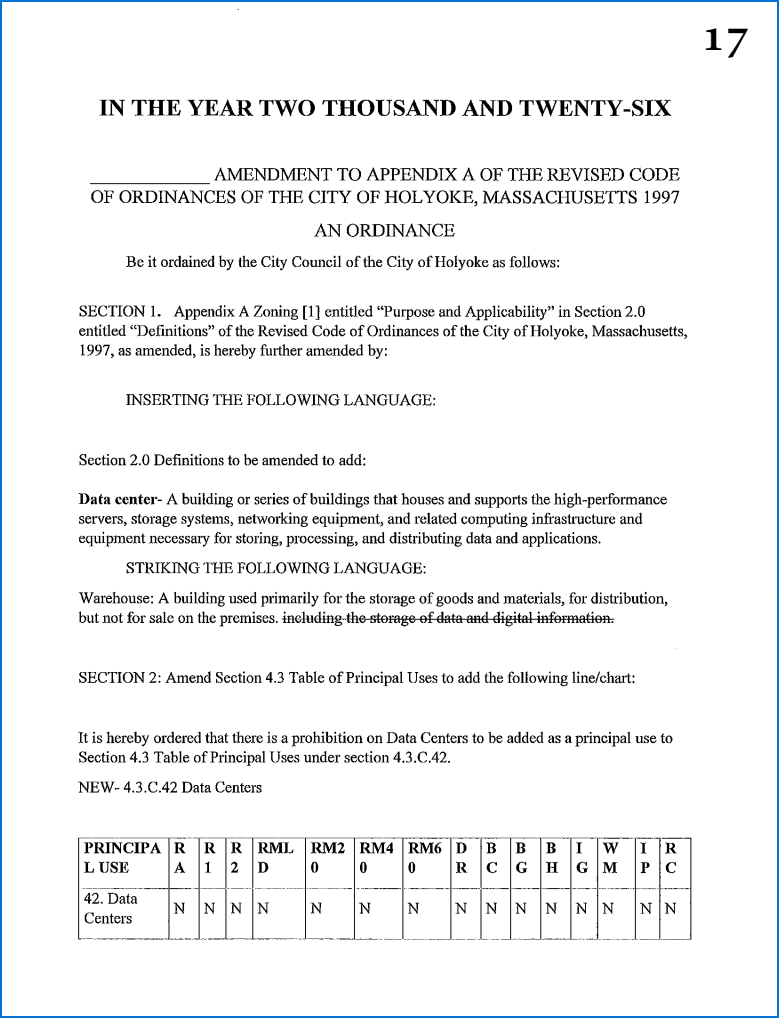
The proposed center would have sat on a long-vacant industrial property on Water Street, and developers had pitched it as new investment that would support local utility revenue. Opposition built quickly: nearly 430 residents signed a petition against the project within days of it becoming public. The council's ordinance committee recommended defining "data center" as a specific land use and banning it citywide.
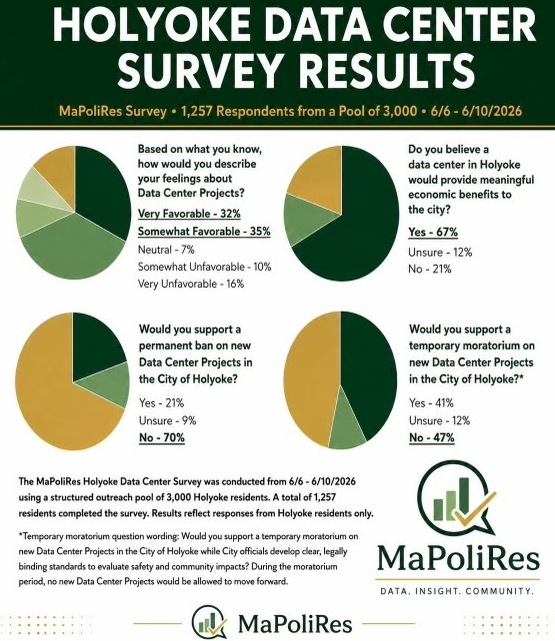
Residents drew a sharp distinction between the proposed facility and an existing Holyoke data center, a nonprofit run by a consortium of universities that uses the city's green energy. In a statement, representatives for the development said they would engage with whatever guidelines the city sets, framing the size threshold as useful guidance for designing a smaller project.
Imperial County, California
Imperial County's Board of Supervisors paused pending and future data center projects for at least 45 days, capping months of community opposition over energy, water, and public health concerns.
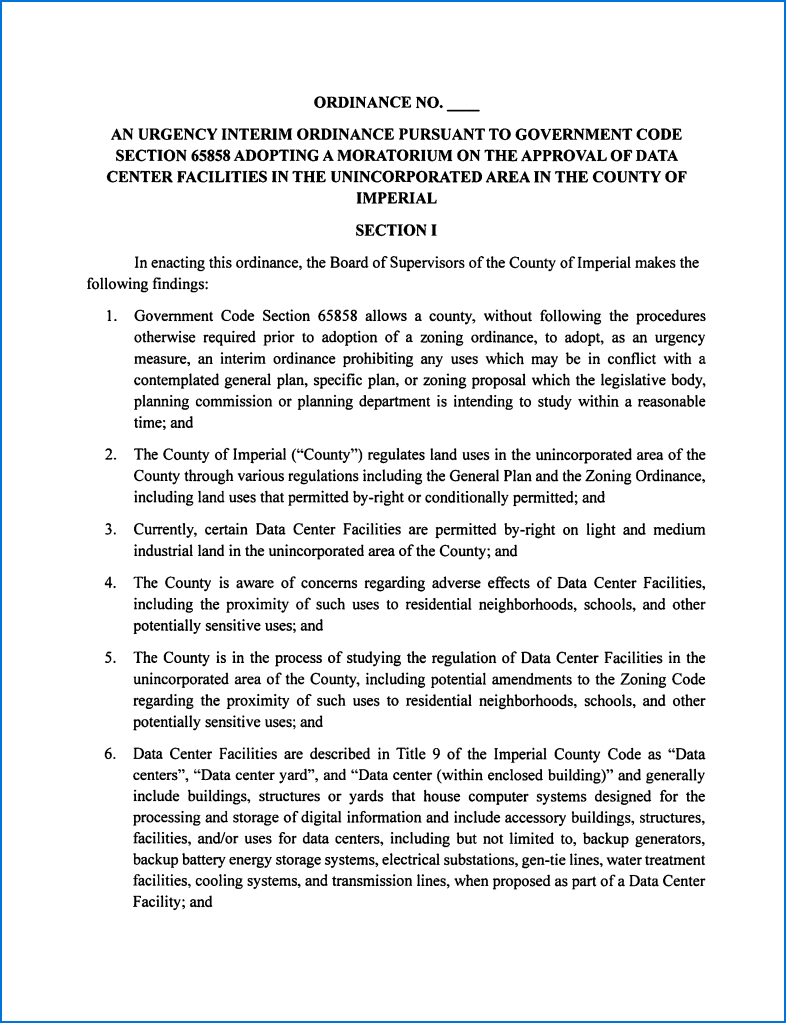
Just three months earlier, supervisors had voted to advance a nearly 1 million-square-foot project that backers call the largest in the state, and two members had been vocal about diversifying the county's economy with tech infrastructure. The urgency ordinance can be renewed for up to 10 months and 15 days while a new 19-member advisory committee develops zoning and policy recommendations by January 2027.
Sebastian Rucci, the Huntington Beach developer behind the contested project, said he would file suit the next morning, writing that the vote "sends a very bad signal for the outside world." County counsel Geoffrey Holbrook countered that no current pending application has vested rights. The Sierra Club is separately challenging the project in court over environmental review.
Henderson, Nevada
Henderson's City Council introduced a bill that would impose a 180-day ban on conditional use permit applications for data centers, a first for any local government in Southern Nevada.
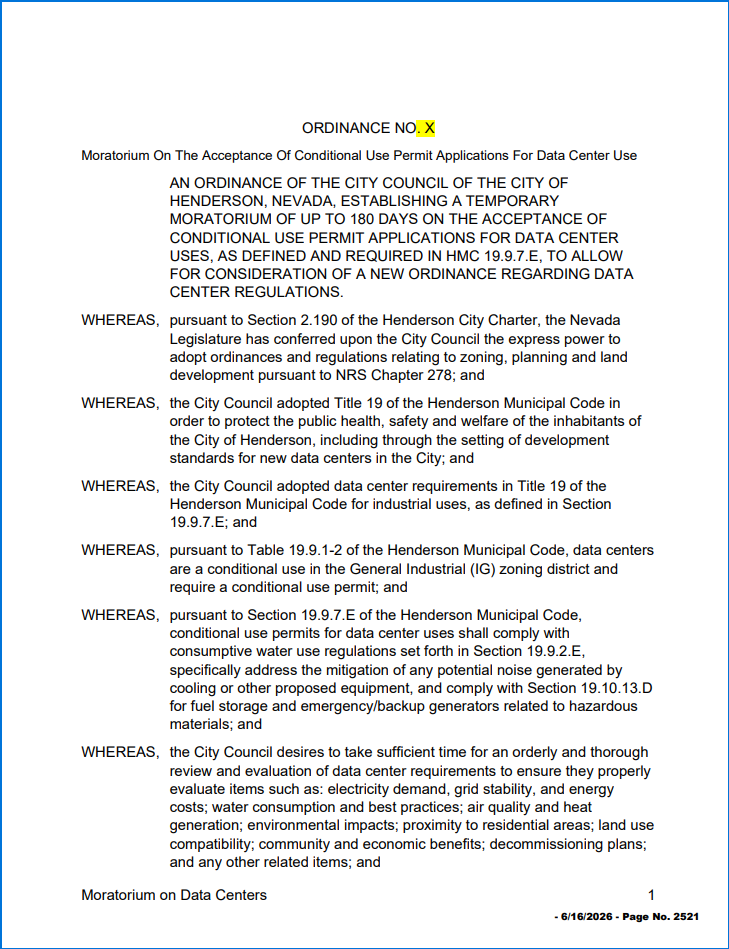
Bill No. 3927 was referred to the council's July 21 meeting for potential adoption. City staff said the proposal will be amended to let the council lift the moratorium before the full 180 days if its questions are answered sooner. The review would cover energy demands, water consumption, air quality, heat, proximity to homes, decommissioning plans, and economic benefits. Mayor Michelle Romero, who requested the early-lift amendment, said the city had heard there is interest in building more data centers locally.
Gage County, Nebraska
🔗 June 16, 2026 Agenda
Gage County's planning and zoning commission approved an 18-month data center moratorium after at least 100 people packed a public hearing at the courthouse in Beatrice.
The proposal comes as a Google data center remains under consideration in southeast Nebraska. The first hurdle, a state bill allowing privately owned power generation facilities, has passed; Gage County is the next. Residents urged commissioners to act, raising concerns about strain on the aquifer, constant noise, and families leaving town. After public comment, commissioners debated and settled on the 18-month length, then sent the decision to the county board of supervisors for approval.
Urbana, Ohio
The Urbana City Council voted Tuesday night to reverse a zoning change that had cleared the way for a proposed data center south of the city.
Ordinance 4635-26 restores the zoning code to its pre-2025 form, removing data centers as a permitted use in the M-1 Light Manufacturing District. The move followed a recommendation from the Urbana Planning Commission in May and a June 9 public hearing. Residents had filled council chambers for months asking leaders to strip the use from the code.
Carroll County, Arkansas
Carroll County's Quorum Court passed a 12-month moratorium on data centers and other "high-intensity digital infrastructure facilities" in Northwest Arkansas.
The pause temporarily blocks construction and authorization of facilities including data centers, AI computing, and crypto mining while county leaders draft regulations. Co-sponsors Harrie Farrow and Jack Deaton, both Justices of the Peace, said the year gives them time to study the issues and decide what permitting and restrictions are needed. They cited concerns about the power and water these facilities consume, and about non-disclosure deals that can lock counties into contracts they cannot reverse.
Because the Quorum Court meets monthly, a standard ordinance could have stretched into September. The co-sponsors submitted it as an emergency ordinance, letting it be heard and voted on in a single meeting. It took effect immediately Tuesday night.
North Tonawanda, New York
North Tonawanda's council voted to extend its AI data center moratorium for another year, halting a proposal to convert an existing crypto mining facility into an AI data center.
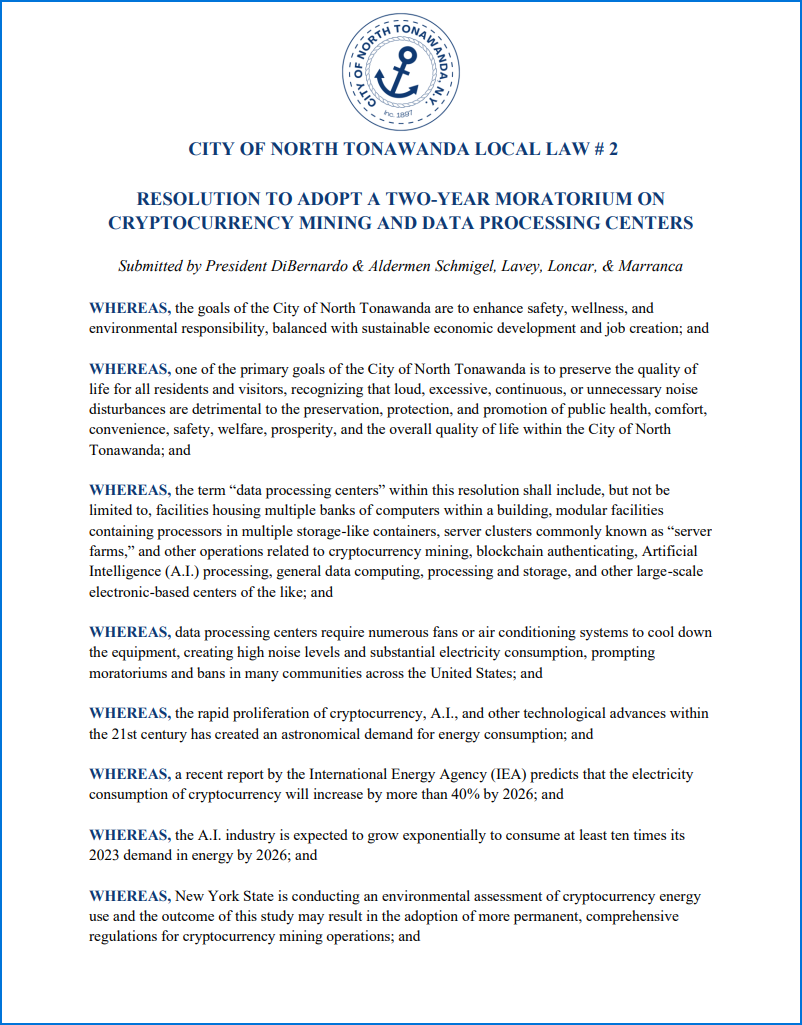
Mayor Austin Tylec said the crypto operation has created years of noise concerns for residents and that any new project will face far more scrutiny than the prior administration allowed. He said a full ban has come up as the city works through a major zoning update, adding the city does not want to "become a data center city." Residents who spoke at the meeting urged the council to write local standards first, noting the city has no written law governing the facilities.
Van Buren Township, Michigan
State environmental officials heard public concerns at a hearing Tuesday over a hyperscale data center that has already cleared the township's board of trustees.
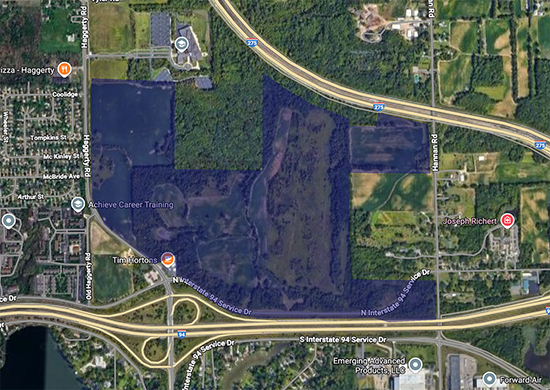
Panattoni Development Co. is seeking a permit from the Michigan Department of Environment, Great Lakes, and Energy to excavate and build in streams and wetlands for Project Cannoli, a five-building campus spanning 282 acres at I-94 and Haggerty Road. The plan would fill 13.55 acres of wetland and is projected to use 2 million to 3.6 million gallons of water per day and one gigawatt of power. OpenAI and Oracle are both expected to use the facility, and their CEOs visited the site in early June.
Five people commented at the hearing, raising concerns about flood storage and wildlife, while more than 50 joined the virtual meeting. EGLE officials said they cannot base permit decisions on public opinion. One commenter pressed for a brownfield site instead; Panattoni said it reviewed seven brownfield sites in Metro Detroit, including the former Packard plant, and found none large enough for the project.
Bowling Green, Kentucky
The Bowling Green City Commission adopted zoning regulations for data centers while rejecting a moratorium for the second time. No projects are currently proposed in Kentucky's third-largest city.
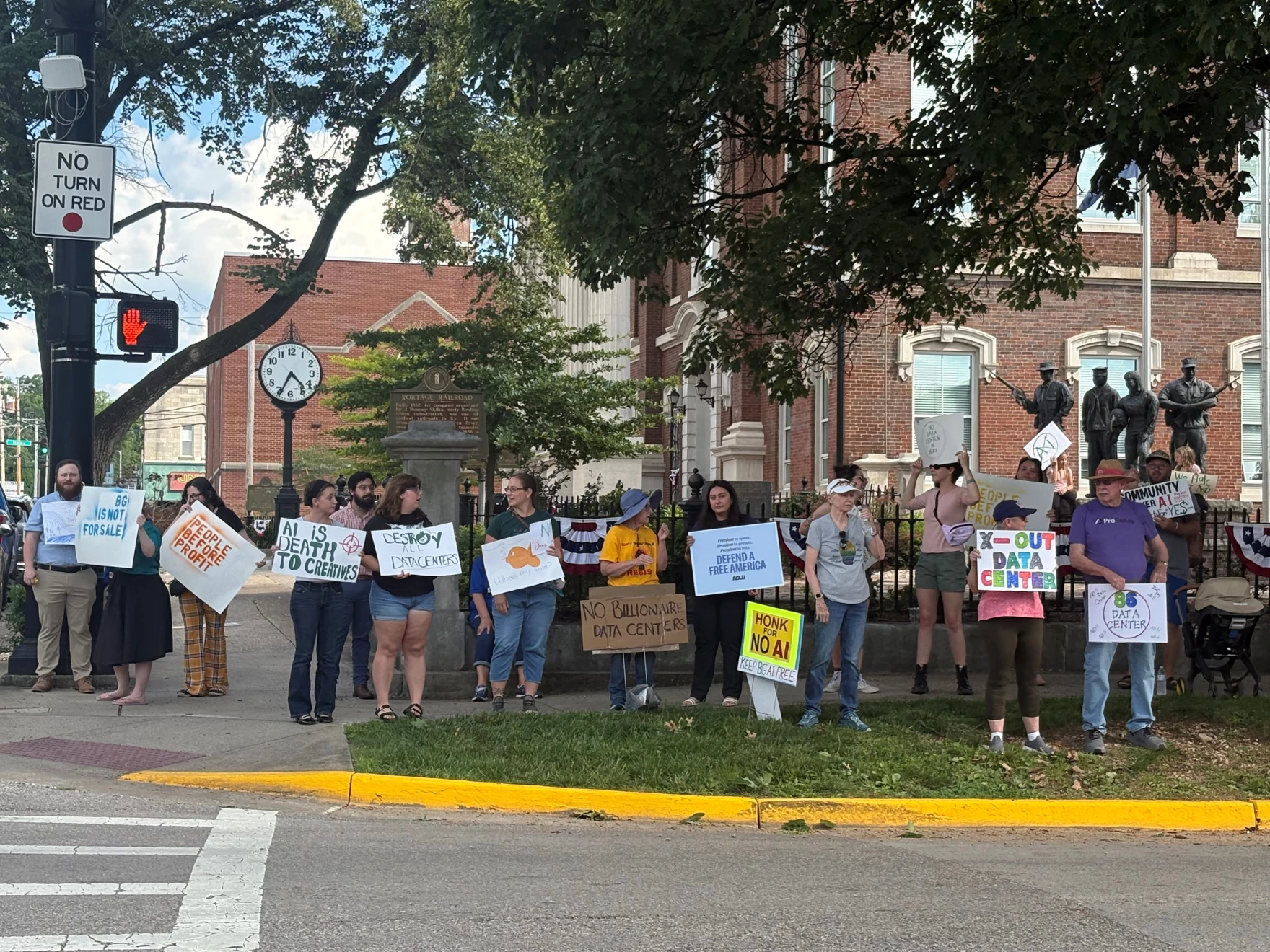
The commission voted to adopt rules covering energy and water consumption, noise, and light pollution, plus a 1,500-foot buffer from residential areas and required decommissioning plans. After the vote, Commissioner Dana Beasley-Brown reintroduced her six-month moratorium; it failed 3-2, mirroring a June 2 vote, and the crowd erupted into chants of "vote them out." Protesters outside city hall said regulations were not enough and that they opposed any data center.
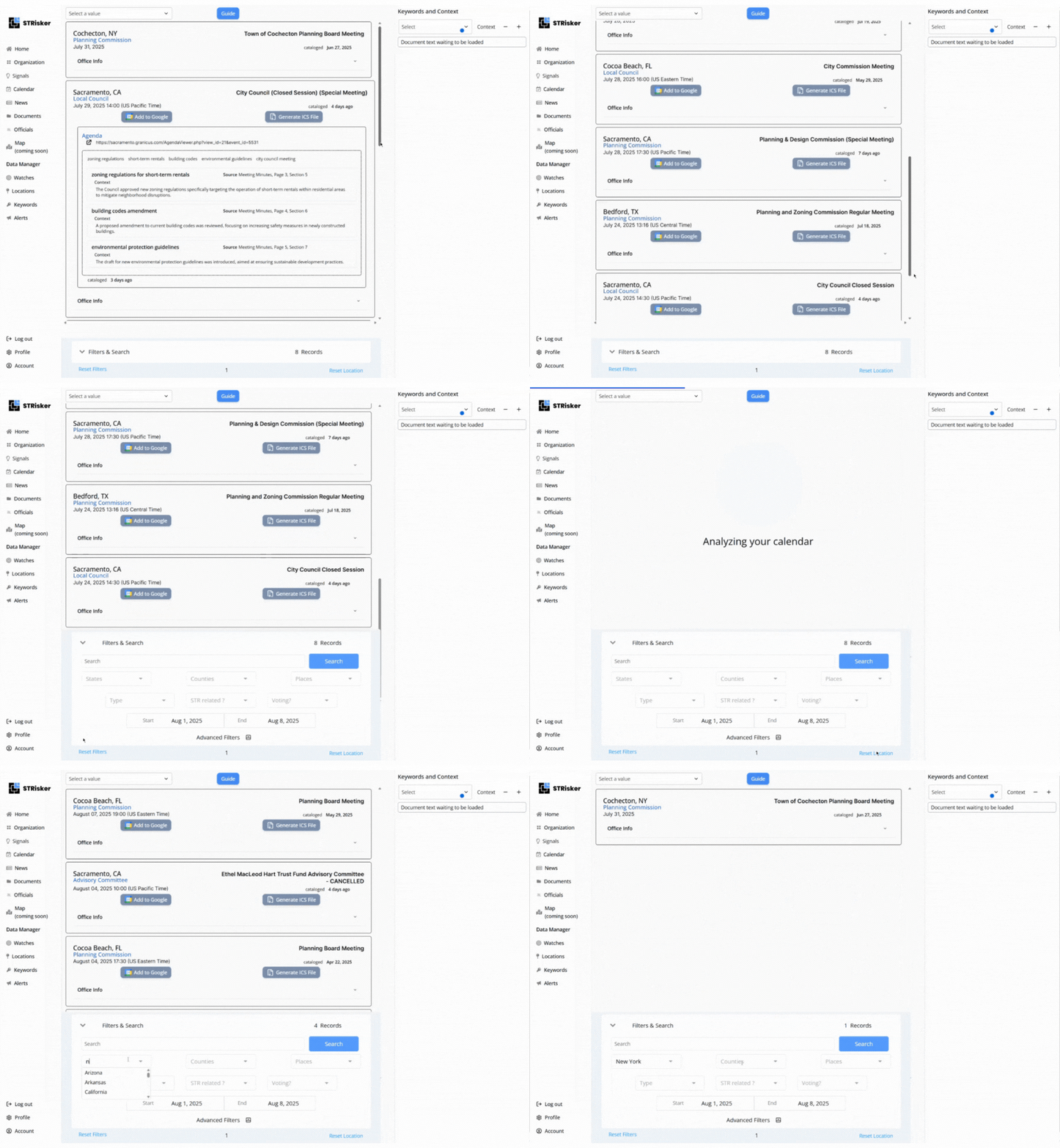
STRisker Calendar Tracker
Staying ahead of STR regulations isn’t just about deadlines—it’s about knowing what’s coming. Our Calendar Tracker keeps you informed on upcoming meetings, key votes, and policy changes, so you never miss a critical update.
Stay Updated with STRisker!
STRisker offers tools and features to keep you updated with the Short Term Rental and Data Centers movement across the world.
👍 We’d love your feedback.
Which stories hit? Which ones missed?
We're exploring a new branch of topics centered around Data Centers and want to make it even more useful for you.
✉️ Just reply directly to this email. We read and respond to every message!
-Will McClure
🙋 P.S.
Know someone else who should be reading Daily Notes? Feel free to forward this along. We’re opening a few more spots.