
Data Centers: Daily Notes | June 25, 2026
Pennsylvania's House clears a sweeping data center package, a powerful Utah primary upset ripples outward, and local fights flare from Virginia to California.


At A Glance 🔽
- Pennsylvania House passes a municipal moratorium bill and a tax-conditioning bill, with a full tax-break repeal teed up for today.
- Hoffman Estates, IL residents protest a Plum Farms rezoning they call a data center "smoke screen" ahead of a July 6 village board vote.
- Hanover County, VA supervisors delay a vote to raise the data center equipment tax rate from $0.45 to as much as $3, ordering a study first.
- Sand Springs, OK conservation group's suit over a proposed Google site reaches court on the landowner's motion to dismiss.
- Cache County, UT council adopts a preemptive 180-day moratorium in unincorporated areas.
- Lewisville, TX council requires a special-use permit for AI data centers and bans them in residential areas.
- Solon Township, MI planning commission tables a fifth ordinance draft after a packed hearing; residents want the moratorium extended.
- Mount Shasta, CA petition urges the city to reject a data center at the former Crystal Geyser plant; the city manager is skeptical.
- Lynn Haven, FL commission directs staff to draft AI data center standards on a 60-to-90-day timeline.
- Nash County, NC opens work on data center development standards as North Carolina's moratorium count tops two dozen communities.
Pennsylvania
The Pennsylvania House passed a pair of data center bills in broadly bipartisan votes on Wednesday, with a full repeal of data center tax breaks set for a Thursday vote.
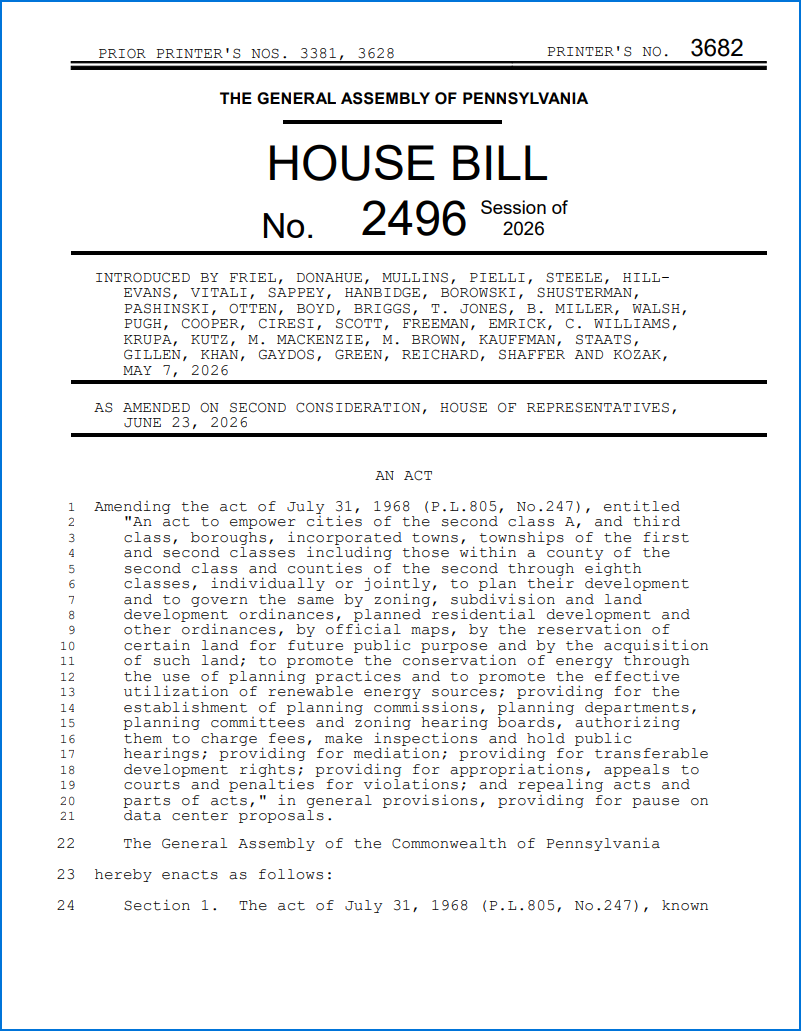
The first bill, which would let municipalities enact a six-month moratorium on new data center development while they update zoning and development standards, passed 201 to 1.
"With this legislation, data center developers will be required to
1. Pay for their own power generation without passing those costs on to consumers.
2. Provide real transparency for the community into their plans.
3. Work with municipalities to enter into community benefit agreements, hire and train local workers, and create at least 250 new jobs.
4. Commit to strong environmental protection measures to minimize their air pollution and water consumption."
- Office of the Governor of Pennsylvania
The second, reflecting a plan from Gov. Josh Shapiro; would condition data centers' tax benefits and permitting help on meeting standards that include securing their own power supplies, paying for electrical infrastructure upgrades, limiting water usage and noise, and creating jobs. A third bill ending data center tax breaks entirely cleared the Appropriations Committee on Wednesday evening.
Hoffman Estates, Illinois
Residents from three communities protested a proposed rezoning of the 186-acre Plum Farms property Wednesday, calling the industrial designation a smoke screen for a data center.


Demonstrators from Hoffman Estates, Barrington Hills and South Barrington pointed to records they obtained showing that data center inquiries for the site at routes 59 and 72 were shared with the village in early 2025. Deputy Village Manager Jon Pape confirmed landowner Karis Critical submitted unsolicited concept plans last year, which staff did not review as a formal proposal. A Jan. 16, 2025 letter from Village Manager Eric Palm to the landowner's attorney noted the village board had previously supported two other data center developments and that past actions can help predict future approvals.
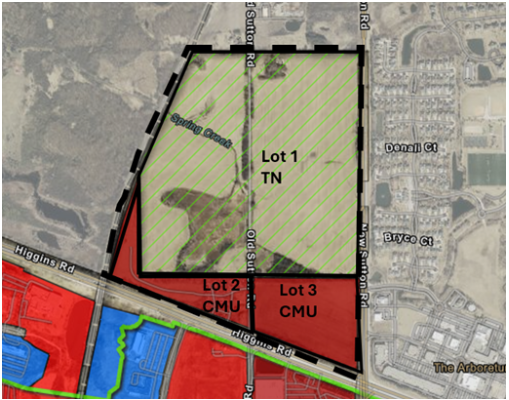
The village plan commission recommended against the rezoning on June 3, and the village presidents of Barrington Hills and South Barrington have joined the opposition. Mayor Bill McLeod stressed that the request before the board on July 6 is a rezoning without a detailed plan attached. "A concept plan isn't worth the paper it's printed on," he said.
Hanover County, Virginia
Hanover County supervisors voted to delay any increase to the tax rate on data center computer equipment saying they needed more analysis first.
 Government Websites by CivicPlus®
Motion considered... The property tax rates and fees for calendar year 2026 as proposed, with the removal of the Data Center Tax Rate.
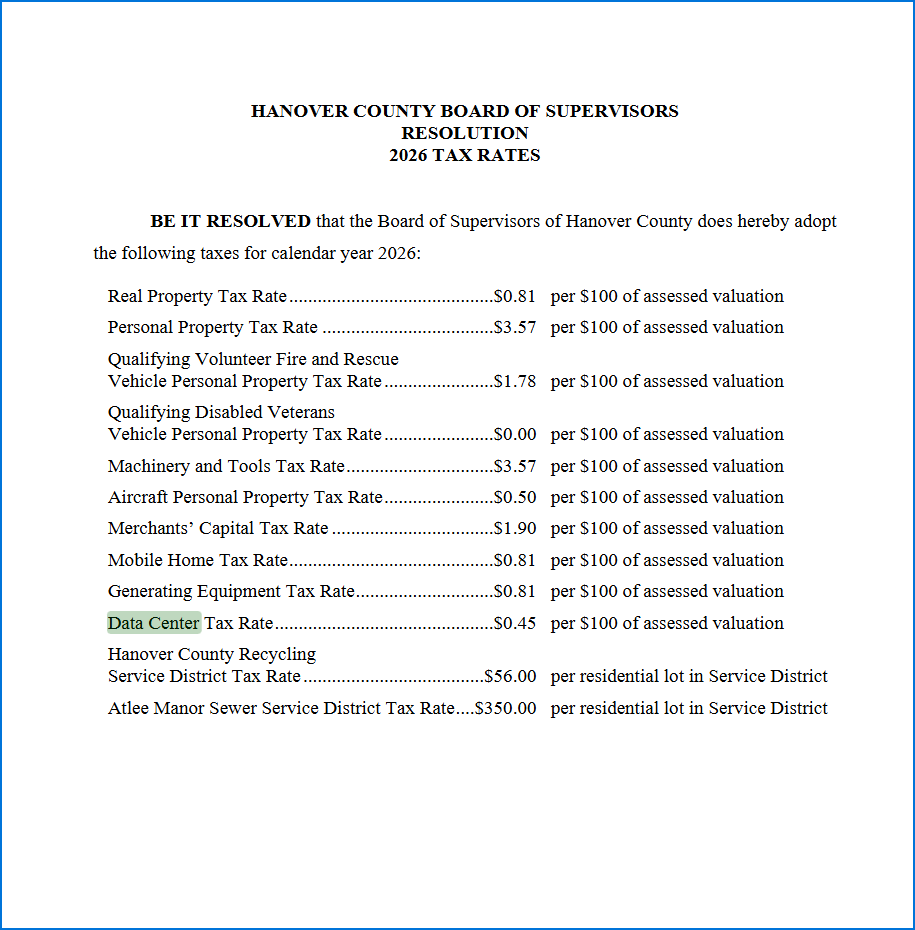
The board had been weighing raising the rate on data center computer equipment from $0.45 per $100 of assessed value to as much as $3 per $100, a tax paid by operators rather than residents. At the June 24 meeting, supervisors opted to leave the current rate in place while the county develops a broader data center policy and studies the industry's financial impact. South Anna District supervisor Susan Dibble said deciding that night would have been worrisome because the board had not looked at it deeply enough.
Several supervisors signaled openness to raising the rate later. Hanover has no active large-scale data centers, though a campus under construction off Hickory Hill Road is expected to begin operating by 2029, with more proposals under review. The county's finance committee will run the tax rate study and report back to the board.
Sand Springs, Oklahoma
The land at the center of a proposed Google data center near Sand Springs was in court Wednesday as a judge weighed the property owner's motion to dismiss a conservation group's lawsuit.
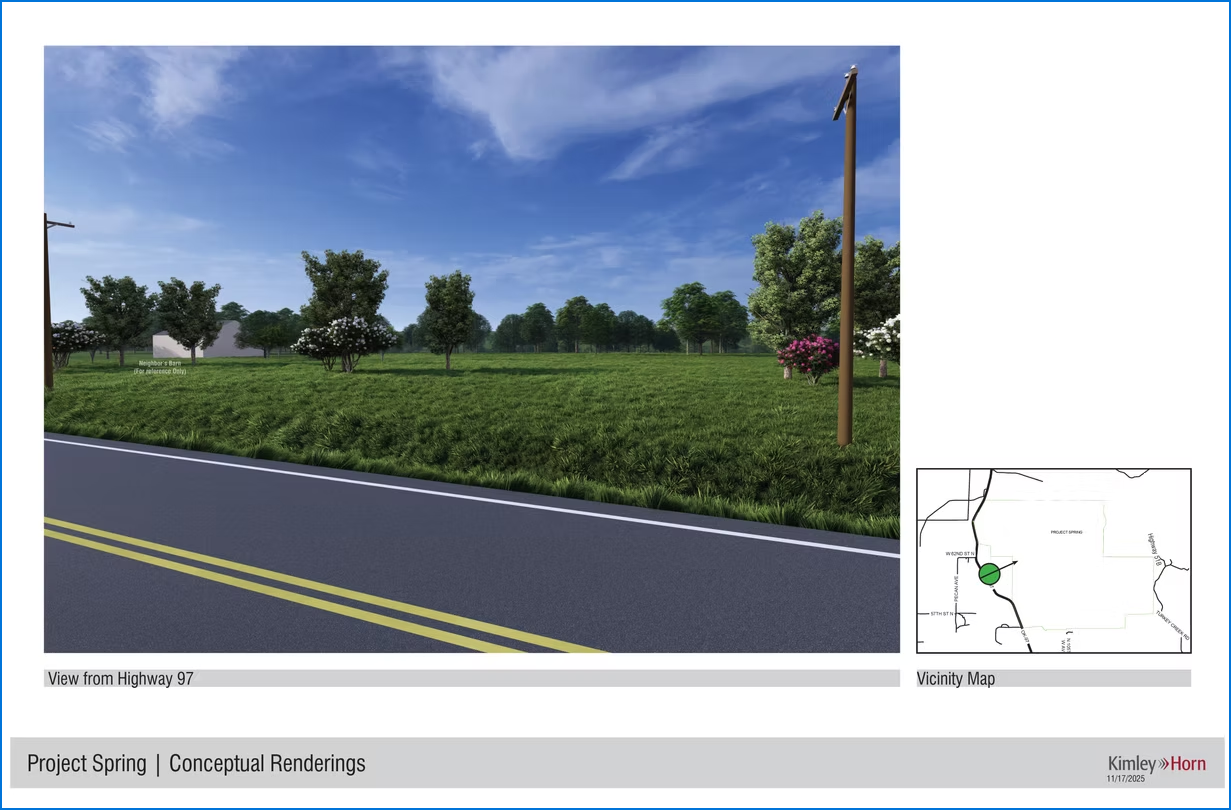
Land Legacy, which holds a conservation easement on 270 acres of the 780-acre property, argues the landowner has no right to build an industrial park on the site. Michael Patton of Land Legacy said the judge seemed receptive and expects a ruling on the motion by Monday. Community activist Kyle Schmidt, who attended, said he was confident the motion would be denied and the case would proceed to trial. Patton said if the group prevails, Google will have to look elsewhere for a data center.
Cache County, Utah
The Cache County Council approved a temporary moratorium on data centers in unincorporated areas at its June 23 meeting, with the vocal opposition in nearby Box Elder County fresh in members' minds.
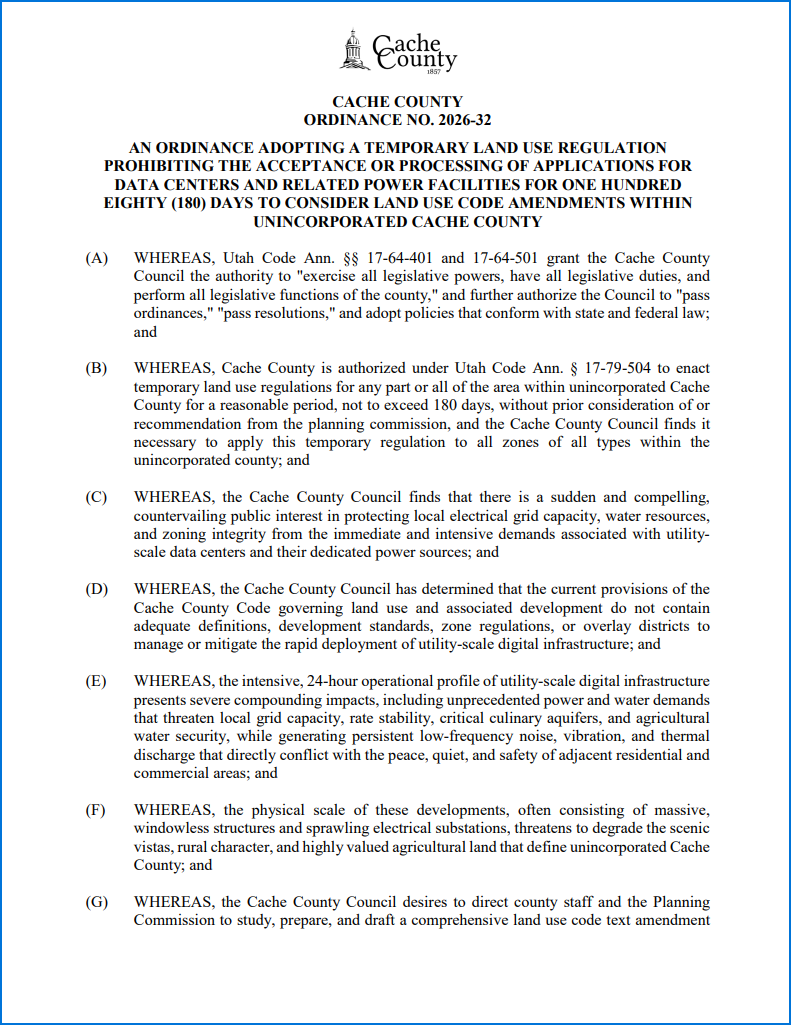
Ordinance 2026-32 passed with minimal discussion. Council Chair Sandi Goodlander said no developer has approached the county, but the ordinance finds a compelling public interest in protecting the electrical grid, water resources and zoning integrity. Development services director Brian Abbot said the current county code lacks adequate definitions, development standards and zoning regulations to manage utility-scale digital infrastructure, and the 180-day moratorium gives officials time to write land use rules.
The moratorium applies only to unincorporated areas; member David Erickson noted municipalities can do what they want. The Logan Municipal Council is slated to meet June 30 to consider a similar move.
Lewisville, Texas
The Lewisville City Council approved an ordinance on June 15 requiring AI data centers to obtain a special-use permit and prohibiting them in residential areas.
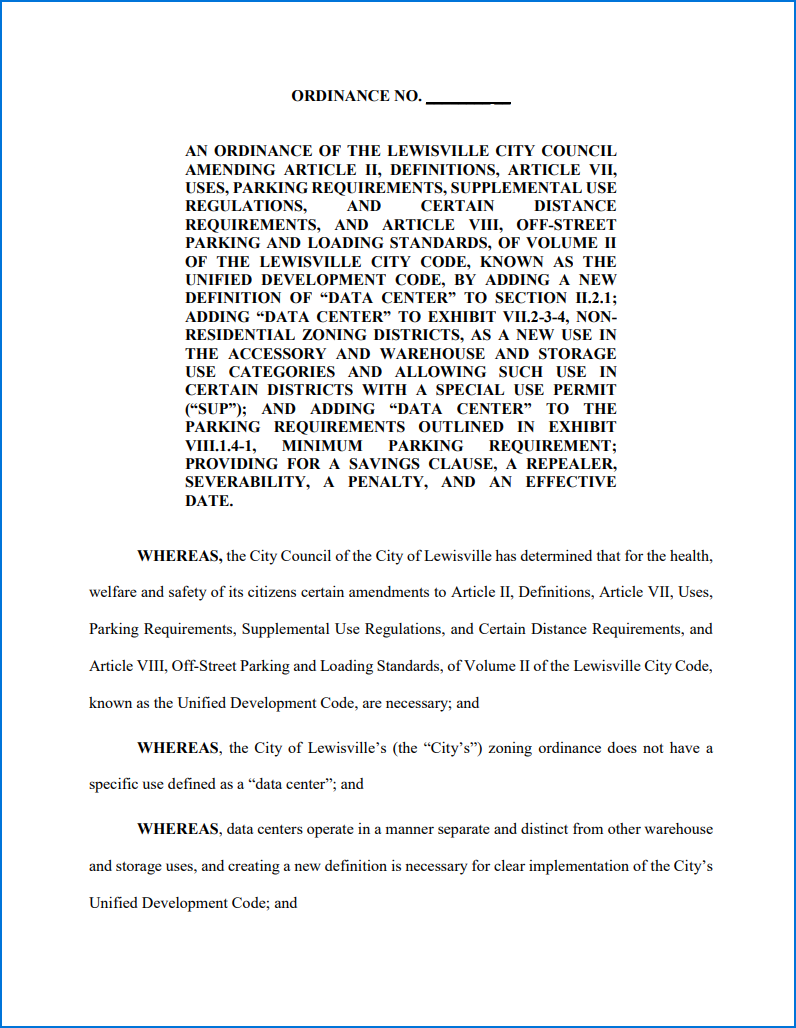
Under the ordinance, data centers are allowed only in light industrial, warehouse and heavy industrial districts. Before one can open, residents get two formal chances to weigh in, at public hearings before the Planning and Zoning Commission and the City Council. City Manager Claire Powell said data centers can strain communities at scale and the ordinance ensures every proposal is assessed thoroughly.
City Planning Manager Vashil Fernandez said Lewisville has not yet received inquiries from data center companies, but the city's concentration of light industrial zoning and warehouse space makes it a prime target for developers.
Solon Township, Michigan
The Solon Township Planning Commission tabled a fifth draft of a data center zoning ordinance Wednesday after residents packed a heated public hearing to oppose a possible project.
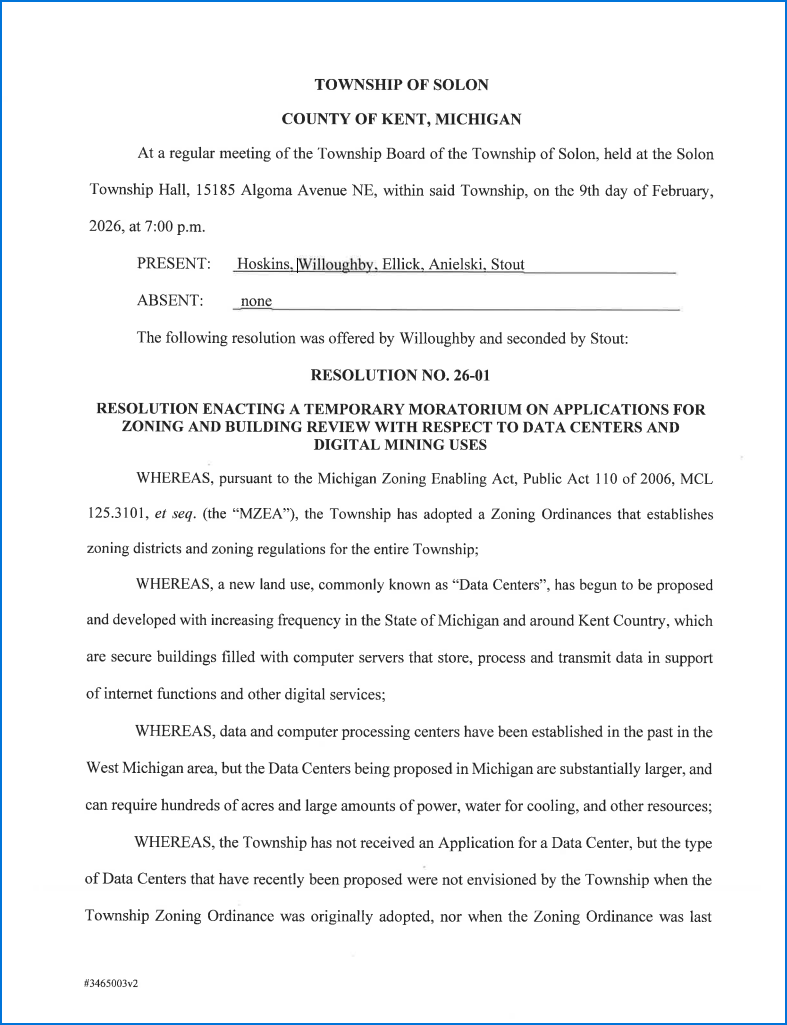
An unidentified developer is eyeing more than 800 acres in the rural Kent County township, about 23 miles north of Grand Rapids, for a project dubbed "Project Peninsula". Those plans were put on hold in February when the township board passed a six-month moratorium, which Township Attorney Ross Leisman said ends in August. Residents told commissioners they fear the project would destroy well water and property values, and they are now asking for the moratorium to be extended.
Stop Solon Township Data Center committee member Anna Feldpausch said her goal is to make the zoning ordinance as strong as possible to protect the community, citing concerns about water, noise and light pollution.
Mount Shasta, California
An online petition is urging Mount Shasta to reject a proposed data center at the former Crystal Geyser plant, citing concerns about water supplies, energy use, traffic, noise and the area's character.


The petition warns the project could strain local water and energy and harm residents' health and property values. The City Council discussed the issue Monday. City Manager Todd Juhasz said an entity had contacted the city about using the former Crystal Geyser site and that officials planned to meet with the group later in the week, but he said that unless the developer does something other data centers don't, he could not imagine it being good for the community.
Council member Tessa Clure said no project has been approved and that other, more appealing offers exist for the property. The site sits in Siskiyou County, and the city is trying to annex it; until that goes through, Clure said the city has little control. She encouraged residents to make their voices heard at the county level, where the next meeting is set for July 7 in Yreka.
Lynn Haven, Florida
The Lynn Haven City Commission approved a resolution directing staff to study data center standards for the city's land development codes Tuesday night.
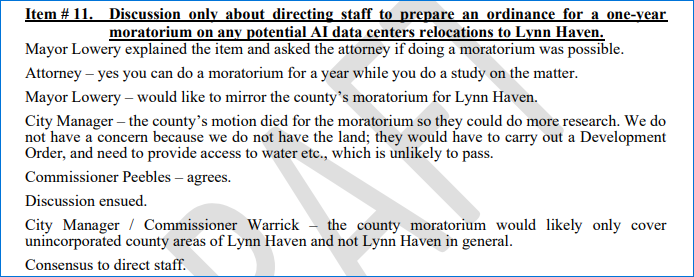
City Manager Chris Lightfoot estimated a 60-to-90-day timeline for staff to research the issue, draft language, and have legal review it before bringing it to the commission. The commission would then discuss and vote on any guidelines or restrictions. City officials framed the move as following the lead of other panhandle counties and cities that have begun setting their own rules.
Nash County, North Carolina
Nash County began work on data center development standards Wednesday, joining more than two dozen North Carolina communities that have adopted moratoriums or zoning restrictions as concerns grow over noise, electricity demand and water use.
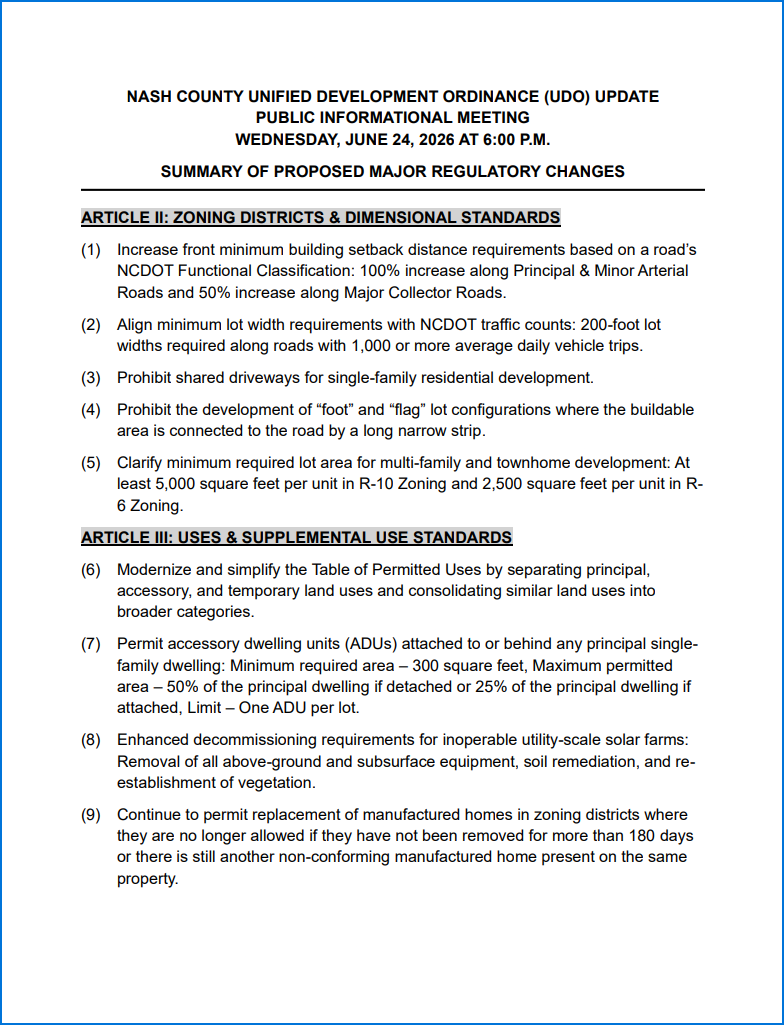
The county discussed updates to its Unified Development Ordinance that would create a "data centers" land use category and permit them only in General Industrial zoning districts, and only with a Special Use Permit issued after a quasi-judicial public hearing. The proposed rules would set separation distances between data centers and residential roads or property and address noise and utility impacts. Planning Director Adam Tyson said there are no current proposals and the work is hypothetical for now, but elected officials are taking the prospect seriously. The next step is turning the language into an ordinance for an eventual vote.
🐦 Social Finds
🏭🚫>275 U.S. state and local data center moratoriums have passed since Jan. 1 and >150 since start of May. pic.twitter.com/1taihT6LjG
— Amir Efrati (@amir) June 24, 2026

Social Listening 🎧: Podcast
Policy talk doesn’t just happen in the news cycle—it can also live in long-form audio. STRisker’s Podcast Signal turns hours of episodes into actionable insight, indexing transcripts so you can surface key mentions of STRs, ordinances, and local decision-makers in seconds.
Stay Updated with STRisker!
STRisker offers tools and features to keep you updated with the Short Term Rental and Data Centers movement across the world.
👍 We’d love your feedback.
Which stories hit? Which ones missed?
We're exploring a new branch of topics centered around Data Centers and want to make it even more useful for you.
✉️ Just reply directly to this email. We read and respond to every message!
-Will McClure
🙋 P.S.
Know someone else who should be reading Daily Notes? Feel free to forward this along. We’re opening a few more spots.