
Data Centers: Daily Notes | October 08, 2026
Cities and townships are setting data center limits: Hillsboro, Oregon advanced its first permanent restrictions, Oakland, California adopted short-term pauses, Memphis postponed its moratorium vote amid protests, and Taylor, Texas is weighing a development agreement. READ MORE.


At A Glance 🔽
- Taylor, Texas City Council takes up a development agreement for the 664-acre Taylor Technology Campus, which includes $28.2 million in community investments, after the developers withdrew their annexation application.
- Oakland, California City Council unanimously approved a 45-day moratorium on approving data centers, with a provision to extend it.
- Memphis, Tennessee City Council voted to postpone a vote on a proposed yearlong data center moratorium until Oct. 20, prompting protests that interrupted the meeting.
- Northfield, Minnesota City Council voted unanimously to change setback requirements for data processing centers, setting a 200-foot setback from trails that matches the distance required from homes.
- Allen Township, Ohio trustees adopted data center and energy storage zoning regulations, then added a last-minute amendment exempting data centers in a Planned Unit Development.
- Hillsboro, Oregon City Council advanced its first permanent data center restrictions, limiting facilities mainly to industrial zones, with a possible final vote Oct. 20.
Taylor, Texas
Taylor City Council takes up a development agreement Thursday with Big Watt Digital and PowerHouse Data Centers for the 664-acre Taylor Technology Campus, formerly Project Mustang, after the developers withdrew their annexation and zoning application in September.
 Emilee Miranda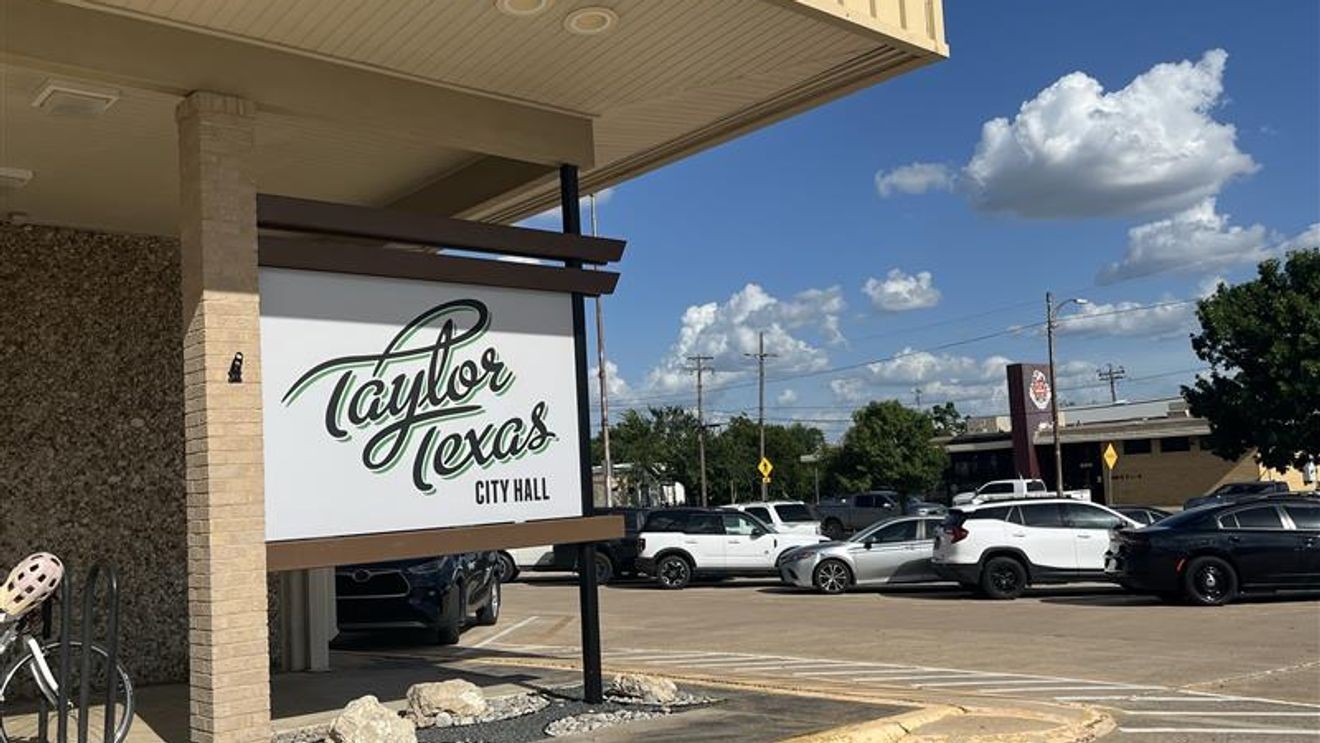
The city kept negotiating after the withdrawal, and the agreement would set binding rules for the project and annex the land into city limits. The campus is planned for 500 megawatts at full buildout, with potential for another 500 later. The agreement calls for $28.2 million in community investments, including $13 million to the city, $10.2 million for Taylor ISD programs and $1 million for the city’s animal-care program. It requires a closed-loop cooling system using reclaimed water, developer-funded utility lines and wastewater upgrades, and withdrawal of the developers’ TCEQ wastewater discharge permit application.
Buildings would sit 300 feet from the north, east and west property lines and 700 feet from the south, and noise could not exceed the greater of 65 decibels or the pre-development level, based on an acoustic study. A developer-commissioned study projects $1.38 billion in gross tax revenue for Taylor over 20 years. Residents with HALT Taylor Data Centers have pushed back for months.
Oakland, California
Oakland’s City Council unanimously approved a 45-day moratorium Tuesday on approving data centers, with a provision to extend it if needed.
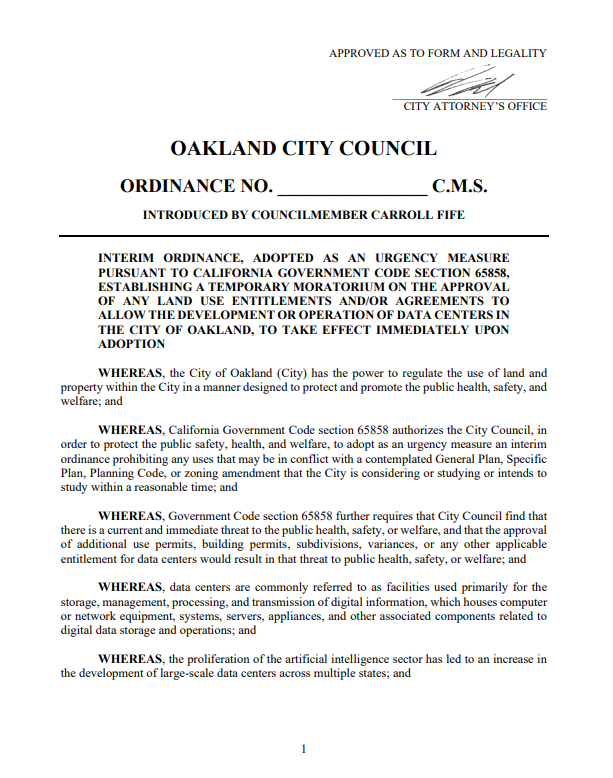
The pause, introduced by Councilmember Carroll Fife on Sept. 10, bars the city from approving land use agreements or entitlements for data center development while staff determines what regulations Oakland needs, conducts community engagement and studies impacts on energy, water, public health and the environment. Fife said the Planning and Building Department will use the 45 days to draft a work plan, review approaches taken by other California cities with moratoriums, and decide whether outside consultants are needed. The council can extend the pause another 45 days.
The measure followed Danville-based developer Behring Co.’s August proposal to convert about 20,000 square feet of a four-story building at 415 20th St. into a data center. About 30 supporters rallied outside City Hall before the vote, and some called for keeping data centers out of Oakland permanently. Mayoral candidate Mindy Pechenuk, who favors data centers, called the moratorium a waste of taxpayer money.
Memphis, Tennessee
Chaos erupts after Memphis City Council delays data center moratorium vote
Memphis City Council voted 7-5 on Oct. 6 to postpone a vote on a proposed yearlong data center moratorium until Oct. 20, a decision that prompted protests that interrupted the meeting.
 Wolfie Zhao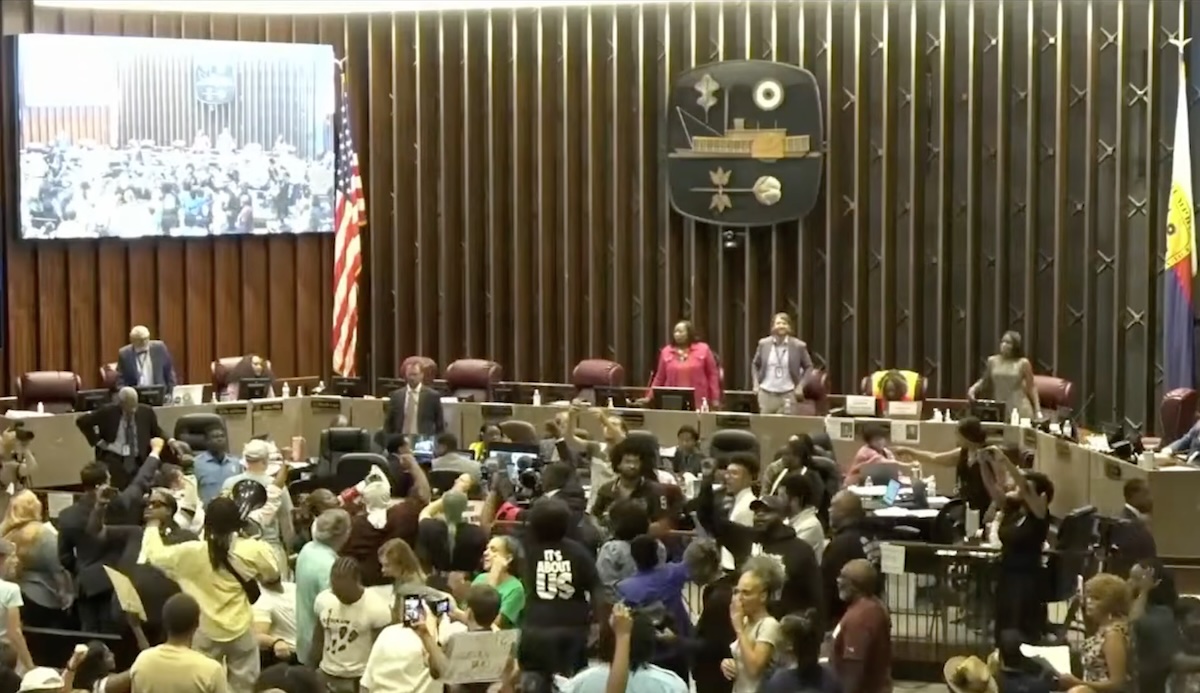
Police cleared the chamber and a fight broke out in the lobby. A police spokesperson said nobody was detained or injured, and the cause of the fight was unclear. Councilman J.B. Smiley Jr., a sponsor of the proposal, criticized how the meeting was handled, saying officials should have listened to the more than 100 residents who came to participate.
The proposal would suspend processing and approval of permits for new data centers and high-density computing facilities, including AI processing, cryptocurrency mining and commercial server operations, for up to 12 months while the city develops permanent rules. Existing lawful facilities that don’t expand their footprint, electrical demand, utility capacity or operating intensity would be exempt, as would applications with legally established development rights. The pause would study water consumption, noise, power infrastructure and how to shift infrastructure costs to developers rather than utility customers. It comes in a city that hosts Colossus, the South Memphis facility used to train Grok, whose operator, SpaceXAI, says it has invested billions locally and paid tens of millions in local taxes since March 2024.
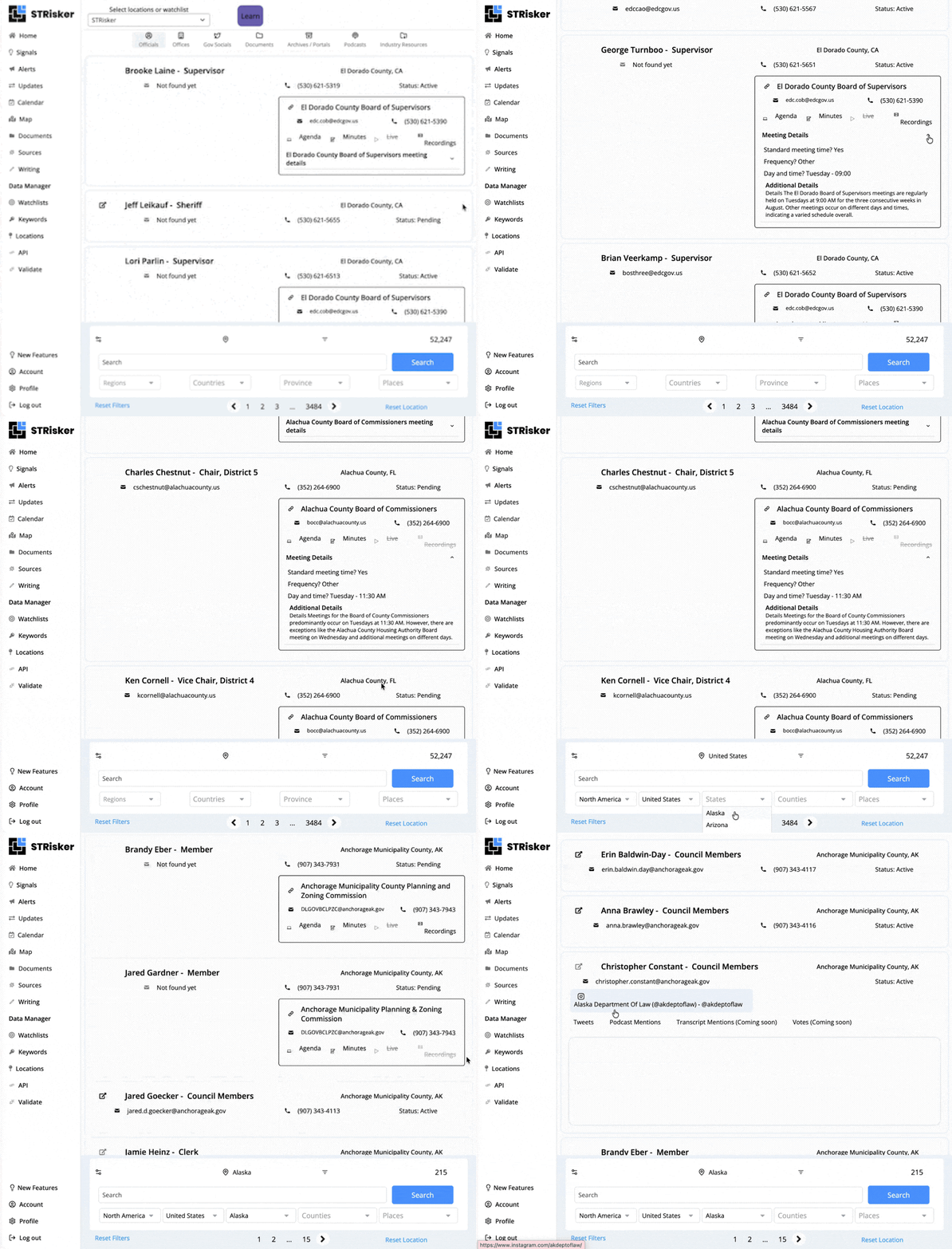
Strisker Government Officials Dashboard
Trying to keep up with the main players in the STR and Data Center game? Know your council members, commissioners, committee chairs, and key staff that are part of the process.
Northfield, Minnesota
Northfield’s City Council voted unanimously Tuesday night to change setback requirements for data processing centers, setting a 200-foot setback from existing or planned trails that matches the required distance from homes.


City Administrator Ben Martig said the previous trail setback was substantially larger and effectively prevented data centers from locating in the affected area. The vote changed zoning requirements only and did not approve construction of a data center. Council members also supported further review of the regulations, including a possible framework based on facility size, to be done alongside the city’s broader land development code update.
Preview of the Oct. 6 City Council meeting: What the data center setback changes, and what it doesn’t
Residents raised concerns about water consumption, noise, vibration and lighting, and some asked for a two to three year moratorium. Mayor Erica Zweifel said the city already paused data center development to put regulations in place, that those protections remain open to improvement, and that any proposal should produce a net benefit, such as reuse of server heat, electrical infrastructure improvements and tax revenue. Martig said conditional use permits allow additional conditions on individual proposals after public review, and that developers in the northwest industrial area would be expected to pay for needed water and sewer infrastructure.
Allen Township, Ohio
Allen Township trustees voted 2-0 with one abstention Tuesday to adopt data center and energy storage zoning regulations, then added a last-minute amendment exempting data centers located in a Planned Unit Development from the new rules.
 SAIGE THORNLEY
saigethornley@thecourier.com
SAIGE THORNLEY
saigethornley@thecourier.com
Trustees Joe Smith and Roger Clark approved the resolution and Kevin Flanagan abstained. The rules would allow data centers in I-2 districts only if they are air cooled, don’t overburden public utilities, are compatible with surrounding land use and sit at least 1,250 feet from a residential lot. They cap water use at 10,000 gallons per day, sound at 40 decibels and total facility load at 10 megawatts, and require the owner to maintain a bond for decommissioning, a provision the Zoning Commission pushed for to guard against a “dump and run.” A separate energy storage resolution caps aggregate storage at one megawatt hour.
The PUD amendment was added to buy time after Onsite Partners, which has approached the township about a speculative data center project, said the rules were too restrictive for it to proceed. Trustees have said the project appears inevitable and want to keep the city from annexing the property. Onsite’s Frank Willson said the project is at an early stage with no formal annexation talks, and projected $300 million to $400 million in tax revenue, up to $280 million for Van Buren Schools.
Hillsboro, Oregon
Hillsboro City Council advanced its first permanent data center restrictions Oct. 6, with a second reading and possible final vote set for Oct. 20 and an effective date 30 days after passage and mayoral approval.
Data Centers in Hillsboro
The ordinance would limit primary-use data centers mainly to the Industrial Park and Industrial Sanctuary zones, with cumulative caps of 215 and 310 acres, plus 83 acres in parts of Jackson East, for 608 acres total. Existing code allows them as a primary use across roughly 6,600 acres. Facilities would need a public hearing. Accessory data centers serving another business would be capped at a quarter of the site’s gross acreage or 30% of the business’s gross floor area, whichever is smaller, and could not lease computing services to outside customers.
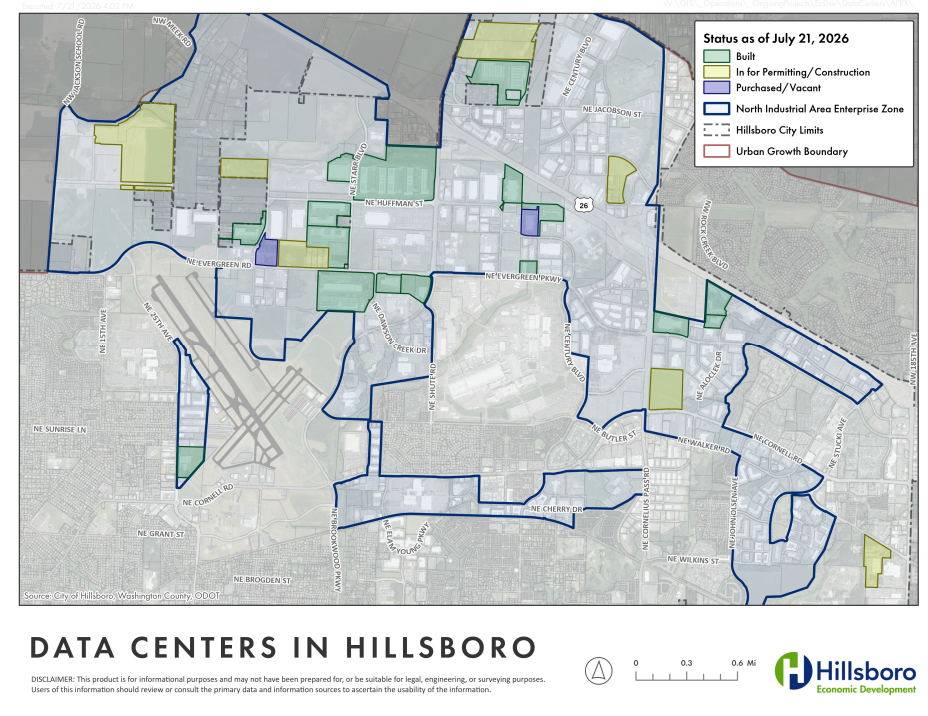
Before advancing it, councilors voted 5-1 to remove a provision letting a business place its accessory data center on a separate affiliated industrial property, with Councilor Kipperlyn Sinclair arguing it could spread heat and other impacts before they are understood and Councilor Cristian Salgado dissenting. They also made a proposed 1,000-foot buffer from schools temporary, lasting 12 months while the city studies the distance. A second phase on building heights, buffers and green-building rules is expected over the winter and spring, and the city’s moratorium remains in place until Nov. 24.
📱 Social Buzz
A controversial data center project is back before Taylor City Council this Thursday, despite months of community pushback.https://t.co/yW8PSHmyDO
— CBS Austin (@cbsaustin) October 8, 2026
Arizona U.S. House candidates discuss data center regulation.
— CSPAN (@cspan) October 8, 2026
@DrAmishShah (D): "If these things can go elsewhere...then they should."
@jayfeely (R): "We have to find positive ways to do it that protects the locals." pic.twitter.com/fYoWy1bSX0
A proposed multi-campus data center development, Project Thunderbird, is drawing mixed reactions in Enid, where city leaders have delayed a key rezoning discussion to allow more public input. https://t.co/DjRUJ6MZjj pic.twitter.com/r3HgXSo9Ke
— KOKH FOX 25 (@OKCFOX) October 8, 2026
With no formal data center permitting application yet, Natrona County commissioners discussed potential conditions for the project and updates from a private location tour. ➡️ Find link to story in bio pic.twitter.com/wbQ6H4Z15q
— Casper Star-Tribune (@CSTribune) October 8, 2026
Data center construction in Wichita Falls may see delay https://t.co/zOsWZBoJwS
— Times Record News (@timesrecordnews) October 8, 2026
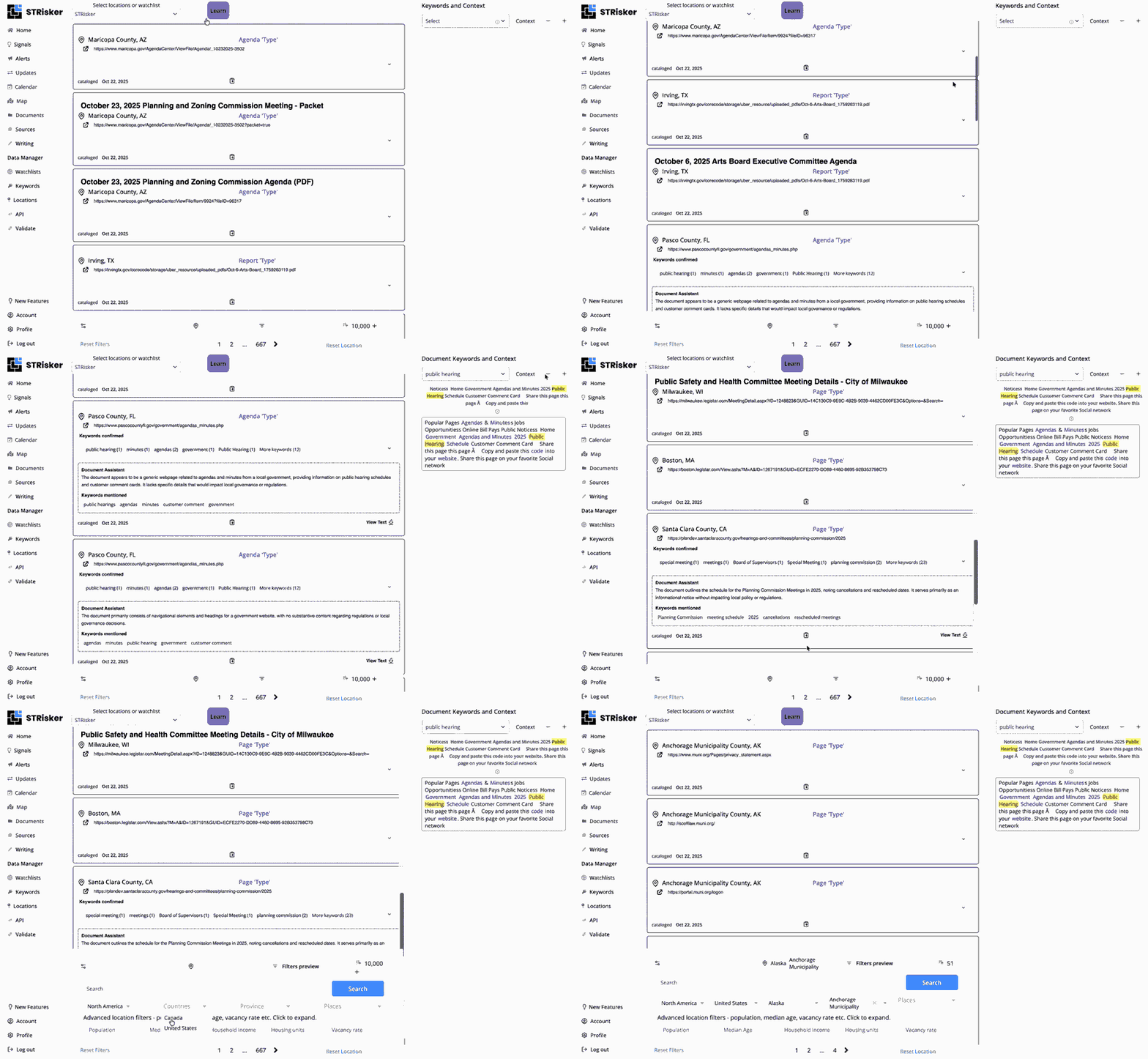
Strisker Document Analysis
Finding the right compliance documents shouldn’t feel like searching for a needle in a haystack - Strisker’s Documents Analysis is built to simplify your life, offering instant access to hundreds of thousands of documents from thousands of cities across the world.
Stay Updated with Strisker!
Strisker offers tools and features to keep you updated with the Short Term Rental and Data Centers movement across the world.
👍 We’d love your feedback.
Which stories hit? Which ones missed?
We're exploring a new branch of topics centered around Data Centers and want to make it even more useful for you.
✉️ Just reply directly to this email. We read and respond to every message!
-Will McClure
🙋 P.S.
Know someone else who should be reading Daily Notes? Feel free to forward this along. We’re opening a few more spots.