
Data Center Permitting: Key Players, Challenges, and Strategies
Identify the key players involved in data center permitting and understand the challenges and strategies for on-time submission of requirements.

At A Glance 🔽
- Data center permitting is the process of acquiring approvals required to build, expand, and operate data centers from government authorities, agencies, and utilities.
- Several agencies, authorities, and utilities are involved in data center permitting, including the data center project team, the local planning and zoning department, elected officials and planning commissions, local building and fire departments, state environmental agencies, utility or grid operators, public and community groups, and federal agencies.
- Some of the challenges that cause delays in approvals include dependencies on other processes, power availability, zoning and land-use discrepancies, community opposition, environmental concerns, generator limitations, differing agency or government timelines, incomplete submissions, and changing data center regulations.
- Developers can minimize delays by selecting screen locations before committing, choosing locations that allow land use, registering the utility interconnection request first, conducting parallel reviews, maintaining a single master schedule, using assistance from local experts, and planning for potential delays.
Definition
Data center permitting is the process of acquiring approvals required to build, expand, and operate data centers from government authorities, agencies, and utilities. These approvals come from local, state, and sometimes federal jurisdictions and cover topics related to data centers, such as land use, construction, environmental impact, grid connection, water, and emissions.
There is no single permit that covers a whole data center project. A data center development usually requires different sets of approvals, each with its own application process, review period, and conditions. Some approvals, such as zoning approval, building permits, and air permits for generators, need to be secured before construction begins. Other approvals, such as Certificates of Occupancy, are issued after the final inspections of the completed facility.
👨👨 Authorities, Agencies, and Utilities Involved in Data Center Permitting
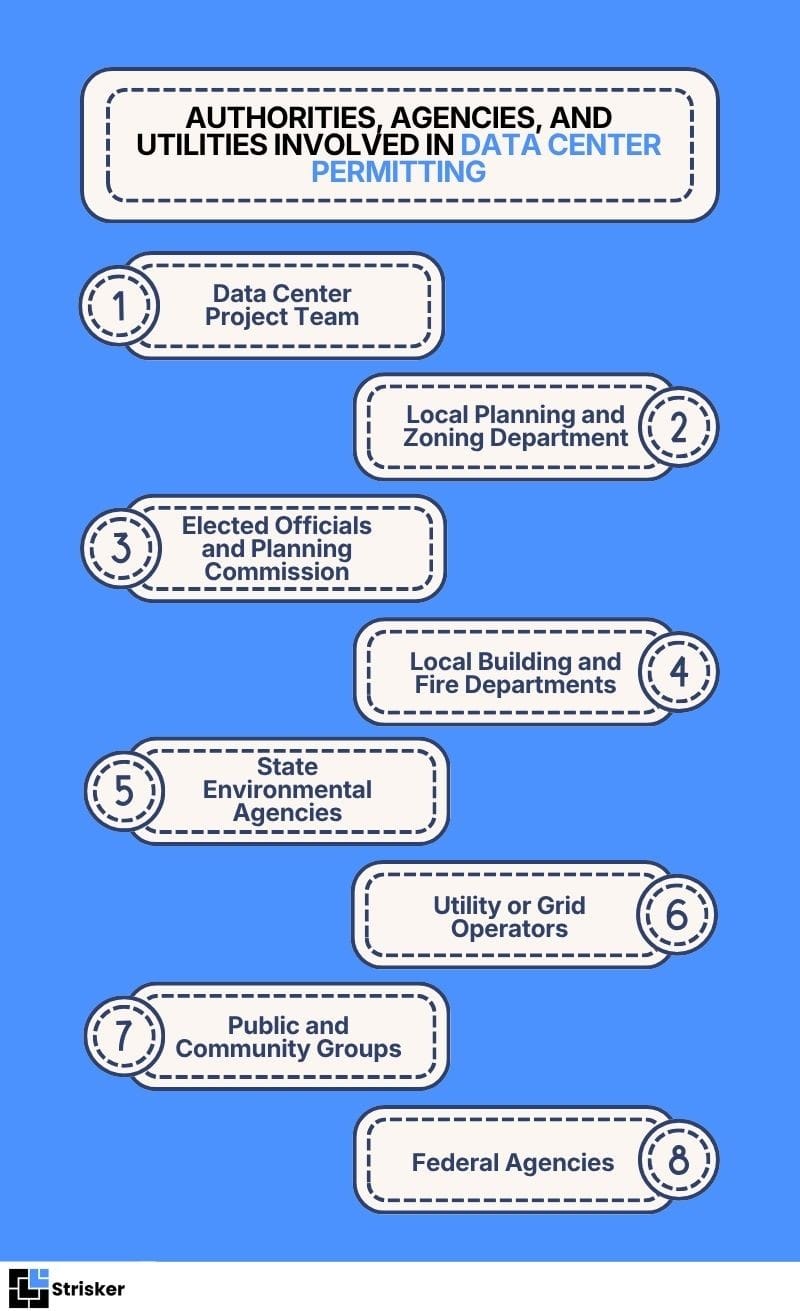
Data center permitting involves multiple agencies, individuals, and utilities reviewing project applications. Identifying them helps ensure you submit the correct application to the right office and at the right time.
Data Center Project Team
The team is responsible for submitting documents and addressing the reviewers' comments through responses and amendments. Typically, the team comprises the developer or project manager, civil and electrical engineers, environmental consultants, and land use attorneys. One team member, usually the project manager, will also track every application submitted to ensure consistency across agencies.
Local Planning and Zoning Department
This department will review the applications to determine whether a proposed data center complies with the local zoning rules and assess the site plans. If a data center is permitted by right, a member may approve the application. If it is not permitted by right, the member will evaluate the area for any rezoning or conditional use requests and provide recommendations to the planning commission, which will make the final decisions.
Elected Officials and Planning Commissions
The planning commission assesses requests for rezoning and conditional use permits and provides recommendations. A governing body, such as a city council or county board, will then hold a public hearing and cast a vote. Their decisions typically take into account residents' opinions on issues such as noise, water supply, and electricity.
Local Building and Fire Departments
The departments’ main responsibilities are to review the structural, mechanical, electrical, and fire-protection plans for the data center project. They will issue the building permits and routinely inspect the project during construction. After construction and final inspections, the department will also issue a certificate of occupancy, which allows the facility to operate.
State Environmental Agencies
The agencies evaluate the facility's emissions, water usage, wastewater discharges, and stormwater management. Air quality agencies will issue generator permits to regulate emissions, fuel consumption, and the operating hours of backup generators. The Environmental Protection Agency (EPA) establishes emission standards for engines used in power generation and emergencies, which must be accounted for in the generator permit. Additionally, some jurisdictions require environmental reviews to assess the impact of data center projects on land, air, water, wildlife, and nearby communities.
Utility or Grid Operators
To assess whether the grid can support a facility or if upgrades are needed, utility studies are essential. Requests for these studies should be submitted after registering for the interconnection queue. Utility or grid operators are responsible for reviewing these requests before offering a service or an interconnection agreement. Most utilities may be privately owned, but their approvals are crucial.
Public and Community Groups
Neighbors, businesses, and community groups are free to raise their concerns at public hearings and submit comments during the comment period. Some of their common concerns are noise, water resources, traffic, and electricity rates, which they use to appeal decisions on data center project developments.
Federal Agencies
Some data center projects may involve intervention by certain federal agencies. Some of these include cases where the projects are on federal land, in conservation areas, or in wetlands. Some data center projects may use federal funding or permits. For example, projects that use federal funding may require an environmental review under the National Environmental Policy Act (NEPA).
🚧 Challenges
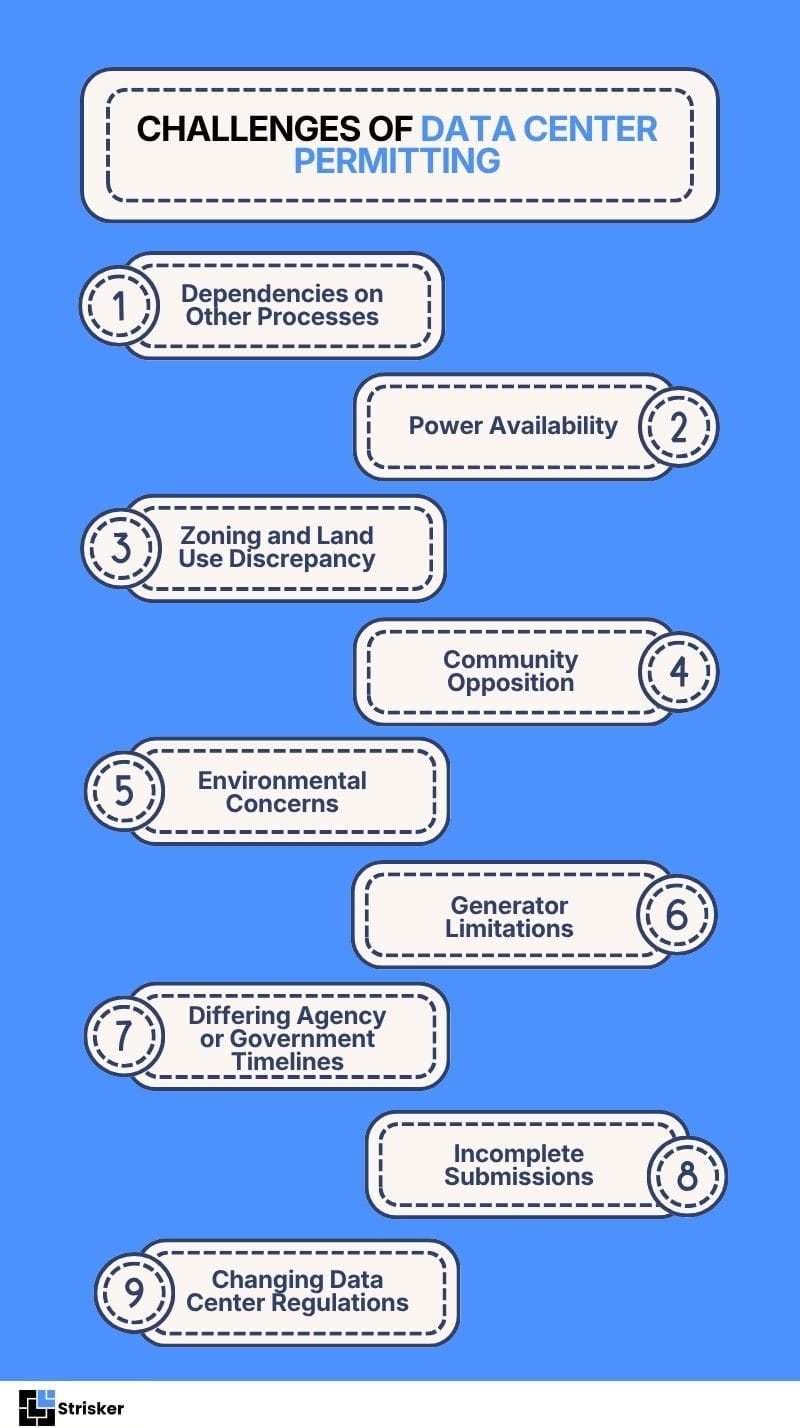
Obtaining permits for data centers can be a complex process. Various factors may slow down or disrupt this permitting process. Here are some challenges that impact it:
Dependencies on Other Processes
Some permits depend on other permits. For example, most building permits require zoning and land-use approvals before they can be issued. Additionally, utility and interconnection approvals must be submitted before financing can occur.
Power Availability
A report by Lawrence Berkeley National Laboratory for the US Department of Energy found that data centers consumed 4.4% of total electricity in 2023 and are expected to consume roughly 6.7% to 12% by 2028. Some locations have limited capacity, resulting in a long interconnection queue.
Zoning and Land Use Discrepancy
Since local codes were established before hyperscale data centers existed, there is a need to amend them or to perform rezoning. These code amendments require a hearing as part of the process.
Community Opposition
Data center developments affect nearby residents. Residents are likely to raise concerns about noise, water resources, electricity rates, and lighting at these projects. Some of these concerns could result in longer hearings and appeals, and, in some locations, a data center moratorium. This resistance may prolong the application process by prompting additional hearings and appeals.
Environmental Concerns
Projects located near wetlands, conservation areas, or regions with poor air and water quality may require additional environmental reviews and studies. Those assessments evaluate conditions and determine the need for redesign efforts and plans.
Generator Limitations
In regions with air quality issues, a generator permit is required to limit the number of units or operating hours. This requirement adds time to the process because it will require changes to the project's electrical design.
Differing Agency or Government Timelines
Coordinating with various local, state, and utility agencies requires effort due to their differing schedules and formats. Some deadlines may overlap while other approvals are delayed, which impacts the sequence of permit applications.
Incomplete Submissions
Some submissions may not meet the application requirements for certain data center permits, rendering them incomplete. Incomplete submissions may delay fulfillment of the requirements or push back the project timeline.
Changing Data Center Regulations
Data center regulations are evolving daily across various jurisdictions. Some areas are implementing moratoriums or establishing new standards for data centers while the projects are still under review. These changing regulations determine the future of these projects.
🔑 Strategies Operators Use
Data center operators need to prepare for various challenges that may delay their projects. While they cannot eliminate every risk, they can at least manage these potential delays. Here are several strategies that can help minimize challenges:
Screen Locations before Committing
Data center operators should evaluate zoning, power supply, air quality, and environmental constraints before selecting any land. Some also use contingent purchase agreements to avoid the site if key approvals are denied.
Select Locations that Allow Land Use
Land designated for industrial use or located in an industrial park may be exempt from rezoning or public hearings, as the application for this land may permit data centers by right. However, it is still crucial to confirm the current zoning rules in your jurisdiction.
Start the Utility Interconnection Request First
The interconnection queue can often be quite lengthy. Operators will submit load requests either before or at the same time as zoning applications.
Set Early Meetings with Agencies
Initial meetings with agencies will help confirm additional requirements not disclosed in the published rules. This aims to reduce surprises if anything is overlooked.
Run Parallel Reviews
In some jurisdictions, operators may submit applications simultaneously. For example, they can submit the environmental assessment, air quality permit, utility plans, and site plan at the same time, rather than waiting for the reviews and outcomes of other applications.
Keep One Master Schedule
There should be a single tracker to check and confirm every submitted application, the reviewers' comments, and the established deadlines. This tracker will help identify which permits most significantly affect the project's timeline.
Use Assistance from Local Experts
Having consultants and attorneys familiar with the local process and applications can help complete the applications and prepare for potential questions from the reviewer.
Plan for Delays
Delays can occur, so it’s important to add a buffer to your schedule and ensure it aligns with financing and construction deadlines.
Conclusion
Data center permitting confirms whether a project can be built, expanded, or operated at a specific location. This process involves multiple reviews and approvals from various agencies. The requirements for these approvals vary based on the data center's location and the scale of the project.
There are several challenges that can delay the data center permitting process. Therefore, it is essential to develop strategies to minimize these potential setbacks. Strisker offers tools, features, and newsletters to help you stay up to date on regulations and gather information for the data center permit application process.
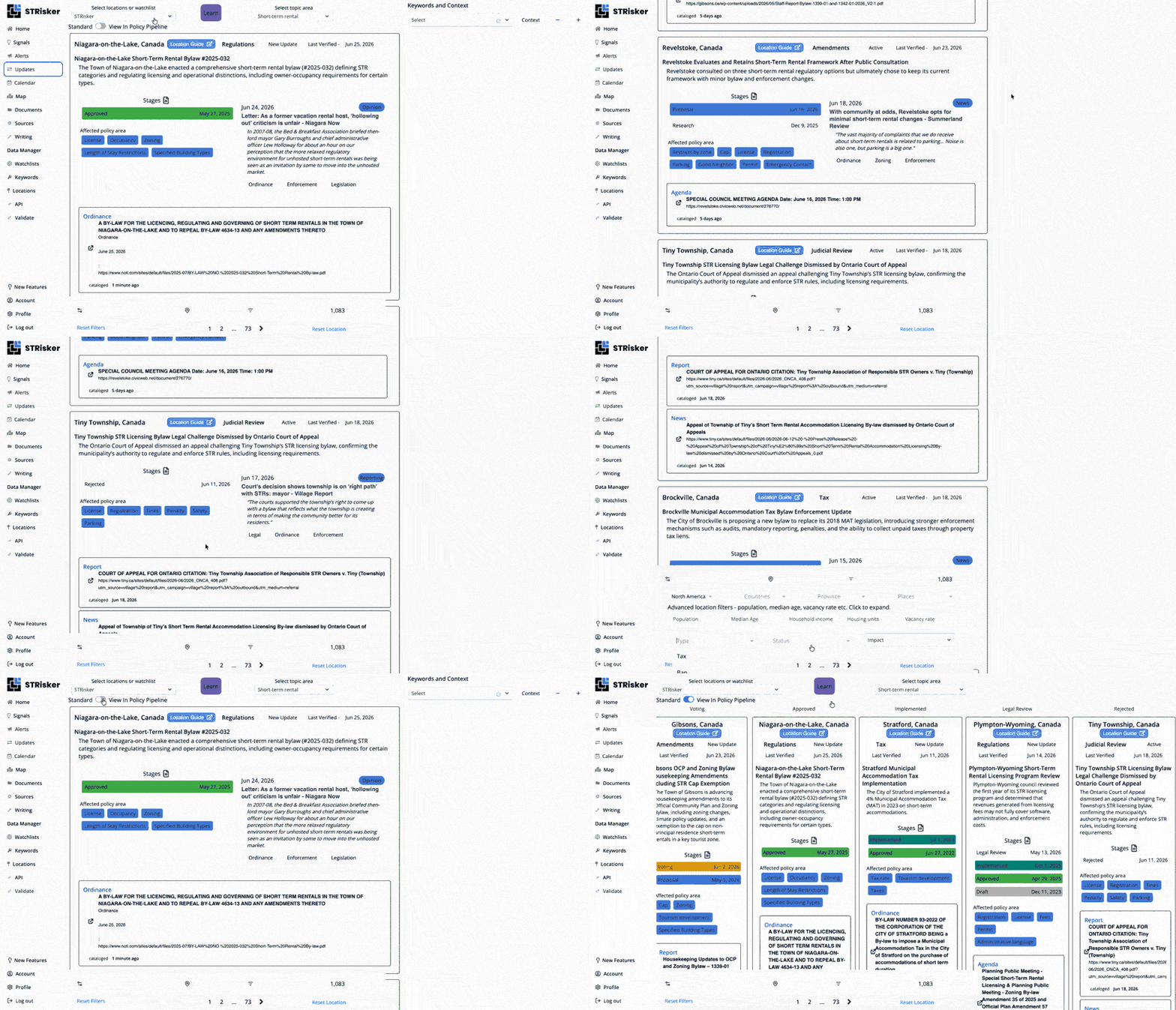
Strisker Updates Tracker
How do you keep up with the regulatory rollercoaster in your market? Strisker's Updates Tracker can be your guide - start tracking latest events as they happen and get access to essential documents as they come in. We know the struggle, which is why we built this product to capture every twist and turn in the regulatory saga so you never miss a beat.
FAQs
What causes data center permitting to be delayed?
Data center permitting gets delayed for different reasons. Here are some of the reasons:
- Local community opposition
- Power and grid limitations
- Zoning and land use outdated codes
- Long environmental reviews and compliance
How long does it take to get a data center permitted?
The length of the data center permitting depends on the site or the jurisdiction. The average time to receive data center permits ranges from 6 to 18 months. However, for complex projects or those facing local opposition, the timeline can extend significantly, often taking at least 2 years.
How do you know if a site can be permitted for a data center?
Here are the criteria to determine if a site is suitable for a data center development:
- Confirm if the zoning code allows land use or if a rezoning is possible
- Check with the utility if they have the capacity to deliver power
- Review the parcel for wetlands, floodplains, and conservation areas
- Assess the air quality of the location and verify the generator permits limits
- Have a conversation with the planning department about local regulations or any pending moratorium
Stay Updated with Strisker!
Strisker offers tools and features to keep you updated with the Short Term Rental movement (and now Data Centers!) movement across the world.
👍 We’d love your feedback.
We're always looking for ways to improve our content.
Was this one useful to you? Other topics you'd like to see get covered?
✉️ Just reply directly to this email. We read and respond to every message!
-Will McClure
🙋 P.S.
Know someone else who might be interested in this content? Feel free to forward this along.