
Data Centers: Daily Notes | September 30, 2026
Jesup commissioners voted to approve the first reading of an ordinance; Lovejoy approved an ordinance banning data center construction citywide; Manitowoc County finalized a draft ordinance; Georgetown; Warren County; East Buffalo Twp; Center Point; Suffolk. READ MORE.


At A Glance 🔽
- Jesup, Georgia commissioners voted to approve the first reading of an ordinance defining data centers and permitting them as a conditional use in light industrial zones, despite calls from residents for a full moratorium.
- Lovejoy, Georgia approved an ordinance banning data center construction citywide, following months of opposition to a proposed 3.5 million-square-foot campus near two schools.
- Manitowoc County, Wisconsin finalized a draft ordinance capping data center development at under 500 acres, with limits on converting agricultural land for such projects.
- Georgetown, Kentucky voted unanimously to direct legal counsel to draft an ordinance banning data centers, particularly targeting large-scale "mega" facilities.
- Warren County, Ohio unanimously approved a six-month moratorium on hyperscale data center development in county-controlled areas, pausing projects pending a water impact study.
- East Buffalo Township, Pennsylvania will hold a public hearing on a new data center ordinance restricting facilities to the industrial zoning district.
- Center Point, Iowa began drafting its own data center ordinance using neighboring counties' regulations as models, acting proactively even though no developer has approached the town.
- Suffolk, Virginia Planning Commission voted to recommend prohibiting data centers as a primary use in every city zoning district, aiming to block new standalone projects outright.
Jesup, Georgia
Jesup advances data center regulations despite pushback from packed crowd
Jesup city commissioners voted 4-2 Tuesday night to approve the first reading of an ordinance formally defining data centers and permitting them as a "conditional use" in light industrial zoning districts, following hours of contentious public debate at a packed Cracker Williams Recreation Center.
Dozens of residents spoke against moving forward with regulations, instead urging commissioners to enact a complete moratorium that would give the city time to study potential effects on local water resources and the power grid before any ordinance is finalized. Resident Erin Wallace said the debate felt disingenuous, noting some commissioners argued the ordinance was needed in case a moratorium failed, while others opposed the ordinance because a moratorium would allow time to strengthen it, when the city could pursue both.
Tuesday's vote was only a preliminary step, and the ordinance still requires additional readings before taking effect. The second reading is scheduled for Oct. 6 at 7 p.m.
Lovejoy, Georgia
Lovejoy city officials approved an ordinance Monday banning data center construction within city limits, following months of public opposition to Stillwater Development's proposed 3.5 million-square-foot data center campus near two schools.
 Atlanta First News staff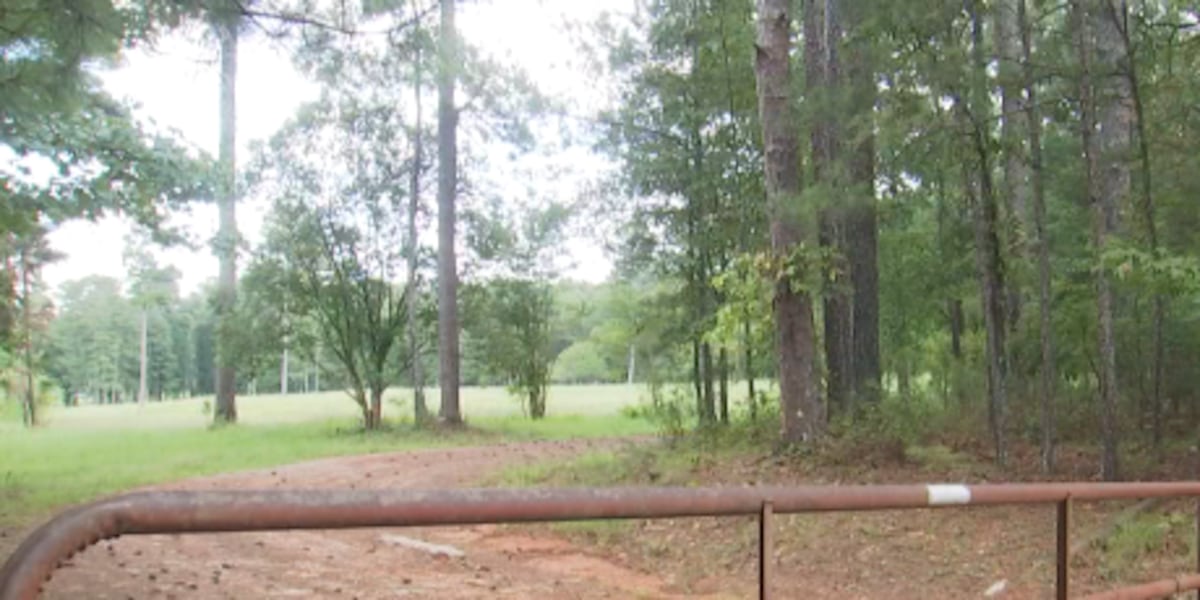
The ordinance prohibits data centers citywide, repeals an article governing special administrative permits, and establishes new standards for high-density housing. The action follows Stillwater's December 2025 filing for a 15-building project with 1.25 gigawatts of capacity at full build-out, proposed at 11760 Panhandle Road near Michelle Obama STEM Elementary Academy and Eddie White Middle School. In its Developments of Regional Impact submission, the city warned the project could worsen existing traffic congestion on Panhandle Road caused by school activity, creating significant delays for drivers, buses and parents.
Manitowoc County, Wisconsin
Manitowoc County finalized a 24-page draft ordinance regulating data center construction, introduced at the Planning and Park Commission meeting, defining a data center as a facility of 50,000 square feet or more on at least 10 contiguous acres designed to house 1,000 or more servers.
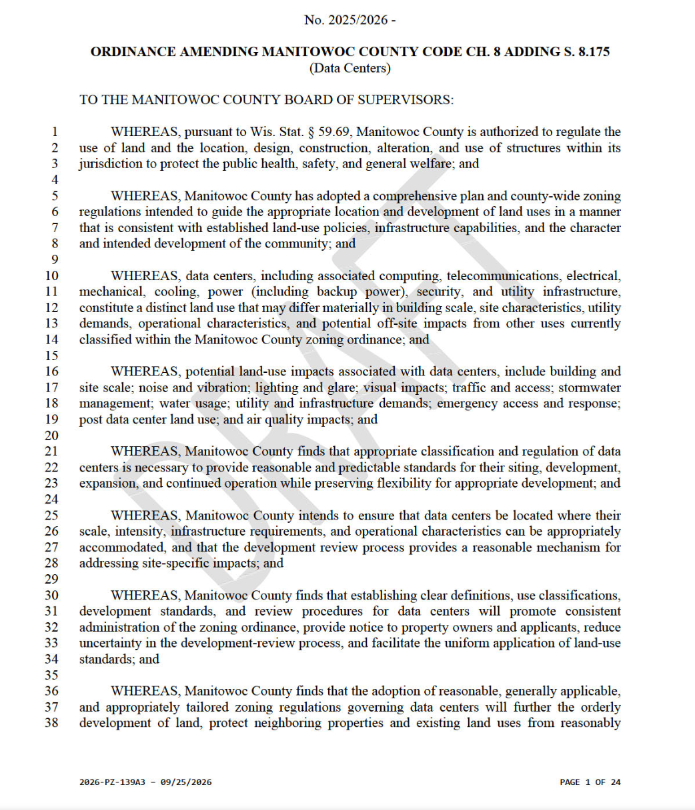
Under the ordinance, data centers in the county would be capped at under 500 acres, with no more than 100 acres allowed to be converted from agricultural use for such a project, a notable limit compared to the 2.5 million-square-foot, 672-acre data center under construction in nearby Port Washington, expected to house hundreds of thousands of servers. Companies seeking to build a data center would need to submit site, development, building and equipment plans, along with power infrastructure, backup power and emergency generation, water supply and use, wastewater, and air quality management plans, among other requirements.
The full draft is posted on the county's website for public review and feedback before the County Board discusses it, likely holds a public hearing, and takes a vote.
Georgetown, Kentucky
Georgetown City Council voted unanimously Tuesday to direct legal counsel to draft an ordinance banning data centers, which would also formally define what qualifies as a hyperscale data center.
 WKYT News Staff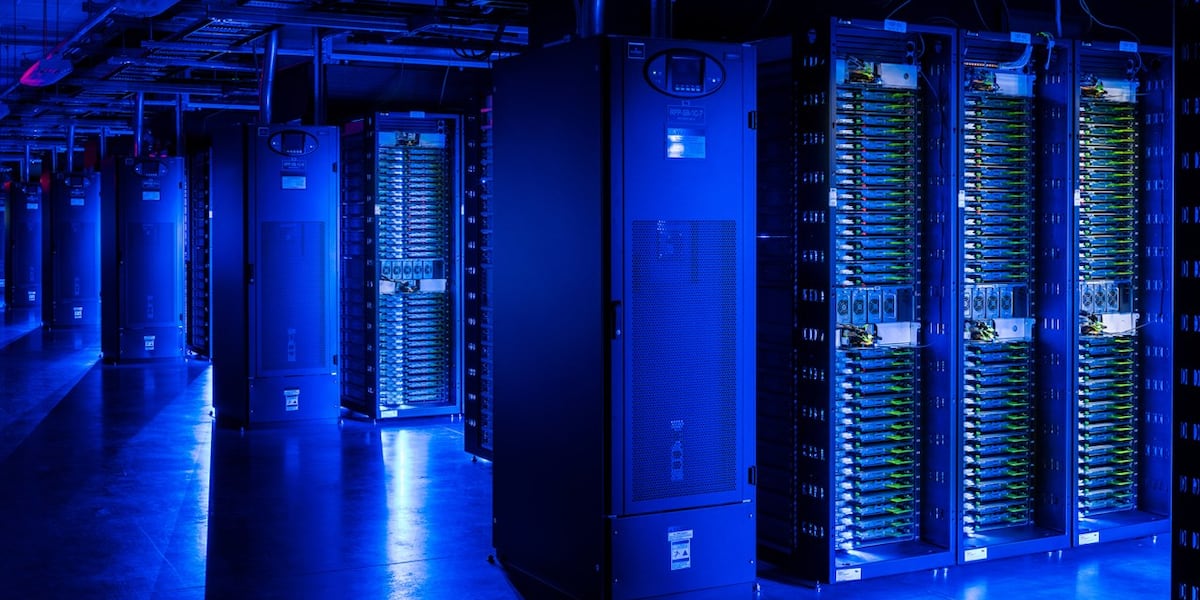
Mayor Burney Jenkins said most of the council's concern centers on large-scale, "mega" facilities, and that the ordinance needs to be careful not to inadvertently restrict smaller operations that support a local facility's own data processing needs. Council Member Karen Tingle-Sames said the city simply lacks the water, land and infrastructure to support a data center as things currently stand. Jenkins said he also wants the ordinance prepared to withstand potential legal challenges to an outright ban.
The proposed ban would still need approval from the Planning and Zoning Commission before taking effect. The vote comes after neighboring Scott County's Fiscal Court extended its own data center moratorium last week.
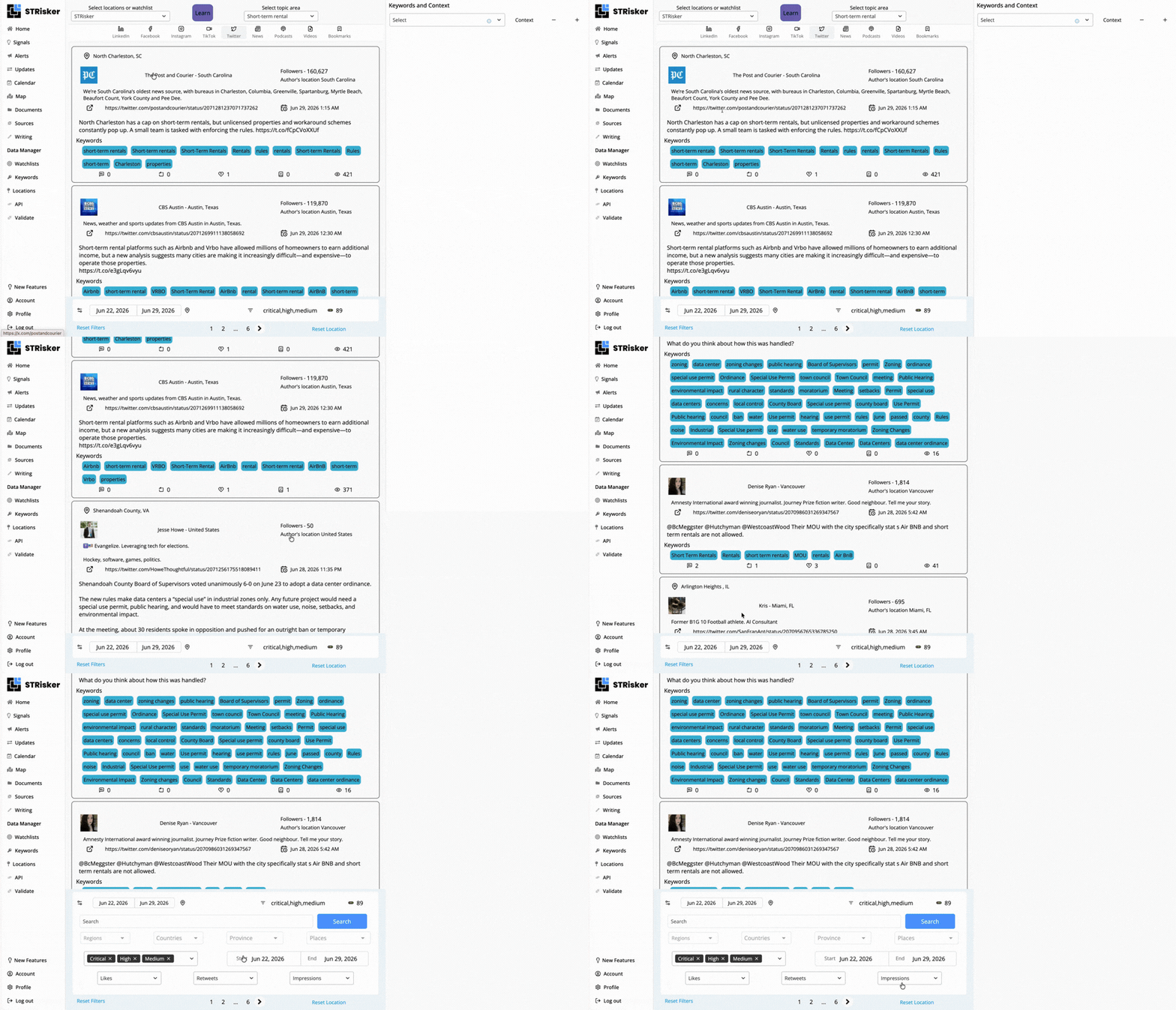
Social Listening📱: Twitter
Strisker’s Twitter Signal pulls real-time posts from officials, agencies, advocacy groups, and local influencers—so you see emerging sentiment and policy signals the moment they surface. Track conversations by place, people, and topics, then zero in on what actually matters.
Warren County, Ohio
Warren County commissioners unanimously approved a six-month moratorium on data center development in county-controlled areas, pausing projects while local and state zoning codes are reviewed and an Ohio EPA and OKI water impact study, expected in November, is completed.
The moratorium applies to so-called hyperscale data centers covering 10,000 square feet or more. Some county municipalities, including Clearcreek and Hamilton townships, already have yearlong moratoriums in place, while Lebanon, Deerfield Township and Mason are home to small data centers serving individual businesses. Commissioner Tom Grossmann, who voted for the pause alongside Commissioners Shannon Jones and Dave Young, said he's neither for nor against data centers outright but wants more study, particularly around size and location.
East Buffalo Township, Pennsylvania
East Buffalo Township supervisors will hold a public hearing Oct. 12 at 5:30 p.m. on a new data center ordinance, with final approval to follow public comment and discussion at the same meeting.
 Mark Lawrence
Supervisor Chair Jim Knight said the ordinance sets conditions data center developers must meet to gain approval, building on a prior township ordinance that regulated smaller-scale cryptocurrency and data mining operations but didn't address larger commercial data centers. The new ordinance restricts data centers to the industrial zoning district. Township Manager Jolene Helwig said large-scale projects would need special exception approval from the zoning hearing board, while smaller-scale projects would go through the planning commission before supervisors make a final decision as a conditional use.
Center Point, Iowa
Center Point's City Council and Planning and Zoning Commission met jointly with Linn County Supervisor Brandi Meisheid to review county data center rules, as the city begins drafting its own ordinance even though no data center has approached the town.
 Elizabeth Schultz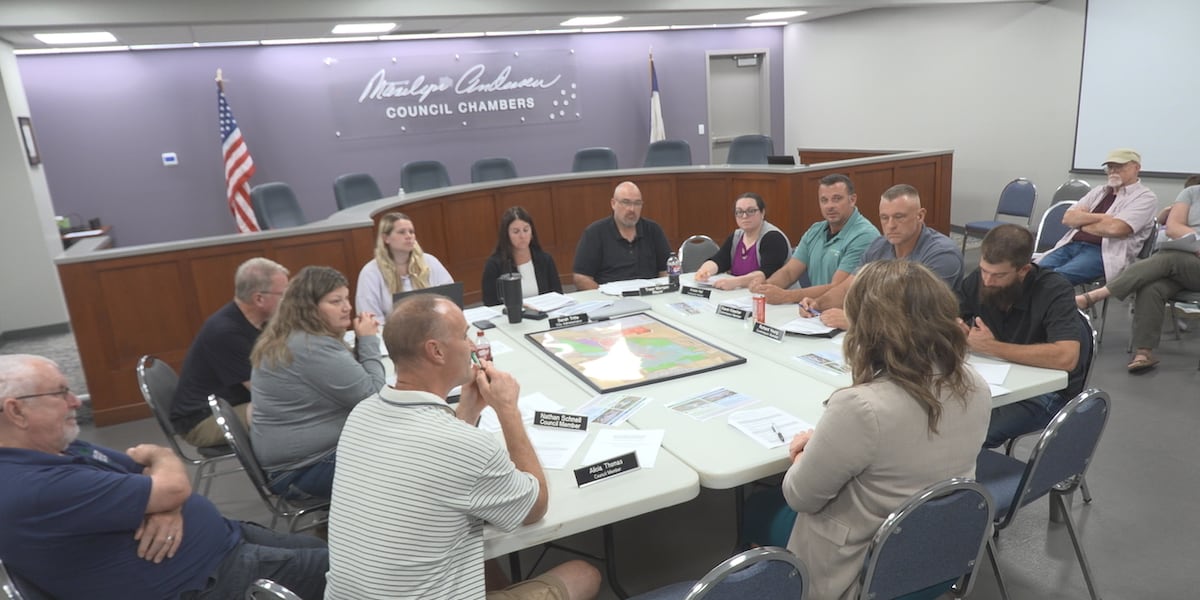
Using Linn and Johnson counties' regulations as models, leaders focused on power grid demands, cooling systems and requiring utility impact studies. Mayor Traer Morgan said it's important to be proactive so the city has a clear path forward if a data center developer does eventually come calling. Several residents questioned whether the city is prepared for the long-term impacts of such a facility, while others thanked the council for getting ahead of the issue.
Following the discussion, the council said it now has enough information to begin drafting a formal data center ordinance.
Suffolk, Virginia
Suffolk's Planning Commission voted 8-0 on Sept. 15 to recommend prohibiting data centers as a primary use in every city zoning district, a measure that would block new standalone data center projects outright if City Council adopts it Oct. 21.
The amendment stems from a June 17 council directive ordering planners to draft the prohibition, after staff flagged that existing zoning language could potentially be interpreted to allow a data center under another permitted use. The city would define a data center as an establishment primarily focused on storing, managing, processing or transmitting digital data, and would separately amend warehouse and distribution definitions to close a potential loophole allowing developers to characterize a data center as a warehouse.
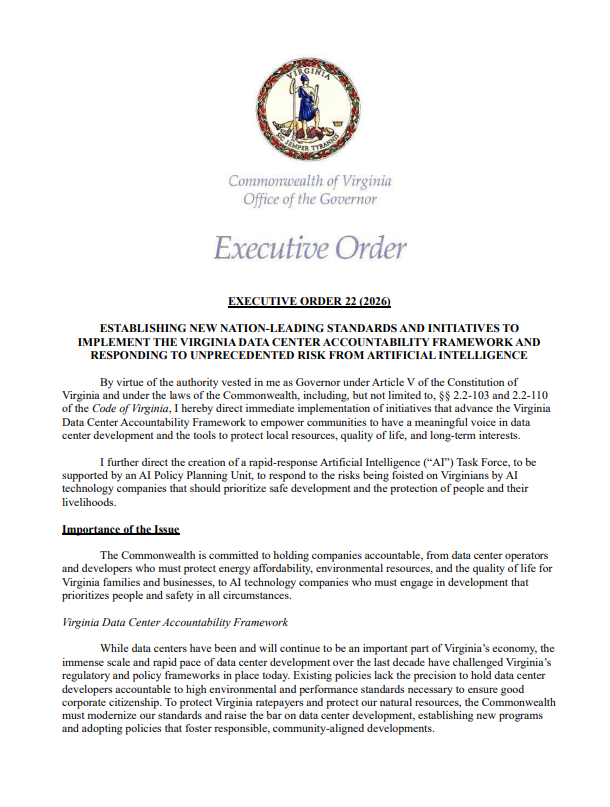
Commissioner Selena Thornton-Manuel questioned whether the blanket definition would distinguish large campuses from smaller operations, and staff clarified the prohibition applies only when a data center is a property's principal use, meaning a hospital or office running its own servers wouldn't be affected. Commissioner Oliver Creekmore confirmed there would be no exception process if adopted, calling it "a dead issue." The vote came three days before Gov. Abigail Spanberger signed Executive Order 22 establishing a statewide Data Center Accountability Framework, which directs state agencies to develop evaluation tools for localities and designates the Eastern Virginia Groundwater Management Area, which includes Suffolk, as a "cooling water scarcity area" for future water rulemaking.
📱 Social Buzz
A startup wants to build a massive nuclear-powered data center on public land in Utah https://t.co/oGbwa0neNR#BreakupTheDuopoly #TwoPartiesNoChoice
— Vote Independent America (@VoteIndeAM) September 30, 2026
Meta's Louisiana data center sits off balance sheet in a Blue Owl SPV, with roughly $27B of bonds placed with insurers and private credit. Oracle has declared force majeure on its Jupiter site, and data center moratoriums are now spreading into Texas.
— The Morning Hog Wallow (@HogWallowAgData) September 30, 2026
What could AI data centers mean for North Dakota?
— Challey Institute (@ChalleyInst) September 30, 2026
Join us October 14th for a panel conversation on the opportunities & tradeoffs of data center development in ND.
📍 Oceti Sakowin Ballroom
🕠 5:30–7 PM
🥂 Hors d’oeuvres to follow from 7–8 PM
🎟 Register on Eventbrite/Zoom pic.twitter.com/LxqEwDfAn7
Two states paused some approvals for large new data centers. On Polymarket, neither one counts
— Polyfactual (@polyfactual) September 30, 2026
Trump on Tuesday: "Elon and I sat with President Xi the other day, and he will take every data center that we don't want."
In July, New York used an executive order to pause state… pic.twitter.com/HLFYLeETGm
$KEEL Bullish catalysts for October:
— Michael (@traderMichael_1) September 30, 2026
Hyperscale data center leasing: Market rumors indicate that pre-leasing negotiations are underway for up to 2.2 gigawatts (GW) of reserved power capacity associated with the "Keel" project.
Fiber optic contract finalization: Contracts for… pic.twitter.com/Evjwz2H3vl
In case you missed it:
 Em Dela Cruz
Stay Updated with Strisker!
Strisker offers tools and features to keep you updated with the Short Term Rental and Data Centers movement across the world.
👍 We’d love your feedback.
Which stories hit? Which ones missed?
We're exploring a new branch of topics centered around Data Centers and want to make it even more useful for you.
✉️ Just reply directly to this email. We read and respond to every message!
-Will McClure
🙋 P.S.
Know someone else who should be reading Daily Notes? Feel free to forward this along. We’re opening a few more spots.