
Data Centers: Weekly Briefing // Jun 15-18, 2026
This week on Data Centers: New York's first-in-the-nation statewide moratorium lands on Gov. Hochul's desk. Monterey Park becomes the first U.S. city to ban data centers. Local moratoriums clear votes from Maryland to California. Google adds $1.5B in Alabama and pledges to cover own power.


At A Glance 🔽
- New York's legislature passed the nation's first statewide data center moratorium, and the bill now sits on Gov. Hochul's desk with roughly $10 billion in projects in the balance.
- Monterey Park, CA became the first U.S. city to ban data centers by popular vote, with nearly 90% of residents rejecting a proposed facility.
- More than a dozen local moratoriums and bans cleared votes, including Montgomery County (MD), Imperial County (CA), Anderson County (TN), Boone County (IN), Carroll County (AR), Coweta County (GA), Gorham (ME), and Luther (OK).
- Red Bank, NJ and Holyoke, MA banned data centers outright, with Red Bank the first New Jersey town to call for a statewide pause.
- Google added $1.5 billion to its Jackson County, AL campus and pledged to cover all of the facility's electricity costs.
- Pennsylvania advanced a bipartisan bill that would let communities enact a 180-day pause on data center applications.
- A $10 billion AI campus split two Texas towns, Ross and Lacy Lakeview, pitting their mayors against each other over annexation and taxes.
- Lawsuits and legal fights spread, from Imperial County (CA) to West Palm Beach (FL) and Pine Island (MN), where a judge halted construction.
📋 This Week's Decisions

State Legislation
- New York: The legislature passed what would be the nation's first statewide data center moratorium, and the bill now sits on Gov. Kathy Hochul's desk. The Responsible Data Center Development Act would halt new permits for data centers with a peak load above 20 megawatts for at least a year, create a new electric and water rate class, and require community benefits. Hochul has until the end of the year to decide, a choice complicated by her reelection bid.
Moratoriums Approved
- Montgomery County, MD: County Executive Marc Elrich signed an executive order directing the county to stop accepting and processing new data center permit applications for six months. Elrich stressed it is not a ban, framing the pause as a chance to write rules before applications start moving, and the council is working on a zoning amendment, ZTA 26-01, that would limit data centers to industrial zones. The order does not halt ongoing planning board work with Atmosphere Data Centers on a former coal plant site in Dickerson, but no permit will be issued during the pause.
- Imperial County, CA: The Board of Supervisors paused pending and future data center projects for at least 45 days, capping months of opposition over energy, water, and public health. The urgency ordinance can be renewed for up to 10 months and 15 days while a new 19-member advisory committee develops zoning recommendations by January 2027. Developer Sebastian Rucci said he would file suit the next morning.
- Anderson County, TN: Commissioners approved a two-year moratorium on new cryptocurrency mining, data processing, and battery storage development after residents packed a Monday night meeting. The county currently has no specific regulations for crypto mining or large-scale data centers.
- Boone County, IN: Commissioners approved a one-year moratorium on new data center developments in unincorporated areas, effective June 16 and running through June 15, 2027. The pause freezes filing, review, and acceptance of applications while the county studies impacts on land use, infrastructure, agriculture, and rural character.
- Carroll County, AR: The Quorum Court passed a 12-month moratorium on data centers and other "high-intensity digital infrastructure facilities" in Northwest Arkansas. Co-sponsors Harrie Farrow and Jack Deaton submitted it as an emergency ordinance so it could be heard and voted in a single meeting, citing concerns about power, water, and non-disclosure deals. It took effect immediately Tuesday night.
- Coweta County, GA: The Board of Commissioners approved a 180-day moratorium to review the county's data center ordinance. The pause halts acceptance of applications for permits, land use amendments, rezoning, conditional use, and variances, and is set to expire Dec. 23 or whenever the board adopts an amendment. The county's five proposed data centers have vested rights under state law and are exempt.
- Gorham, ME: The Town Council backed a 180-day moratorium on new data center proposals on June 2. Officials will study what regulations should govern large AI facilities, and Town Councilor Seven Siegel said the freeze could be extended another 180 days.
- Luther, OK: The town council passed a moratorium on a proposed data center through Dec. 31, 2026 after a crowd forced leaders to move the meeting outdoors and block off Main Street. Wednesday's meeting also covered a rezoning request, a specific use permit, and an infrastructure agreement.
- North Tonawanda, NY: The council voted to extend its AI data center moratorium for another year, halting a proposal to convert an existing crypto mining facility into an AI data center. Mayor Austin Tylec said the crypto operation has created years of noise concerns and that the city does not want to "become a data center city." Residents urged the council to write local standards first.
- Massillon, OH: City Council extended its data center moratorium another 60 days at its June 15 meeting, continuing a citywide stay that was set to expire June 22. The extension runs through mid-to-late August while members work on zoning rules; proposed legislation would define smaller data centers as 100,000 square feet or less and steer larger ones to heavy-industrial areas.
Regulations Passed
- McLean County, IL: The County Board approved 13 rules for future data centers, making the county one of the most restrictive in the state. The regulations cover noise limits, landscaping screens, water sourcing, and battery capacities, and require applicants to provide a decommissioning plan. Some residents pushed for tighter wording, questioning whether a 500-foot setback from homes is enough.
- Bowling Green, KY: The City Commission adopted zoning regulations for data centers while rejecting a moratorium for the second time. The rules cover energy and water consumption, noise, and light pollution, plus a 1,500-foot buffer from residential areas and required decommissioning plans. Commissioner Dana Beasley-Brown's six-month moratorium failed, and the crowd erupted into chants of "vote them out." No projects are currently proposed in the city.
- Franklin Park, PA: Borough Council adopted an ordinance establishing a data center overlay district in the borough's zoning map. The legislation sets guidelines covering dimensional standards, landscape buffers, noise and vibration, water and sewer, power supply, and decommissioning. Borough Manager Zachary Filous noted the rules let the borough regulate sound and vibration for nearby residents.
Projects Approved
- Clark County, NV: Commissioners approved zoning and development items for a Switch data center in the southwest valley after commenters urged the county to slow data center growth. Switch described the LAS 19 facility as roughly 56,000 square feet, less than half the square footage previously approved for the site, and said it would use a closed-loop cooling system. The application scored 6.5 out of 7 on the county's sustainability point system and would be supported by 100% renewable sources.
- Jackson County, AL: Google will invest $1.5 billion to expand its Bridgeport data center and committed to pay for all of the facility's electricity costs. The build-out runs through 2026 and 2027 at the site, which opened in 2018 on TVA's retired Widows Creek coal plant, and will bring 1,000 contract workers to the area. Covering both energy and infrastructure costs aligns with the Trump administration's Ratepayer Protection Pledge. Google paired the announcement with $2 million for an Energy Impact Fund and $550,000 for STEM kits.
Projects Denied/Withdrawn
- Holyoke, MA: The City Council voted to ban data centers from every zoning district in the city, ending a fight over a proposed $200 million project on a vacant Water Street property. Nearly 430 residents signed a petition against the project within days of it becoming public.
- Red Bank, NJ: The borough council voted to ban data centers and became the first New Jersey municipality to call for a statewide pause on new large-scale facilities. The June 11 vote enacted a local moratorium, with officials citing risks to water resources, electricity demand, and property values. No company has a publicly confirmed plan to build in Red Bank.
- Allegany, NY: The town banned data centers, accessory data centers, and cryptocurrency mining facilities across all zoning districts. Town Supervisor Christopher McPherson said the board wanted to preserve scarce land for housing and commercial development. The ban does not stop existing businesses from running ordinary server rooms, and comes as New York's grid operator reviews two dozen proposals statewide seeking more than 9 gigawatts.
- Urbana, OH: The City Council voted to reverse a zoning change that had cleared the way for a proposed data center south of the city. Ordinance 4635-26 restores the zoning code to its pre-2025 form, removing data centers as a permitted use in the M-1 Light Manufacturing District. Residents had filled council chambers for months asking leaders to strip the use from the code.
- Monterey Park, CA: The city became the first in the country to effectively ban data centers by popular vote, with nearly 90% of residents rejecting a proposed facility in the June 2 election. The vote killed plans for a data center on a vacant Saturn Avenue property and capped a six-month grassroots campaign that had already secured two earlier moratoriums. The city is now hosting community meetings to decide what to build instead.
💬 Catch Up on Discussions

- Pennsylvania: A bipartisan bill cleared committee in the State House that would let communities enact a 180-day pause on considering data center applications while they adopt, amend, or repeal zoning. State law bars outright bans, so municipalities can only decide where projects go and under what conditions.
- Nashville, TN: Mayor Freddie O'Connell signed an executive order launching a multi-department review of large data centers, days after residents packed a Metro Planning Commission meeting over a proposed facility near the Nashville Zoo. The order targets facilities covering at least 20,000 square feet or requiring five megawatts or more, and lands as Metro Council moves on a temporary moratorium that cleared its first reading.
- Michigan: Attorney General Dana Nessel entered testimony in the state's first contested case over a data center, opening a rare window into the contracts behind the projects. The case concerns Google's proposed center in Van Buren Township, and Nessel is pushing to limit energy credits, secure exit fees if Google leaves, and require infrastructure costs be paid up front. The Public Service Commission countered that DTE Electric projects a $300 million affordability benefit from the new load.
- Van Buren Township, MI: State environmental officials heard public concerns at a hearing over Panattoni's Project Cannoli, a five-building hyperscale campus on 282 acres that has already cleared the township board. The plan would fill 13.55 acres of wetland and is projected to use 2 million to 3.6 million gallons of water per day and one gigawatt of power, with OpenAI and Oracle both expected to use the facility. EGLE officials said they cannot base permit decisions on public opinion.
- Gage County, NE: The planning and zoning commission approved an 18-month data center moratorium after at least 100 people packed a public hearing in Beatrice. The proposal comes as a Google data center remains under consideration in southeast Nebraska. The decision now goes to the county board of supervisors for approval.
- Pasco County, FL: The planning commission voted to recommend a one-year moratorium on data centers, which still needs final approval from the Board of County Commissioners. The recommendation followed a standing-room-only hearing in Dade City that ran three and a half hours. The county has no existing data centers and none in the pipeline, and sits under a Phase 3 extreme water shortage order.
- Lakeland, FL: City leaders agreed to draft a one-year moratorium ordinance on hyperscale data centers after public backlash over "Project Swan", a 600,000-square-foot proposal in west Lakeland. A de facto moratorium took effect after Friday's study meeting, letting staff deny new hyperscale applications until rules are adopted. City Attorney Palmer Davis will draft the ordinance for public hearings July 6 and July 20.
- Spartanburg County, SC: The County Council took its first step toward a moratorium on new data center construction, voting June 15 to direct officials to draft a banning ordinance. The move follows discontent over the NorthMark data center on Pine Street, a 450-megawatt project powered by gas turbines that will not be stopped by the moratorium, and comes as a second facility, Project Lighthouse, recently applied for a permit.
- Escambia County, FL: County Attorney Alison Rogers told commissioners she will recommend a ban on data centers, drawing applause from residents who packed the chambers and spoke for more than an hour. The concern stems from rumors that economic development leaders were negotiating with a company exploring a data center in northern Escambia County. Commissioners said they did not support data centers and agreed to add the issue to that evening's agenda.
- Henderson, NV: The City Council introduced a bill that would impose a 180-day ban on conditional use permit applications for data centers, a first for any local government in Southern Nevada. Bill No. 3927 was referred to the July 21 meeting for potential adoption. Mayor Michelle Romero requested an amendment to let the council lift the moratorium early if its questions are answered sooner.
- Tucson, AZ: The Planning Commission held a follow-up public hearing on proposed regulations for large-scale data centers, continuing work that began with direction from Mayor and Council in August 2025. The rules aim to set clear boundaries and require public review for any large-scale data center in the city. The commission held an initial hearing June 3, where twelve community members spoke.
- Broken Arrow, OK: The city council will weigh a six-month moratorium on data center proposals at its Monday meeting. The vote follows the expiration of a letter-of-intent agreement to buy 52 acres in east Broken Arrow for a possible data center. City Manager Michael Spurgeon plans to recommend the pause, arguing it makes sense to study the issue before applications arrive.
- Wausau, WI: The Plan Commission held a public hearing June 16 on the city's first rules for data centers, a land use its zoning code does not currently define. The amendment would allow a data center only through a conditional use permit in medium- and heavy-industrial districts, and require applicants to submit estimates of water use, energy demand, noise, and a sustainability plan.
- Summit, NJ: The Common Council took up ordinances June 16 that would add AI data center facilities to the city's list of prohibited uses, alongside a parallel ban on detention centers. The proposals amend the "Prohibited Uses" section of the development code, and land as nearby towns wrestle with large projects including the roughly $1.8 billion CoreWeave data center under construction at the former Merck campus in Kenilworth.
- West Palm Beach, FL: A legal battle between two property owners is complicating the Project Tango AI data center proposal, weeks before key hearings on the 202-acre site off Southern Boulevard. WPB Logistics filed an emergency lawsuit against PBA Holdings, asking a judge to force it to withdraw its master plan application before a July 2 zoning hearing and a July 15 county commission vote. The proposal continues to draw strong opposition from residents and the teachers' union.
- Pine Island, MN: The City Council adopted a new public comment policy following a contentious meeting over a proposed data center linked to Google, and Mayor David Friese abruptly resigning this week. The new rules limit public input to 20 minutes total. The Minnesota Center for Environmental Advocacy sued the city and developer over what it calls an inadequate environmental review, and a judge granted its request to temporarily halt construction. The next hearing is set for Thursday.
- Pinellas Park, FL: American Tower filed a permit to build a data center at 10700 76th Court North, less than a quarter-mile from the nearest home. The proposal would tear down an empty building and add an eight-foot security fence and four large generator pads. The city will treat the facility as a conditional use, requiring formal review and public approval, since local zoning does not explicitly define data centers.
- Lufkin, TX: Residents packed a town hall over the proposed Amp Z AI data center planned for the old paper mill property on State Highway 103. The biggest concern was East Texas water; specialist Kris Hill said Amp Z is looking to expand to a 1.1 gigawatt facility by 2028, which would take 15 to 30 million gallons of water a day. County Judge Keith Wright said at least two public hearings must happen before any tax abatement deal is finalized.
- Ross and Lacy Lakeview, TX: A proposed $10 billion AI data center has split two intertwined central Texas towns, pitting their longtime mayors against each other. Developer Infrakey bought a 520-acre plot next to Ross for a campus with power capacity of nearly one gigawatt. Ross, a farming town of about 200 with no taxing authority, has no way to shape it, while Lacy Lakeview is moving to annex the land and stands to collect up to $50 million a year in taxes. A newly elected Lacy Lakeview council member ran specifically to challenge the plan.
📅 Upcoming Meetings

- Summit, NJ: Council took up the AI data center prohibition ordinance, June 16.
- Broken Arrow, OK: Council to consider a six-month moratorium, Monday June 22.
- Lakeland, FL: Public hearings on the hyperscale moratorium ordinance, July 6 and July 20.
- West Palm Beach, FL: Project Tango zoning hearing July 2; county commission vote July 15.
- Henderson, NV: Council to weigh the 180-day moratorium bill, July 21.
- Gage County, NE: Board of supervisors to consider the 18-month moratorium recommendation.
- Pasco County, FL: Board of County Commissioners to vote on the recommended one-year moratorium.
🖱️Most Clicked Link This Week
 Isabella Ledonne
👀 In case you missed it...
Read something interesting from this weekly briefing? You can read more about it below.
 Dane Artisola
 Dane Artisola
 Dane Artisola
 Dane Artisola
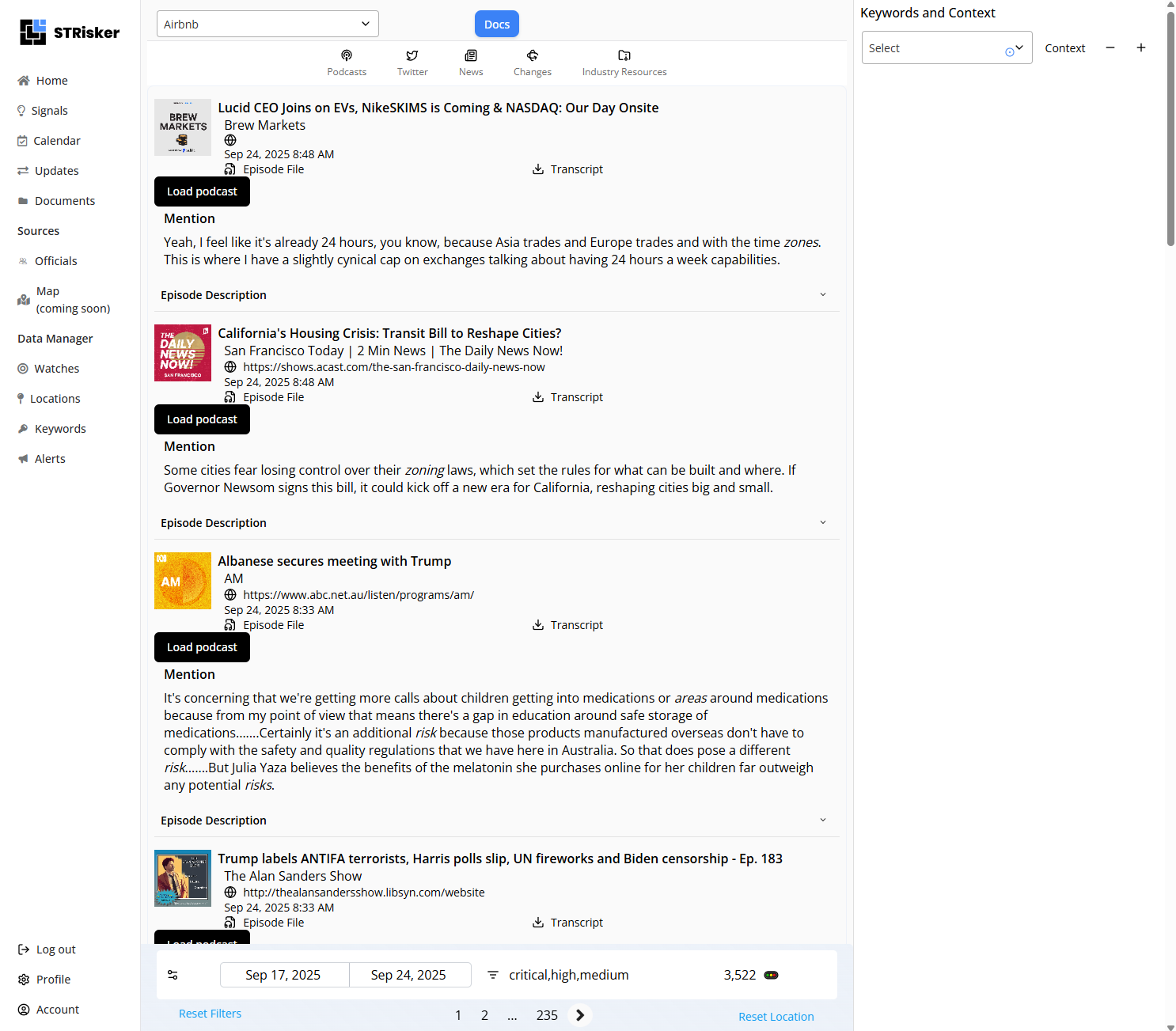
Social Listening 🎧: Podcast
Policy talk doesn’t just happen in the news cycle—it can also live in long-form audio. STRisker’s Podcast Signal turns hours of episodes into actionable insight, indexing transcripts so you can surface key mentions of STRs, ordinances, and local decision-makers in seconds.
Stay Updated with STRisker!
STRisker offers tools and features to keep you updated with the Short Term Rental movement (and now Data Centers!) movement across the world.
👍 We’d love your feedback.
Which stories hit? Which ones missed?
We're constantly refining Weekly Briefing to make it even more useful for you.
✉️ Just reply directly to this email. We read and respond to every message!
-Will McClure
🙋 P.S.
Know someone else who should be reading Weekly Briefing? Feel free to forward this along. It is the easiest way to stay ahead of regulation changes in short-term and vacation rentals.