
Data Centers: Weekly Briefing // Jun 8 - 12, 2026
This week on Data Centers: New York passes the nation's first statewide data center moratorium, nine local moratoriums clear votes from Seattle to Nassau County, Harford County MD bans data centers outright, and El Paso keeps Meta's 25-year tax break after seven hours of public comment.


At A Glance 🔽
- New York's legislature passed the nation's first statewide data center moratorium, a one-year pause that now heads to Gov. Hochul.
- Nine local moratoriums approved in four days, spanning Seattle (WA), Charlotte (NC), Edmond (OK), Nassau County (FL), Leeds (AL), Greenville (WI), Edmonson County (KY), West Haven (CT), and Lincoln Township (MI).
- Harford County, MD banned data centers from every zoning district in the county.
- Statehouse incentive crackdown: Illinois pauses new tax incentives July 1, Arizona's budget deal pauses exemptions for three years, Ohio's SB 374 would halve a $1.6 billion break, and Gov. Abbott wants Texas' exemption repealed.
- El Paso, TX voted to keep Meta's 25-year, 80% tax break after seven hours of public comment.
- Edgerton, KS denied DAMAC Digital's $700 million data center, though the land stays zoned for data center use.
- Faribault, MN lost at the Court of Appeals, which ruled the city's environmental review of a 500,000-square-foot project inadequate.
- Three Mississippi residents filed a class action against xAI and SpaceX over turbine noise near Southaven, on behalf of a class estimated at more than 10,000.
📋 This Week's Decisions

State Action
- New York: The legislature passed a one-year moratorium on new data centers, putting the state on track to become the first to temporarily ban the projects statewide if Gov. Kathy Hochul signs the bill. The pause would bar new data centers until November 2027, direct the state's environmental agency to report on electricity, water, land, and pollution impacts, and require projects with peak demand of at least 20 megawatts to hold and fund a public hearing at least three months before approval. The bill also creates a new state council charged with protecting ratepayers.
- Illinois: Gov. JB Pritzker directed the state to pause new data center tax incentives starting July 1, stepping in after the General Assembly did not act. The order stops the Department of Commerce and Economic Opportunity from processing new agreements under the Data Center Investment Program; agreements entered before July 1, 2026 will be honored. Pritzker paired the pause with a framework requiring data centers to pay their fair share of energy costs, accept interruptible service when the grid is strained, fund their own clean energy, and use water-efficient systems, and called on lawmakers to advance reforms in the veto session.
- Arizona: The state's new budget deal includes a three-year pause on tax exemptions for new data centers, ending months of negotiations between Gov. Katie Hobbs and Republican legislative leaders three weeks ahead of deadline. The 2013 exemption is viewed as a major reason Arizona is now home to more than 150 facilities. The pause does not touch data centers already receiving tax breaks, and Hobbs had pushed to eliminate the program entirely, calling it a $38 million corporate handout.
Moratoriums Approved
- Seattle, WA: The City Council voted unanimously to impose a one-year emergency moratorium on new data centers with electrical capacity over 20 megavolt-amperes. More than 50 people testified, not one in favor, and councilmembers said they received over 98,000 emails. Roughly 30 existing smaller facilities are exempt and can each expand by up to 20 megavolt-amperes. Mayor Katie Wilson is expected to sign, with permanent zoning legislation expected by early 2027.
- Charlotte, NC: The City Council voted to place a 150-day moratorium on new data centers, making the state's largest city the latest in North Carolina to do so. The freeze does not touch projects that already have approval; Council Member Kimberly Owens noted the city lacks legal authority to halt those.
- Edmond, OK: The City Council voted to pause new applications for data center land and building permits through Dec. 31, 2026, with an emergency clause making it effective immediately. The council laid out a research timeline of two months to study impacts, a draft ordinance in three months, and a final draft in five. An Oklahoma State University research committee member offered to examine 117 questions on water and energy use.
- Nassau County, FL: Commissioners approved a 12-month moratorium on new data center projects following a final public hearing. County staff will review effects on groundwater tied to the aquifer, grid demand, land use compatibility, and environmental concerns including noise, lighting, and wildlife. The county's fact-finding committee will keep meeting through the summer.
- Leeds, AL: The City Council passed a one-year moratorium on all development approvals and permits for data center campuses. No data centers are currently under development, but residents raised concerns after a councilor reported operators were eyeing Leeds. Councilor Sabrina Rose said she would make the ban permanent if she could, and the city plans to update its zoning ordinance to address data centers long term.
- Greenville, WI: Village trustees voted to impose a yearlong moratorium on facilities 10,000 square feet or larger whose primary use is a data center, leaving room for businesses with smaller on-site data closets. Officials could extend the pause another six months. To satisfy Wisconsin's moratorium law, the public works director signed off that a data center could strain the village's water utilities.
- Edmonson County, KY: The Fiscal Court enacted a one-year moratorium on new data centers, AI processing facilities, and cryptocurrency mining operations, effective immediately after its second reading. Existing legal facilities are grandfathered in, and ordinary office computers are unaffected.
- West Haven, CT: The City Council approved a one-year moratorium on new data centers, preemptively hitting the brakes so the city can craft regulations first. Mayor Dorinda Borer proposed the resolution after hearing from fellow mayors about similar moratoriums, warning the city could face legal liability if it rejected a proposal with no regulatory language on the books. Server rooms incidental to a development's principal use are exempt.
- Lincoln Township, MI: The Board of Trustees approved a ten-month moratorium while the planning commission works toward an ordinance. Trustees pointed to complaints from Dowagiac residents about a hyperscale data center there as opposition mounts across Michigan.
Regulations Passed
- Harford County, MD: The County Council voted to ban data centers from every zoning district in the county, with 46 speakers addressing the council and overflow crowds waiting outside. The vote completes the fast-track path chosen in May, when the council scrapped a separate moratorium bill in favor of emergency legislation for a permanent prohibition. The Maryland Tech Council called the bill vague and legally dubious, and State Sen. JB Jennings expects the issue to resurface in Annapolis next session.
- Birmingham, AL: The City Council approved new data center zoning regulations as roughly 300 people crowded City Hall, with about 100 more outside. The rules set 20 conditions for hyperscale data centers, including a 5-acre minimum lot size, 500-foot setbacks from residential properties, mandatory closed-loop cooling, and a ban on diesel or gas power generation outside of emergencies. Many objected to the removal of a special exception process; applications meeting all 20 conditions now require no hearing at all. The regulations tentatively take effect June 20.
- South Strabane Township, PA: The Board of Supervisors adopted a pair of ordinances governing data center development plus noise and dust, ending more than six months of public outcry. The centerpiece is a 1,500-foot setback from any occupied residence, which the township solicitor described as among the largest in any Pennsylvania municipal ordinance; it leaves just 651 of the roughly 1,400 acres at the Zediker Station Road property available for data center use. An attorney for landowner CNX Resources asked for 1,000 feet; supervisors kept it at 1,500. A third ordinance governing fossil fuel power generation is being drafted.
Projects Approved
- Iron County, UT: The Planning Commission approved a conditional use permit for Pronghorn Development's Antelope Data Campus, planned on 640 acres about 8 miles west of Cedar City, despite pushback over water and air quality. The project could include five data center buildings constructed in phases over eight to 10 years. The approval came on the heels of the commission's 180-day moratorium on new AI data center applications; staff said the Antelope project was not affected by that pause.
- El Paso, TX: The City Council voted to keep the city's incentive agreement with Meta in place, rejecting a termination proposal after seven hours of public comment. The 2023 agreement grants Meta an 80% break on city taxes for 25 years on its full $10 billion investment; an attorney estimated the city could be liable for $800 million if it broke the contract. The city expects about $15 million a year in city taxes, making Meta its biggest taxpayer. Opponents pressed concerns about groundwater, electricity demand, and jobs; four council seats are on the November ballot.
Projects Denied/Withdrawn
- Edgerton, KS: The planning commission denied DAMAC Digital's application for a $700 million data center on about 54 acres in southern Johnson County, after putting the proposal on hold last month. DAMAC already owns the warehouse and land, which is zoned for data center use, leaving the door open for a new application; opponents plan to keep organizing. The City Council was expected to take up a moratorium discussion June 11 as resistance spreads across Johnson County.
In the Courts
- Faribault, MN: The Minnesota Court of Appeals ruled the city's environmental review of the proposed 500,000-square-foot Archer Datacenters project was inadequate, sending the city back for a more complete analysis. The review had reported emissions 98% lower than expected for a facility of that size; during litigation, the city acknowledged the estimate assumed the data center would use no more electricity than a typical warehouse. The Minnesota Center for Environmental Advocacy called the decision a win for residents' right to know a project's impacts before approval.
- Southaven, MS: Three Mississippi residents filed a proposed class action against xAI, SpaceX, and MZX Tech over noise and vibrations from gas-fired turbines powering AI data centers near Southaven. The suit describes the noise as "omnipresent and inescapable" and seeks damages for emotional distress and diminished property values for a class estimated at more than 10,000 residents. The case adds to xAI's legal exposure in Mississippi, where the company already faces a separate NAACP lawsuit that has drawn interest from the U.S. Justice Department.
💬 Catch Up on Discussions

- Texas: Gov. Greg Abbott released sweeping regulatory recommendations for the 2027 session, including repealing the industry's sales tax exemption, projected to cost the state $3.2 billion over the next two years. He called for requiring new facilities to add power generation to the grid, pay their own infrastructure costs, use closed-loop water systems, and report electricity and water use annually, and directed the PUC to require data centers to pay for all of their electric infrastructure costs. The PUC and ERCOT owe him a joint memo by July 17.
- Ohio: Lawmakers unveiled a sweeping data center bill that would cut the state's 100% sales tax exemption in half, targeting a tax break that ballooned to roughly $1.6 billion in the last year. Most projects would see a 50% exemption, with 75% for brownfield projects that bring their own power. The bill also caps local property tax abatements at 50%, ends access to Ohio's 30-year mega project grant, requires water use reporting, and directs the PUCO to create a data center rate class. A full Senate vote was possible just one day after introduction.
- Pennsylvania: State Sen. Rosemary Brown is backing a statewide moratorium on new hyperscale development, arguing Gov. Shapiro's voluntary GRID standards don't go far enough because participation is optional. Her "Residents First" package would require developers to show utilities can support a project at full capacity before applications are submitted, limit large-scale data centers to industrially zoned areas, and mandate independent water impact studies.
- Fayetteville, AR: Councilmembers proposed an ordinance that would move data centers from permitted to conditional uses, requiring reports on water and electricity consumption, a public noise-verification webpage, and a single community contact, and letting the mayor prioritize residential water use. Arkansas bars outright bans under Act 851, but under the proposed rules an operator would have to prove the community will not be harmed. A vote could come as soon as June 16, with an emergency clause making the rules effective immediately.
- Clay County, FL: The county held its first public hearing on a proposed one-year moratorium on rezoning and permitting applications tied to data centers in unincorporated areas. Staff would review impacts on water systems, the grid, and the environment during the pause. A second and final hearing is set for June 23.
- Lexington, KY: Mayor Linda Gorton said the city will not back public incentives for DartPoints, which closed a $29 million purchase of the former Lexmark data center property on May 15. The 345,000-square-foot site on roughly 30 acres has current capacity of 20 to 30 megawatts with long-term potential of 70, and is already zoned for data centers, so no rezoning was required. A consultant is drafting a zoning amendment to define and regulate data centers, and the Planning Commission took public input June 11.
- Lowell Township, MI: Hundreds packed a Planning Commission meeting that ran nearly six and a half hours without a decision on Microsoft's rezoning bid for its proposed Covenant Business Park near I-96, which would include five data center buildings, a utility substation, and an employee office building over a roughly 10-year buildout. Microsoft said the campus would not raise electricity costs for nearby residents; neighbors voiced doubts about local water. A workshop is set for June 22, a regular meeting July 13, and a second workshop July 27 with Consumers Energy.
- Festus, MO: The City Council voted against holding a special recall election, drawing boos from the crowd in a dispute rooted in a proposed data center. The county clerk had certified all petition signatures targeting the mayor and three councilmen over their votes to advance the project, but the city attorney advised the petitions did not state facts amounting to misconduct. Pending lawsuits remain active, and organizers said they are moving to "Plan B."
- Suffolk, VA: The City Council teed up a June 17 vote on a motion asking the Planning Commission to amend the unified development ordinance to prohibit data centers in all zoning districts until permanent regulations are adopted. Mayor Mike Duman noted data centers are not specifically named in Suffolk's ordinance, which could raise questions about whether one could be built by right in an M-2 district.
- Nashville, TN: Metro Council advanced a temporary countywide moratorium on data centers, clearing the first of three required readings. The pause could affect at least two proposals: the DC BLOX project next to the Nashville Zoo and another at Fisk University. The zoo's petition grew from 288,000 signatures early in the week to more than 360,000, with country star Brad Paisley calling the proposal an "absolute nightmare scenario." Revised plans for the site now include a second, much larger building of three stories, 202,000 square feet, and 40 megawatts, and zoo leaders have filed a zoning appeal seeking to overturn DC BLOX's permits.
- Spokane, WA: Three council members introduced an emergency ordinance that would stop the city from accepting building permit applications for data centers for one year, with a public hearing and vote set for June 15. The push follows the revelation that Avista is negotiating with an unnamed developer over a data center that would draw 125 megawatts starting in 2029 and ramp to 500 megawatts by 2032, roughly half of all the power Spokane County consumes.
- Goochland County, VA: Denver-based Tract submitted an initial application for Tuckahoe Technology Park, a multi-phase campus on nearly 900 acres and the first project proposed under the county's technology overlay district. Plans show 12 data center buildings, most 60 feet tall behind minimum 500-foot setbacks. Tract projects $400 million in real property tax revenue and more than $600 million in personal property tax revenue over 20 years, $3 billion in construction, and 350 permanent jobs. The application comes weeks after Hanover County supervisors rejected Tract's Mountain Road Technology Park 4-3.
- Murray, KY: The Planning Commission voted to send its draft data center regulations back for revisions after more than 20 speakers said the rules don't go far enough. The draft would limit data centers to industrial zones, require a 1,500-foot setback from homes and schools, and cap allowable noise. Several speakers urged a moratorium instead, but the commission lacks that authority. It meets again June 23.
- Milwaukee, WI: The co-owner of the Midtown Center Walmart redevelopment insists its computing component is not a data center, as about 100 people attended a contentious open house. The plan combines a relocated library branch, city offices, self-storage, 200 affordable apartments, and a 19,000-square-foot "computational research" facility running a roughly 7-megawatt IT load with closed-loop cooling. An initial zoning review set for May was canceled over concerns about the computing component.
- Homewood, AL: Mayor Jennifer Andress wants a data center moratorium in place before any developer comes knocking. No one has approached the city, but at just eight square miles, she said, any development would affect nearly everyone. She expects a moratorium to come up at the June 22 council meeting.
- Bonner, MT: A packed meeting at the KettleHouse Taproom showed local opposition to a data center proposed by Idaho-based Krambu, with organizers Missoula Neighbors United citing pollution, grid strain, and inconsistencies in the application. Final approval goes before the Missoula County Consolidated Land Use Board, which has not yet scheduled its next hearing.
- Raton, NM: Commissioners postponed a proposed six-month moratorium on business licenses and zoning approvals for data centers, holding off pending more information from attorneys because of the city's current MOU with Atterix. The city will keep working on data center ordinances, and commissioners plan a workshop before their next meeting on June 23.
📅 Upcoming Meetings

- Spokane, WA: Public hearing and council vote on one-year moratorium, June 15.
- Fayetteville, AR: Possible council vote on conditional-use ordinance, June 16.
- Suffolk, VA: Council vote on temporary citywide data center prohibition, June 17.
- Birmingham, AL: New hyperscale regulations tentatively take effect, June 20.
- Homewood, AL: Moratorium expected at council meeting, June 22.
- Lowell Township, MI: Planning workshop on Microsoft rezoning, June 22, with sessions to follow July 13 and July 27.
- Clay County, FL: Second and final hearing on one-year moratorium, June 23.
- Murray, KY: Planning Commission reviews revised data center regulations, June 23.
- Raton, NM: Commission workshop and next meeting on postponed moratorium, June 23.
- Texas: PUC and ERCOT joint memo due to Gov. Abbott, July 17; PUC action on residential transmission costs due by July 31.
👀 In case you missed it...
Read something interesting from this weekly briefing? You can read more about it below.
 Dane Artisola
 Dane Artisola
 Dane Artisola
 Dane Artisola
📱 Social Buzz
Nashville’s Metro Planning Commission is holding a meeting this afternoon to discuss data centers in the city, and so many people showed up that the meeting reached fire capacity... - WSMV 4, Nashville
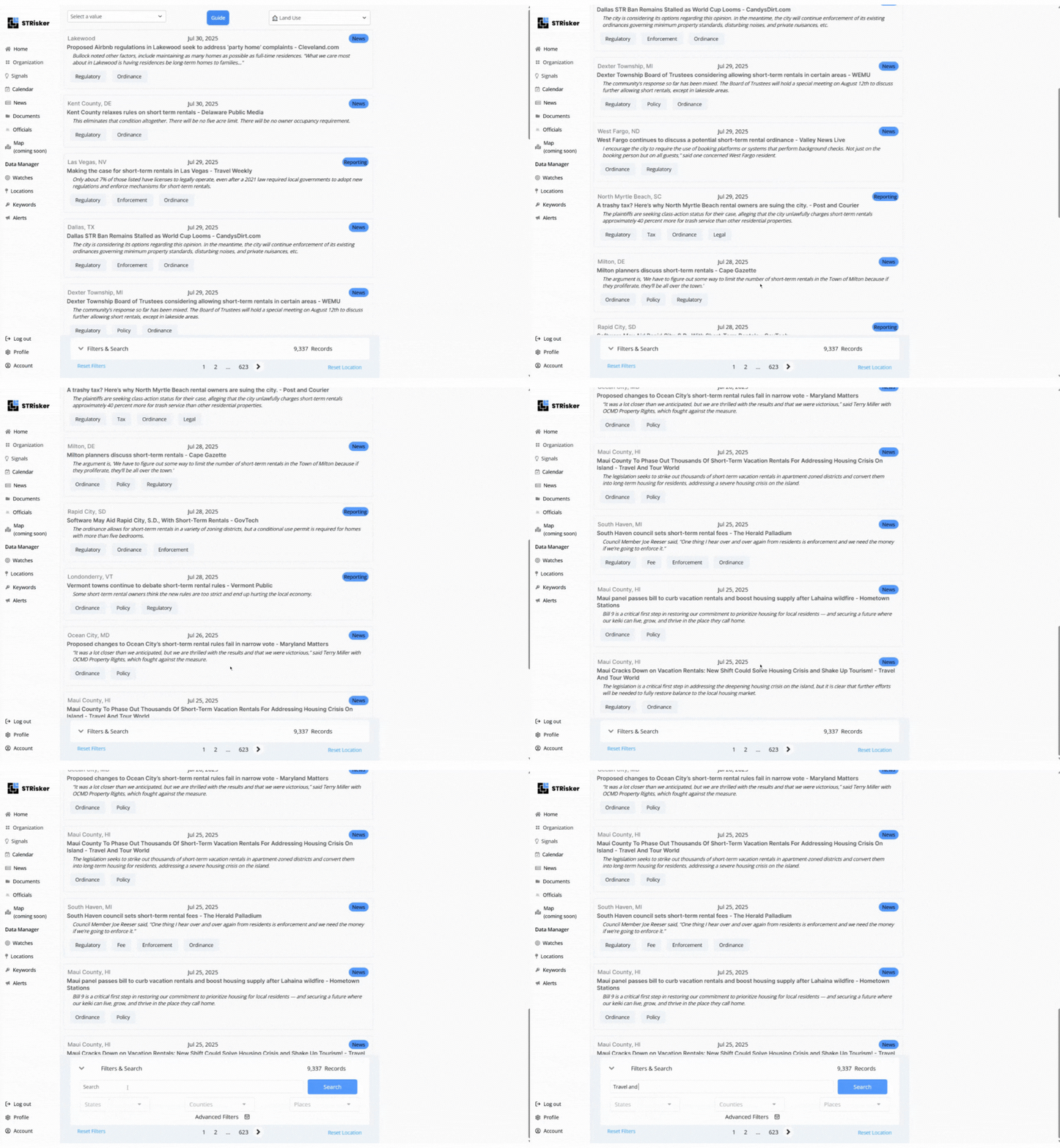
STRisker News Tracker
Trying to keep up with regulations across multiple cities and states? Our News Tracker makes it easier than ever. Filter by location, search a comprehensive database, and sort by impact level—this tool helps you focus on what matters most.
Stay Updated with STRisker!
STRisker offers tools and features to keep you updated with the Short Term Rental movement (and now Data Centers!) movement across the world.
👍 We’d love your feedback.
Which stories hit? Which ones missed?
We're constantly refining Weekly Briefing to make it even more useful for you.
✉️ Just reply directly to this email. We read and respond to every message!
-Will McClure
🙋 P.S.
Know someone else who should be reading Weekly Briefing? Feel free to forward this along. It is the easiest way to stay ahead of regulation changes in short-term and vacation rentals.