
Factors and Common Debates in Data Center Policy Discussions
Learn what data center policy is, the factors that influence it, the common debates surrounding it, and the states with different data center policies.

At A Glance 🔽
- Data center policy refers to the laws, regulations, and regulatory frameworks that govern where data centers can be sited, powered, taxed, and permitted.
- Several key policy factors influence data center policymaking, including utility rates and energy grid management, water resources and cooling systems, zoning, site selection, land use, data security, compliance, residency, tax incentives, and community impacts.
- Debates are common in policymaking, as they involve discussions among various groups. Some discussions focus on who will fund the grid, whether tax incentives remain effective, whether decisions should be made at the state or local level, and the need for transparency versus confidentiality regarding project details.
- Several states and localities focus on different policy areas within their jurisdictions.
Definition
Data center policy comprises the laws, regulations, and regulatory frameworks that govern where data centers can be sited, powered, taxed, and permitted. This covers economic development laws such as sales and property tax incentives, utility regulations such as rate increases or grid upgrades, and local land-use frameworks, including zoning, noise, and water limits. This also involves different governing bodies and authorities. Meaning to say, a single data center project can be influenced by the state tax statute, a utility commission tariff order, or a county moratorium all at once.
🚀Major Policy Factors
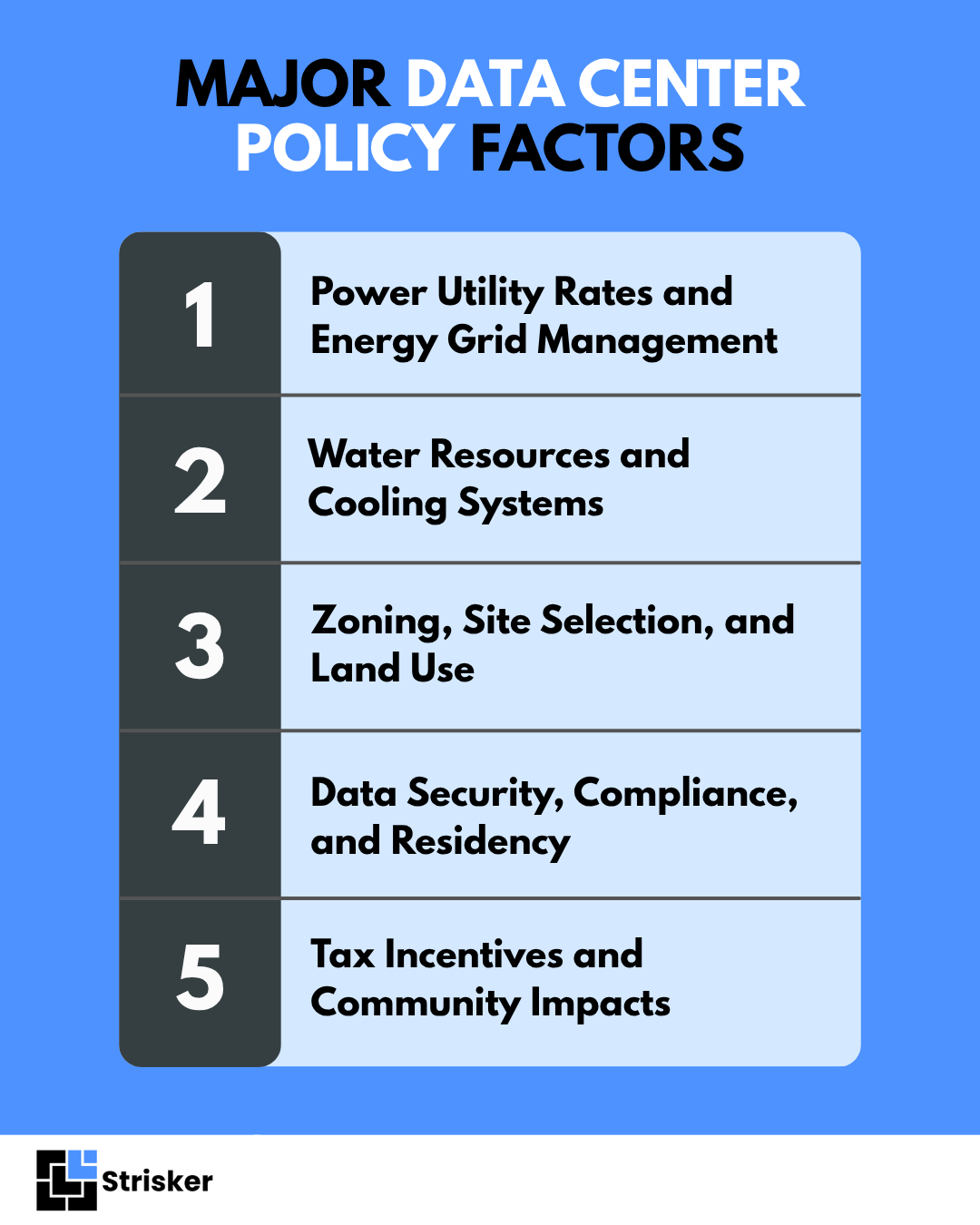
Data center policy covers various critical areas, including how facilities are powered, cooled, located, secured, and financed. Here are some of its factors:
Power Utility Rates and Energy Grid Management
Ratepayer protection rules, including large-load tariffs and minimum billing requirements, are designed to ensure that the costs associated with serving data centers do not fall on the ratepayers. Meanwhile, grid capacity is managed through interconnection queues, connection prioritization, and demand response requirements. An example of this is New Jersey’s Bill S731, which requires large data centers to have power cuts before residential customers are affected during a grid emergency.
Water Resources and Cooling Systems
Data centers need water resources and cooling systems to remove heat from the equipment. This is why states are including rules on reporting, planning, and cooling processes for data center development. This includes some of the policies from Utah’s House Bill 76 and Virginia’s HB 496. Additionally, California has AB 2469, which requires a water supply assessment before new local data centers approvals, while Oklahoma’s SB 259 requires data centers to use cooling systems to obtain a groundwater permit.
Zoning, Site Selection, and Land Use
Zoning and permitting rules dictate where a data center can be built. Pennsylvania's Executive Order 2026-05 has removed data centers from the Fast Track permitting process. It now requires local government approval prior to state permit reviews by the Department of Environmental Protection. It also prevents the DEP from issuing final permits until local approvals are secured.
Data Security, Compliance, and Residency
Security and compliance rules focus on how a facility safeguards the data it collects, while residency rules pertain to where this data may be stored. Operators prioritize certifications based on various standards, including ISO/IEC 27001.
Tax Incentives and Community Impacts
A tax incentive is a reduction in a tax bill designed to attract projects. This often includes exemptions from sales tax on equipment or partial property tax abatements. According to the National Conference of State Legislatures (NCSL), 38 states offer data center tax incentives. However, lawmakers in at least 28 of these states have introduced bills in 2026 to amend or add guardrails to these programs. Some states also impose conditions, such as requiring data centers to create jobs, a measure already required by at least 17 states.
🙋♂️Common Debates
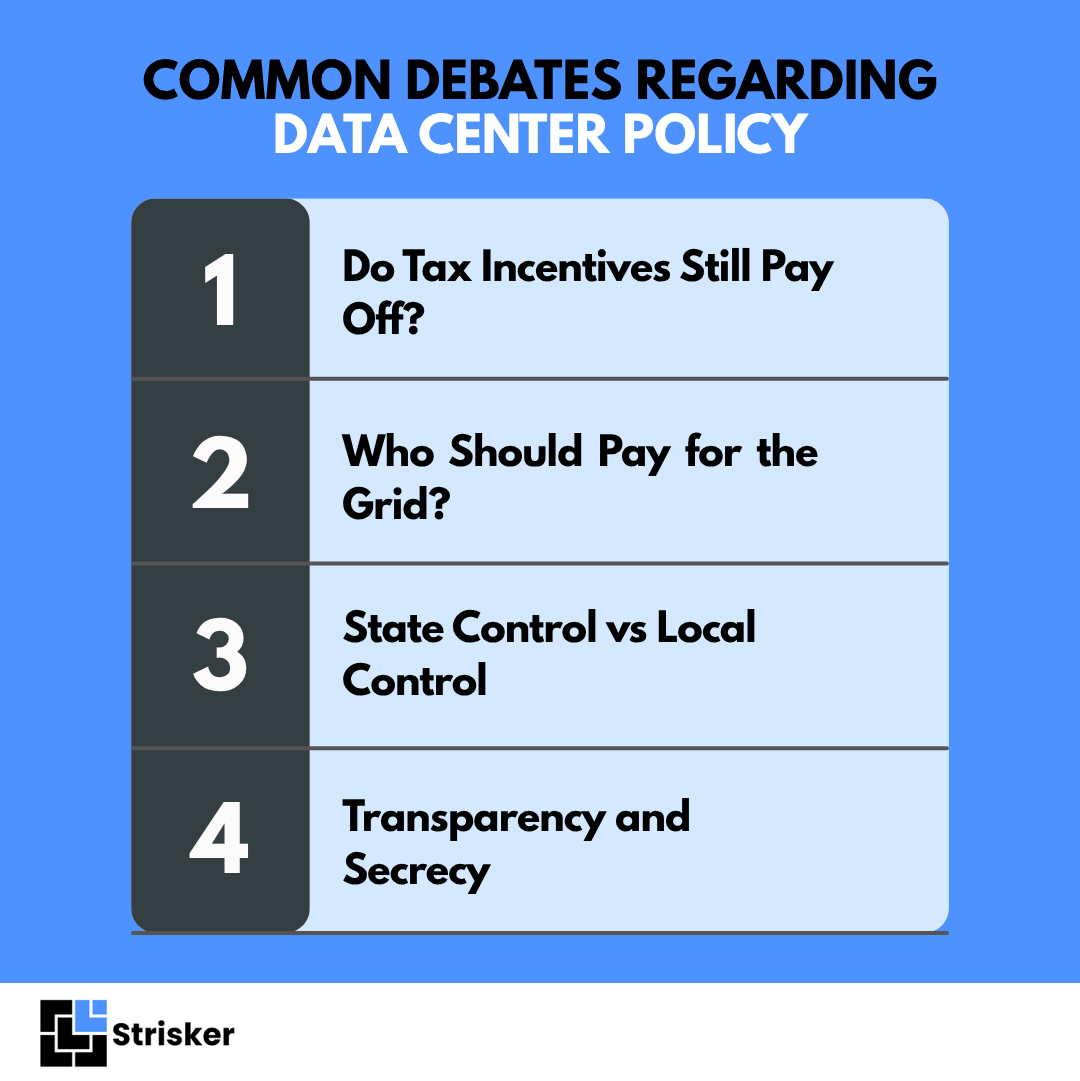
When it comes to policymaking for data centers, disagreements often arise among lawmakers, utilities, developers, and residents regarding their management. Here are some common debates that typically require discussion among these groups:
Do Tax Incentives Still Pay Off?
Supporters argue that tax incentives attract significant investments, create construction jobs, and generate future tax revenue for a state. However, critics contend that these incentives waste public funds on projects that would have been completed regardless. A notable example is a Georgia state audit that found 70% of data centers would likely have chosen to locate in Georgia even without the subsidy.
Who Should Pay for the Grid?
Many residents believe that data centers should bear the costs of the grid upgrades necessary for their operation. Conversely, utilities argue that large customers can actually lower costs for everyone if they are billed appropriately. This is because these customers help spread the grid's fixed costs across a larger user base. Additionally, this is why many states implement minimum billing and long-term contracts to ensure that data centers continue to pay even if their power consumption decreases.
State Control vs Local Control
Some states prefer a uniform set of rules applied statewide, while others allow individual cities and counties to make their own decisions. West Virginia prefers state control and enacted a law in 2025 that prevents local governments from imposing their own zoning, noise, and permit regulations on large certified data centers. Under this law, the Secretary of Commerce has 14 days to confirm certification after the data center notifies the state. In contrast, critics believe that the voices of local communities are ignored. Virginia, likewise, has taken a middle-ground approach, wherein its 2026 law requires sound and site studies for data centers but leaves zoning decisions to its local governments.
Transparency and Secrecy
Data center developers frequently use non-disclosure agreements (NDAs) to protect confidential project details during initial discussions with local governments. However, communities often argue that these NDAs hinder their ability to make informed decisions. For instance, a dispute in Botetourt County, Virginia, later revealed that a proposed Google data center could consume between 2 and 8 million gallons of water per day.
🗽States and Their Data Center Policies
Currently, there is no specific national data center policy, resulting in different policies for the same project depending on its location. The table below summarizes how various sites have implemented common data center policy factors.
Conclusion
Data center policy refers to the laws, regulations, and frameworks that govern the construction and operation of data centers. The development of these policies is influenced by various factors, reflecting ongoing debates among different groups.
Different states and localities prioritize different aspects of data center policy. Therefore, these different groups need to understand the focus and current status of certain policies to form their own positions. Strisker provides tools, features, and newsletters to help you stay informed about new and proposed policies regarding data center developments.
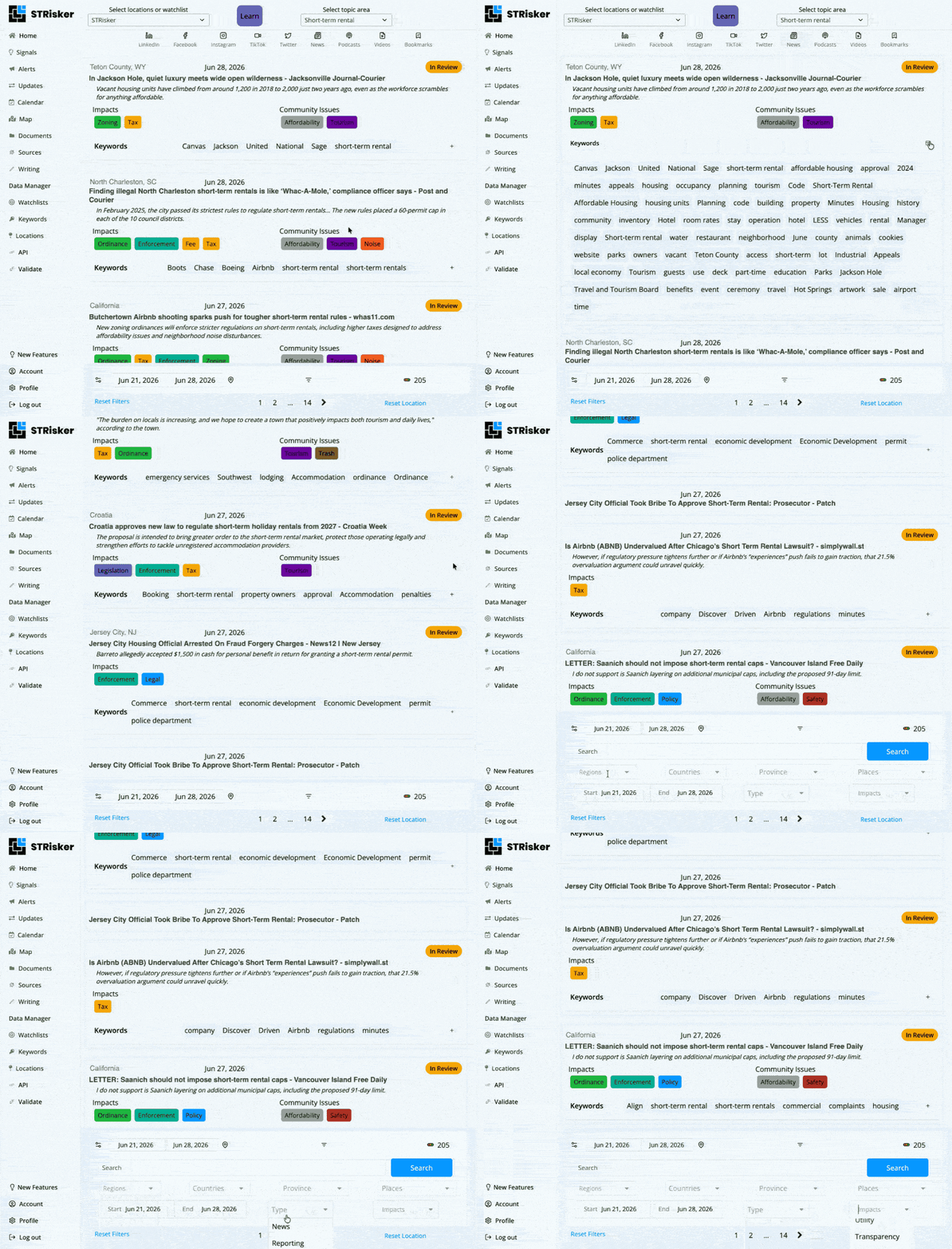
Strisker News Tracker
Trying to keep up with STR and data center regulations across multiple cities and states? Our News Tracker makes it easier than ever. Filter by location, search a comprehensive database, and sort by impact level—this tool helps you focus on what matters most.
FAQs
How is a data center policy different from a data center standard?
A data center policy is a regulatory guideline set by an organization or government that outlines the required and prohibited actions related to security, access, and operations. In contrast, a data center standard defines technical and industry benchmarks, offering measurable guidelines and specifications for the design, construction, and operation of data centers.
How often should a data center policy be reviewed?
A data center policy should be reviewed at least annually (every 12 months) as a baseline industry standard, or semi-annually (every 6 months) in highly regulated environments. There are instances that may prompt ad hoc or trigger-based reviews, particularly when policies require evaluation outside the regular schedule. This might occur due to significant changes such as the introduction of new laws or tariffs, modifications in facility size or power contracts, security incidents, or funding audits.
How do I audit compliance with a data center policy?
Here are some initial steps to audit compliance with a data center policy:
- Verify all requirements outlined in the policy, including tariff terms, incentive conditions, and reporting deadlines.
- Collect evidence for each requirement, such as utility bills, signed contracts, incentive applications, access logs, and previous reports.
- Evaluate the evidence against the requirements and label each one as met, partially met, or not met.
- Document each gap along with the assigned owner and the deadline for resolution.
- Review the completed items after their due dates and document the findings for the next assessment.
Stay Updated with Strisker!
Strisker offers tools and features to keep you updated with the Short Term Rental movement (and now Data Centers!) movement across the world.
👍 We’d love your feedback.
We're always looking for ways to improve our content.
Was this one useful to you? Other topics you'd like to see get covered?
✉️ Just reply directly to this email. We read and respond to every message!
-Will McClure
🙋 P.S.
Know someone else who might be interested in this content? Feel free to forward this along.