
🎯 STRisker: Bulletin - Japan
A reversal of eight years of national guidance opens the door to outright local bans on private lodging in residential neighborhoods.




Japan Tourism Agency to Let Municipalities Set Minpaku Days to Zero
Photo by Tianshu Liu on Unsplash
The Japan Tourism Agency announced on June 17, 2026 that it will allow local governments nationwide to set the annual operating-day limit for minpaku private lodging to zero through ordinance, a change that effectively permits prefectures, special wards, and health center cities to ban short-term home rentals outright in any area where the practice is judged to be damaging residential life. This shift marks an about-face for an agency that had treated outright bans as "inappropriate" since the Private Lodging Business Act took effect in June 2018 and a departure from the law's purpose of expanding tourist lodging supply.
Check this Facebook post: https://www.facebook.com/JapanToday/posts/japan-to-clear-way-for-local-govts-to-effectively-ban-private-lodgings-the-japan/1542524524581166/
Under the national law, hosts who register with their prefecture may operate a minpaku for up to 180 days a year and Article 18 already gave local governments power to shorten that window by ordinance within a defined zone, but what the agency had never sanctioned until this month was using that power to push the cap to zero. Agency chief Shigeki Murata told reporters the reversal responds to a steady rise in complaints tied to noise and improper garbage disposal, many of them in otherwise quiet residential streets.
"If it is necessary to do so in order to prevent the deterioration of the living environment due to noise emissions and other events caused by the private lodging business, a prefecture (or ... city with a health center or a special ward) may limit the period for carrying out the private lodging business ... by specifying the area, in accordance with the criteria specified by a Cabinet Order, and as specified by Prefectural or Municipal Ordinance."
- Article 18 (Restrictions on the Conduct of a Private Lodging Business under the Prefectural or Municipal Ordinance), Act on Business of Housing Accommodation
The agency plans to send a formal notice in a form of a technical advisory rather than binding law to municipal governments by the end of June and state that local governments may justify a zero-day restriction wherever minpaku numbers are expected to increase near homes or schools in ways that threaten the living or learning environment. It will also let municipalities tighten rules on properties already operating where nuisances have taken hold and is expected to encourage conditions such as sound-level meters and entrance cameras.
🏠 Japan's 2026 minpaku regulations could reshape short-term rentals. Here's what Shinjuku officials are saying.
Watch here: https://youtube.com/shorts/EvGIEAN4Vnc?si=X6czk1BJJbvimpBj
Two Tokyo wards offer an early picture of what a zero-day approach looks like in practice: Meguro Ward's ordinance already limits operation citywide to the window between Friday noon and Sunday noon and caps annual business at roughly 104 days, while Arakawa Ward permits only Saturday noon through Monday noon under a similarly tight rule, leaving both wards with only a handful of registered properties. Kyoto on the other hand which already restricts much of its residential zoning to a roughly two-month window each winter is preparing a further ordinance revision for its city council later this fiscal year. Nationally, around 40,700 minpaku properties were registered as of May 2026 which is a base the agency's notice could now expose to far steeper local restriction.
Platforms operating in Japan including Airbnb already require hosts to obtain and display a valid notification number on every listing under the existing law, and unregistered properties are subject to removal. The agency separately plans to pilot a nighttime call center this fiscal year to take noise complaints directly, adding another channel through which municipalities can build the case for tighter local ordinances.
⦾ Effective date: JTA notice expected by end of June 2026; actual zero-day ordinances depend on individual municipalities adopting or revising local rules
⦾ Registration required: Yes, national notification under the Private Lodging Business Act
⦾ Night cap: National baseline of 180 nights/year; municipalities may now set a local cap as low as 0 nights/year via ordinance
⦾ Penalty for non-compliance: Existing law penalties apply, up to ¥1,000,000 in fines or up to six months imprisonment for unregistered operation; new local enforcement tools (sound meters, entrance cameras) to be set municipality by municipality
⦾ Platform responsibility: Yes, platforms including Airbnb, Vrbo, and Booking.com must verify and display notification numbers on listings
In case you missed it:
 Jasmine Ruth Albatana
 Jasmine Ruth Albatana
 Jasmine Ruth Albatana
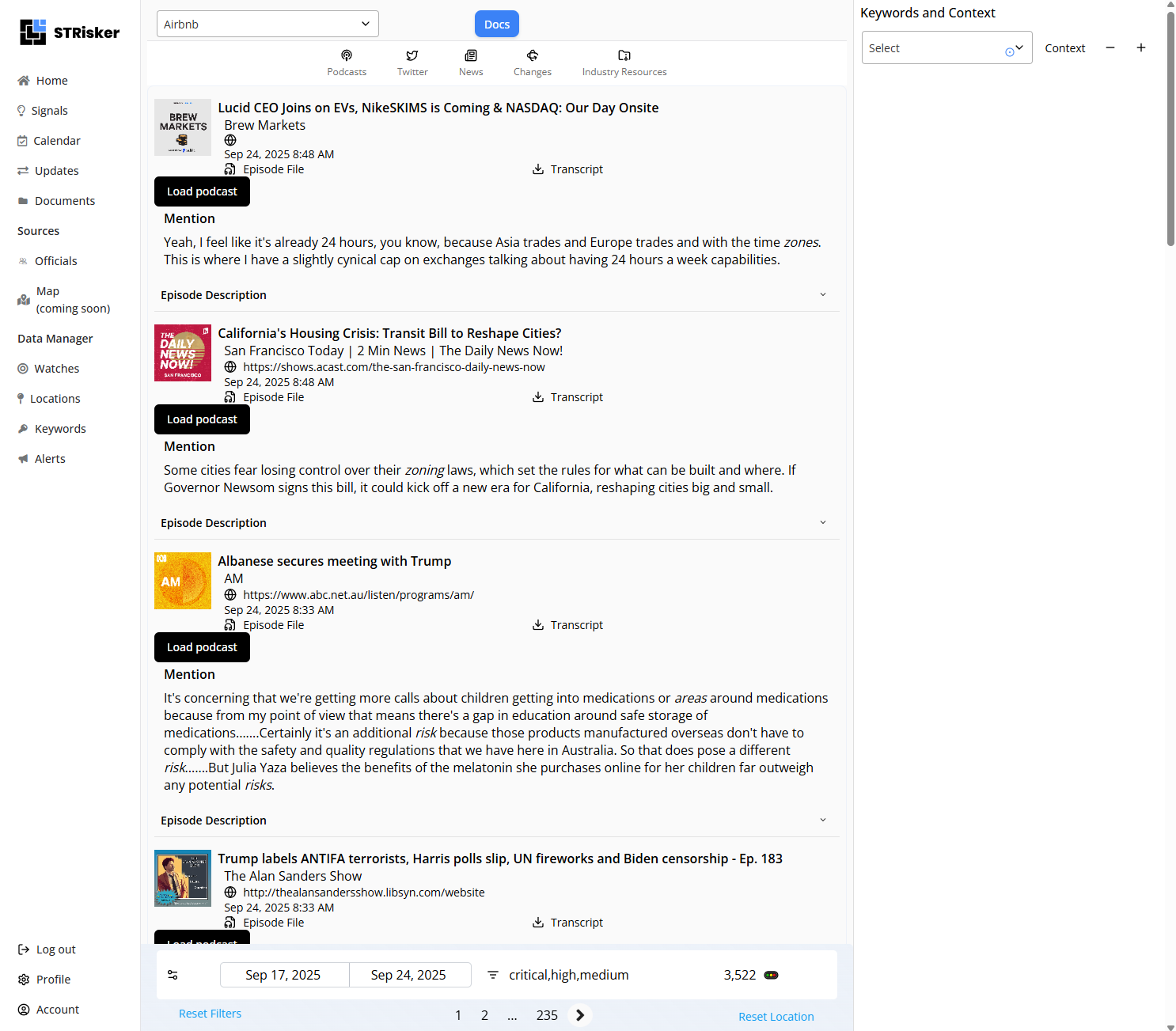
Social Listening 🎧: Podcast
Policy talk doesn’t just happen in the news cycle—it can also live in long-form audio. STRisker’s Podcast Signal turns hours of episodes into actionable insight, indexing transcripts so you can surface key mentions of STRs, ordinances, and local decision-makers in seconds.
Stay Updated with STRisker!
STRisker offers tools and features to keep you updated with the Short Term Rental movement (and now Data Centers!) movement across the world.
👍 We’d love your feedback.
We're always looking for ways to improve Bulletins.
Was this one useful to you? Other topics you'd like to see get covered?
✉️ Just reply directly to this email. We read and respond to every message!
-Will McClure
🙋 P.S.
Know someone else who should be reading this Bulletin? Feel free to forward this along. We want to make sure operators and stakeholders are aware of regulatory changes in their area.