
🎯 Strisker: Bulletin - Omaha, NE
The surviving measure would create the city's first STR contact registry; no fee, night cap or inspection attached yet



Omaha Short-Term Rental Registration Ordinance Heads to Council After Licensing Plan Collapses
The surviving measure would create the city's first STR contact registry; no fee, night cap or inspection attached yet
Photo by John Matychuk on Unsplash
Watch on Youtube: https://www.youtube.com/watch?v=Jw3PyaE02Ws
Omaha City Council member Ron Hug plans to introduce a short-term rental registration ordinance within roughly a month, a measure that would require STR operators citywide to file the name and contact details of a manager reachable during an emergency.
As of today, no such ordinance had appeared on a council agenda and Hug has described the measure as a narrowed substitute for an earlier licensing plan that drew enough opposition to stall before reaching a vote.
What would change and what would not
The proposal creates a registration duty rather than a licensing policy so operators would file contact details without any approval step, inspection, discretionary denial, night cap, or primary residence test.
Hug has pointed to a February overdose death at a room rental south of Westlawn-Hillcrest Memorial Park Cemetery where responding officers could not readily identify who managed the property. No fee, penalty schedule, effective date, or ordinance number has been published yet.
Omaha has no baseline count of its STR stock
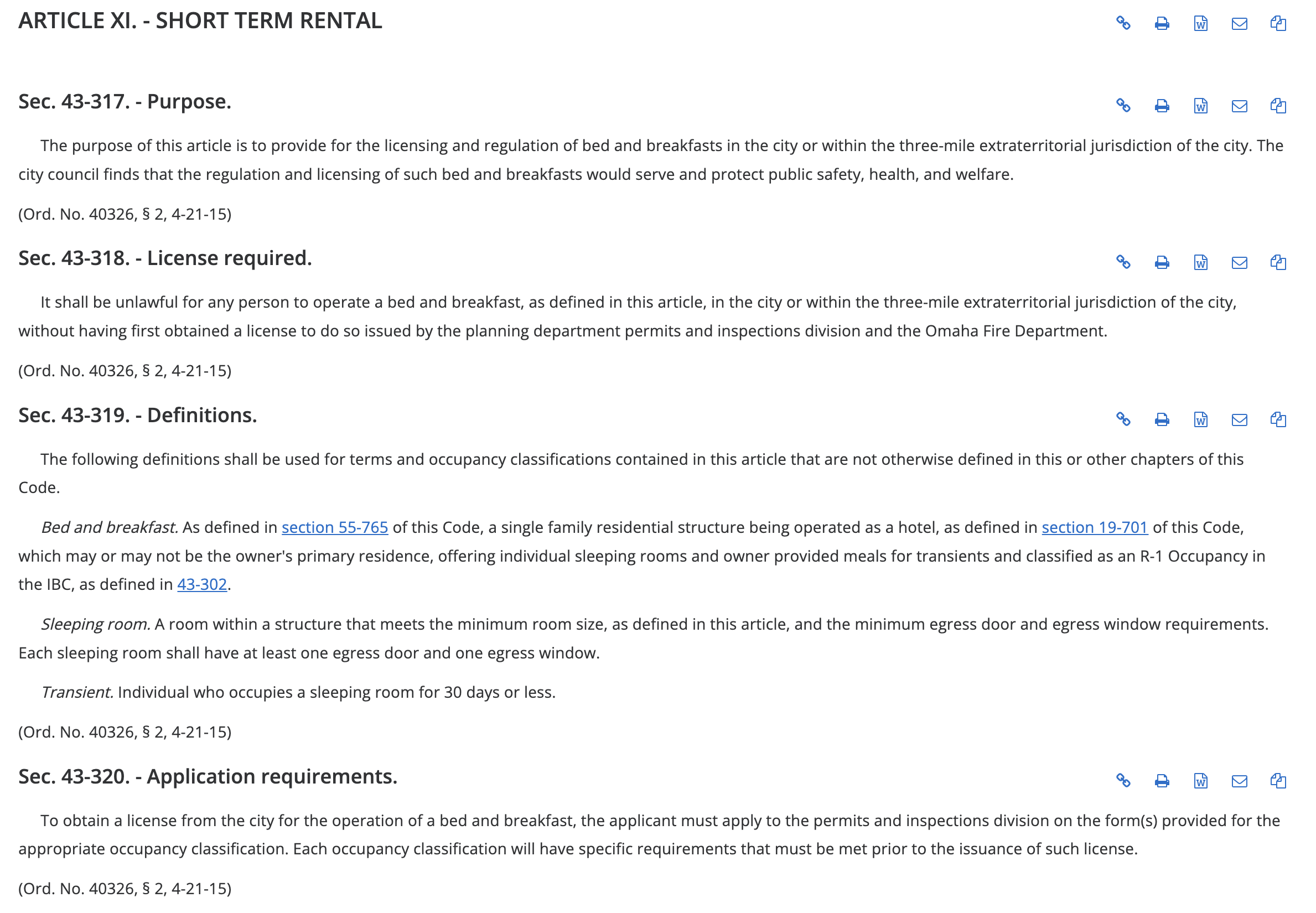
Because no registry exists, the city holds no official inventory of short-term rentals which is the gap the ordinance is designed to close. Chapter 43, Article XI of the Omaha Municipal Code licenses bed and breakfasts and carries an annual renewal fee of $150 plus $15 per sleeping room while the separate rental registration program under Ordinance 41767 was built around residential tenancies.
Commercial trackers diverge sharply on market scale which reported anywhere from roughly 590 to 2,290 Omaha listings depending on methodology.
Omaha's Rental Registration
Omaha already uses rental registration to identify properties and responsible owners. The city’s existing program provides useful context as Councilmember Ron Hug pursues a separate registration requirement for short-term rentals and their emergency contacts.
The state ceiling that shaped the retreat
Nebraska Revised Statute 18-1758 is enacted as LB57 on a 46-0 vote in March 2019 and since then bars municipalities from adopting ordinances that expressly or effectively prohibit short-term rental use, and permits STR-specific regulation only where the primary purpose is protecting public health and safety. The statute expressly lists emergency contact designation among permitted requirements which puts Hug's narrowed measure on firmer ground than the model he abandoned.
Lincoln licenses STRs under Chapter 5.39 of its municipal code at $250 per unit annually, requires a contact who can reach the property within 45 minutes, and allows revocation after three verified noise or disturbance complaints in a calendar year.
Check on Facebook: https://www.facebook.com/wowt6news/posts/pfbid02kBZLvn4c68usPZVx4C34bSiXCnfFpsqifw7m5YV5UaksbD6JxDRt3fWMKrDuKH39l
Platform and tax duties already bind operators
Under LB284 effective April 2019, multivendor marketplace platforms must hold Nebraska sales and lodging tax permits and remit on bookings they facilitate. State guidance nonetheless requires hosts to obtain their own lodging tax permit and file a return for each location even where a platform collects, an obligation that registration would not displace.
Applicable levies include Omaha's 5.5% hotel occupation tax, the 1.5% city sales tax, Nebraska's 5.5% sales tax, and the 1% state lodging tax plus Douglas County's 4% lodging tax. Airbnb states it collects each of these on Omaha listings.
⦾ Status: Proposed; not yet introduced, numbered, or agendized
⦾ Effective date: Unspecified; introduction signalled for late August 2026
⦾ Registration required: Yes, if enacted. Manager name and emergency contact
⦾ Licensing or permit: No, licensing with complaint-based revocation was dropped
⦾ Night cap / primary residence rule: None proposed
⦾ Registration fee: Not specified
⦾ Penalty for non-compliance: Not specified
⦾ Platform listing duty: None proposed
⦾ Platform tax duty (already in force): Yes, MMPs must hold Nebraska sales and lodging tax permits and remit on facilitated bookings
⦾ Host tax duty (already in force): Hosts must separately hold sales and lodging tax permits and file per location even where a platform collects
⦾ Combined levies: 5.5% Omaha hotel occupation tax; 1.5% Omaha sales; 5.5% Nebraska sales; 1% state lodging; 4% Douglas County lodging
⦾ State law ceiling: Neb. Rev. Stat. 18-1758 bars STR bans; expressly permits emergency contact requirements
In case you missed it:
 Jasmine Ruth Albatana
 Jasmine Ruth Albatana
 Jasmine Ruth Albatana
Strisker Document Analysis
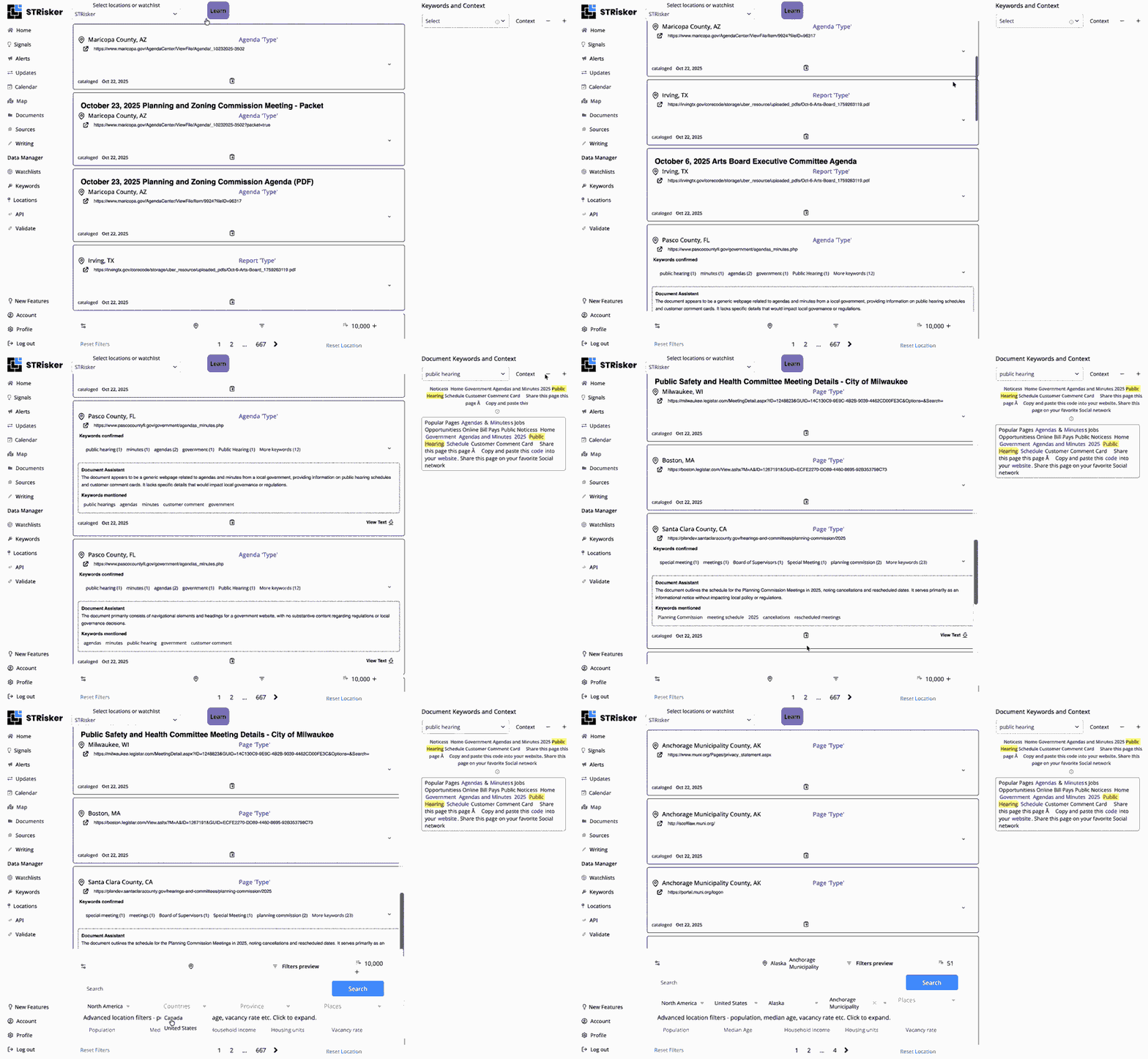
Finding the right compliance documents shouldn’t feel like searching for a needle in a haystack - Strisker’s Documents Analysis is built to simplify your life, offering instant access to hundreds of thousands of documents from thousands of cities across the world.
Stay Updated with STRisker!
STRisker offers tools and features to keep you updated with the Short Term Rental movement (and now Data Centers!) movement across the world.
👍 We’d love your feedback.
We're always looking for ways to improve Bulletins.
Was this one useful to you? Other topics you'd like to see get covered?
✉️ Just reply directly to this email. We read and respond to every message!
-Will McClure
🙋 P.S.
Know someone else who should be reading this Bulletin? Feel free to forward this along. We want to make sure operators and stakeholders are aware of regulatory changes in their area.