
Bulletin: Cape Town, South Africa News Today
The City says its registration and data-sharing policy enforces existing rates policy rather than introducing a levy on hosts



Cape Town Publishes Draft Short-Term Letting By-law Requiring Registration for Every Listed Rental
The City says its registration and data-sharing policy enforces existing rates policy rather than introducing a levy on hosts
Photo by Tobias Reich on Unsplash
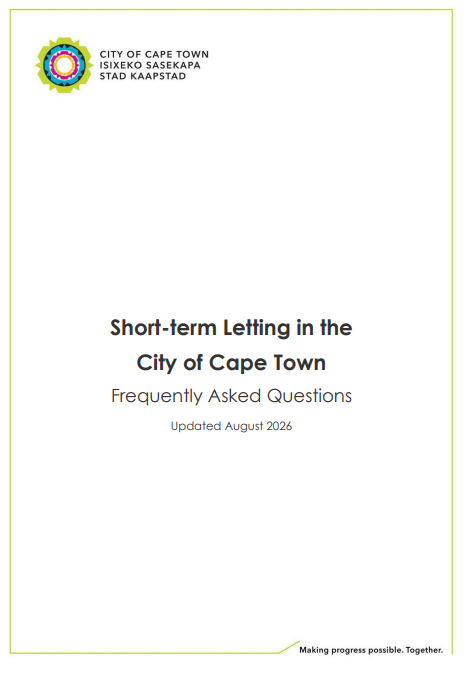
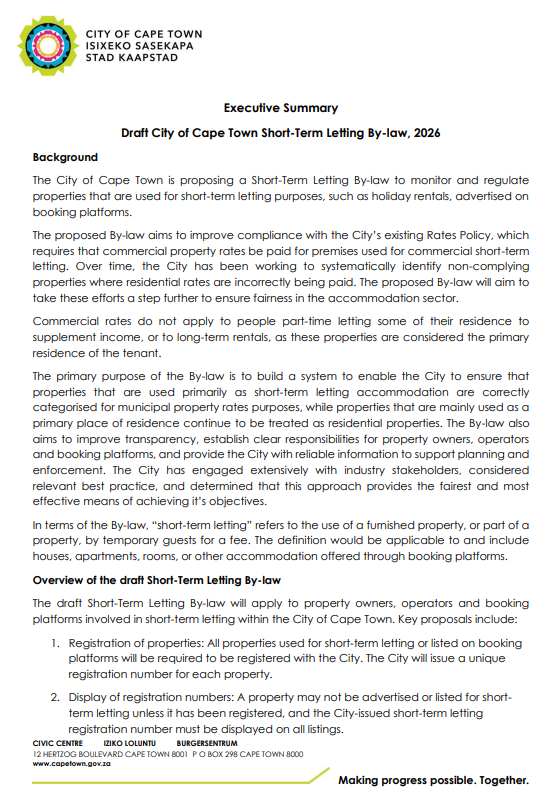
The City of Cape Town has published a draft Short-Term Letting By-law for public comment and proposed mandatory registration for every property advertised on booking platforms and a data-sharing regime designed to identify commercial-scale operators paying cheaper residential property rates.
The comment window opened on 5 August 2026 and closes on 5 October 2026 with the rates changes taking effect already last 1 July 2027.
Public comment on City’s draft Short-Term Letting By-law
What the Draft By-law Requires
Under the proposed by-law, every property listed for short-term letting must obtain a City-issued registration number and display it on all listings. Platforms such as Airbnb and Booking.com would be required to remove listings that lack a valid registration number, and both platforms and operators must share listing availability data with the City. That data feeds directly into rates enforcement which is the by-law's core purpose.
“A property will be categorized as Business and Commercial if the short-term letting availability ratio for that property exceeds 50%.”
- Rates Policy, 2026-2027
The City stresses that the measure introduces no new tax while its existing Rates Policy already requires commercial accommodation including hotels, guesthouses and B&Bs to pay commercial property rates. The by-law gives the City the data to apply that policy to short-term rentals operating at commercial scale while billed as residential. "The proposed By-law ensures fairness in the commercial accommodation sector," said Mayoral Committee Member for Finance Siseko Mbandezi.
The 50% Room-Night Test
A property crosses into commercial territory when it is available for short-term letting for more than 50% of its total annual room nights and calculated as the number of bedrooms multiplied by 365. A three-bedroom home, for example, has 1,095 room nights so availability beyond roughly 547 nights across its rooms in a rolling 365-day period triggers commercial classification.
Properties that are not a primary residence and are used mainly for short-term letting also qualify as commercial regardless of the threshold. Reclassifications will be processed through supplementary valuations which the City runs roughly every two months.
The City of Cape Town has published a new draft Short-Term Letting By-Law for public comment.https://t.co/sXxPiYowLV
— BusinessTech (@BusinessTechSA) August 6, 2026
Exemptions and What Stays the Same
Not every host is affected as owners who let out their primary residence occasionally and stay under the 50% threshold keep their residential rates, and the same goes for long-term rentals where the tenant lives in the property as their home.
Hosts also face no new planning hurdles since the City confirms that the Municipal Planning By-law already permits short-term letting and that no zoning change or land use approval is required. The draft nonetheless forms part of a broader national shift toward formalizing the sector following the Department of Tourism's Code of Good Practice for short-term rentals published in March 2026 which moves platform rentals closer to the rules that govern mainstream tourism accommodation.
⦾ Public comment: open August 5th to October 5th 2026
⦾ Registration required: Yes, city-issued number displayed on all listings
⦾ Night cap: N/A (50% of annual room nights triggers commercial rates, not a ban)
⦾ Penalty for non-compliance: Platform delisting for unregistered properties; reclassification to commercial rates for qualifying properties; fine amounts not yet specified
⦾ Platform responsibility: Yes, platforms must remove unregistered listings and share availability data
In case you missed it:
 Jasmine Ruth Albatana
 Jasmine Ruth Albatana
 Jasmine Ruth Albatana
Strisker News Tracker
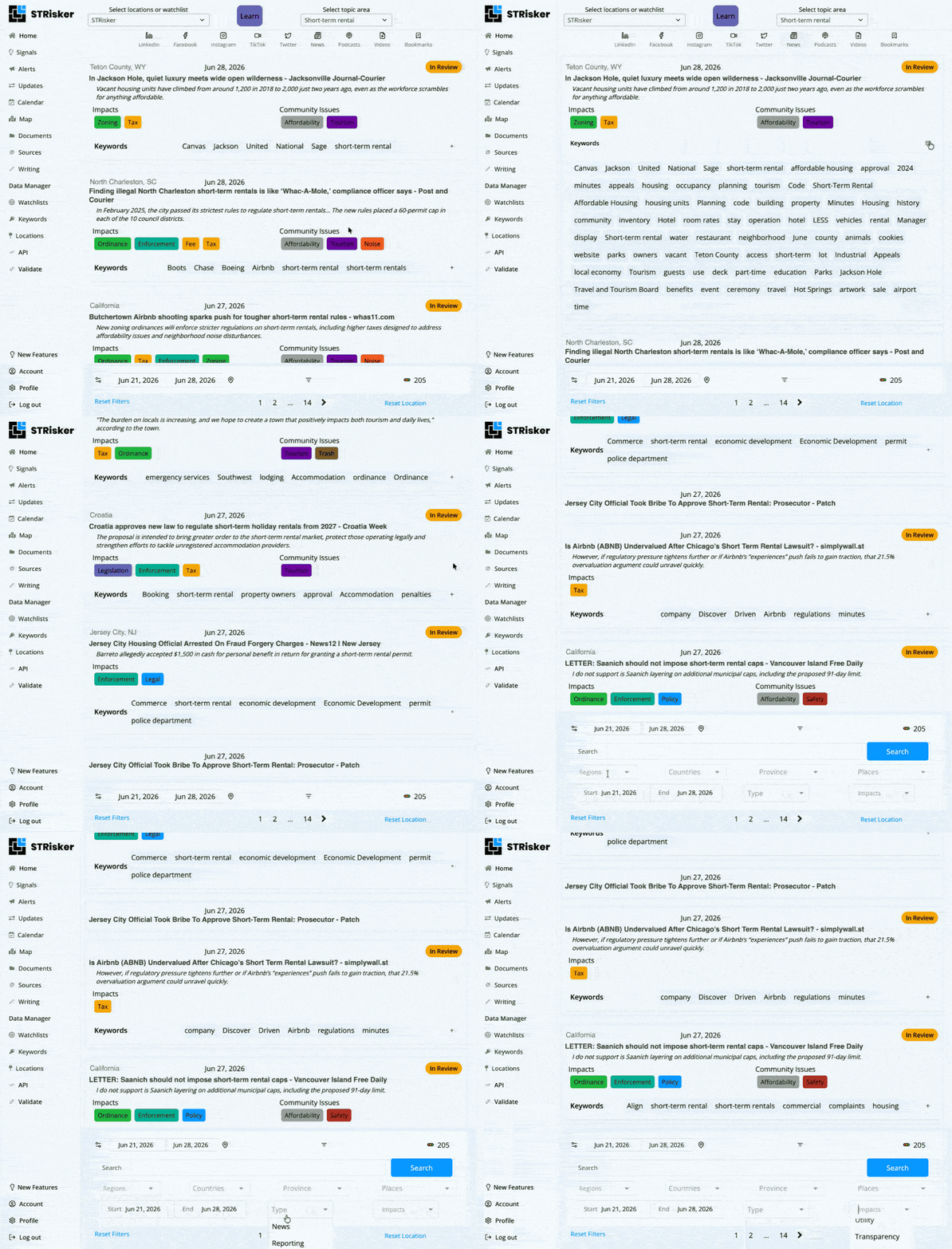
Trying to keep up with STR and data center regulations across multiple cities and states? Our News Tracker makes it easier than ever. Filter by location, search a comprehensive database, and sort by impact level—this tool helps you focus on what matters most.
Stay Updated with Strisker!
Strisker offers tools and features to keep you updated with the Short Term Rental movement (and now Data Centers!) movement across the world.
👍 We’d love your feedback.
We're always looking for ways to improve Bulletins.
Was this one useful to you? Other topics you'd like to see get covered?
✉️ Just reply directly to this email. We read and respond to every message!
-Will McClure
🙋 P.S.
Know someone else who should be reading this Bulletin? Feel free to forward this along. We want to make sure operators and stakeholders are aware of regulatory changes in their area.