
Data Center Development Agreement: Importance, Coverage, and Approval Process
Learn more about what a data center development agreement is, its importance, coverage, and approval process.

At A Glance 🔽
- A data center development agreement is a legally binding contract between a local government and the developer or owner of the land where the project will be constructed.
- Some of the importance of a data center development agreement includes regulatory assurance for developers, negotiating leverage for local governments, and public accountability
- The coverage of a data center development agreement includes land use and rezoning conditions, infrastructure and utility obligations, operational standards, and tax incentives and decommissioning.
- The approval process for a development agreement involves negotiation and drafting, public notice and hearing, adoption by the governing body, and recording and compliance review.
Definition
A data center development agreement is a legally binding contract between a local government and the developer or owner of the land where the project will be constructed. This agreement outlines what may be constructed on the site, each party's infrastructure responsibilities, the construction schedule, and the regulations that will apply throughout the term of the agreement. Development agreements generally require state enabling legislation, so their scope, duration, and required approvals may vary from state to state.
Difference from a Data Center Community Benefit Agreement
A data center development agreement and a data center community benefit agreement (CBA) both secure commitments from a data center developer, but they differ in terms of the parties involved, the legal basis, and their specific focus.
A data center development agreement is established between the local government and the developer. It is authorized by state law and can be adopted into an ordinance following a public hearing. This type of agreement generally emphasizes land use, infrastructure, and vested rights.
On the other hand, a data center community benefit agreement is a contract between the developer and local community groups or government entities. This agreement is based on general contract law and does not grant vested rights. Typically, it focuses on benefits such as local hiring, community funding, and environmental commitments. The Federation of American Scientists describes CBAs as binding agreements that allow communities to obtain commitments from data center developers before development begins.
✅Importance
A data center development agreement helps balance the developer’s need for long-term certainty with the local government’s need to protect its community. Without this agreement, both sides will rely solely on general zoning rules that may not apply to hyperscale campuses. Here are some of the reasons why having a development agreement is important:
Regulatory Assurance for Developers
Data center campuses are typically constructed in phases over a decade or more, with new buildings added as tenant demand and power supply allow. Having a development agreement provides developers with vested rights that protect the project from zoning or land-use changes adopted during the term of the agreement. As a result, lenders and tenants can be assured that committing capital will not be affected by a new set of rules in later phases.
Negotiating Leverage for Local Governments
Ordinary zoning approvals impose limits on what a city or county can require of a developer. Since a development agreement is voluntary for both parties, local governments in some states can negotiate commitments beyond what ordinary zoning could require. In other states, such as Washington, limit those terms to what other laws already permit. As explained by the Municipal Research and Services Center, developers benefit from the assurance that regulations will not change during the term of the agreement, while the jurisdiction can mandate impact mitigation measures.
Public Accountability
Proposals for data centers often raise concerns among residents regarding noise, water usage, power consumption, and land use. Since development agreements are approved at a public hearing, residents have a formal opportunity to review the project's terms and express their concerns before those terms are finalized for years to come.
📋Coverage
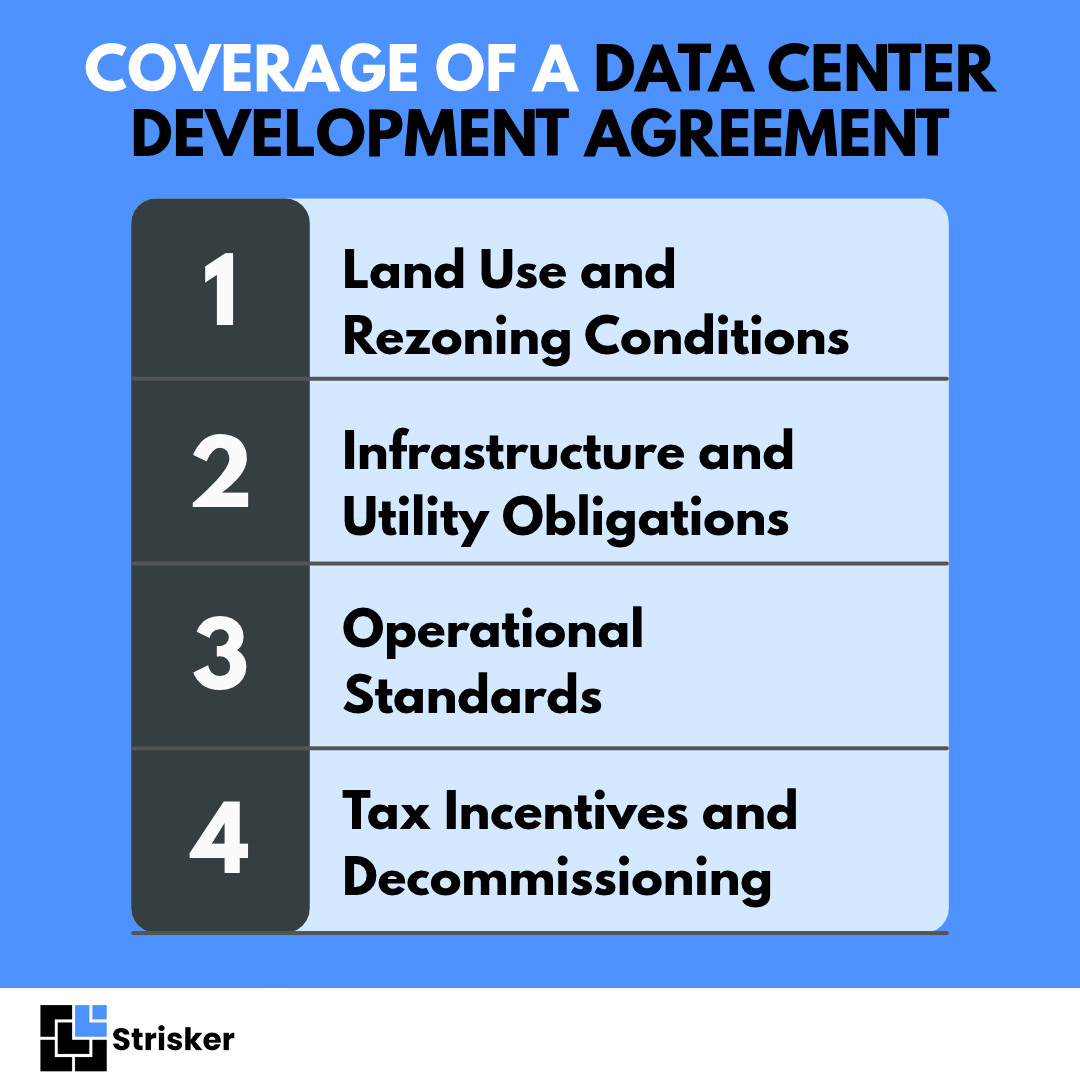
A data center development agreement typically follows a standard structure, but data center projects often include provisions on utilities, noise, and end-of-life obligations that are uncommon in residential or retail agreements. Here are some of the topics that can be discussed in a data center development agreement:
Land Use and Rezoning Conditions
The agreement focuses on what can be built, including permitted uses, total building square footage, maximum height, site layout, and phasing. Most agreements involve obtaining approvals and rezoning the property from agricultural or general industrial to a district that permits data centers. In some states, a development agreement cannot authorize a use that is not permitted by the underlying zoning. This is why it is common for both approvals to be processed simultaneously.
Infrastructure and Utility Obligations
Data centers place significant demands on roads during their construction and on electric, water, and wastewater systems during operation. The agreements typically outline responsibilities for substations, transmission easements, water lines, and road improvements. Additionally, some agreements require payment of impact fees prior to the start of construction.
Operational Standards
Some agreements include specific standards for data centers, such as noise limits at the property line, restrictions on backup generator testing hours, requirements for screening and building design, and water-use management for cooling. These terms are crucial because they impact operations for decades, not just during the construction phase.
Tax Incentives and Decommissioning
When a project receives local tax incentives, such as property tax abatements or a payment-in-lieu-of-taxes (PILOT) arrangement, the agreement typically outlines the terms of these incentives, as well as the investment and job-creation targets the developer must meet. Additionally, many agreements include decommissioning provisions, which require the owner to remove equipment, fuel tanks, and structures if the site is abandoned.
🏛️Approval Process
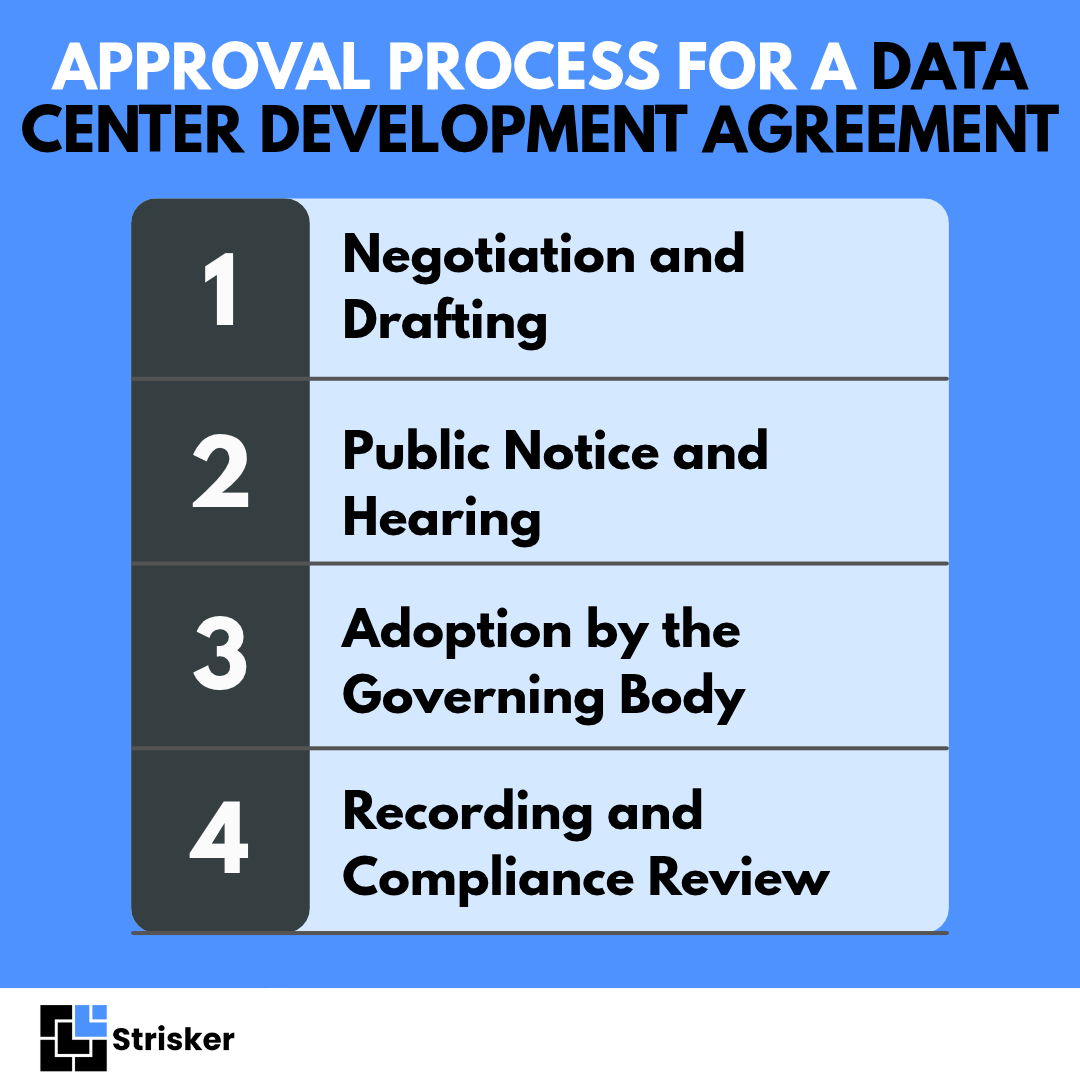
Since a data center development agreement limits a local government's future regulatory authority, states require that it undergo a public legislative process rather than just a staff-level review. Here’s the approval process:
Step 1: Negotiation and Drafting
The process starts with negotiations between the developer and the local staff, which is typically the planning department and the local government’s attorney. The draft usually includes a legal description of the property, the proposed development, infrastructure responsibilities, the term of the agreement, and the construction schedule. This step often coincides with grid capacity studies and rezoning applications.
Step 2: Public Notice and Hearing
Most state laws require a public hearing before the governing body can approve a development agreement. According to the UNC School of Government, North Carolina follows the same notice and hearing procedures as those used for zoning text amendments, or rezonings. Additionally, the draft agreement should be publicly accessible upon publication of the notice. In some cases, local governments may refer the agreement to the planning commission for a recommendation, even if state law does not require this step.
Step 3: Adoption by the Governing Body
This step involves the city council or county board adopting the agreement, typically through an ordinance. This decision is legislative, giving the board the discretion to approve, deny, or return the agreement for further negotiation.
Step 4: Recording and Compliance Review
Once the agreement is adopted, it is recorded with the county register of deeds to attach the project to the property. Some states also require periodic compliance reviews, during which the local government assesses whether the developer is meeting their obligations. If there is a breach, the government sends a notice and provides the developer an opportunity to address any significant violations before terminating or modifying the agreement.
Conclusion
A data center development agreement can provide developers with the long-term assurance needed to expand a campus in phases when it is negotiated and enforced correctly. These agreements also offer local governments commitments related to infrastructure, operational standards, and decommissioning
It is also important to understand what a data center development agreement covers and how it moves through the approval process. This knowledge can help residents and officials review the terms before the project is locked in for years. Strisker offers tools, features, and newsletters to keep you informed and updated about the development agreements proposed and approved for data centers in your area.
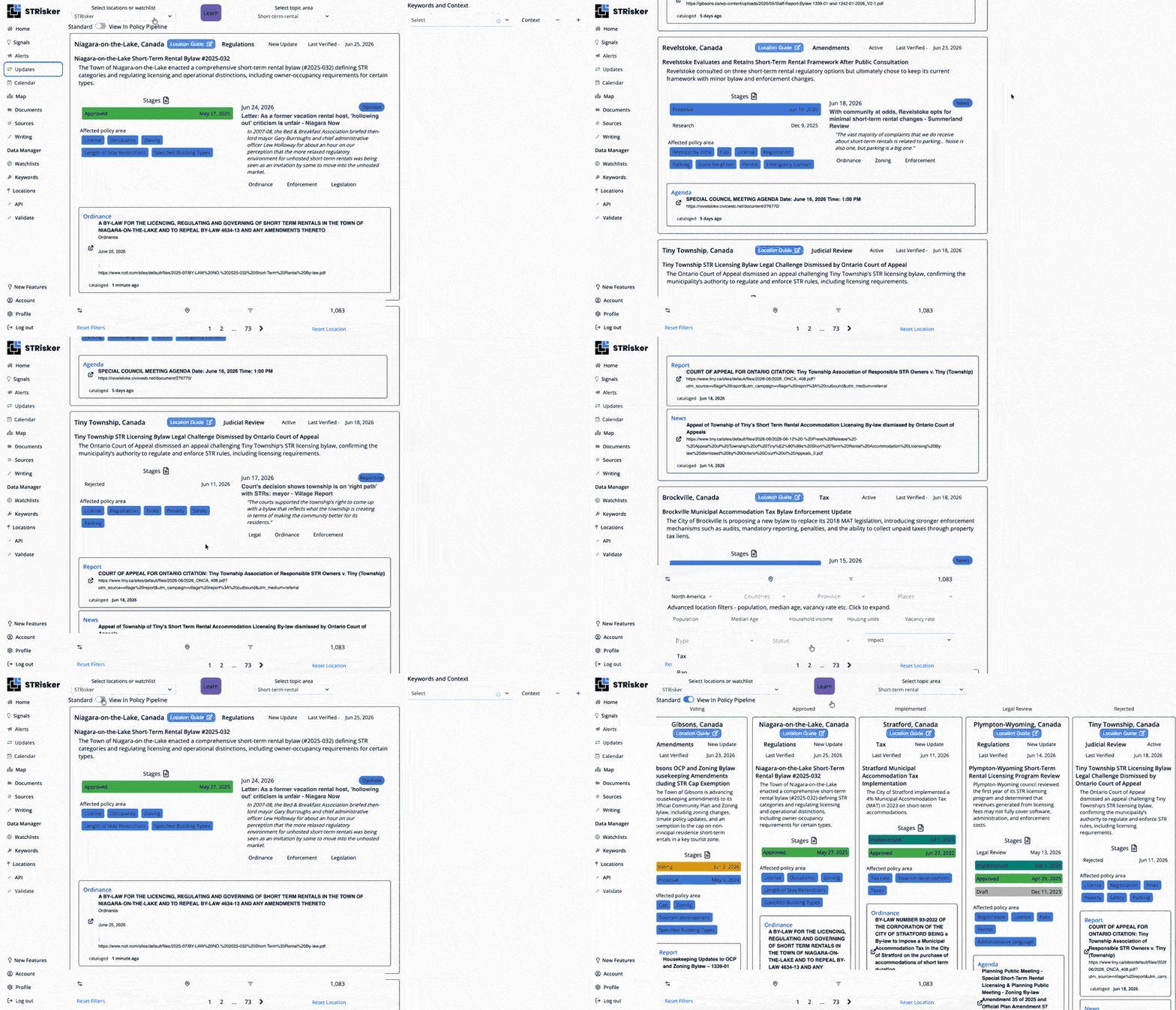
Strisker Updates Tracker
How do you keep up with the regulatory rollercoaster in your market? Strisker's Updates Tracker can be your guide - start tracking latest events as they happen and get access to essential documents as they come in. We know the struggle, which is why we built this product to capture every twist and turn in the regulatory saga so you never miss a beat.
FAQs
Can a data center development agreement be changed after it is approved?
Yes, a data center development agreement can usually be changed after its approval. However, the specific rules still depend on the governing law, terms of the contract, and the reason for its change. If there is mutual consent between the local government and the developer, the agreement can still be amended or canceled. Major changes, as usual, will still go through the same process of notice and public hearing as the original agreement. Additionally, it can be terminated if the developer commits a material breach and fails to cure it after receiving notice and an opportunity to do so.
How are data center tax incentives written into a development agreement?
Local tax incentives are typically documented in a separate incentive or PILOT agreement that is referenced in the development agreement. These terms generally include the following:
- Type of incentive, such as property tax abatement or PILOT payment schedule
- Minimum capital investment the developer must make
- Job creation or wage targets
- Construction deadlines for each phase
- Clawback provisions if the developer fails its targets
- Infrastructure, environmental, and community responsibilities
- Approval and assignment rules
What happens to the agreement if the data center property is sold?
If the data center property is sold, the development agreement usually moves to the new owner since it is recorded against the land and binds successors. Meaning to say:
- The new owner inherits the vested rights granted under the agreement
- The new owner is tied to the same infrastructure, operational, and decommissioning obligations
- Buyers should review the recorded agreement during due diligence
- Some agreements need local government’s consent or notice before they can be assigned
Stay Updated with Strisker!
Strisker offers tools and features to keep you updated with the Short Term Rental movement (and now Data Centers!) movement across the world.
👍 We’d love your feedback.
We're always looking for ways to improve our content.
Was this one useful to you? Other topics you'd like to see get covered?
✉️ Just reply directly to this email. We read and respond to every message!
-Will McClure
🙋 P.S.
Know someone else who might be interested in this content? Feel free to forward this along.