
Data Centers: Weekly Briefing // November 9 - November 12, 2026
Upper Sandusky voters capped data centers at 25 MW, Boise, Reno, Potsdam and Abbeville County locked in moratoriums, and Pennsylvania’s HB 2888 would make hyperscale projects commit $250 million locally. Plus: Beaufort County eyes a two-year pause and St. Clair Township moves to ban. READ MORE.


At A Glance 🔽
- Upper Sandusky, Ohio voters approved a charter amendment barring data centers over 25 MW, 1,893 to 568, after months of opposition to a $900 million proposal.
- Boise, Idaho adopted an emergency six-month moratorium on large data centers, effective immediately.
- Reno, Nevada, Potsdam, New York and Abbeville County, South Carolina also locked in data center moratoriums.
- Pennsylvania lawmakers introduced HB 2888, which would require hyperscale data centers to secure added power and commit at least $250 million in local investment.
- Beaufort County, South Carolina voted 7-3 to advance a two-year moratorium, doubling the original 12-month proposal.
- St. Clair Township, Ohio moved closer to a data center ban that could stop a proposed $5 billion AWS campus.
- Fort Worth, Texas held its first hearing on a 90-day moratorium as a city commission delivered 19 recommendations.
- San Jose, California could approve Google's 250 MW project before the city's new data center standards take effect.
📋 This Week's Decisions
Ballot Results
- Upper Sandusky, Ohio: Voters approved a charter amendment on Nov. 3, 1,893 to 568, barring data centers with electrical demand above 25 MW inside city limits. It follows months of opposition to Smartland Energy's $900 million development on about 146 acres, which included a 150 MW natural gas power plant; Smartland later withdrew its zoning request. The amendment doesn't apply to the rest of Wyandot County.
Moratoriums Approved
- Boise, Idaho: The City Council unanimously adopted an emergency six-month moratorium on data centers of 100,000 square feet or more or using 20 MW or more, effective immediately. Mayor Lauren McLean, who proposed it, said no large applications are pending.
- Potsdam, New York: The Town Board approved a 12-month moratorium on Nov. 5 on data centers of at least 20 MW or 50,000 square feet and crypto mining of 5 MW or more, adopted as Local Law 2026-6. Ordinary server rooms for schools, hospitals, banks and businesses are exempt.
- Reno, Nevada: The City Council formally adopted a temporary moratorium on new data center approvals and started drafting regulations. Newly elected Mayor Kate Marshall said data centers don't belong in Reno neighborhoods, including the Keystone Avenue area, where Centra is building one.
- Abbeville County, South Carolina: Council approved third reading of a data center ordinance without discussion, so no data centers will be approved for the next 12 months. Chairman Bryan McClain said the goal is steering future data centers to industrial parks rather than neighborhoods.
Regulations Passed
- Lumberton, North Carolina: The City Council approved data center regulations on Nov. 9 despite residents asking for a delay, limiting data centers to the Southeast Crossroads Industrial Park near I-74 and I-95. The remaining 100 acres there could fit one facility starting around 20 MW. Developers must disclose water and power use and use water-efficient cooling, but there are no numerical caps; noise is generally limited to 65 decibels at residential property lines.
- Rogersville, Tennessee: The Board of Mayor and Aldermen passed an ordinance on second reading, 4-2, placing extensive restrictions on high-density data centers and crypto mining. It stops short of a ban, but its requirements would make siting a data center in town very difficult. Alderman Todd Biggs and Vice Mayor Brady Forgety voted no.
Projects Denied/Withdrawn
- Gibson County, Tennessee: Property owners withdrew a request on Oct. 26 to rezone about six acres near Hughes Loop Road in Milan for a data center, so commissioners didn't vote. A large crowd still turned out, citing two nearby schools and environmental impacts. It's unclear whether a data center is still being considered.
💬 Catch Up on Discussions

State Debates
- Pennsylvania: State lawmakers introduced House Bill 2888 on Nov. 4, setting energy, water, employment and reporting requirements for hyperscale data centers. Operators would have to secure enough added electricity for full demand, disclose annual power and water use, and submit community-benefit plans with at least $250 million in investment, 200 prevailing-wage construction jobs and 50 permanent jobs. The bill sits in the House Energy Committee, and the session ends Nov. 30. 🔗 HB 2888
- New York: State Sen. Kristen Gonzalez is pressing Gov. Kathy Hochul to sign the Responsible Data Center Development Act, which passed the legislature in June and would cover data centers of 20 MW or more, compared with the 50 MW threshold in Hochul's one-year moratorium. Gonzalez cited a poll she said found 63% of New Yorkers would support extending the moratorium. 🔗 S10642
Moratoriums on the Table
- Beaufort County, South Carolina: The County Council voted 7-3 on Nov. 9 to advance a two-year moratorium on data center applications, permits and approvals. Council member Logan Cunningham moved to extend it from 12 to 24 months. It needs two more votes, and five new members join the 11-member council in January.
- Fort Worth, Texas: The city held the first of two required hearings on a proposed 90-day moratorium. The same day, a city commission led by TCU's Michael Slattery presented its final report with 19 recommendations, including closed-loop cooling, residential zoning protections and a pilot study on low-frequency noise.
- Greeneville, Tennessee: The Municipal Planning Commission voted to recommend a six-month moratorium on new data centers, exempting existing operations, accessory equipment and broadband facilities. The town's zoning doesn't define data centers.
- Rapid City, South Dakota: After more than 900 public comments, Mayor Jason Salamun proposed either a six-month permit pause or a stronger interim ordinance. The Planning Commission delayed permanent regulations.
- San Joaquin County, California: Supervisors postponed a vote on extending the county's 45-day moratorium by 10 months because only three supervisors were present and the extension needs four votes. They voted 3-0 to accept a staff report on work underway.
- Minneapolis, Minnesota: Council members discussed rules that would allow data centers only downtown or in the North Loop, inside existing buildings, capped at 150,000 square feet and with computers at least 20 feet from exterior walls. A vote was scheduled for Nov. 12, with the six-month moratorium expiring Nov. 21.
- Jefferson County, Florida: The county held a public workshop on data center impacts as commissioners weigh extending the one-year moratorium, which expires in June 2027. No vote was taken.
- Topeka, Kansas: Protect Kansas is collecting signatures for a petition to ban data centers over 25 MW, bar city water service to data centers outside city limits, and prohibit annexation for them. It needs 6,000 verified signatures, even though the city and Shawnee County both have moratoriums.
Zoning and Rules in the Works
- St. Clair Township, Ohio: The Butler County Planning Commission unanimously recommended a zoning change banning data centers, which could stop AWS's proposed 18-building, $5 billion campus on 600 acres across Madison and St. Clair townships. The proposal returns to the township zoning commission before trustees take a final vote.
- Hazle Township, Pennsylvania: Residents packed the Hazleton Area High School auditorium to push back on a 40-page zoning ordinance that would create an Energy and Technology Overlay District where data centers wouldn't need a special exception. The amendment would cut the residential setback to 500 feet, and at least one resident urged keeping 1,250 feet. 🔗 Updated ordinance
- Grand County, Utah: Commissioners voted unanimously on Nov. 4 to spend up to $5,000 on Sunrise Engineering to draft two paths: a countywide ban or allowing smaller facilities under conditions. Applications are paused until Jan. 3, 2027.
- DeKalb County, Georgia: Commissioners voted 5-2 to withdraw Commissioner Ted Terry's proposal to require an independent health and environmental study before lifting the moratorium. Commissioner LaDena Bolton's measure to redefine data centers by operation type, energy and water use, backup power and noise was deferred.
- Paulding County, Georgia: Commissioners voted down a proposal to cut public comment time after residents fighting data centers packed the chamber. The commission earlier approved four data center overlay districts without a public hearing, then reversed course with a six-month moratorium that runs through January.
- Cincinnati, Ohio: Water and sewer officials floated a reuse system that would send partially treated water to data centers instead of drinking water, though it would need new infrastructure. Councilman Mark Jeffreys said the city should calculate what current data centers cost so new projects can offset it.
- Chillicothe, Ohio: The city will hold a public open house on land use standards for data centers, battery storage and crypto mining, since its Unified Development Code doesn't define data centers.
- Russell County, Kentucky: Magistrates began discussing how to regulate data centers. The county attorney doubted a moratorium would hold up in court and pointed to zoning instead. The PVA said his office got a May email seeking parcel data for a data center site-screening project.
Projects Under Review
- San Jose, California: Google's project at 5079 and 5087 Disk Drive in Alviso could come up for approval at a planning director's hearing as early as December, possibly before new data center standards take effect. It would need 250 MW across nearly 483,000 square feet. Google calls it an R&D lab, and the city plans no full environmental review.
- Milwaukee, Wisconsin: The Forest County Potawatomi tribe plans to expand its data center at 33rd and State streets from 46,000 to 59,000 square feet. Alderman Robert Bauman said the city's moratorium doesn't apply because the site is under a detailed plan development, though it still needs Plan
📅 Upcoming Meetings

- Chillicothe, Ohio: Public open house on data center land use standards, Nov. 16.
- Greeneville, Tennessee: City Council takes up the six-month moratorium, Nov. 17.
- San Joaquin County, California: Supervisors return to the moratorium extension, Nov. 17.
- Rapid City, South Dakota: Planning Commission weighs a pause or interim ordinance, Nov. 25.
- Pennsylvania: Legislative session ends, Nov. 30 (HB 2888 must advance before then).
- San Jose, California: City Council expected to vote on data center standards, December.
- DeKalb County, Georgia: Data center redefinition measure returns, Dec. 15.
- Fort Worth, Texas: Second moratorium hearing tentatively Jan. 12; possible vote in February.
- Rapid City, South Dakota: Permanent regulations delayed until Jan. 21, 2027.
👀 In case you missed it...
 Em Dela Cruz

 Em Dela Cruz
☀️ Most Clicked Link
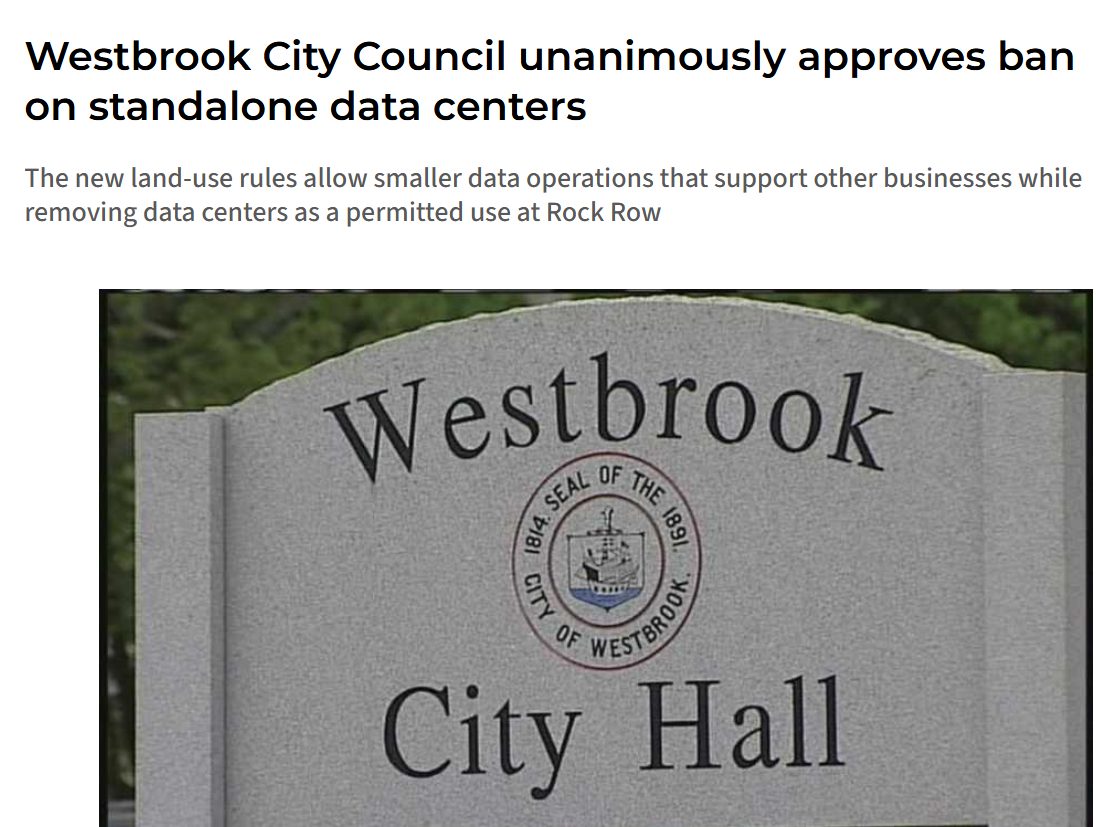
Westbrook City Council unanimously approves ban on standalone data centers
📱 Social Buzz
Episode Title: What separates great leaders from good managers in the age of AI | Srikanth Velamakanni
Episode: Unmute with Ganesh Natarajan
Kyle councilwoman pushing for citywide data center ban ahead of public meeting https://t.co/a5zXFG5sfN
— KVUE News (@KVUE) November 13, 2026
In this evening’s episode of:
— No Safe Words (@Cyber_Trailer) November 13, 2026
“Who is cock blocking data centers”
We have an update on the Minnesota City Council vote-
The Minneapolis City Council passed its data center ordinance 7-6 today, and it now goes to Mayor Jacob Frey to sign or veto. New data centers are limited to… https://t.co/3EGXa3YBxm
Petersburg City Council introduces data center zoning rules as public concerns remain pic.twitter.com/ht55EB8LWc
— 12 On Your Side WWBT Richmond (@12OnYourSide) November 13, 2026
The Minneapolis City Council narrowly approved a data center ordinance on Thursday, by a vote of 7 to 6. READ MORE at the link in bio. pic.twitter.com/BB8p8XgWqZ
— KSTP (@KSTP) November 13, 2026
OpenAI and Georgia county leaders hit with Mafia-style RICO racketeering lawsuit over $30 billion AI data center — residents allege closed-door conspiracy and NDAs were used to push 3.2-gigawatt ‘Project Camellia’ through#OpenAI
— TechStacks (@webstacks) November 13, 2026
https://t.co/cxQjUKAnmc
Social Listening📱: Instagram
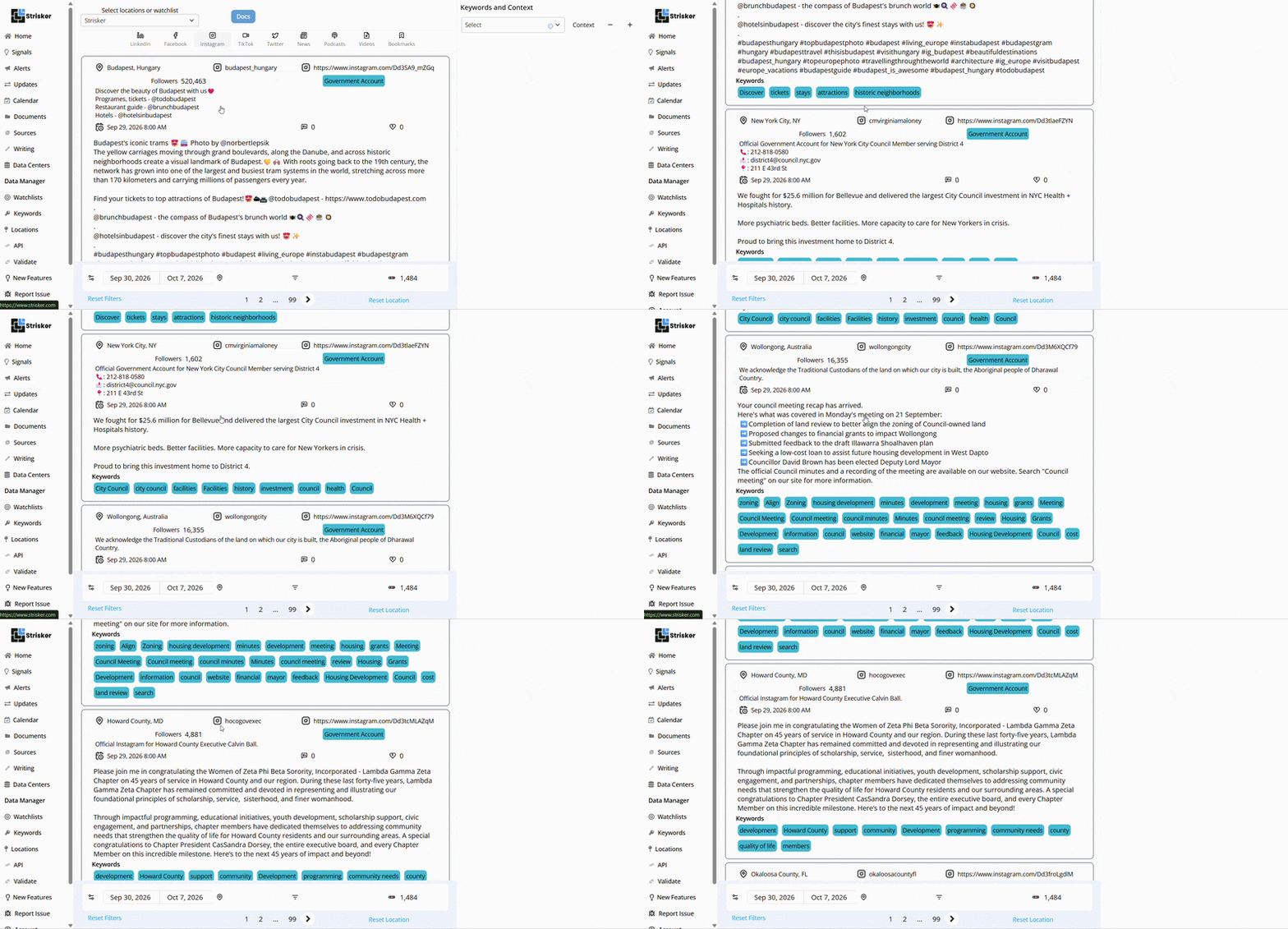
Strisker's Instagram Signal captures posts, captions, and updates from departments, advocacy groups, and local influencers, transforming visual chatter into policy insights. Monitor emerging issues related to Short-Term Rentals (STRs) and data center projects as they become more prominent.
Stay Updated with Strisker!
Strisker offers tools and features to keep you updated with the Short Term Rental movement (and now Data Centers!) movement across the world.
👍 We’d love your feedback.
Which stories hit? Which ones missed?
We're constantly refining Weekly Briefing to make it even more useful for you.
✉️ Just reply directly to this email. We read and respond to every message!
-Will McClure
🙋 P.S.
Know someone else who should be reading Weekly Briefing? Feel free to forward this along. It is the easiest way to stay ahead of regulation changes in short-term and vacation rentals.