
Data Center Ban Explained: Importance, Examples, and Consequences
Learn what a data center ban is, its importance, examples, and the consequences of having permanent bans for data center projects.

At A Glance 🔽
- A data center ban is a permanent prohibition applied to a local zoning code or ordinance that restricts the construction or expansion of data centers.
- A ban is different from a data center moratorium, which only temporarily pauses approvals for a given period of time, and with a defined deadline.
- A data center ban signals developers to redirect their projects to other locations, while also providing assurance and protection for communities.
- The National League of Cities has recognized a number of jurisdictions that have continued to impose permanent bans.
- A ban on data centers results in the permanent redirection of investment in these projects, the forfeiture of revenue and development rights, and increased pressure for amendments.
Definition
A data center ban is a local or state law that restricts approvals, permitting, and construction of new data centers within a jurisdiction. Bans are enacted through ordinance announcements, council votes, or, in some cases, executive orders. They can be applied citywide, countywide, or even statewide. Most bans aim to prohibit large-scale or hyperscale data centers, which consume substantial resources, rather than smaller server data centers used by small businesses.
It is also different from a data center moratorium, which is considered a temporary pause or ‘ban’ that usually lasts six months to three years, giving officials time to review and evaluate data centers before deciding what to do with these projects permanently. A data center moratorium has a confirmed expiration or review schedule, while a data center ban does not.
The common process for data center bans usually starts with a data center moratorium and may later be updated to a permanent ban after the evaluation period of local officials based on their review. Other localities skip the moratorium stage and implement a permanent ban directly.
✅Importance
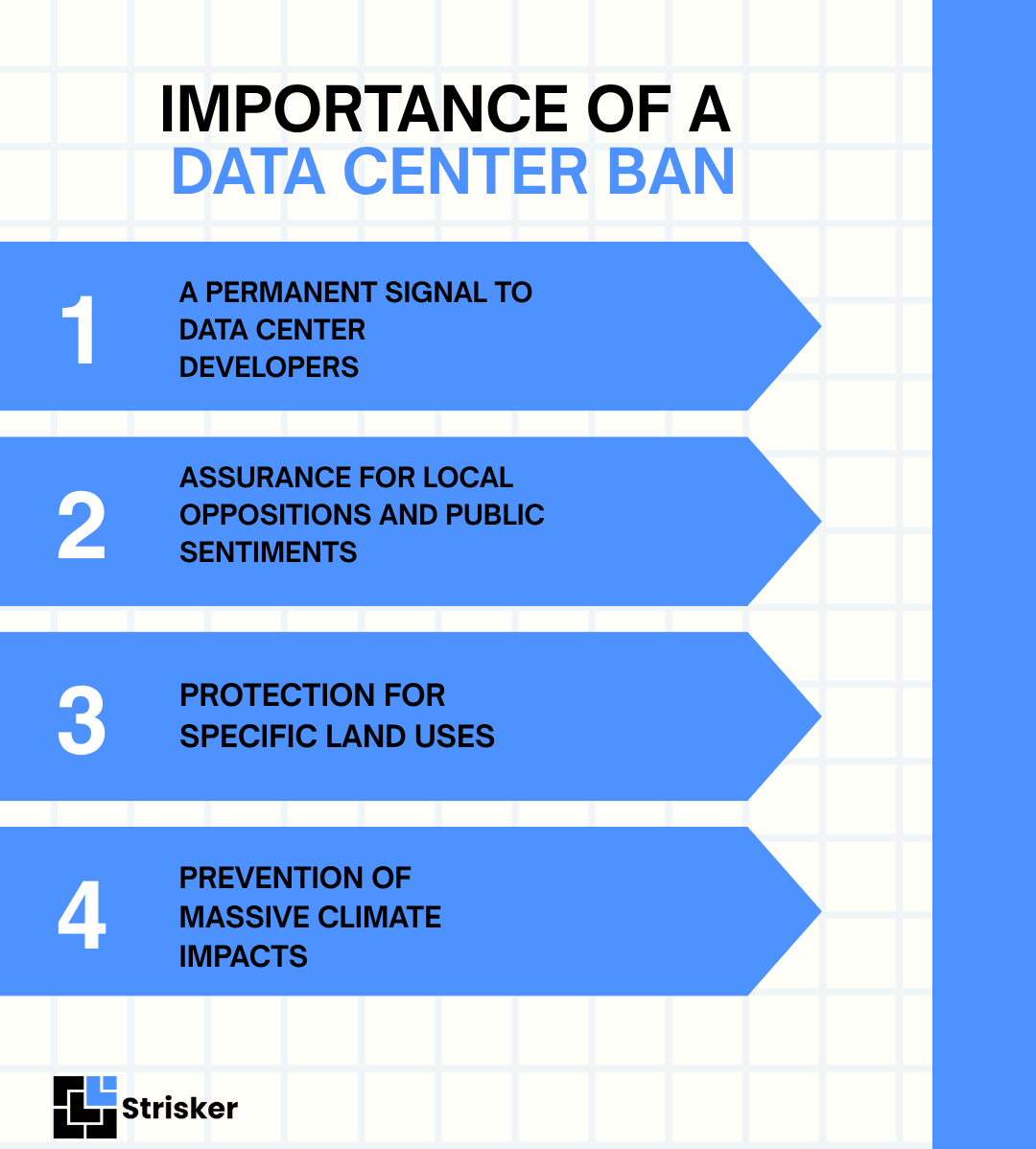
A data center ban is important because it serves as one of the endpoint responses to a nationwide debate against data center construction. Currently, more than 300 cities, towns, and counties are imposing their own restrictions on hyperscale data center projects. With the implementation of data center bans, developers and residents are able to recognize the following:
A Permanent Signal to Data Center Developers
With the data center ban, new data center development is halted indefinitely. This prompts the operators and developers to redirect their planned investments to other locations immediately, rather than waiting for the repeal of the data center ban.
Assurance for Local Oppositions and Public Sentiments
According to a Gallup poll reported by Stateline, seven in ten Americans would oppose the construction of AI data centers near them. This poll also indicates that Americans have higher opposition to data centers than to nuclear power plants, at 53% last March 2026.
In some cities, like Mansfield, Massachusetts, where they passed a ban on new data centers, albeit with no active data center projects at the time. This decision reflects their actions as a preemptive measure instead of a reactive one, signaling their clear local policy stance on data centers.
Protection for Specific Land Uses
Some bans aim to protect specific zoning districts or land-use goals rather than restricting data centers' jurisdiction-wide. An example of this ban is Atlanta's ban within its Beltline Overlay District, which focuses on conserving a specific corridor for the mixed-use and public-space goals the district aims to support. City officials also argued that data centers do not align with the city's pedestrian-oriented vision. This is because data centers occupy large footprints and generate little foot traffic, unlike housing, retail, or offices.
Prevention of Massive Climate Impacts
Large data center campuses demand enormous and continuous electricity. In addition, these facilities require substantial water sources for cooling. If these two resources are consumed solely for data center operations, they may negatively impact nearby communities. With a data center ban in place, construction is halted indefinitely, ensuring the protection of utility and water resources that should instead be distributed to the communities.
🏛️Examples of a Data Center Ban
Permanent bans are still rare compared with the increasing number of data center moratoriums. Despite this, the locations that have passed bans exhibit common patterns that prohibit new developments across entire jurisdictions; some bans depend on an established size threshold or a single zoning district. The examples below show these patterns as referenced to the National League of Cities tracker and local news coverage:
Citywide and Countywide Bans
Here are some of the cities that enacted permanent jurisdiction-wide bans on new data center developments, as determined by the National League of Cities. These bans cover a broader scope than size- or district-specific bans, since they restrict new facilities anywhere within the jurisdiction's boundaries instead of just a defined section of it.
Size and Power Threshold Bans
Instead of banning data centers immediately, some jurisdictions set bans on facilities that do not meet their established size and power capacity caps:
- Sandpoint, Idaho - The Sandpoint City Council approved an amendment to prohibit large data centers with 5,000 square feet in the city recently.
- Groton, Connecticut - The location set an explicit ban on data centers with a size larger than 12,500 square feet
- Nashville, Tennessee - Nashville submitted an outright prohibition on any data centers that consume more than 100 MW of power or have an area of 500,000 square feet.
District-Specific Bans
Some bans apply only within a specific zoning overlay or district, rather than citywide or countywide. Here are some of the district-specific bans:
- Atlanta, Georgia — BeltLine Overlay District - The ordinance restricts data centers within the BeltLine Overlay District since it
- Jersey City, New Jersey - Industrial District - The City Council updated its land use ordinance to prevent cyber hotels and data centers as an acceptable use specifically within the city’s industrial district.
🚨Consequences
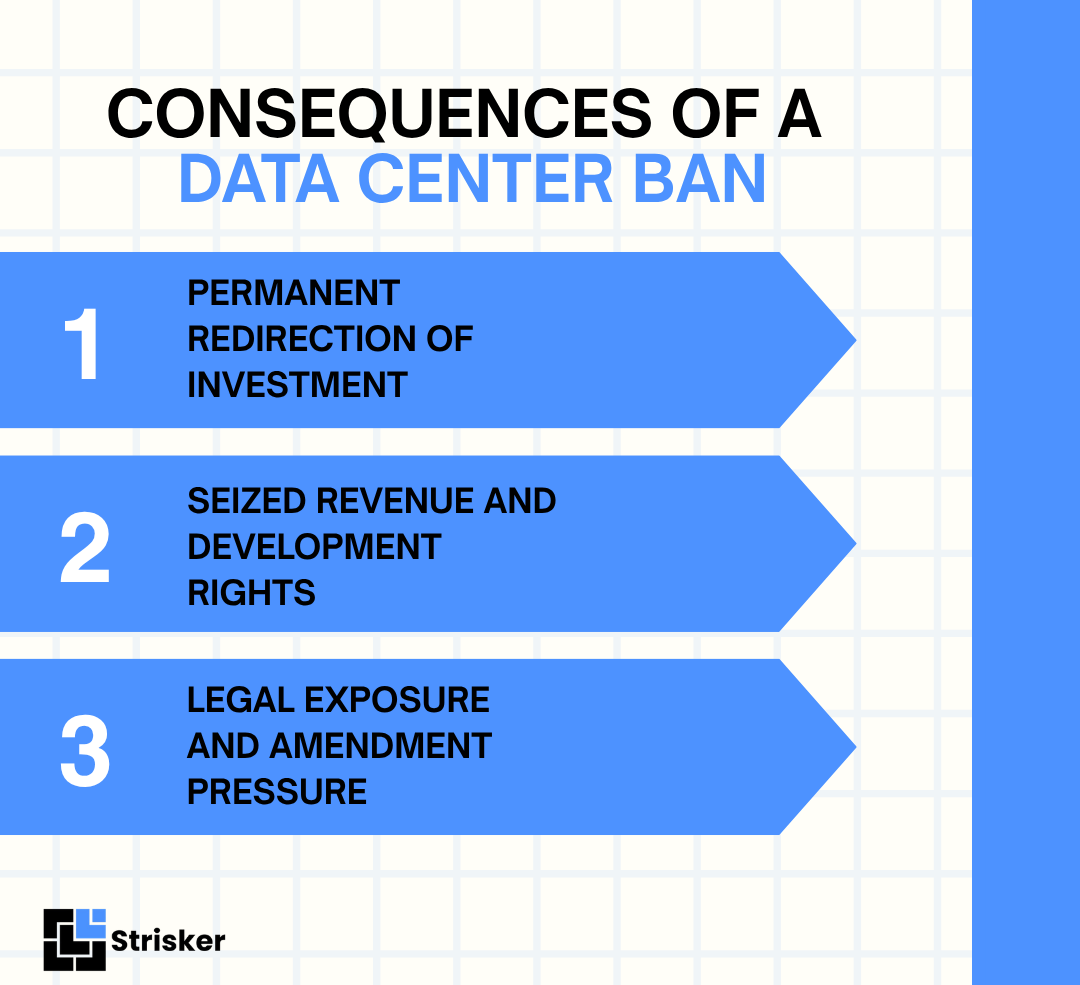
A permanent ban has more lasting consequences than a temporary moratorium, for both the jurisdiction that approves it and the broader market and community surrounding it. The following are some of the consequences of a data center ban:
Permanent Redirection of Investment
With the enactment of the ban, new data center approvals and developments are closed indefinitely, and operators are required to redirect their planned projects to neighboring counties or states with open zoning. Rather than waiting for the ban to be repealed or contested, developers should focus on growth, grid capacity, and water demands that remain open for discussion in nearby jurisdictions.
Seized Revenue and Development Rights
Data centers generate substantial property tax revenue and construction-phase employment, so a jurisdiction implementing a ban is also forfeiting that revenue, rather than it being a temporary hold during a review following a moratorium.
The local officials who signed these bans consider this trade-off beneficial, believing that no amount of potential revenue can offset the strain on the grid, water, and land use that such facilities may impose on their communities.
Legal Exposure and Amendment Pressure
Developers can challenge the enacted ban by arguing that it conflicts with existing zoning rights or the jurisdiction's preemption rules. A future council can also amend or repeal these permanent bans later. However, reversing this decision still requires a formal legislative process, unlike a moratorium that ends automatically.
Conclusion
A data center ban is a clear and more permanent prohibition than a moratorium. It directly closes the approvals for new data center developments and expansions rather than pausing it for a review. There might be a small number of local governments enforcing these permanent bans, ranging from citywide restrictions to district-specific restrictions.
For developers, it is important to stay up to date on local cities and districts with active data center bans to assess whether they need to relocate their planned data centers. For policymakers, it’s also necessary to stay updated on these data center bans to assess the revenue and development rights of these data centers. Strisker offers tools, features, and newsletters to keep you updated on newly enacted data center bans in locations near you.
FAQs
What happens to data centers that were approved before a ban?
As with the data center moratorium, data center projects approved or pre-approved before the ban are exempt from the effects of the ban due to grandfather clauses. These data center developments can continue if they have already obtained their final permits or begun construction before the ban took effect.
Can a data center ban be overturned in court?
In principle, a ban can still be overturned since it is a local zoning ordinance. Some developers challenged these bans on grounds of conflict with state preemption law, violation of vested development rights, or procedural flaws such as inadequate public notice.
Additionally, a ban can also be repealed or reversed without challenges from these developers if the government council or commission amends the ordinance.
How are data center bans enforced?
Once a ban on data centers is in place, developers must comply with the decision unless it is challenged. Local governments will enforce the following measures:
- Denial of permits
- Issuance of stop-work orders
- Implementation of grid interconnection freezes
- Enforcement of zoning and planning codes
- Establishment of buffer zones and siting restrictions
Stay Updated with Strisker!
Strisker offers tools and features to keep you updated with the Short Term Rental movement (and now Data Centers!) movement across the world.
👍 We’d love your feedback.
We're always looking for ways to improve our content.
Was this one useful to you? Other topics you'd like to see get covered?
✉️ Just reply directly to this email. We read and respond to every message!
-Will McClure
🙋 P.S.
Know someone else who might be interested in this content? Feel free to forward this along.