
Importance and Categories of Data Center Legislation
An overview of data center legislation, its importance, the categories being addressed, and the individuals responsible for monitoring these new laws.

At A Glance 🔽
- Data center legislation refers to the collection of state statutes, local ordinances, and bills that govern the planning, construction, taxation, and operations of data centers.
- It is important in addressing concerns about electricity demand and grid capacity, household utility bills, and public finance and local economies.
- Some of the major categories of data center legislation include tax incentives and abatements; cost allocation and ratepayer protection; grid capacity, tariffs, and reporting; moratorium bills; and water, environment, and transparency.
- Legislative research organizations, utility regulators and grid operators, academic and policy researchers, and industry, advocacy, and community groups are among those who track this legislation for compliance.
Definition
Data center legislation refers to the collection of state statutes, local ordinances, and bills that govern the planning, construction, taxation, and operations of data centers. This legislation addresses various aspects, including tax policy, utility regulations, zoning, environmental impact approval, and public disclosure. Since the United States lacks a unified federal data center law, the rules and policies that data center developers must follow vary by state, county, or utility service territory where a project is located.
State Statutes and Bills
Lawmakers evaluate incentive programs, utility regulations, and reporting guidelines that can be implemented statewide. An increasing number of states now treat data centers as a separate customer category rather than as general commercial or industrial classifications. This marks a significant shift in industry regulation compared to five years ago.
Local Ordinances and Zoning Codes
Counties and municipalities establish land-use regulations that determine where data centers can be constructed. They also specify the required distance between these data centers and residential areas, as well as guidelines on noise levels, setbacks, and design standards.
Many local governments are revising their zoning codes to create a dedicated data center use category, and some are allowing the facilities only as a conditional use that needs public hearing rather than as by-right development.
Utility Commission Rules and Tariffs
Even if public utility commissions are not legislatures, their orders and regulations significantly influence how electricity is priced and delivered. Additionally, they establish tariffs for large loads, interconnection procedures, and special contracts between utilities and data center operators.
✅Importance to Different Sectors
Data center legislation helps manage the possible impacts of the growing number of data center projects. This legislation has been a priority for local lawmakers to address the challenges data centers may pose to their local communities. Through data center legislation, it can help address the following concerns:
Electricity Demand and Grid Capacity
The U.S. Department of Energy published a 2024 report from the Lawrence Berkeley National Laboratory that found electricity usage by data centers rose from 58 TWh in 2014 to 176 TWh in 2023. The report also projects that data center electricity consumption could range from 325 TWh to 580 TWh by 2028. This ongoing increase has significant implications for regional power grids, which were not designed to accommodate such high demand levels. Grid capacity constraints are frequently cited as one of the main reasons for advocating new legislation regarding data centers. Having legislation can provide new interconnection rules or even an outright moratorium on new approvals.
Household Utility Bills
The pricing for new transmission and generation built to serve data centers must be recovered from some customers. Researchers at the Harvard Electricity Law Initiative found that numerous special contracts between utilities and data center operators are negotiated outside the normal rate case process. The researchers include warnings that if rates fall below the cost of service, residents and small businesses may end up absorbing the difference. That concern is a major reason ratepayer protection has become a priority for lawmakers in both parties in legislative discussions.
Public Finance and Local Economies
Different states compete for data center investments by offering tax breaks, while local governments evaluate new property tax revenue against environmental impacts and the effects on power and transportation infrastructure. Legislators are currently reviewing the incentives offered during the early stages of construction, especially now that the demand for these facilities is being criticized.
📚Major Categories of Bills
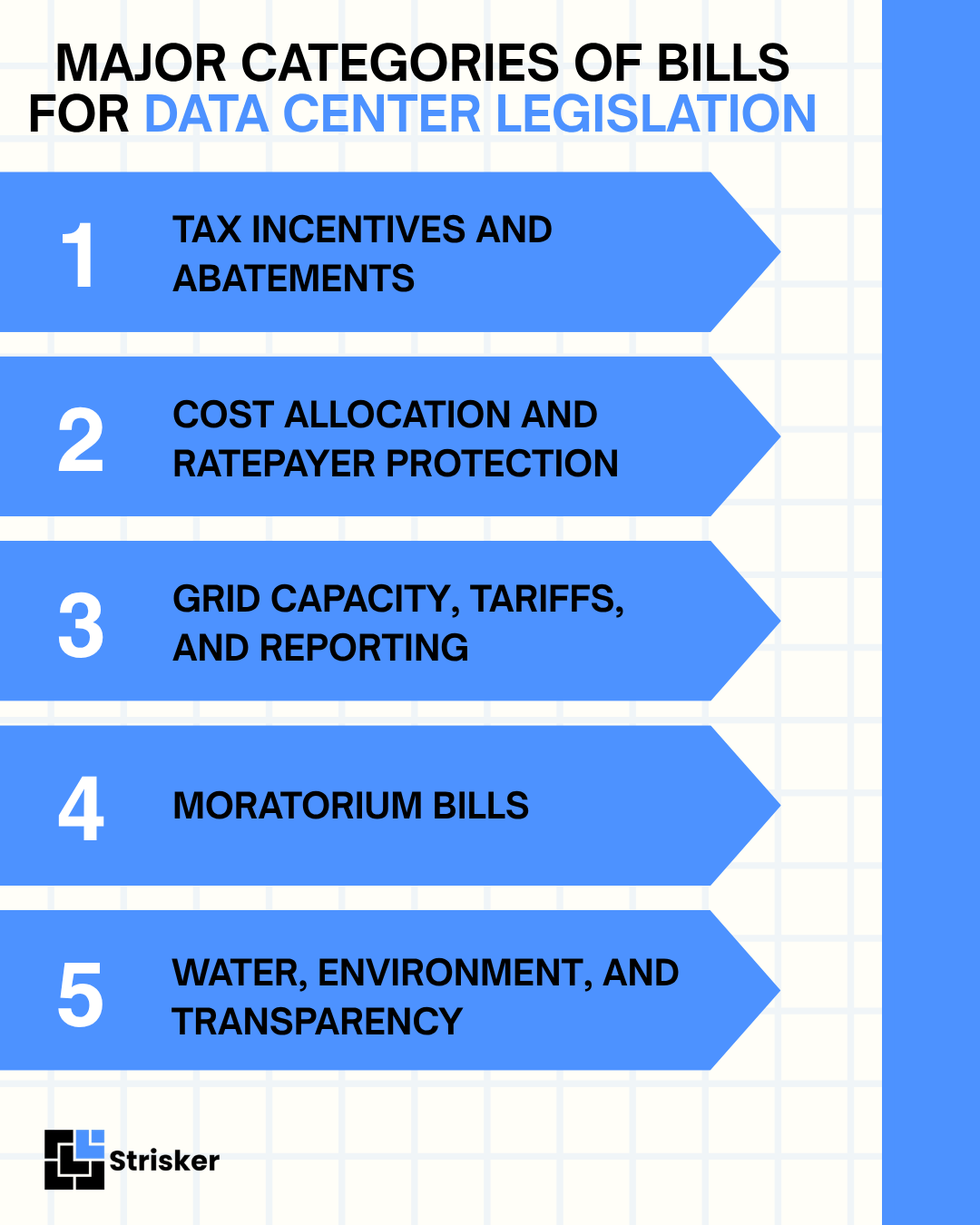
The majority of data center bills fall under the recurring categories. Numerous states have enacted legislation across multiple categories. Additionally, a single comprehensive bill can cover several factors at once. Here are some of the categories of bills:
Tax Incentives and Abatements
According to NCSL research, 38 states offer dedicated tax incentives for data centers, and all exempt essential data center equipment from sales taxes. Additionally, 14 of those extend the exemption to electricity used at the facilities, and 11 also offer a partial property tax abatement. Legislative activity is also moving in two directions. The first one is that some states expand and create new incentives. The second one consists of including new conditions or proposing opposition or repeal. NCSL also found that during this year’s legislative sessions, nine states have considered completely repealing their data center incentives, while four states have considered creating new ones.
Cost Allocation and Ratepayer Protection
Ratepayer protection legislation is intended to protect regular utility customers from expenses incurred by data centers. These bills facilitate cost allocation, enabling regulators to determine which customers are responsible for specific utility costs. They also allow the establishment of a separate rate class for very large customers, similar to Oregon's approach, which may require these customers to cover the full cost of the services they use.
Grid Capacity, Tariffs, and Reporting
These bills and rules address how data centers connect to the power systems and who will pay for the upgrades. On June 18, 2026, the Federal Energy Regulatory Commission (FERC) issued six show-cause orders requiring each regional transmission organization and independent system operator under its jurisdiction to justify or revise its rules governing large-load interconnection and co-location.
Moratorium Bills
A data center moratorium bill is a temporary ban on new approvals, permits, and construction for data centers. This pause allows states the opportunity to study the effects of data centers. According to the National Conference of State Legislatures (NCSL), lawmakers in at least 16 states have considered implementing such bans. One notable example is New York, where Gov. Kathy Hochul signed an executive order in July that paused permits for data centers with 50 megawatts or more of capacity for up to one year. The order came as an alternative to legislation, where the state legislature separately passed the Responsible Data Center Development Act in June 2026, which would impose a one-year pause on state permits for data centers using 20 megawatts or more. However, as of October 2026, the governor has not signed this legislation.
Water, Environment, and Transparency
Data centers consume large amounts of water and generate emissions, leading to bills that reflect these costs. The US Environmental Protection Agency has a Clean Air Act resource page for data centers, which focuses on the engines and turbines that provide primary and backup power. EPA also notes that state and local air agencies issue most air permits for data centers. During Minnesota's 2025 special session, HF 16 was enacted to establish a pre-application review process with the Department of Natural Resources. This process specifically targets data centers projected to use over 100 million gallons of water annually and includes specific permit conditions for those facilities.
🔍Who Tracks It?
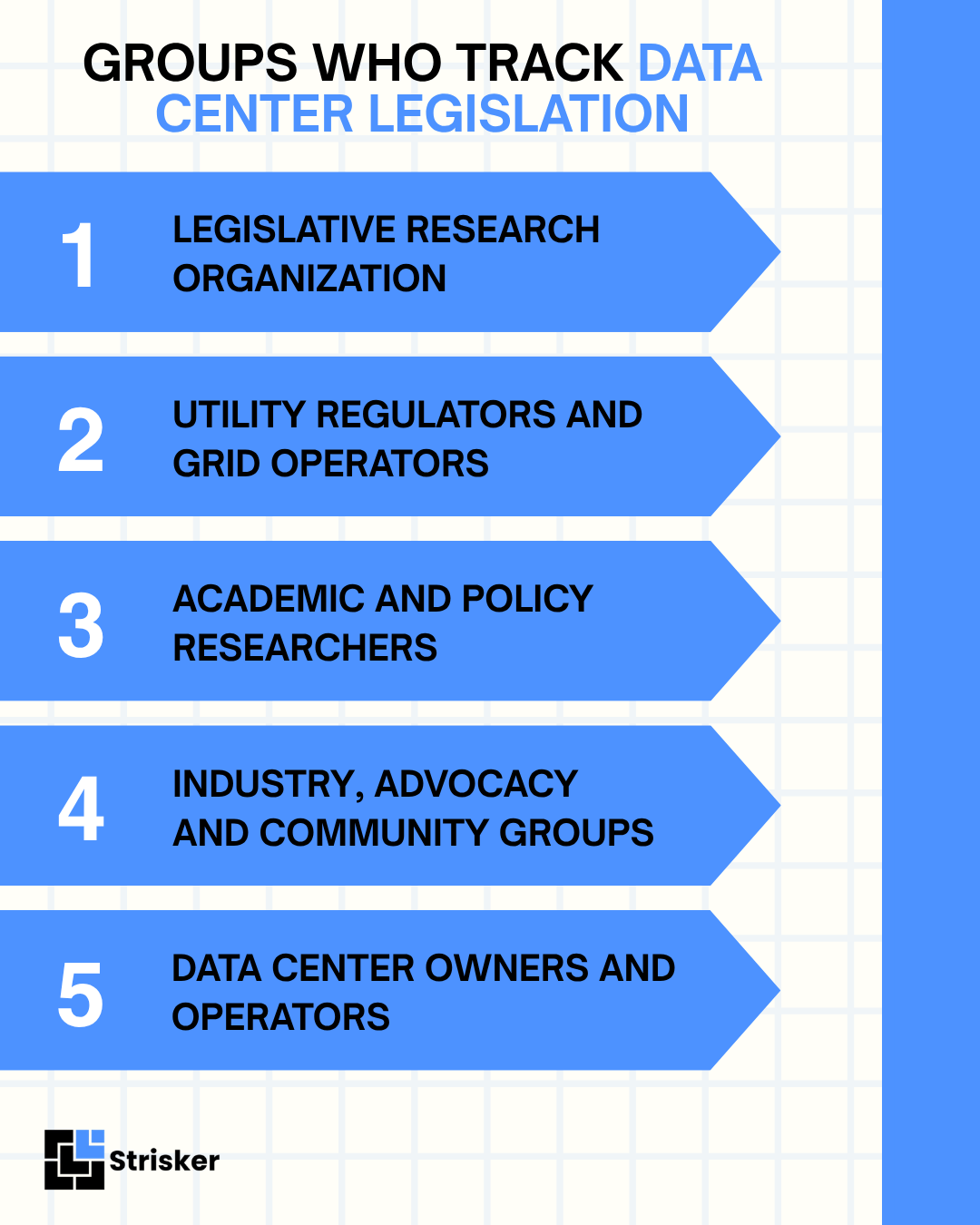
Data center policy is essential for groups and individuals who are directly involved in data center development. Additionally, groups and individuals experience the impacts of these data center developments. This is why it became the responsibility of these people to stay informed about updates to data center legislation. Here are some of them:
Legislative Research Organization
The National Conference of State Legislatures manages running counts of data center bills, incentive programs, and moratorium proposals. The staff regularly testifies before state committees on national trends. The NCSL provides comparisons among the states.
Utility Regulators and Grid Operators
State public utility commissions publish dockets regarding large-load tariffs and special contracts, while regional transmission organizations release load forecasts and interconnection queue data. These documents determine the specifics of cost allocation, often well after a bill has been enacted.
Academic and Policy Researchers
University programs such as Harvard’s Electricity Law Initiative and federal labs like the Lawrence Berkeley National Laboratory conduct research that legislators reference when drafting bills. Some of the topics include energy-use projections and utility contract analysis.
Industry, Advocacy and Community Groups
Trade associations monitor bills affecting incentives and permitting, while consumer advocates track rate cases, and local residents’ groups observe zoning hearings. Each group tends to highlight different legislation.
Data Center Owners and Operators
They are primarily responsible for planning, submitting permit and approval applications, and ensuring compliance with codes for data center facilities. Staying informed about new legislation helps them avoid missing updates on laws, which could lead to project rejections.
Conclusion
The growth of the data center industry has highlighted the importance of data center legislation, which plays a crucial role in establishing regulations, restrictions, and guidelines for these facilities. This legislation is essential for mitigating the impact of data centers on various aspects, including the power grid, households, and public sentiment.
There are also different categories that data center legislation focuses on, including resource aspects, while various individuals and groups ensure awareness of and compliance with these categories. Strisker provides tools, features, and newsletters to help you stay up to date on newly enacted legislation in your area.
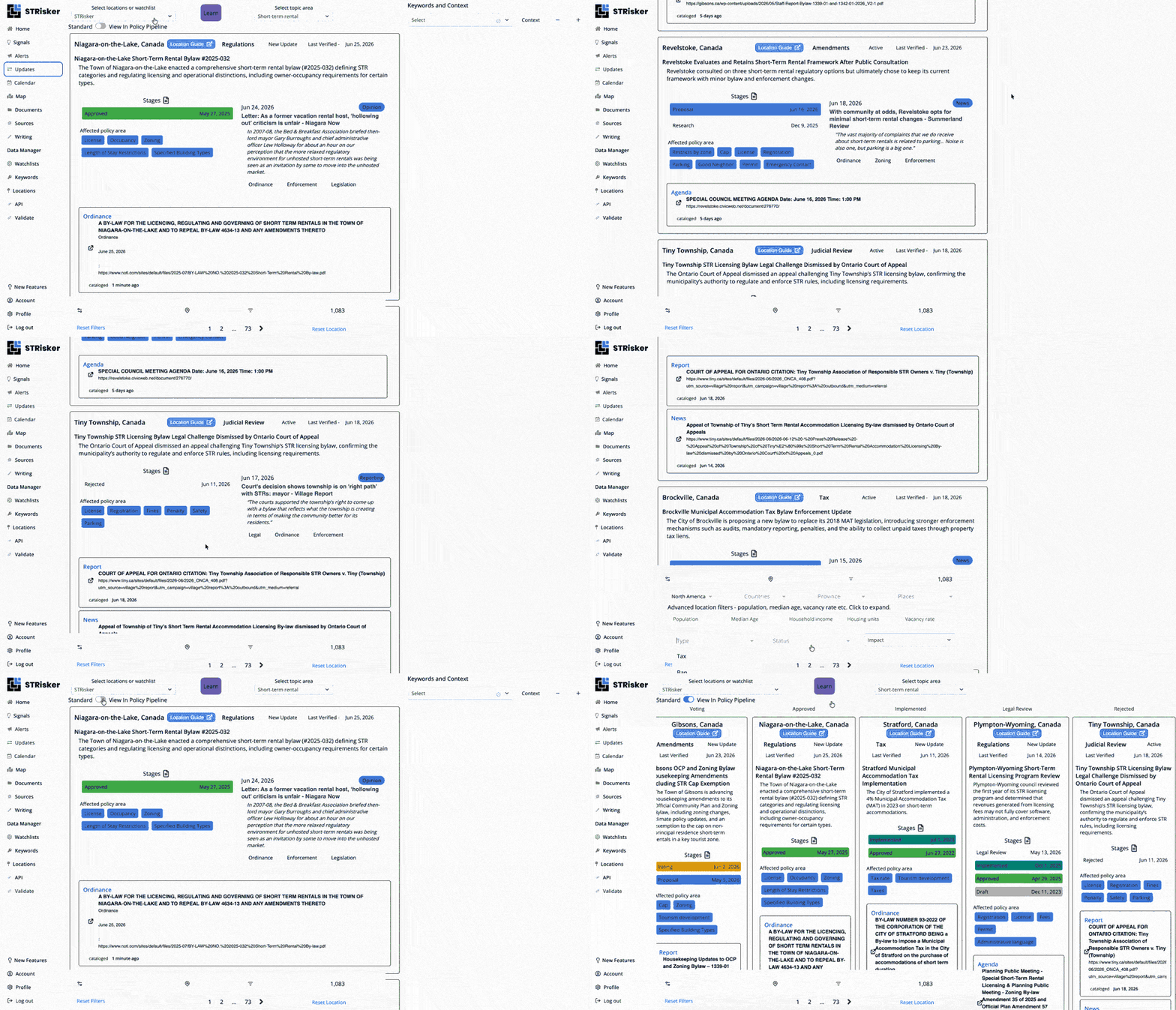
Strisker Updates Tracker
How do you keep up with the regulatory rollercoaster in your market? Strisker's Updates Tracker can be your guide - start tracking latest events as they happen and get access to essential documents as they come in. We know the struggle, which is why we built this product to capture every twist and turn in the regulatory saga so you never miss a beat.
FAQs
What laws apply when building a data center?
In order to build a data center, it would require compliance with local zoning and land-use approvals, get approvals and permits for state environmental permits, such as for air emissions from backup generators or water discharge or use, meet building and fire codes, and meet the interconnection and tariff requirements of the local utility. Some federal laws mandate that generators obtain permits under the Clean Air Act.
Can residents challenge a proposed data center?
Yes, residents can challenge a proposed data center by doing the following:
- Participation in local public hearings
- Comments submissions
- Public records requests
- Formation of a neighborhood coalition.
- Support for moratoriums
- Legal challenges fillings in court
What information must data centers disclose to the public?
While there is no universal law mandating public disclosure, certain details may remain confidential due to non-disclosure agreements (NDAs) with local governments and utility providers. However, some specific information may still be subject to disclosure.
- Electricity and energy consumption
- Water consumption and withdrawal
- Project ownership and identity
- Environmental and community impacts
- Data security and privacy compliance
Stay Updated with Strisker!
Strisker offers tools and features to keep you updated with the Short Term Rental movement (and now Data Centers!) movement across the world.
👍 We’d love your feedback.
We're always looking for ways to improve our content.
Was this one useful to you? Other topics you'd like to see get covered?
✉️ Just reply directly to this email. We read and respond to every message!
-Will McClure
🙋 P.S.
Know someone else who might be interested in this content? Feel free to forward this along.