
Reasons, Factors, and Process for Data Center Rezoning
Discover what data center rezoning is, why developers and local governments pursue it, what factors contribute to the decisions, and how the process goes from applications to final decisions.

At A Glance 🔽
- Data center rezoning is the legal process of changing the zoning classification of data centers to allow permissions or conditional permissions for land use where it was previously not allowed.
- Some reasons for rezoning include a shortage of suitably zoned land, the expansion of the local tax base, and access to power and network infrastructure.
- Approvals for rezoning decisions depend on the consistency with the comprehensive plan, power, water, and infrastructure capacity, historical, cultural, and environmental resources, and compatibility with surrounding areas.
- The common process for rezoning consists of pre-application and plan review, application and evaluation, public notice and hearing, and decisions and legal challenges.
Definition
Data center rezoning is the legal process of changing the zoning designation for data center development, allowing construction in areas where existing ordinances would otherwise prohibit or restrict it. The rules, approval bodies, and review benchmarks vary between counties and municipalities since zoning in the United States is primarily regulated at the local level. The final decision typically rests with the elected board or council, which holds the legislative power to approve, deny, or set conditions on a request.
💡Reasons for Data Center Rezoning
Some current zoning codes do not allow scale, power use, or even the industrial character of data centers. As a result, developers may appeal for rezoning of the land to accommodate their projects. Common reasons for this include:
Shortage of Suitably Zoned Land
It is important for hyperscale data centers to be located on large, contiguous parcels near high-voltage transmission lines and fiber routes. However, the available land for industrial or data-center use near that infrastructure has become scarce. As a result, developers often need to request rezoning before the construction can proceed.
Expansion of Local Tax Base
Data centers offer significant real property and business personal property tax revenue. This fiscal contribution is often the strongest justification for supporting rezoning decisions. Elected officials or governing bodies may weigh this against the raised issues and concerns by local residents.
Access to Power and Network Infrastructure
The value of a data center parcel depends on the efficiency of its grid and fiber connectivity. Land near transmission lines or substations is typically targeted for rezoning, even though it is often located in rural areas. This is because the cost and time required to build or extend this infrastructure can be high.
🚀Factors That Influence a Rezoning Decision
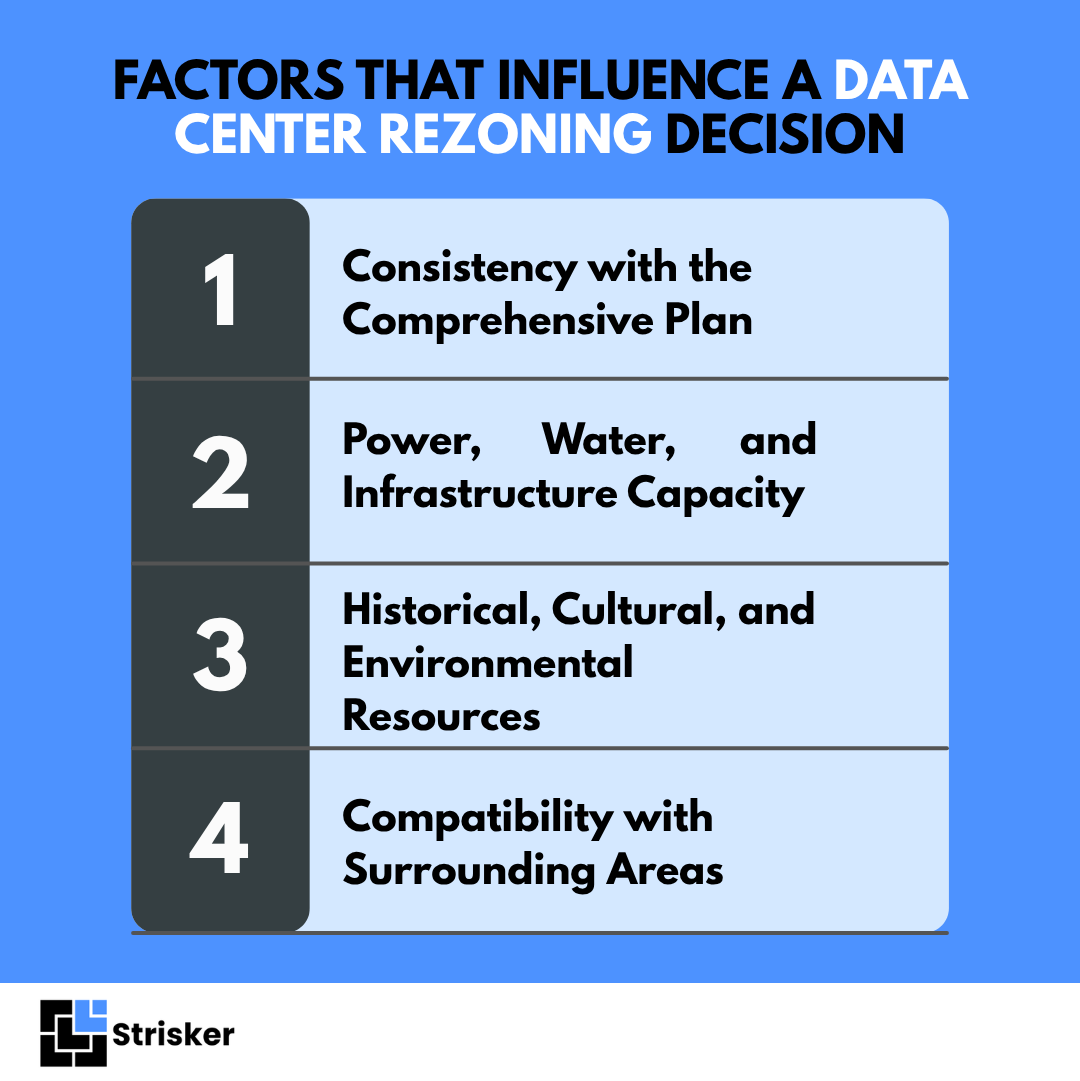
There are several factors officials should consider when assessing data center rezoning requests. Each governing body evaluates these factors differently, but common factors to consider include:
Consistency with the Comprehensive Plan
This factor involves checking the compatibility of the proposed lines with the municipality’s current long-range land use plan, and whether revisions are needed alongside the rezoning. These revisions may recategorize the area for technology or industrial use.
Power, Water, and Infrastructure Capacity
This focuses on verifying whether the local utility, especially electric service, can support data center development without requiring new transmission lines or substations that would affect additional land use. Additionally, it also includes evaluating the water demand for cooling, wastewater discharge, and stormwater.
Historical, Cultural, and Environmental Resources
It is also crucial to consider the distance of the data centers to battlefields, historical sites, parks, wetlands, or any conservation habitats. One example of these was the invalidation of the Prince William Digital Gateway rezoning, which was planned near Manassas National Battlefield Park.
Compatibility with Surrounding Areas
Nearby residents often oppose data centers due to noise from cooling equipment and backup generators, nighttime lighting, and the large size of the buildings. These concerns influence how the board evaluates the placement of data centers relative to residential areas. They may set specific conditions such as acceptable noise limits, building design standards, and setbacks.
⚙️Data Center Rezoning Process
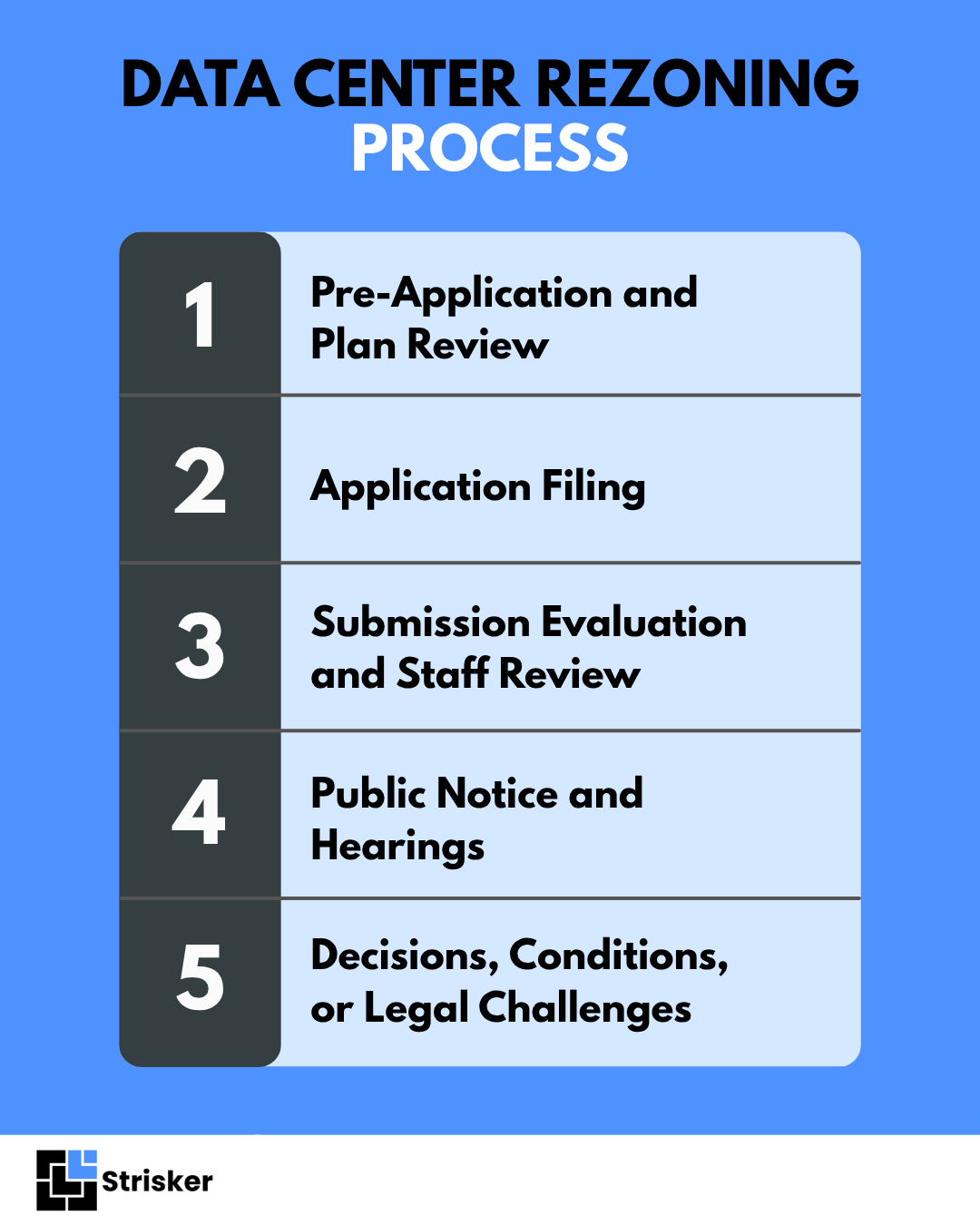
While local governments have varying standards or criteria, most data center rezonings follow the same process. Here are the common processes of the rezoning applications:
Step 1: Pre-Application and Plan Review
Before submitting applications, developers usually meet with planning staff to identify any conflicts with existing plans, required studies, and potential conditions. If the comprehensive plan does not support data center use at the site, a plan amendment may be required to be approved or processed before proceeding with the rezoning.
Step 2: Application Filing
The developer will submit a rezoning application to the local planning or zoning department. This application must include a legal description of the project, the requested zoning classification, a site plan, and supporting studies such as traffic and environmental reviews. Incomplete submission of the application requirements may delay the review before it reaches the hearing.
Step 3: Submission Evaluation and Staff Review
After the application is submitted, planning staff and external agencies, such as utilities, the transportation department, and environmental regulators, evaluate the submission and provide a report with recommendations.
Step 4: Public Notice and Hearings
State and local regulations impose strict requirements for advertising public hearings, and both the planning commission and the governing body usually conduct one each. The Prince William Digital Gateway sets an example for this one, in which the rezoning was approved by the Board in December 2023. However, in August 2025, Circuit Court Judge Kimberly Irving declared the approval void due to the county's failure to comply with public notice requirements, specifically the failure to advertise the rezoning hearings. The Virginia Court of Appeals upheld this ruling on March 31, 2026.
Step 5: Decisions, Conditions, or Legal Challenges
The governing body votes to either approve, deny, or defer the submissions. After each vote, the aggrieved parties have a limited time to challenge these decisions in court. They can contest the decisions on the grounds of defective notice, inconsistency with the comprehensive plan, or failure to follow the required procedures. The deadline for submitting challenges varies by state.
Conclusion
Data center rezoning helps determine whether land never planned for data centers can be used for development. It needs legislative review, a public hearing, and binding conditions to check if the parcel’s zoning classification can be amended. Some local governments are tightening this process by considering various factors that affect rezoning decisions.
For developers, it’s important to follow the standard rezoning process to prepare the studies, standards, or other procedural conditions required for approval. For residents, rezoning hearings provide a venue to raise concerns about noise, water use, traffic, lighting, and the proximity of these data centers to residential areas. Strisker provides tools, features, and newsletters to guide you in your compliance and information for data center rezoning decisions.
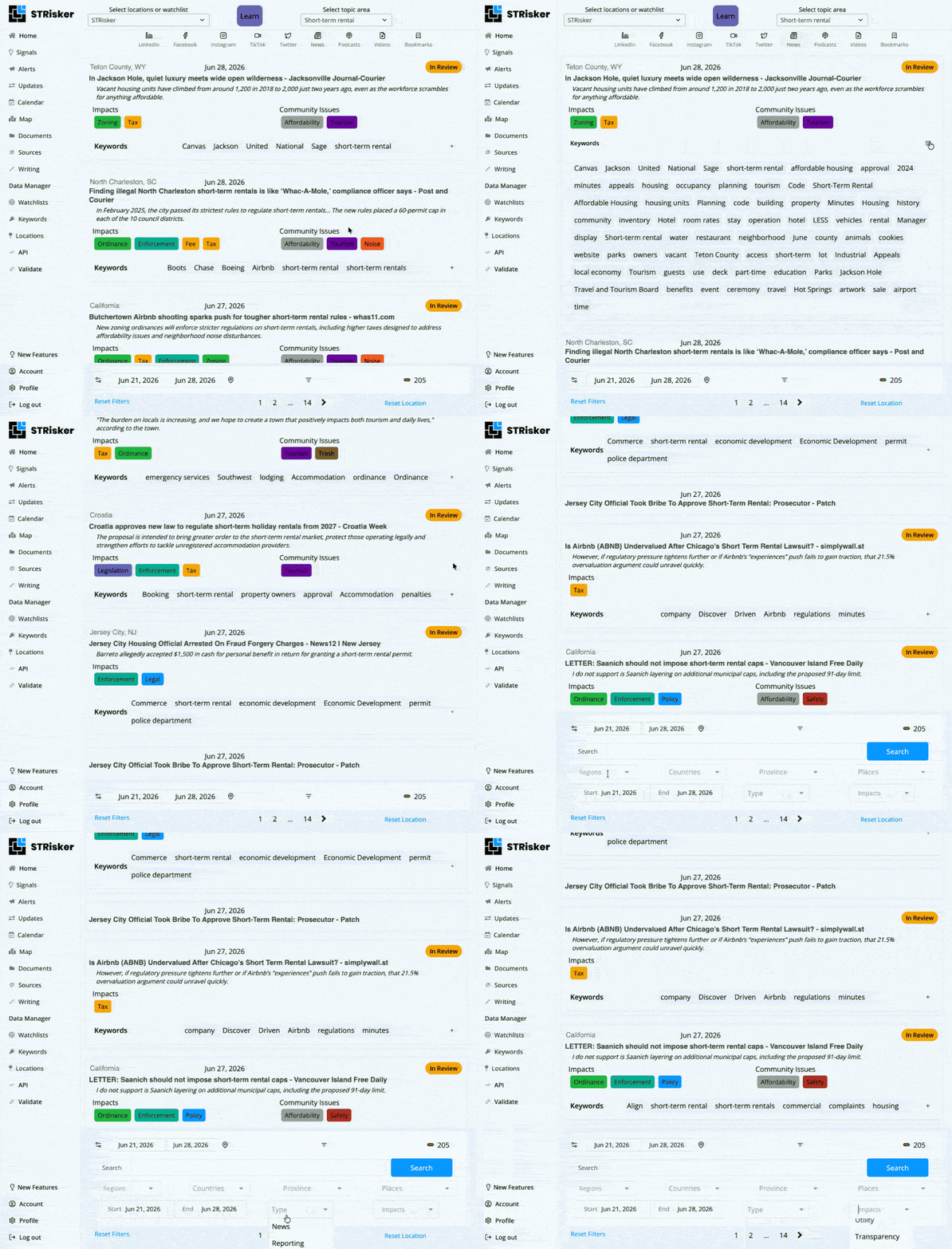
Strisker News Tracker
Trying to keep up with STR and data center regulations across multiple cities and states? Our News Tracker makes it easier than ever. Filter by location, search a comprehensive database, and sort by impact level—this tool helps you focus on what matters most.
FAQs
How long does data center rezoning usually take?
The estimated timeline for data center rezoning typically ranges from 6 to 18 months, depending on project complexity and the level of community opposition. For instance, a straightforward rezoning application may be completed within a few months. However, more contested proposals that require comprehensive plan amendments, additional studies, or extended hearings can prolong the process by up to two years.
How can residents challenge a data center rezoning proposal?
Residents can challenge a data center rezoning proposal through the following:
- Participating in local hearings and discussions: meetings, written comments
- Raising legal and zoning arguments: environmental challenges or any procedural errors (improper public notice)
- Organizing policy change requests: community mobilization, community benefit agreement, and data center moratorium discussions
What environmental studies should be required before data center rezoning?
One of the requirements for Board approval of a data center rezoning application is to conduct standard environmental studies. These studies are necessary to assess the significant resource demands and potential impacts on neighboring areas of these facilities. Some of the key considerations include:
- Noise and acoustic impact analysis
- Air quality and emission modeling
- Water resource and consumption assessment
- Energy and grid capacity review
- Stormwater and drainage plan
- Ecological and wetland delineation
Stay Updated with Strisker!
Strisker offers tools and features to keep you updated with the Short Term Rental movement (and now Data Centers!) movement across the world.
👍 We’d love your feedback.
We're always looking for ways to improve our content.
Was this one useful to you? Other topics you'd like to see get covered?
✉️ Just reply directly to this email. We read and respond to every message!
-Will McClure
🙋 P.S.
Know someone else who might be interested in this content? Feel free to forward this along.